

Yesterday I said the best AI investment I could find might not be a stock at all. Here is what I meant, and where it leads. The whole series started with a company I loved and could not buy, because the price terrified me. That is the value investor’s position in this boom, in one line: we were not early enough on the AI names, or they are simply too expensive now for anyone with our discipline. So I stopped asking the question everyone else is asking, which AI company wins, and started asking a better one. Who gets paid no matter who wins, and is still trading at a price I could truly pay? That question walks you off the exchange, and then, if you want, right back onto it.
The Long View · Where the real opportunities in the build are hiding · Not a recommendation, and not transaction advice
The Long View names no positions here and does not broker deals. This is an investing idea examined in full, and a reminder to do your own work before acting.
The value investor’s honest position
Let me start with the uncomfortable truth about where people like me stand in this boom. We look for good businesses at defensible prices with a margin of safety. By that standard, the marquee AI names are not buys. Either we did not get in early enough, back when the price still made sense, or the valuations have run so far past the fundamentals that no disciplined investor can touch them now. Both of those can be true at once, and for most of the famous names, they are.
That is exactly where this series began. I graded Nebius, a great business growing more than four hundred percent a year, and I could not bring myself to buy a single share, because the price demanded that everything go right forever. A wonderful company is not a wonderful investment. The gap between those two things is the whole game, and in the AI trade that gap has become a canyon.
And the canyon does not sit in still air. These prices assume a calm, cooperative world, and the numbers describe something else. The federal debt is roughly the size of the economy, the interest bill runs over a trillion dollars a year, and the consumer underneath it all is stretched thin, with savings near record lows and delinquencies rising. Then there is the part that never makes the earnings call. Normally about 20 million barrels of oil a day move through the Strait of Hormuz, roughly a fifth of what the world consumes, per the U.S. Energy Information Administration. In the first quarter of 2026 that flow fell nearly 30 percent from a year earlier, to 14.6 million barrels a day, and Brent crude climbed from the low seventies in late February toward the mid nineties within weeks. I take no side on any of that. I only note the number, because it is the kind of shift that reprices energy, shipping, and inflation expectations while the market is looking the other way.
I raise the environment for a specific reason, and it is the reason this piece exists. A stretched, distorted environment is exactly where prices get manipulated and where traps get set. When money is cheap and stories are loud, weak businesses get dressed up as strong ones, circular arrangements get counted as real demand, and a richly priced name can look inevitable right up until the environment shifts under it. The value investor’s job in a moment like this is not to predict the shift. It is to hunt for the trap, the place where the price is quietly resting on something that only holds if nothing goes wrong. Which is why the safest ground is often the boring, physical, essential layer that gets paid no matter which story turns out to be true.
Most investors respond to that canyon by staring harder at the same names, waiting for a dip, asking which model will win, which chip, which hyperscaler. I think that is the wrong question, and I think asking it is exactly how you get led away from the real opportunities.
The question that pays
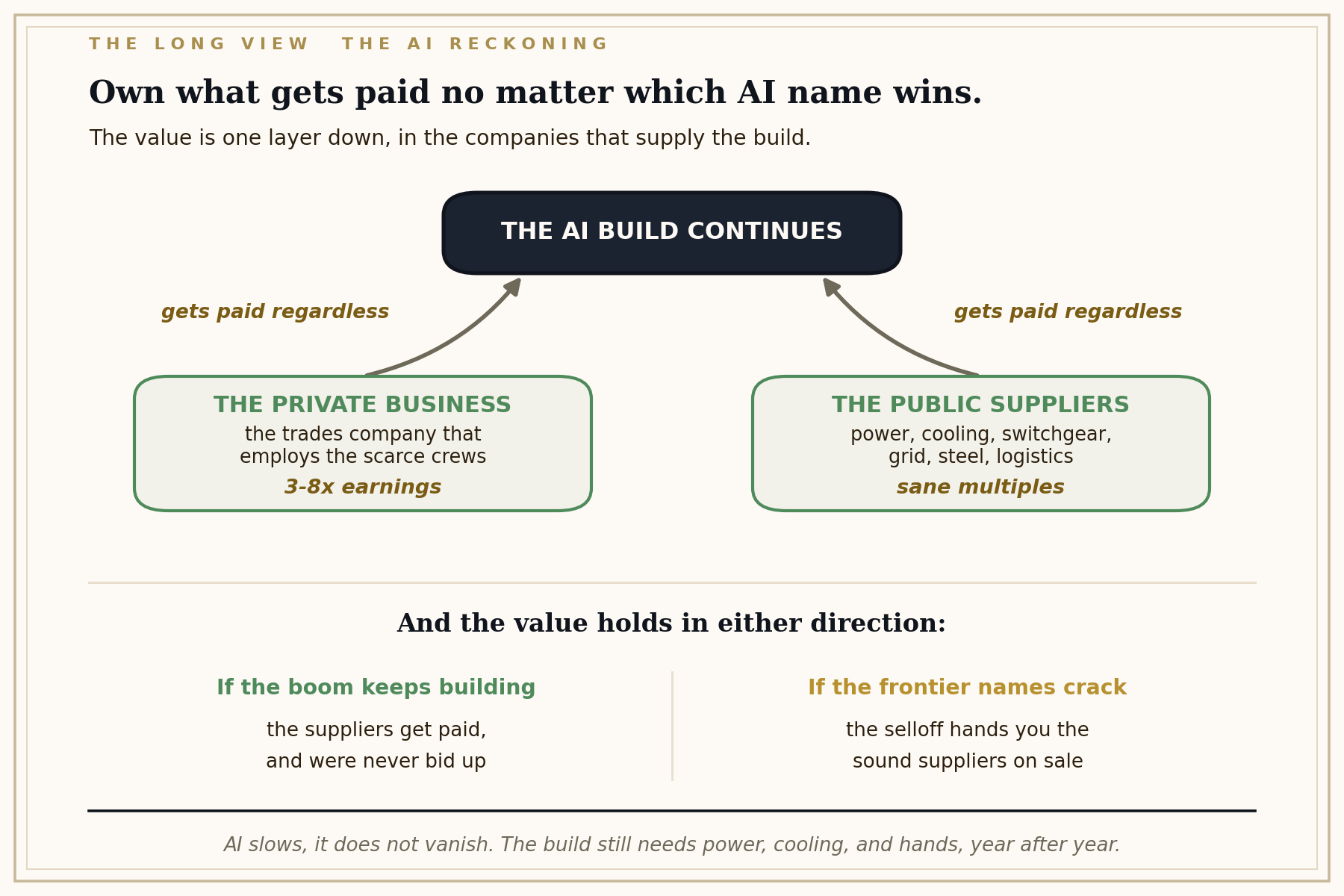
Here is the better question, the one this whole series has been sharpening. Not which AI company wins. Instead: who gets paid no matter which one wins?
You do not have to predict the winner of a gold rush to make money. You can own the outfit selling picks, shovels, denim, and rail freight to every prospector on the mountain, and get paid whether any single miner strikes it rich or goes home broke. The AI boom has the same shape. Underneath the handful of enormously expensive names sits an entire physical economy that gets paid to build the thing, and a lot of it is unglamorous enough that the crowd has not bid it into the stratosphere.
Follow that question to its logical end and it leads somewhere that sounds absurd and is completely serious.
The purest version: it might not be a stock at all
The scarcest input in the entire buildout is not chips or capital. It is skilled labor, the electricians, pipefitters, and mechanical crews the whole thing physically cannot proceed without. I made that case yesterday and will not re-argue it here.
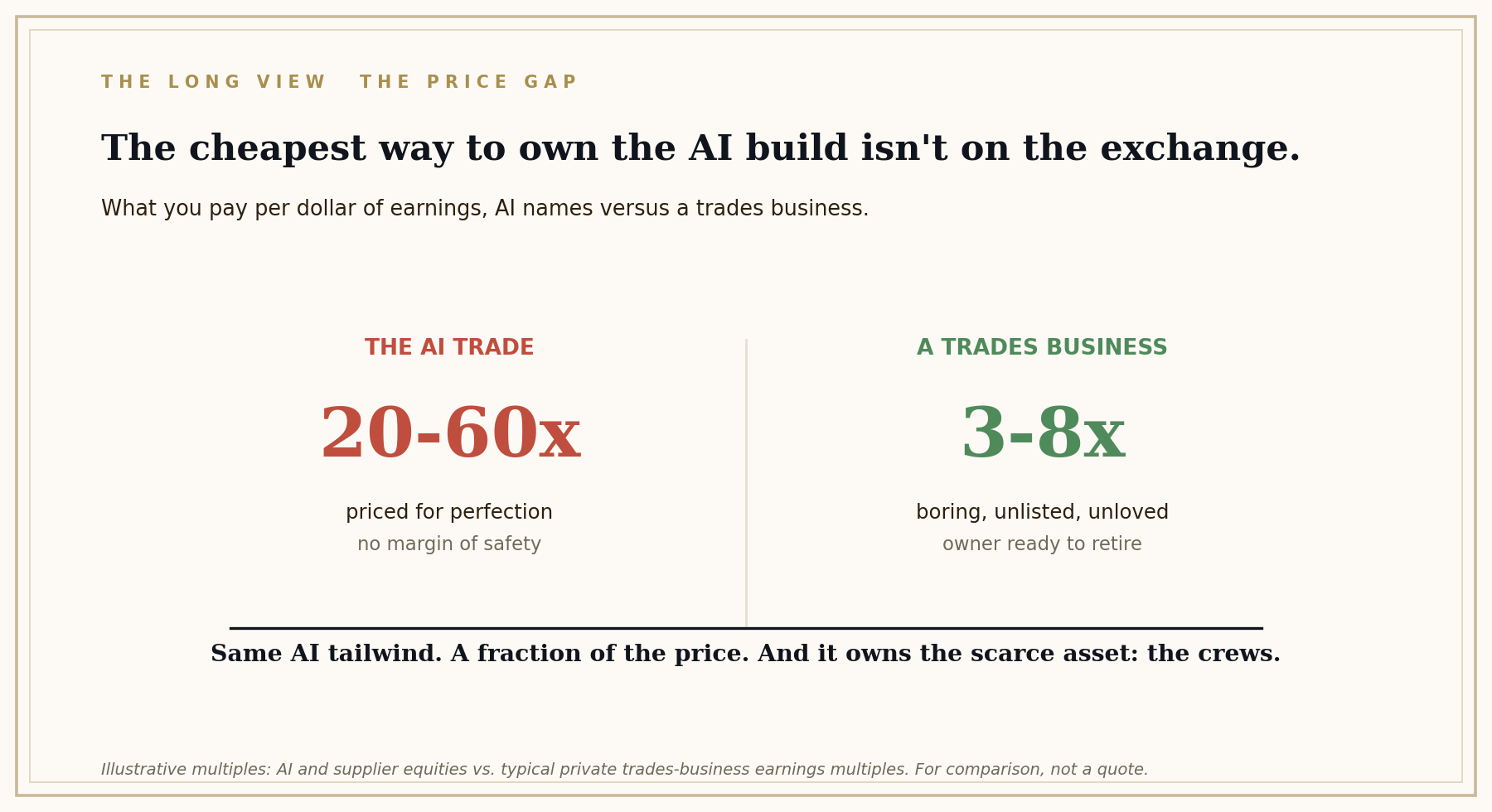
So the purest way to own that scarcity is to own the business that employs it. A local electrical or mechanical contractor, the kind whose owner is heading into retirement, changes hands for roughly three to eight times earnings. The AI names trade at twenty to sixty times sales. Same tailwind underneath both. One of them is priced for perfection. The other is priced like a used truck, and it owns the one thing the largest construction boom in history cannot get enough of.
That is the most extreme expression of the value idea, and it is real. It is also not for everyone, and I want to be honest about why in one breath rather than a manual: it is an operating business, not a ticker. It needs someone to run it, and the value can walk out the door with the seller if you are careless. It rewards an operator, not a passive holder. If that is you, it may be the best risk-adjusted asset in this whole story. If it is not you, do not force it.
And if that is not for you, look at what the build cannot happen without
Here is the part that brings it back to the stock market, because most readers do not want to run a plumbing company, and that is fine.
Those skilled workers cannot build a single data center with stock options. They build it with tangible things: transformers, switchgear, and busway to move the power. Chillers, cooling loops, and air handlers to haul away the heat. Generators, turbines, and grid connections to feed it. Steel, concrete, fiber, and the trucks and logistics to stage it all. Project management and engineering to sequence it. Every one of those is made or provided by a company, and many of those companies are public, ownable, and tied directly to the volume of the build rather than to which chatbot wins.
That is the same principle as the plumbing company, just expressed as shares instead of a business. Own what the build consumes. Own the layer that gets paid per data center, not per victory in the model wars. The demand reaching those suppliers is set by how much gets built, and right now the plans call for more building than the world has the power, the parts, or the people to deliver.
Here is why this matters for the question driving the whole series. We have spent weeks on what would have to happen for the famous AI names to ever fall to a price a value investor could pay, and that answer is still unfolding, it depends on the environment finally catching up with the valuations. But there is a second, quieter answer hiding in plain sight. The value you are hunting may not require the frontier names to crash at all. It may already exist, in real dollars and cents, one layer over, in the companies that supply the build. The hype, and the punishing multiples that come with it, concentrated on a handful of frontier names. A lot of the suppliers underneath them were never bid up to anything like the same extreme, because they are dull, industrial, and easy to overlook. That is the whole opportunity. The market’s attention is a spotlight, and value tends to survive in the parts of the room the spotlight never swings to.
I am not saying every supplier is cheap, some have been discovered and bid up too, which is tomorrow’s warning. I am saying the measurable value, the kind you can count on a balance sheet rather than hope for after a crash, is far likelier to be found in this layer than in the names on the front page. That is a real answer to the series’ question, and it does not require you to wait for anything to break.
And here is the part that makes this the strongest ground in either direction. Suppose the thing this whole series has been circling does happen, and the environment finally cracks the frontier valuations. That shock would not spare the suppliers. They would sell off too, dragged down in sympathy, because in a panic correlation goes to one and almost everything falls together. For the frontier name that started at sixty times sales, a forty percent drop may still leave it expensive. But for a sound supplier with real earnings, real customers, and an already-sane multiple, that same drop does something very different. It turns a reasonable price into a gift. A good business, essential to the build, suddenly on sale because it had the bad luck to be standing next to the names everyone was fleeing.
That is where the value is truly hiding in these scenarios, and it is why the work matters now, before anything happens. The winners in a repricing are not bought during the panic, they are identified before it, so that when the correlated selloff comes, you already know which supplier is a fragile pretender and which is a durable business being handed to you at a discount it does not deserve. The frontier names falling is not the risk to this strategy. For the right supporting companies, it is the entire opportunity. Cheap and crisis tend to arrive together, and the disciplined investor’s job is to have already done the homework on who is worth buying when they do.
And this is the assumption underneath all of it, the one that makes buying into a selloff sound rather than reckless. AI is not going away. Whatever happens to the valuations, the technology is real, it does useful work, and it is being woven into the economy for good. What a repricing would change is the pace, not the existence, of the build. The frenzy might cool. The spending might slow from a sprint to a walk. But a walk still needs power, cooling, switchgear, and skilled hands, year after year. That is the difference between this and a true bubble in something with no underlying use. You would not be buying a supplier to a fad that vanished. You would be buying a supplier to an essential industry that merely stopped sprinting, marked down because the market cannot tell the two situations apart in a panic. Telling them apart is the whole job.
Are we being led away from the real opportunities
This is the thought I keep coming back to. The opportunities in this boom are not hidden. They are simply boring, and the noise machine that surrounds AI is built to keep your eyes on the exciting, expensive names instead of the dull, essential ones. Every hour spent debating which frontier model wins is an hour not spent asking who supplies the power and the cooling to run all of them.
I think a lot of ordinary investors are being distracted, not maliciously, just by the gravity of the hype, from the parts of this build where a value investor can still find a defensible price. The distraction is expensive. It keeps people either paying any price for the famous names or sitting the whole thing out because those names scare them. There is a third door, and it is standing open in the least glamorous part of the room.
The market priced me out of the AI trade. It did not price me out of the AI build, and it certainly did not price me out of the companies that supply everything the build depends on. That is the long view: the best investment on the board is rarely the one everyone is looking at. Sometimes it is the one nobody thinks to get excited about.
There is one more piece to this posture, and it is the least glamorous of all. While you do the homework and wait for the price, cash is not a failure to invest. It is a position. With short-term rates sitting around three and a half to four percent, you are paid something real to hold it, and in an environment of sticky inflation, where the market now leans toward rates holding or rising rather than falling, that yield is less likely to melt away under you than it would be in a fast-cutting cycle. I will be honest that inflation eats part of that return, so cash is not free, it is patience with a modest coupon. But patience with a coupon, aimed at businesses you have already identified, is a very different thing from fear sitting on the sidelines. One is waiting for a pitch. The other is refusing to swing at all. The value investor waits, gets paid a little to do it, and keeps the list ready.
There is a live tension worth naming here, and it takes us straight back to the five roads out of the debt. With inflation still sticky, the direction of rates is truly contested right now. The Fed has held steady for several meetings, but its own projections have turned more hawkish, with several officials penciling in a possible hike, even as a softer jobs number has others arguing for a cut. I am not going to predict which way it breaks, and anyone who tells you they know is guessing. What matters for a saver is that the two roads have opposite consequences. If the authorities raise rates or hold them high to tamp down inflation, that rewards the saver, the coupon on cash holds or grows. If instead they let inflation run while keeping rates below it, which is one of the quiet roads a government can take to shrink a debt this size, that is the road that punishes the saver, because inflation eats the coupon and then some. So even cash, the most boring position on the board, is a bet on which road gets taken. I hold it with my eyes open, not because it is safe, but because it is patient and, for now, paid.
And here is the part that closes the loop. Look at what each direction hands me. If rates stay high or climb, I keep getting paid to wait. If rates fall, they will not fall in a vacuum, the authorities cut because something in the economy cracked, the labor market or credit or the market itself, and that is exactly the dislocation that finally reprices the expensive names and puts sound companies on sale. In other words, the same event that lowers the yield on my cash is the event that gives my cash something worth buying. High rates pay me to wait. Falling rates tell me it is time to deploy. The cash wins in both directions, as long as I have done the homework and know what I am waiting to buy. The only way to lose this setup is to not hold the powder, or to spend it early on the very names this whole series has warned are too expensive.
Where this goes tomorrow
I have kept this deliberately at the level of the map, the layers, the principle, the right question, because tomorrow I get specific. I will name the parts of the supply chain worth watching, from the electrical and cooling layers to the power and grid names that feed them, and I will be honest about the trap waiting even here: some of the obvious picks-and-shovels names have already been discovered and bid up, and buying them at those prices repeats the very mistake this series keeps warning against. The right question gets you to the right room. Tomorrow we look at what is in it.
Run any company through the Stock Story Firewall, free, at firewall.readthelongview.com. Subscribers get the Watch cards, the Evidence tool, and the full Research Tracker.
Not investment advice. The subscriber decides.