

Yesterday I said the value in this boom is one layer down, in the companies that supply the build. Today is not a list of them. It is something more useful and harder to find: what to look for in that layer, the handful of traits that separate a durable business you could own at the right price from a crowded trade wearing a picks-and-shovels costume. I will use real companies as examples, but the names are not the point. The lens is the point, because a lens you can use on anything outlasts a list that goes stale the day after I publish it.
Where yesterday left us
Yesterday made the case that the surest way to own this boom is to own what the build consumes, the power, cooling, and electrical layer that gets paid no matter which AI model wins. Today I could hand you a list of those companies and call it a service. I am not going to, because a list is the least valuable thing I could give you.
A list tells you what I think today. It goes stale the moment a price moves, and worse, it invites you to buy without understanding, which is how good investors turn into bag holders. What lasts is the lens: the specific traits that make a supplier worth owning at the right price, and the ones that mark a trap. Learn those and you can evaluate any company in this layer, including the ones that do not exist yet, long after this piece is forgotten.
So this is a teaching piece, in keeping with everything the series has been about. Not which stock, but how to think. Here is what I look for, and what I look out for, with real companies as illustrations of each.
Trait one: it gets paid whether or not the winner is picked
The first question is the one that has driven this whole series. Does this business get paid based on how much gets built, or based on which specific AI company wins? You want the former. You want a toll on the whole road, not a bet on one car.
A company like Vertiv is a clean illustration of the trait, it supplies the power and cooling nearly every data center needs, so its demand tracks the build itself rather than any single model. Eaton shows the same trait from the electrical side, the switchgear and distribution gear that has to go into the building regardless of whose chips arrive. The lesson is not “own these two.” It is that before anything else, you check whether a company is levered to the volume of the build or to the fortunes of one customer. Volume of the build is the trait you want. One big customer is the fragility you avoid.
Trait two: diversified enough to survive a slowdown
The build will not proceed in a straight line. So the second trait is whether the business can survive the pace slackening without falling apart.
Here the contrast teaches more than any single name. A pure-play tied entirely to data-center spending gives you the most exposure to the boom and the most damage if it cools. A diversified company, where data center is a real but not exclusive slice, gives up some of the upside for a great deal more durability. Eaton is a useful illustration again, its electrical business rides the build, but it also earns from aerospace, grid modernization, and broad industrial electrification, so a data-center slowdown dents it rather than breaks it. The lesson is to know which kind you are holding. There is nothing wrong with a pure-play, as long as you understand you are trading durability for exposure, and you are paying a price that respects the risk.
Trait three: the price leaves room to be wrong
This is the trait the crowd forgets, and it is the heart of the whole approach. A wonderful business is not a wonderful investment at any price. The third thing to look for, and the hardest to accept when a stock is running, is whether the price still leaves a margin of safety.
The examples here are a warning. Vertiv has climbed more than 250 percent in a year and trades at a forward earnings multiple in the forties. Comfort Systems has run well past two hundred percent. These are strong businesses that have become expensive, and buying a strong business at a euphoric price is the exact mistake this series began with, the Nebius error, one layer down. The lesson is not that these are bad companies. It is that the picks-and-shovels idea is no longer a secret, it is on magazine covers, and once a theme reaches the cover the easy money in the obvious names is usually gone. The trait you are hunting is the gap between a price and the durable demand beneath it. When that gap closes, you wait, no matter how good the story sounds.
Trait four: it sits where the bottleneck is deepest
Not all layers are equally scarce. The fourth trait is whether a company sits at the tightest bottleneck in the build, because scarcity is what protects both pricing and demand.
Right now the deepest bottleneck is power itself. You cannot wish a gigawatt into existence, and the grid takes years to expand. So the companies that generate power and make the heavy equipment to move it, the turbine and grid names, the utilities and independent power producers, sit at the point of greatest scarcity. They tend to be slower, duller, and more regulated than the cooling darlings, which is precisely why the crowd has often overlooked them and why they can still trade at saner prices. The lesson is to look for the tightest constraint in any supply chain, because that is where durable pricing power and the least crowded valuations tend to coincide.
Trait five: it has delivered this before, somewhere else
Here is a trait the crowd rarely looks for, and it is where some of the best-value research often hides. Look for the proven operator repositioning into this build, rather than only the established name everyone already calls an AI stock.
The AI buildout does not require inventing everything from scratch. It needs power, cooling, electrical work, precision manufacturing, complex construction, and systems integration, all things certain companies have done well for decades in other fields. A business that has already delivered at scale in an adjacent technology, and is now turning that proven capability toward the AI build, can capture a real slice of this spending long before the market relabels it an AI company and reprices it accordingly. That window, between delivering and being recognized for it, is where value lives.
But hold the discipline, because a track record elsewhere is necessary, not sufficient. These are mission-critical builds with long qualification cycles and no tolerance for failure. Operators cannot drop untested equipment into a live data hall. So the trait to hunt is both halves together: a company that has truly delivered this kind of work before, and can get qualified into the AI deployment path. Proven capability plus a credible route in. That combination is rarer, and more valuable, than either one alone.
The trait that sits underneath all of them: the environment
Every one of those traits is read against the environment we have spent the series mapping, and this is the part most stock write-ups leave out. This whole layer is levered to how much gets built, and how much gets built depends on the cost of money, the weight of the debt, a stretched consumer, and external pressures on energy and shipping that can move input costs without warning.
That changes what a fair price is. A richly priced supplier is doubly exposed, once to its own stretched multiple and once to any slowdown in the build the environment might force. So the final trait is really a discipline: demand a price with enough room that you survive being wrong about the environment, not just about the company. And keep cash ready, because the same environment that could pressure these names is the one that would eventually hand you the good ones at a price worth paying.
Why this is really about being ready
Here is the part that ties this piece to everything we have been building toward. Owning a lens for this layer is not academic. It is preparation for a specific moment that this whole series has argued is more likely than the market assumes.
Walk the logic back. The famous AI names are too expensive for a value investor. What could bring them down is not a company stumble but the environment cracking, the debt, the strained consumer, the cost of money, the pressures on energy and shipping. When that happens, and cheap and crisis tend to arrive together, the correlated selloff will not spare this supplier layer. Everything will fall at once. That is exactly the moment the lens pays off.
Because in that moment, most people freeze or sell. The person who has already run these five questions on a handful of names does the opposite. They already know which supplier is a fragile pretender and which is a durable business being handed to them at a discount it does not deserve. They are not scrambling to form an opinion in the middle of a panic. They are pouncing on a decision they made in the calm, with cash they were paid to hold while they waited. The homework is what turns a frightening selloff into the best buying window of the cycle.
That is the whole strategy of this series in one line. You cannot control when the environment hiccups. You can control whether you are ready when it does. And everything this series has laid out, the debt, the strained consumer, the geopolitics, the stretched valuations, is the environment starting to signal that the time to build that list is now, not after the move. The research takes weeks. The window may not.
What this is really teaching
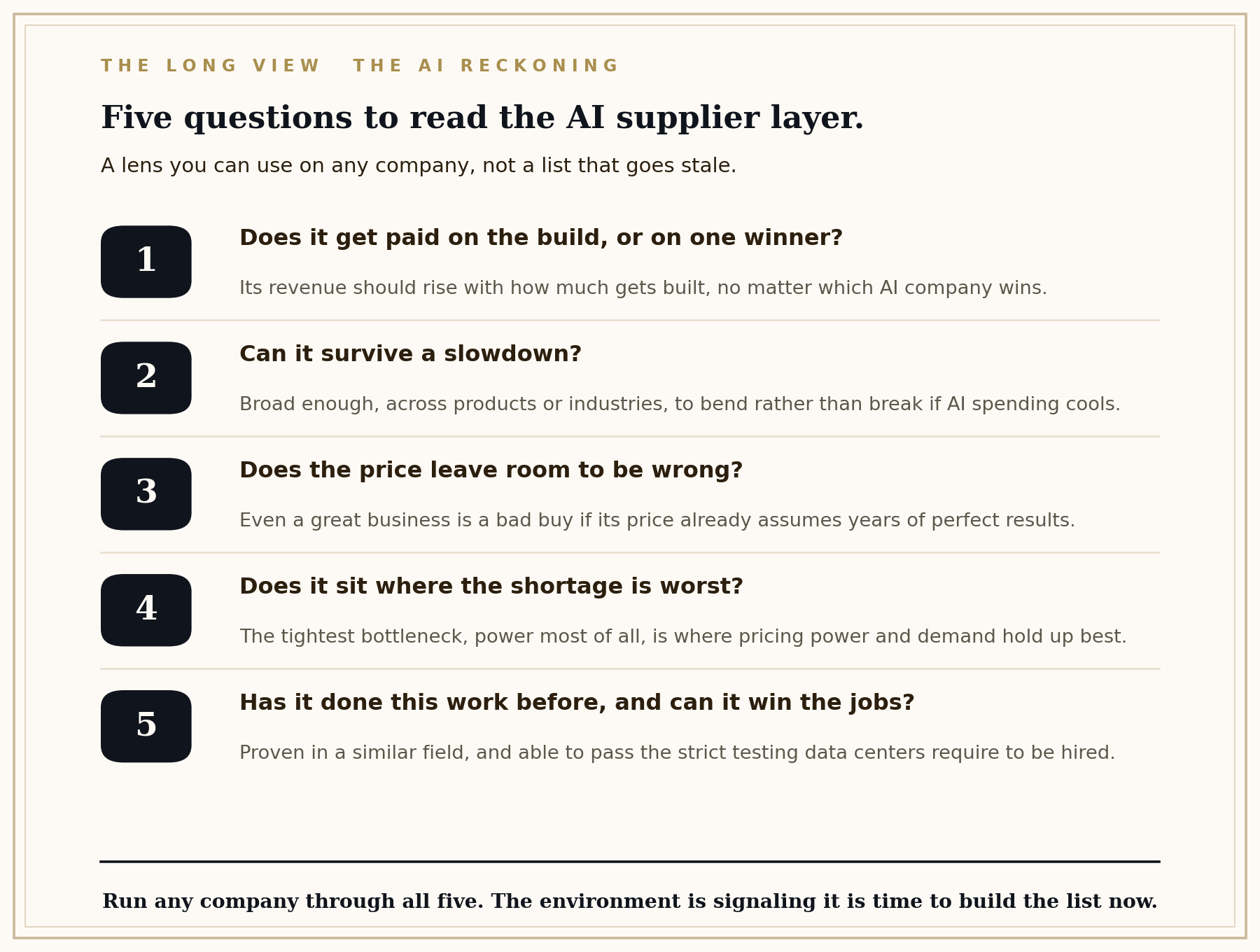
Put the traits together and you have a lens, not a list. Does it get paid on the build or on one winner. Can it survive a slowdown. Does the price leave room to be wrong. Does it sit where the bottleneck is deepest. Has it delivered this kind of work before and can it get qualified in. And does it all hold up against an environment that could break more than one way. Run any company in this space through those five questions and you will know far more than a ticker list could ever tell you, and you will know it next year too, when the list would have been useless.
So keep the lens close and the list short. Run these five questions on the handful of names in this layer you find most durable, write down the price that would finally make each one a buy, and then wait, in cash, paid to be patient, ready to move the day the environment gives you your price.
Tomorrow I close the series where it began. I go back to the question that started all of this, the one about a great company at a price I could not pay, and I give you my honest answer: what I now believe could bring that repricing, how close I think we are, and what a value investor does about it. It is the reckoning this whole series has been building toward.
Run any company through the Stock Story Firewall, free, at firewall.readthelongview.com. Subscribers get the Watch cards, the Evidence tool, and the full Research Tracker.
Not investment advice. The subscriber decides.