

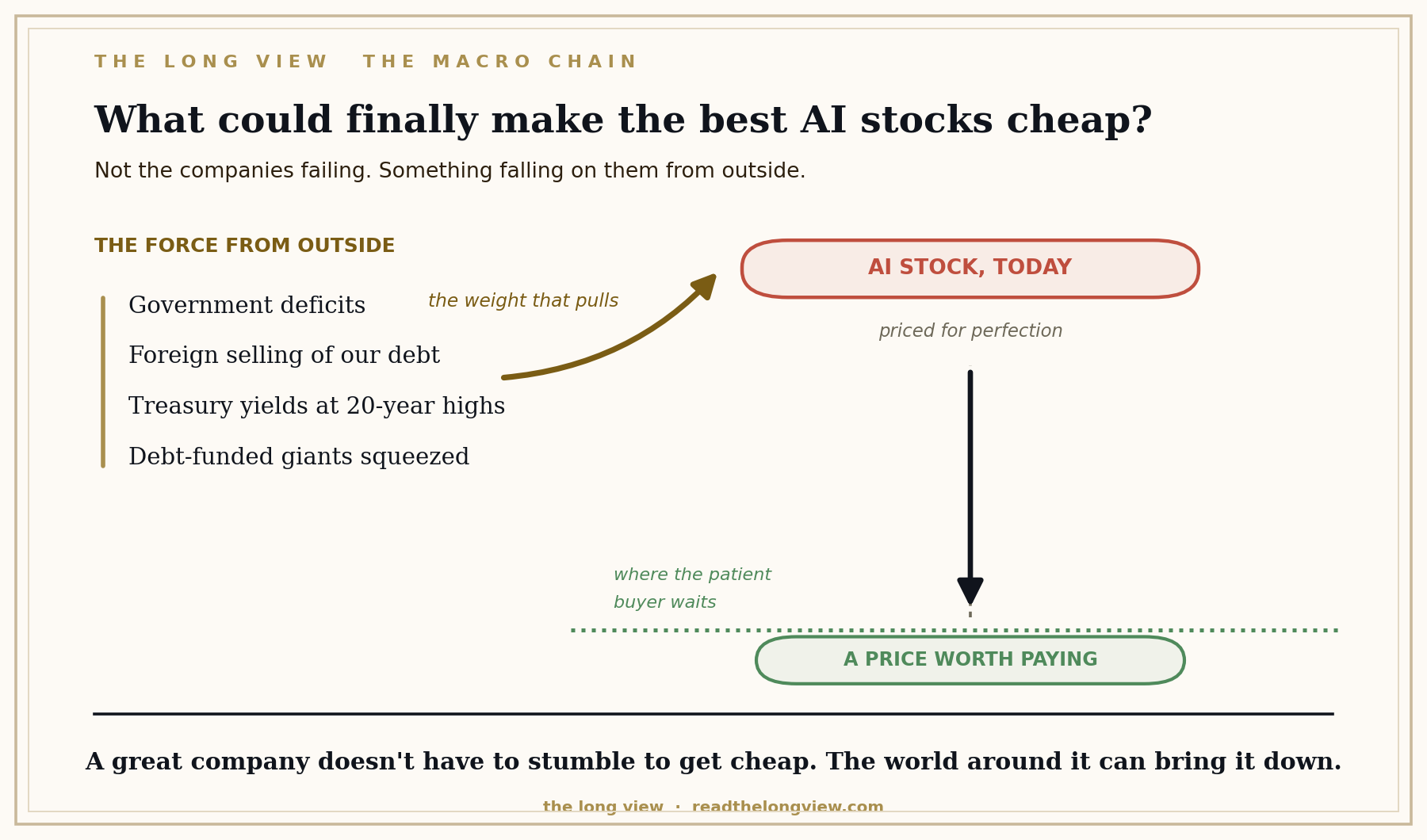
Government debt, hyperscaler debt, and the cost of money that ties them together. Here is the chain, link by link, and why the chain, not any company stumbling, is the thing most likely to hand a patient investor a great business at a fair price.
The Long View · The AI economy, seen from the bond market
The Long View holds none of the companies named here. This is analysis, not a recommendation, and explicitly not a prediction of any particular outcome.
We have spent a lot of words lately on price, on the idea that a great company and a great investment are not the same thing, and that the bridge between them is always what you pay. This piece is about the thing that could move those prices, not company by company, but all at once, and it starts somewhere most technology investors never look: the market for government bonds.
Stay with me, because the connection is more direct than it seems, and once you see it you cannot unsee it.
Link one: the buildout runs on borrowed money
Start with what the AI boom really costs. The largest technology companies, Microsoft, Meta, Amazon, and Alphabet, are spending on a scale with no precedent. Industry capital expenditure on AI infrastructure is projected to exceed $700 billion in a single year. And that spending has crossed a line that matters: it now consumes essentially all of the cash these companies generate, and then some.
Consider Meta. In its most recent quarter it produced about $31.9 billion in operating cash flow, an enviable figure for almost any business on earth, and it spent $31.1 billion of it on capital expenditure, leaving a mere $784 million behind. A year earlier that leftover figure had been over $8 billion. To keep building at this pace, Meta issued roughly $25 billion in new long-term debt in that single quarter, lifting its total debt to nearly $84 billion. It is not alone. Across the four giants, capital spending is rising far faster than the cash coming in, free cash flow is collapsing toward zero and in some cases through it, and most of them are tapping the debt markets to make up the difference. Alphabet posted its first-ever negative free cash flow quarter. The AI buildout, in other words, is increasingly financed with borrowed money, on the promise that the revenue will arrive later.
That is link one, and it is the foundation everything else rests on: the companies funding the AI economy are now dependent on continued, affordable access to debt.
Link two: borrowed money has a price, and that price is set by Treasuries
Here is where government enters the story. The cost of all that corporate borrowing is anchored to the yield on U.S. Treasury bonds, the interest rate the American government pays to borrow. That yield is the risk-free rate, the number against which every other loan, bond, and investment in the economy is priced. When it rises, every corporate bond issued to build a data center costs more. When it falls, borrowing gets cheaper.
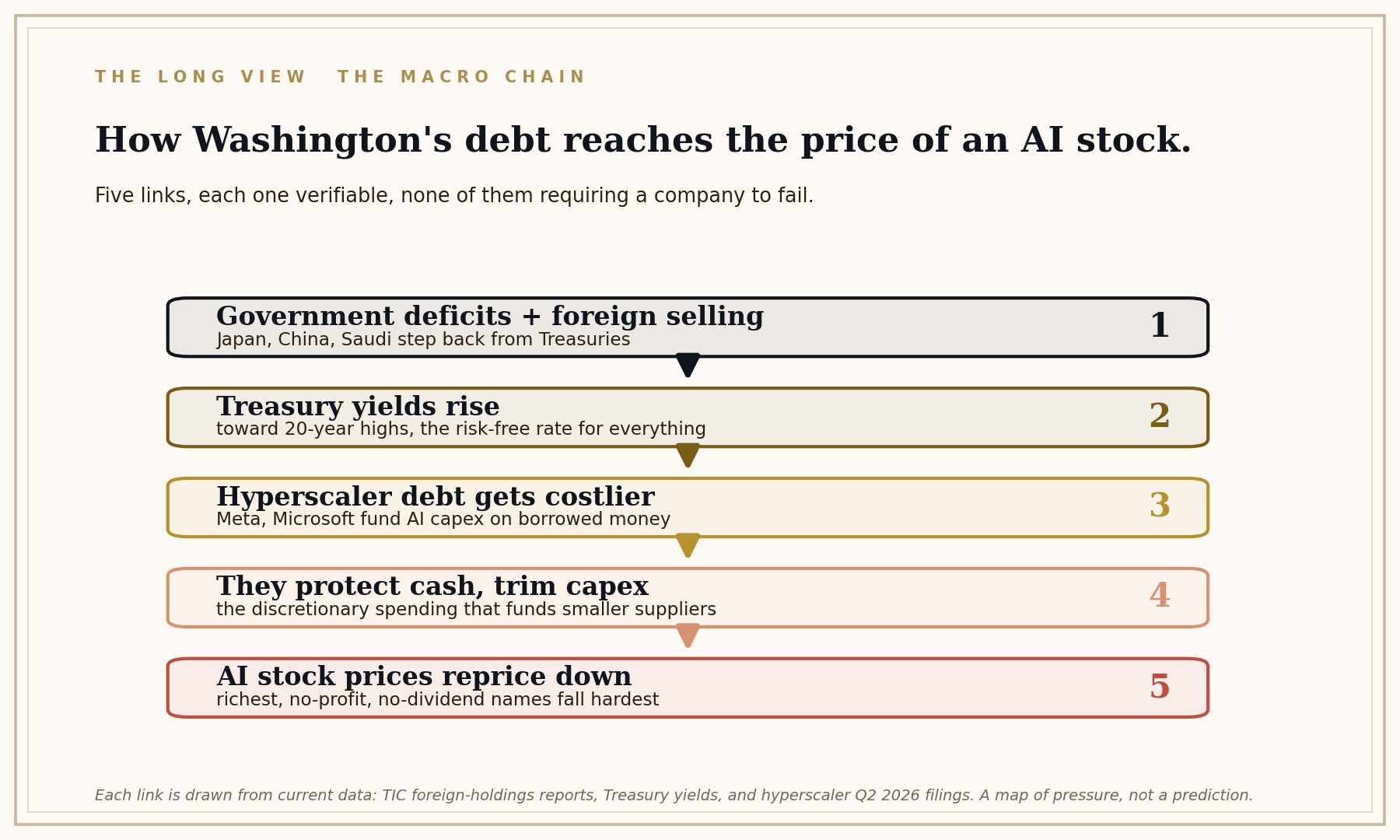
And Treasury yields have been climbing toward levels not seen in two decades. The reason is partly the simplest force in any market: supply and demand. The U.S. government is running enormous deficits and issuing a torrent of new debt to fund them, increasing the supply of bonds. At the same time, some of the largest long-standing buyers of that debt are stepping back.
Link three: the foreign buyers are turning into sellers
For decades, foreign governments were reliable, price-insensitive buyers of U.S. debt. That is changing, and it is not a threat or a forecast, it is in the data. Foreign holdings of U.S. Treasuries fell by roughly $72 billion in a single recent month, the third decline in four months, led by selling from Japan and China, the two largest foreign holders. Earlier in the year, a single month saw Japan and China sell a combined $89 billion, with Saudi Arabia, Taiwan, India, Canada, and the United Arab Emirates also among the sellers.
The reasons are ordinary, which is what makes them durable. Japan’s own government bonds now yield the most since the 1990s, so Japanese institutions have less reason to send their money abroad and more reason to bring it home. A war in the Middle East has pushed oil prices up, adding to inflation and pushing Japan’s central bank to keep tightening, which lifts domestic yields further and accelerates the repatriation. When a country’s own bonds finally pay something, the appeal of American debt fades. So the foreign bid that helped hold U.S. yields down for a generation is weakening, and weaker demand for bonds, against rising supply, means higher yields.
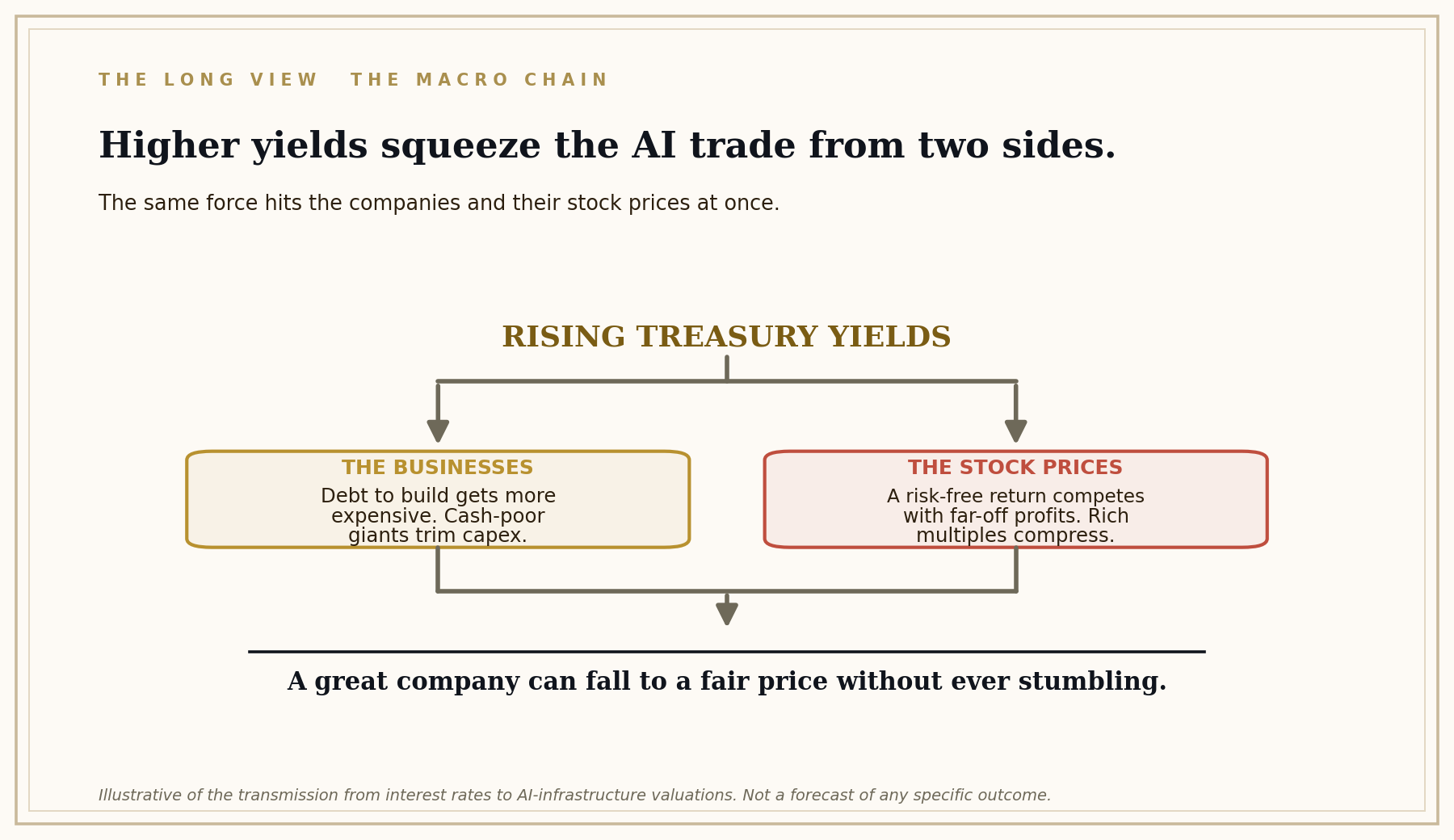
Link four: higher yields squeeze the AI complex two ways
Now the chain closes, and it closes on the AI trade from two directions at once.
The first is direct. The hyperscalers funding the buildout with debt face rising costs to issue that debt as yields climb. A company already running its free cash flow down to nearly nothing, borrowing tens of billions to keep building, is acutely sensitive to the price of that borrowing. Higher yields make the return math on a debt-funded data center harder, and at some point they force a choice: keep spending at any cost, or protect the balance sheet. The lever a cash-conscious giant pulls first is discretionary capital spending, which is precisely the money flowing to the smaller AI-infrastructure companies underneath them.
The second is indirect, and it hits valuations. When the risk-free rate rises, the entire logic of paying a high price for far-off future profits weakens, because now you can earn a real return with no risk at all, just by holding a government bond. The stocks most exposed to this are exactly the ones priced for perfection: the fast-growing, unprofitable, no-dividend names trading at extreme multiples of their sales. Their value lives almost entirely in profits many years away, and a higher discount rate shrinks the present value of those distant profits the most. When money is expensive, the market’s patience for a story that pays off in a decade grows short.
Where this lands: a great company at a price you can finally pay
Put the chain together and you have the mechanism a patient investor should understand cold. Government deficits and foreign selling push Treasury yields up. Higher yields raise the cost of the debt funding the AI buildout and squeeze the cash flow of the giants financing it. Those giants, protecting themselves, trim the discretionary spending that flows to their smaller suppliers. And the same higher yields independently compress the rich multiples of the most expensive AI stocks. None of that requires a single company to fail, to miss, or to stumble. It is transmitted entirely from the outside, through the cost of money.
This is the answer to a question we get often: how does a magnificent business, one growing several hundred percent a year with real margins, ever fall to a price a value investor could pay, if it never stops executing. The answer is that it may never fall because of anything it does. It falls because the environment it lives in reprices. The discipline that keeps us out of these names at today’s prices is the same discipline that would let us in tomorrow, if this chain tightens and drags the whole complex down with it, leaving the best businesses on sale for reasons that have nothing to do with the businesses themselves.
The honest other side
Now the truth protocol, because a chain of plausible links is not a prophecy, and anyone who sells you certainty here is selling you something.
Foreign selling of Treasuries has been forecast to trigger a crisis for well over a decade, and it has not, because every time foreign demand softens, other buyers appear: domestic institutions, pension funds, even the stablecoin issuers who now hold well over a hundred billion dollars in Treasury bills. American government debt remains the reserve asset of the world, with no real substitute at scale. The selling so far has been gradual, a repricing at the margin, not a stampede. And there is a scenario that runs the other way entirely: a sharp economic scare would send money rushing into Treasuries as a haven, pushing yields down, easing the pressure, and extending the very buildout this chain threatens. A recession would hurt the AI trade through demand instead, a different mechanism with a different shape. The hyperscalers, too, are among the strongest companies in history, with enormous cash reserves and the ability to slow spending on their own terms rather than being forced to.
So this is a pressure, not a prediction. A map of how the pieces connect, not a claim about when or whether they will move. The value of understanding it is not that it tells you what happens next. It is that it tells you what to watch, so that if it does begin to move, you recognize it early, while everyone still staring only at the technology wonders why the best AI stocks are suddenly on sale.
And then, this week, the government pushed back
Here is how alive this is. As I was finishing this piece, the tension in the chain broke into the open. Long-dated Treasury yields had just spiked to a nearly twenty-year high, the thirty-year touching levels not seen since before the financial crisis, on exactly the forces described above: heavy issuance, a buyers’ strike in long-dated bonds since early summer, and worry about deficits and inflation. Then the Treasury Department stepped in. It announced it would more than double its buybacks of longer-dated government debt, targeting the very part of the market that had been under the most strain, and yields fell sharply on the news while stocks rose.
This matters for the argument in both directions, and honesty requires saying both. On one hand, it is the clearest possible confirmation that the pressure is real. Governments do not double their debt buybacks and single out the long end of the market unless the strain is serious. The chain I just described is not a thought experiment. The authorities acted this week to relieve exactly the force it runs on.
On the other hand, it is a reminder that this is not a one-way street. There is a policy backstop. When the long end of the bond market gets truly stressed, the Treasury and, if it came to it, the Federal Reserve have tools to lean against it, and they will use them. That can cap the rise in yields, and with it, cap the pressure on the AI trade. A patient investor waiting for the cost of money to bring great companies down to earth has to respect that the people who manage the debt do not want a disorderly rise any more than the market does.
But notice what a buyback does, and does not do. It manages the symptom, the liquidity and the price in one stressed corner of the market. It does not shrink the deficit, bring the foreign buyers back, or make the AI buildout any less dependent on borrowed money. The structural pressure is still there. This week bought some relief at the long end. It did not remove the thing generating the strain, and the fact that intervention was needed at all tells you how real the strain has become. The chain still runs. It is just now a chain the government is actively managing, which is a different thing from a chain that has been broken.
The Treasury has reached for this before
It is worth knowing that this tool is not new, because the two times the Treasury has leaned on something like it, the outcomes could not have been more different, and both are worth carrying in your head.
The first is recent and reassuring. From 2000 to 2002, the Treasury ran a buyback program, repurchasing about $67 billion of its own debt across several dozen operations. But it did so from a position of strength: the government was running a budget surplus and simply had extra cash to retire debt. The effect was benign, a modest scarcity that helped flatten the yield curve, and the program wound down on its own as the surplus faded and the 2001 recession arrived. Buybacks from surplus are a housekeeping tool, not a distress signal.
The second is older and more sobering. During the Second World War, from 1942 to 1951, the government faced the opposite problem: it had to finance an enormous war debt and could not afford high interest rates. So the Federal Reserve agreed to cap yields outright, pegging short-term rates near zero and holding long bonds at 2.5 percent, buying whatever quantity of Treasuries was needed to keep the lid on. It worked, for a while. But it turned monetary policy into a servant of the debt, and when inflation surged after the war, running near 18 percent for a stretch, the Fed was still handcuffed to those caps and could not fight it. It took a formal accord in 1951 to free the central bank to raise rates again. Holding yields down to manage debt has a price, and that price can be inflation the authorities are slow to confront.
Here is why both matter for this week. Today’s buyback is being presented as liquidity support, the benign 2000 framing. But the context is the opposite of 2000: not a surplus, but enormous deficits and a buyers’ strike in long bonds. That is structurally closer to the 1940s problem, financing heavy debt cheaply, than to the surplus housekeeping of 2000, and some analysts are already calling it a backdoor form of yield-curve management. The thing to watch is which way it goes. If it stays a modest liquidity tool, it is a footnote. If it escalates, quarter by quarter, into the government leaning ever harder on the long end to hold down the cost of its own borrowing, the 1940s are the precedent, and the eventual bill for that tends to be inflation, which is its own repricing engine for every richly-valued stock in the market. Neither history is a prediction. But the Treasury just reached for a lever it rarely touches, and a patient investor should know what happened the last two times it did.
What we watch
The hyperscalers’ free cash flow, quarter by quarter, because it is already near zero at some of them, and the moment it turns durably negative, the pressure to cut spending builds.
Their capital-spending guidance, because the first sign of discipline is a target that stops rising, and that would ripple straight down to their suppliers.
Treasury yields and the monthly foreign-holdings data, because they are the pressure gauge for the entire chain, the place the tightening would show up first.
And credit spreads, the extra yield lenders demand to fund riskier borrowers, because when they widen, the debt-funded buildout gets more expensive and more fragile at the same time.
Run any company through the Stock Story Firewall, free, at firewall.readthelongview.com. Subscribers get the Watch cards, the Evidence tool, and the full Research Tracker.
The AI future is bright. That was never the question. The question is what you pay for it, and the thing most likely to change what you have to pay is not the technology at all. It is a chain that starts in Washington’s deficits and the world’s bond markets, and ends at the price of every AI stock you have been watching and waiting to afford.
Not investment advice. The subscriber decides.