

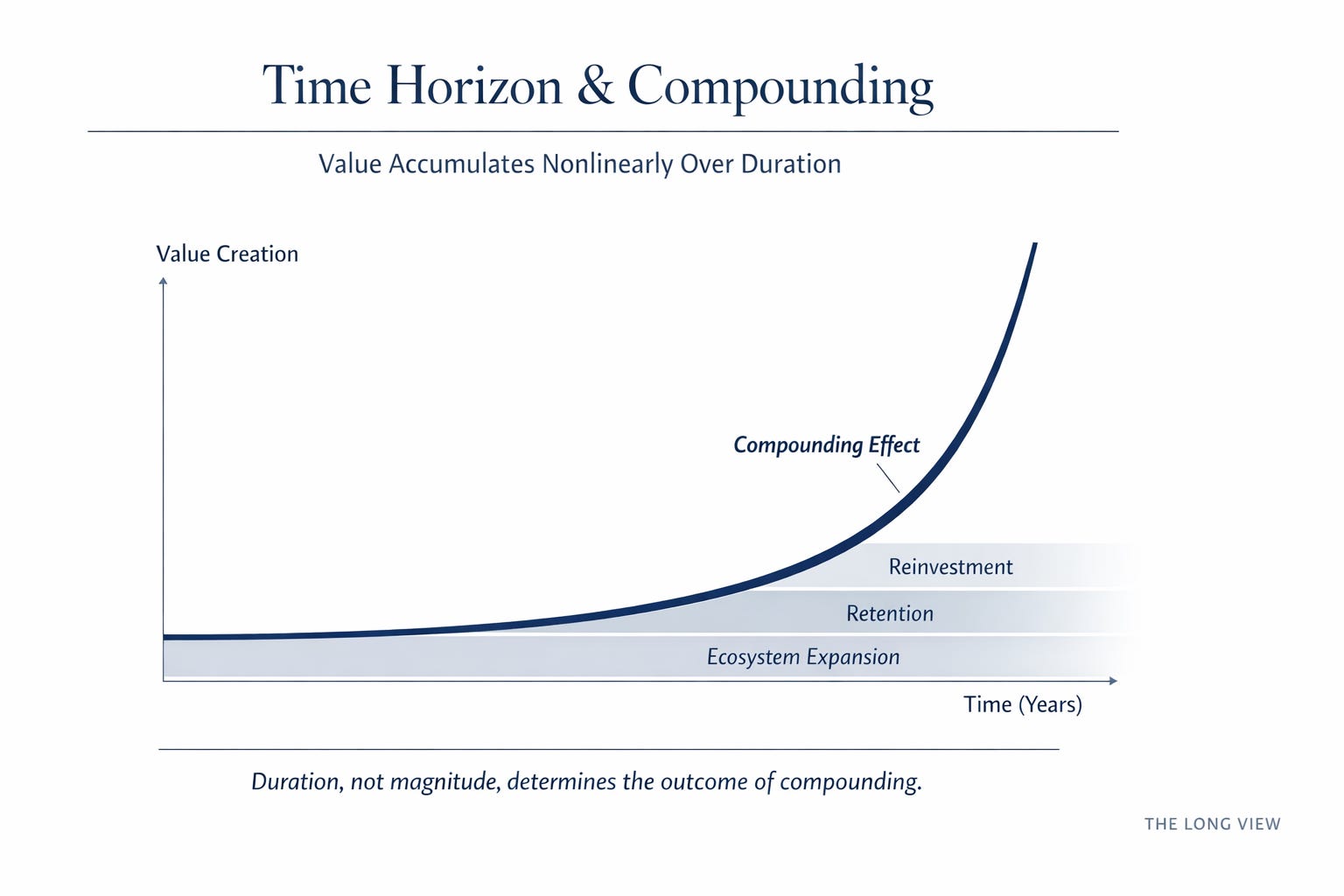
Time Horizon & Compounding asks whether a company’s economics improve as time passes. That improvement can come from customer retention, ecosystem depth, installed-base economics, operating systems, or capital allocation discipline. The key is not speed. The key is reinforcement.
ASML provides a clear example. Its role in semiconductor manufacturing becomes more important as the industry becomes more advanced. Each wave of chip complexity increases reliance on the infrastructure layer. That creates a long-duration compounding pattern built on necessity and technical depth.
Costco compounds differently. Its engine is trust. The company keeps pricing disciplined, shifts much of its economics toward memberships, and strengthens the customer relationship over time. In this case, the compounding mechanism is not technological lock-in. It is loyalty reinforced by operational consistency.
Danaher demonstrates management-system compounding. The Danaher Business System turns process discipline into better operating outcomes, then turns those outcomes into capital that can be reinvested. This creates a cumulative effect that becomes visible only across long periods.
MongoDB illustrates early platform compounding. Developer adoption, integration, and application-layer dependence can create stronger economics over time, even when the near-term picture still looks uneven. For young platforms, compounding often begins in ecosystem position before it appears in financial maturity.
Evaluation Checklist When using Time Horizon & Compounding, ask:
1. Does the company become stronger as the surrounding system matures?
2. Is reinvestment making the position more durable?
3. Does customer or developer dependence increase over time?
4. Is management building for reinforcement rather than short-term extraction?
Long View research is designed to help investors evaluate businesses through durable frameworks rather than short-term narratives. Our institutional reviews emphasize structure, discipline, and capital efficiency as the foundations of long-term outcomes.