

Nebius (Nasdaq: NBIS) plans to spend $40 to $45 billion on data centers and chips in 2027. Three customers made up 70 percent of its sales from July to September 2026. Its funding plan leans on customer contracts, and its Microsoft contract is running late. This piece traces who pays for the build, link by link, using Nebius’s own filings and announcements. You will finish with three questions you can ask any company that builds first and collects later.
Disclosure: the author holds no individual shares in any company named here. He owns broad index funds that include some of them.
The question behind the build
Nebius rents out computing power for artificial intelligence. It buys the chips, fills data centers with them, and charges AI companies to use them.
On Monday I showed that cash from running the business covered about 27 cents of every dollar Nebius spent on its build in the nine months to 30 September 2026. Borrowing and share sales covered the rest.
That leaves the bigger question. Nebius plans to spend $40 to $45 billion in 2027 alone, according to its shareholder letter of 12 November 2026. Its 2027 sales target is $12 to $13 billion. Somebody has to fund the difference.
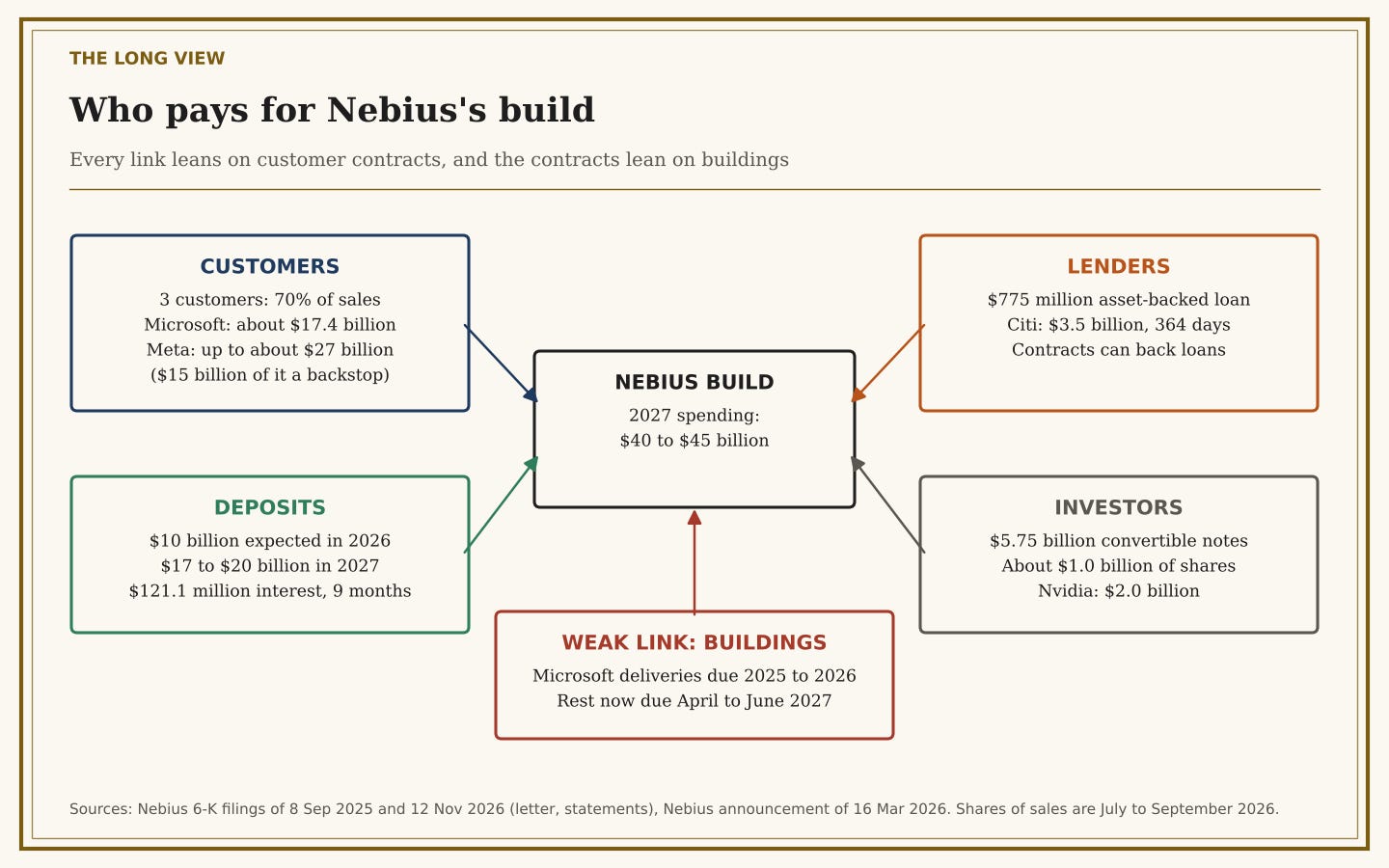
Nebius’s answer fits in one sentence from that letter: it expects “to cover 75-85% of our capex through advanced prepayments and asset-backed financing.” Capex is short for capital spending: the money that goes into buildings and chips.
That sentence names two sources: customer deposits, and loans backed by customer contracts. Both lead back to the same place, the customers. So that is where this piece starts.
Who the customers are
In the September financial statements, the biggest customers carry letters, not names. From July to September 2026, three of them made up most of the sales:
Customer E, 33 percent. Customer D, 22 percent. Customer C, 15 percent. Together, 70 percent.
Seven of every ten dollars Nebius earned from July to September came from three customers.
Two customers are named elsewhere, in Nebius’s own announcements.
Microsoft signed a contract worth “about $17.4 billion through 2031,” according to a filing Nebius made on 8 September 2025. The computing is supplied from a new data center in Vineland, New Jersey.
Meta signed an agreement on 16 March 2026 with “a contract value of up to approximately $27 billion,” according to Nebius’s announcement that day. That deal comes in two parts, and the difference between them matters.
I looked in the section on customers in the September statements and found no line saying which letter is Microsoft or Meta. So whether the 70 percent belongs to these two is NOT PROVEN.
Not all contract value is the same
The Meta number shows why a headline contract value needs a second look.
Of the $27 billion, $12 billion is what the announcement calls “dedicated capacity.” That is computing set aside for Meta.
The other $15 billion is different. Meta “has committed to purchase additional available compute capacity” in some upcoming Nebius data centers. The announcement says Nebius “currently intends to sell this capacity to third-party customers,” with Meta buying whatever is left.
In plain words, $15 billion of the $27 billion is a backstop. It is a promise from Meta to buy what other customers do not. My reading: if Nebius sells that space to other customers, Meta pays nothing for it. The announcement describes a plan, “currently intends,” not a fixed term. The backstop protects Nebius from empty buildings. It is not $15 billion of extra sales on top.
The same announcement says delivery of the Meta capacity starts “early 2027.” So the largest named deal on Nebius’s books has not started yet.
A contract value tells you the most a customer might pay. It does not tell you what it will pay, or when.
Deposits: the first link, and their hidden cost
Nebius’s main answer to “who pays” is the customer deposit, which it calls a prepayment. A deposit is money a customer pays up front, before the service starts.
The letter calls deposits “now the standard structure of our agreements.” It expects “$10 billion in committed customer prepayments in 2026, rising to $17-20 billion in 2027.” It adds: “We receive them well in advance, which gives us visibility into our funding.”
Two details in the financial statements complicate that picture.
First, as Monday’s piece showed, money customers owed Nebius rose from $288.6 million on 30 June to $4.04 billion on 30 September 2026. Customer D accounted for 75 percent of that total. Money owed is revenue billed but not yet collected. If customers paid well in advance, my reading is that this number would stay small. Instead it grew about fourteenfold.
Second, some deposits are not free money. When a customer pays a large sum far in advance, the accounting rules treat part of it like a loan from that customer, and the company records interest on it. Nebius’s cash flow statement shows $121.1 million of this interest on customer contracts over the nine months to 30 September 2026.
A deposit that carries interest is partly a loan from your customer.
Loans: the second link, and what secures them
The second half of Nebius’s plan is “asset-backed financing.” That means loans secured on something valuable, so lenders can claim it if the loan is not repaid.
For Nebius, that something is largely the customer contracts. The letter says: “Our long-term agreements with investment-grade customers can be financed directly,” and “Our agreements with Microsoft and Meta can be financed the same way.” Investment-grade means a company that rating agencies judge very likely to pay its debts.
The first example so far: in July 2026 Nebius closed what the letter calls “the first facility under our asset-backed financing framework: $775 million at SOFR plus 2.50%.” The letter says it is secured against long-term agreements with an investment-grade customer. SOFR is a standard short-term interest rate that banks use as a base.
The letter lists a second kind of loan separately: “short-term facilities.” On 22 October 2026 Nebius signed a “senior secured facility agreement with Citi in an aggregate principal amount of $3.5 billion,” according to the September statements. The rate is SOFR plus 2.75 percent, rising to at most SOFR plus 3.50 percent. It runs for 364 days.
The statements say Nebius intends to use it for data centers and chips, as well as general corporate purposes. A one-year loan for assets Nebius expects to earn from for years has to be repaid or replaced when the year is up.
The other people in the chain
Customers and contract-backed lenders are not the only ones paying.
Investors bought $5.75 billion of convertible notes in August 2026. These are loans that can later turn into shares. Others bought about $1.0 billion of shares through what Nebius calls its at-the-market program in July to September, meaning shares sold gradually into the market.
One of the investors also makes the systems Nebius installs. On 11 March 2026, Nebius agreed to sell Nvidia rights to 21,065,936 shares for $2.0 billion, according to the September statements. The same shareholder letter describes Nebius putting Nvidia’s newest systems, called Vera Rubin, into its data centers.
So Nvidia is both an investor in Nebius and the maker of the systems it installs. Whether Nebius buys from Nvidia directly or through server makers, the filings I read do not say. My 20 November piece on Nvidia’s stakes and guarantees covered a similar pattern, and I will not repeat it here.
The weak link: the buildings
Every link above rests on one thing. The capacity has to be ready, because a customer pays for computing it can use, not computing that is still waiting for buildings or power.
Here is what the Microsoft filing of 8 September 2025 said about timing: “The GPU Services will be deployed in several tranches during 2025 and 2026.” A tranche is one batch of delivery.
The shareholder letter of 12 November 2026 ties the delay to power at the New Jersey site, where temporary generators were switched off ahead of a move to permanent power. It says Nebius expects to have delivered “more than half of the capacity contracted with Microsoft by the end of the year,” and the remaining tranches are “now scheduled for 2Q27,” which is April to June 2027.
The same 2025 filing set out what happens when delivery is late. If Nebius misses an agreed date after a grace period and cannot offer other capacity, Microsoft “has the right to terminate that GPU Service.” The contract also includes “liquidated damages for late delivery,” which are set penalties.
The letter adds one reassuring line: “Microsoft has been part of the planning process.”
What I cannot tell you is whether Microsoft has agreed to the new dates, or whether the grace period covers them. The filings I read do not say. That is NOT PROVEN, and it is the most important open question in this piece.
The deposits, the loans and the backstop all hang on contracts. The contracts hang on buildings.
The hidden assumption
Every investment story rests on something that must be true for it to work. Here is the hidden assumption in who pays for Nebius’s build.
The contracts survive the delays.
If they do, the chain holds. Customers keep paying deposits. Lenders keep lending against the contracts. The Meta backstop protects against empty space. The 364-day loan gets replaced on reasonable terms.
If one large contract is cut back because a building is late, the damage runs down every link at once. Fewer deposits arrive. The loans secured on that contract are worth less to lenders. The cash gap gets filled with more borrowing or more shares, which shrink each owner’s slice.
Nothing in the September quarter shows a contract failing. It shows the timing under strain. The first tranches were due in 2025 and 2026, and the last ones now land in 2027.
How long the wait is
My usual test for a stock is simple. If you put $5000 in and want it to grow 10 percent a year for five years, it has to become $8053. I then ask what the business has to earn to support that.
Here I can do the first half. Nebius closed at $97.80 on 23 November 2026, its closing price that day. For $5000 to become $8053 by November 2031, the shares have to reach about $157.51. That is $97.80 times 1.61051 (10 percent a year, compounded for five years), a rise of about 61 percent.
The second half I cannot do yet, because there are no earnings to test. Nebius lost $37.5 million from continuing operations in July to September 2026. Its letter says it expects “to reach pre-tax breakeven by the end of 2027.” Breakeven means neither a profit nor a loss. My reading: if that target holds, the first full year that could show a pre-tax profit is 2028.
Your five-year clock starts the day you buy. On Nebius’s own target, its profit clock starts around 2028.
Until then, any rise in the price is a bet on profits that do not exist yet, and the funding chain above has to hold in the meantime.
The lesson: three questions for any company that builds first
This lesson applies to any company with Nebius’s shape: spend first, on buildings and chips, and collect later, from a small number of very large customers. For any of them, three questions do most of the work. Each one can be answered from the company’s own filings.
Who are the customers, and how few? Look for the customer section in the financial statements. If three customers make up 70 percent of sales, as at Nebius from July to September, your investment is partly a bet on those three.
Does the cash arrive before the building, or after? Compare what the company says about deposits with cash from running the business, and with the money customers owe. At Nebius, the letter says deposits arrive “well in advance.” The cash records through September show borrowing and share sales doing most of the work.
Can the customer walk away if the building is late? Read the contract summary the company filed when it signed. Nebius’s Microsoft filing says yes, after a grace period. Then check the latest delivery dates against the original ones.
You do not need to predict anything to ask these questions. You only need to know where to look.
What to watch, and where to find it
Three things will show whether the chain is holding.
First, the Microsoft dates. The next shareholder letter should show whether the New Jersey tranches are still on track for April to June 2027.
Second, cash from running the business. It was negative $273.0 million in July to September 2026, found by subtracting the six-month total from the nine-month total. If it rises while spending stays high, deposits are arriving as Nebius says.
Third, new loans. Watch whether the $3.5 billion Citi facility is repaid or replaced when its 364 days run out, and on what terms.
Reply to this post with the company you would run these three questions on next. I read each reply.
Not investment advice. The subscriber decides.
Three customers at 70% of sales matters more than the $40 to $45 billion plan itself. If one of them pushes deliveries further out, Nebius is still carrying build costs on a schedule set for 2027 revenue.