

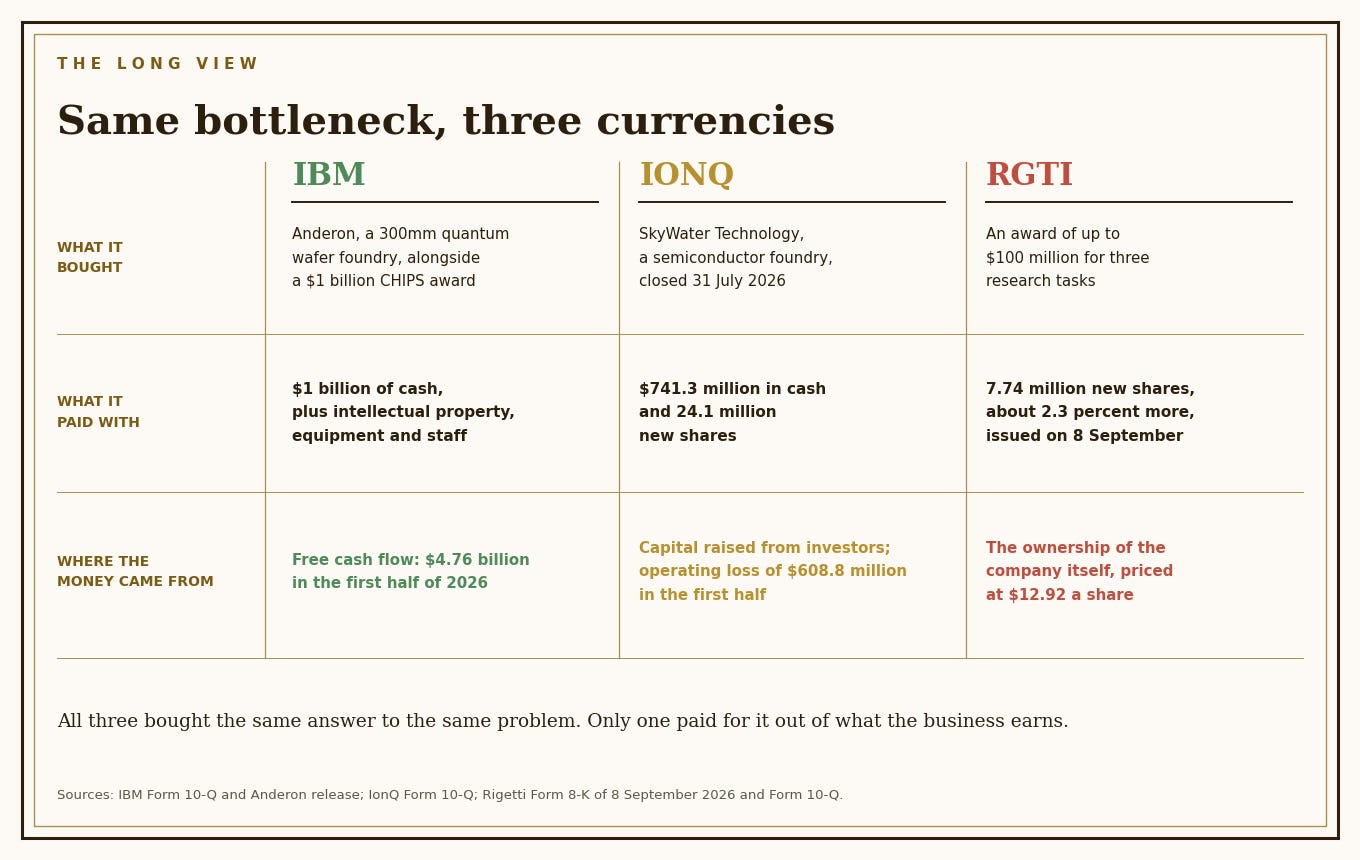
In May I told you the Commerce Department had committed $100 million to Rigetti. It had not, not yet. The definitive agreement came on 4 September, and four days later Rigetti issued the government 7,739,938 new shares of its own stock. That is the question this week promised for today. Three companies bought their way into the same bottleneck inside eight days, and the interesting part is not what each of them announced. It is which one paid with money the business earned, which paid with money it had raised, and which paid with pieces of the company itself.
Disclosure: the author has held IBM since March 2020, is up about 100 percent on the position, and reinvests the dividend. He also holds a small position in Rigetti. No position in IonQ. This is analysis, not a recommendation.
The correction, first
On 28 May I wrote that the Department of Commerce had committed $100 million to Rigetti. The document that existed that week was a letter of intent, and it described a proposed award of up to $100 million over three years. Commitment was the wrong word, and a letter of intent is not a cheque. For a value investor the difference is not pedantry. A commitment is something you can count. A letter of intent is something you can hope for, and I counted it.
The definitive agreement arrived on 4 September, and the share issuance that came with it on 8 September. Even the definitive agreement says up to $100 million. The award funds three research tasks: shrinking readout electronics into an integrated package, a new cryostat architecture, and fabrication for higher-connectivity chips.
I held Rigetti when I wrote that piece and did not say so, and I should have.
What Rigetti gave up
The filing is plain about the price of the award. As an inducement to enter the agreement, Rigetti issued the Department 7.74 million shares, all at once, on 8 September. Divide the $100 million by the share count and the implied price is $12.92 a share.
That price came from a formula set in May: the lowest closing price on three reference dates, discounted by 15 percent. One of those reference dates, 5 May, came before the program was announced to the public on 21 May.
Rigetti had 333.8 million shares outstanding at the start of August. Adding 7.74 million is about 2.3 percent more shares. Every share that existed before, mine included, now owns a slightly smaller piece of the company, and the United States government now sits on the same share register I do, having paid a lower price for its place on it.
Here is the part a headline cannot carry. The ownership changed hands in full on the first day. The money is up to $100 million, for research that has not been done yet. If you own the stock, the cost is certain and the benefit is conditional.
What IonQ gave up
IonQ’s route to a foundry was an acquisition. It closed the purchase of SkyWater Technology on 31 July, and its 10-Q gives the total consideration as about $1.8 billion: $741.3 million in cash and 24.1 million new IonQ shares. Under the collar in the original agreement, SkyWater’s holders were set to own between 4.4 and 6.7 percent of the combined company.
The cash is real money. It is also money IonQ raised from investors rather than money a business produced. IonQ’s operations lost $608.8 million in the first half of 2026, and its accumulated deficit stood at $2.26 billion at 30 June. Paying for a factory out of capital raised is not a flaw. It is a different transaction from paying for one out of profit, and the difference is who ultimately carries the bill.
IonQ was also not among the nine companies that signed letters of intent with Commerce in May. It has no government equity on its register because it has no government award.
What IBM gave up, and the question I promised to answer
IBM is putting one billion dollars of cash into Anderon, alongside intellectual property, equipment and staff, to match the Department’s one billion. That cash comes from a business that produced $4.76 billion of free cash flow in the first half.
On Monday I wrote that IBM’s announcement named no equity condition attached to the government money, and that I would go looking today. I looked.
The Department’s own release of 21 May lists the two foundries, IBM and GlobalFoundries, in one section, and the seven quantum computing companies in the next. The sentence saying the Department will take a minority, non-controlling equity stake sits at the end of the second section, under the seven. GlobalFoundries disclosed in its own release that the Department would receive about 1 percent of the company. IBM disclosed nothing of the kind in May or in September, and has said other investors are expected to join Anderon as it grows.
Some coverage reports that all nine recipients gave equity. I cannot find that for IBM in any document I can read. That is not proof there is none. It goes into the disclosure tally as open, and it is a fair question to put to IBM directly.
Four things that get called investment
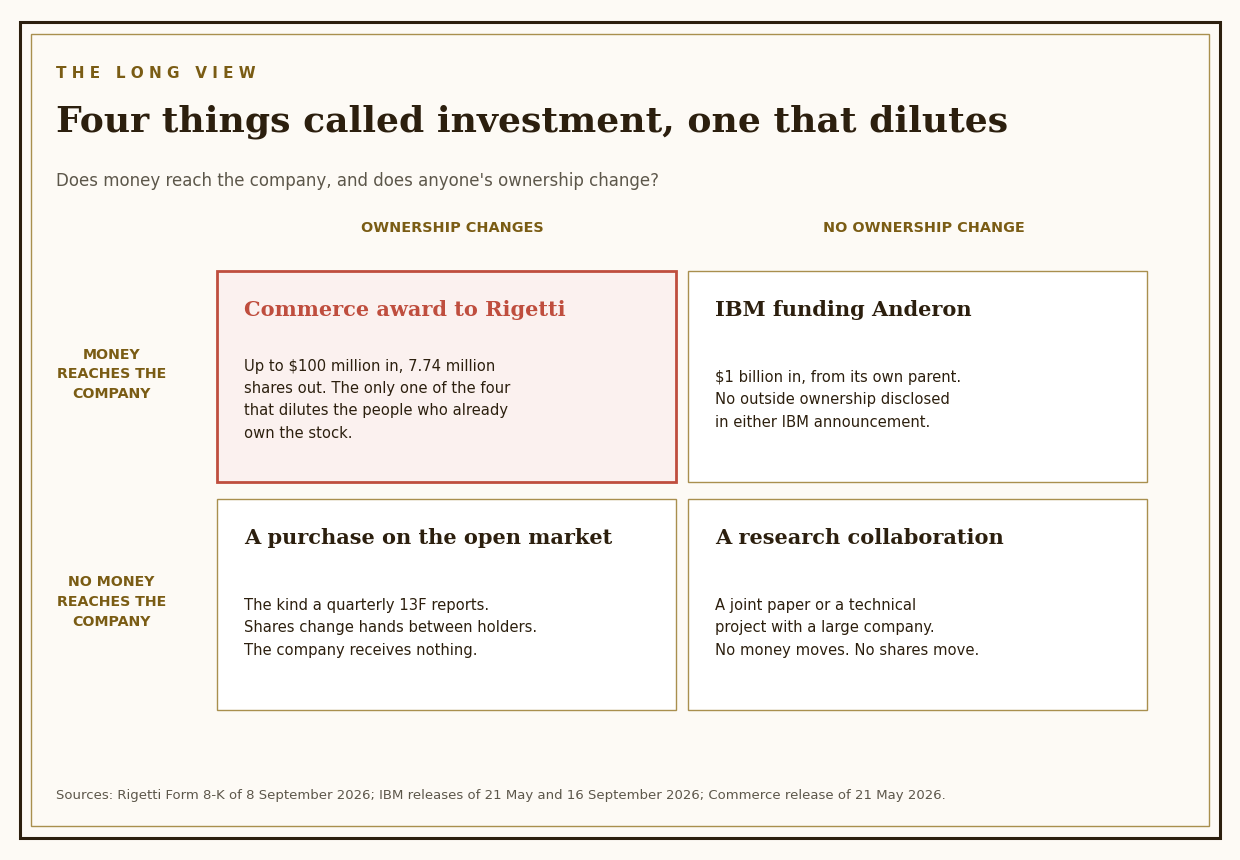
The word is doing too much work in this sector, so here are four different events, all of which moved a share price.
The Department sending Rigetti up to $100 million and taking shares: money reaches the company, and ownership changes. IBM funding Anderon: money reaches the company, from its own parent, and no outside ownership is disclosed. An institution buying shares on the open market, the kind of purchase a quarterly 13F filing reports: ownership changes, but the company receives nothing, because the money goes to whoever sold. A research collaboration with a large technology company: no money moves and nobody’s ownership changes.
Only the first of those four dilutes the people who already own the stock. It is the one diluting me.
Two foundries and a question nobody is asking
Both IBM and IonQ now own foundries that sell to the rest of the industry. Anderon is being built as a pure-play foundry for any quantum customer. SkyWater already made chips for other quantum companies before IonQ bought it.
That creates a quiet problem for the smaller developers. If the plant that makes your chips is owned by a competitor, you are trusting that competitor with your designs and your schedule. It may work out fine. It is a question a customer of either foundry will have to answer, and it is the kind of detail that surfaces in a filing a year from now as a lost customer.
Grading what I said to watch in May
The May piece closed with three things to watch. It is only fair to mark them.
Cash against burn. Rigetti’s cash and investments went from the $569 million I reported in May to $541.3 million at 30 June, a fall of about $27.7 million in the quarter. At that pace the runway is measured in years, not quarters. I also said to watch for the $100 million to appear as cash in the next filing. It did not, because the award was not final until September, and when it was, the shares came first.
Partner announcements turning into revenue. Second-quarter revenue of $5.1 million was driven by on-premises sales of Rigetti’s Novera systems to several customer types, which is revenue from product rather than press releases. Partial credit, and our own scorecard still marks recurring cloud revenue as unproven.
Hardware against IBM and Google. That is tomorrow’s work, and it runs on the company I own before it runs on anyone else.
What this means for a value investor
A value investor asks one question about a big expense: who pays for it. At IBM, a profitable business is spending part of its surplus, and the shareholder is paid a dividend throughout. At Rigetti, each milestone is financed partly by issuing new shares, so the shareholder pays with ownership. IonQ sits between the two, spending raised cash and issuing stock at the same time.
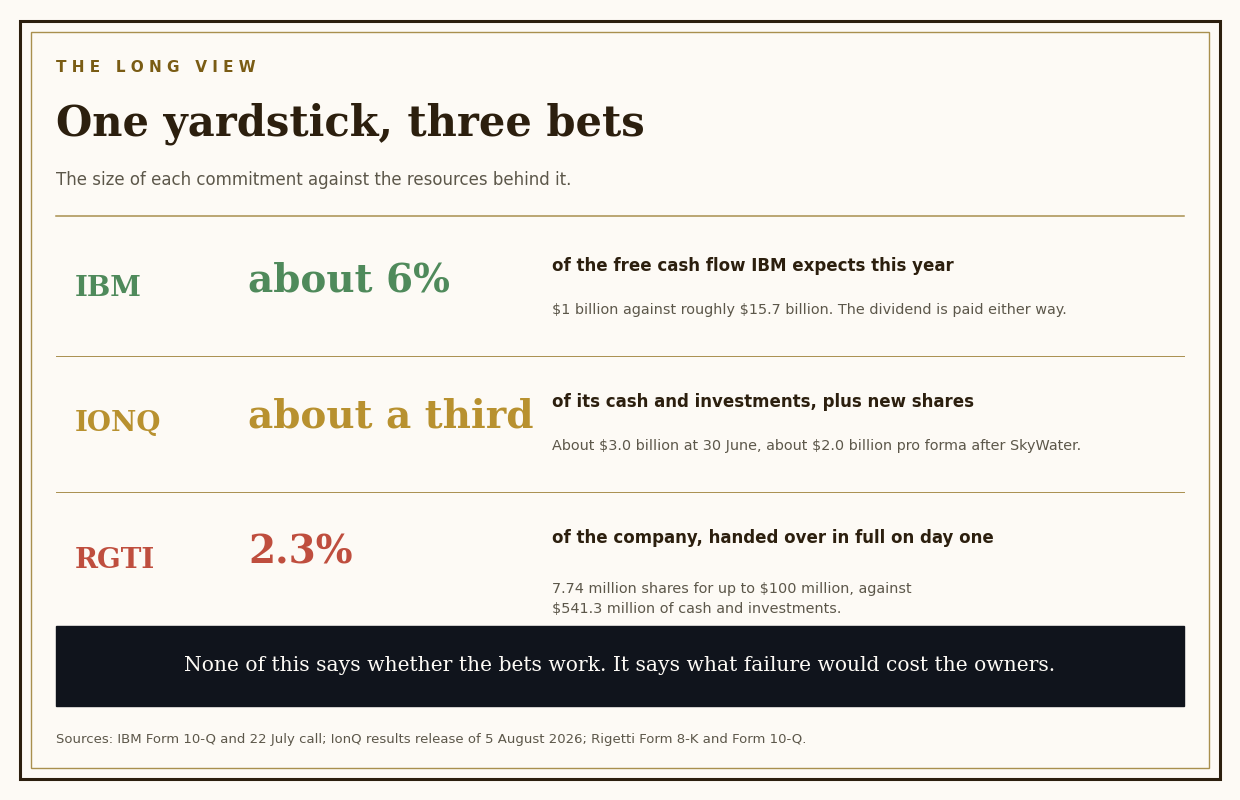
Put all three on one yardstick, the size of the commitment against the resources behind it. IBM’s billion is about 6 percent of the free cash flow the company expects to produce this year, and the dividend is paid either way. IonQ’s own release put its cash and investments at about $3.0 billion at 30 June and about $2.0 billion pro forma for the SkyWater closing, so one acquisition used roughly a third of the cash pile, on top of the new shares. Rigetti’s award is meaningful against $541.3 million of cash and investments, and it was paid for with 2.3 percent of the company, handed over in full on the first day.
None of that tells you whether the bets will work. It tells you what failure would cost the people who own each company, and that is the part of a quantum story no press release ever prices.
Tomorrow
Tomorrow the week turns on itself. I take the framework I used on Rigetti in May and on IonQ this week and apply it first to IBM, then to Rigetti, and only then to IonQ, the one I do not own. In a single day in July, IBM announced three separate claims of quantum advantage. One of them was answered from outside faster than most people would believe.
Run any company through the Stock Story Firewall, free, at firewall.readthelongview.com.
Not investment advice. The subscriber decides.