

From Monday 2 November to Friday 6 November, I read the filings and the reporting on four of the companies paying for the AI build: Amazon (Nasdaq: AMZN), Alphabet (Nasdaq: GOOGL), Meta (Nasdaq: META) and Microsoft (Nasdaq: MSFT). Here is what I think they told us. On the test I published, the business each build serves added more dollars of sales than its company added in depreciation. On cash, three of the four spent more than their businesses brought in, and two borrowed to cover part of it. The build is selling. It has not yet paid for itself. The space between those two is where the risk sits for anyone who owns these companies, directly or through an index fund. Six lessons follow, then where I land on each builder.
Disclosure: the author holds no individual shares in any company named here. He owns broad index funds that include some of them.
Lesson one: the businesses the build serves are selling fast
I started the week with a doubt. Not whether AI demand is real. Anyone can see AI is hot. My doubt was size: is the demand big enough to pay the bills, with power, permits, equipment and workers all standing between the build and the revenue?
The test I fixed on 31 October and published on Monday 2 November asked one question. Did sales in the business each build serves grow by more dollars than the company’s depreciation, the cost of wearing out its equipment, comparing the September 2026 quarter with a year earlier?
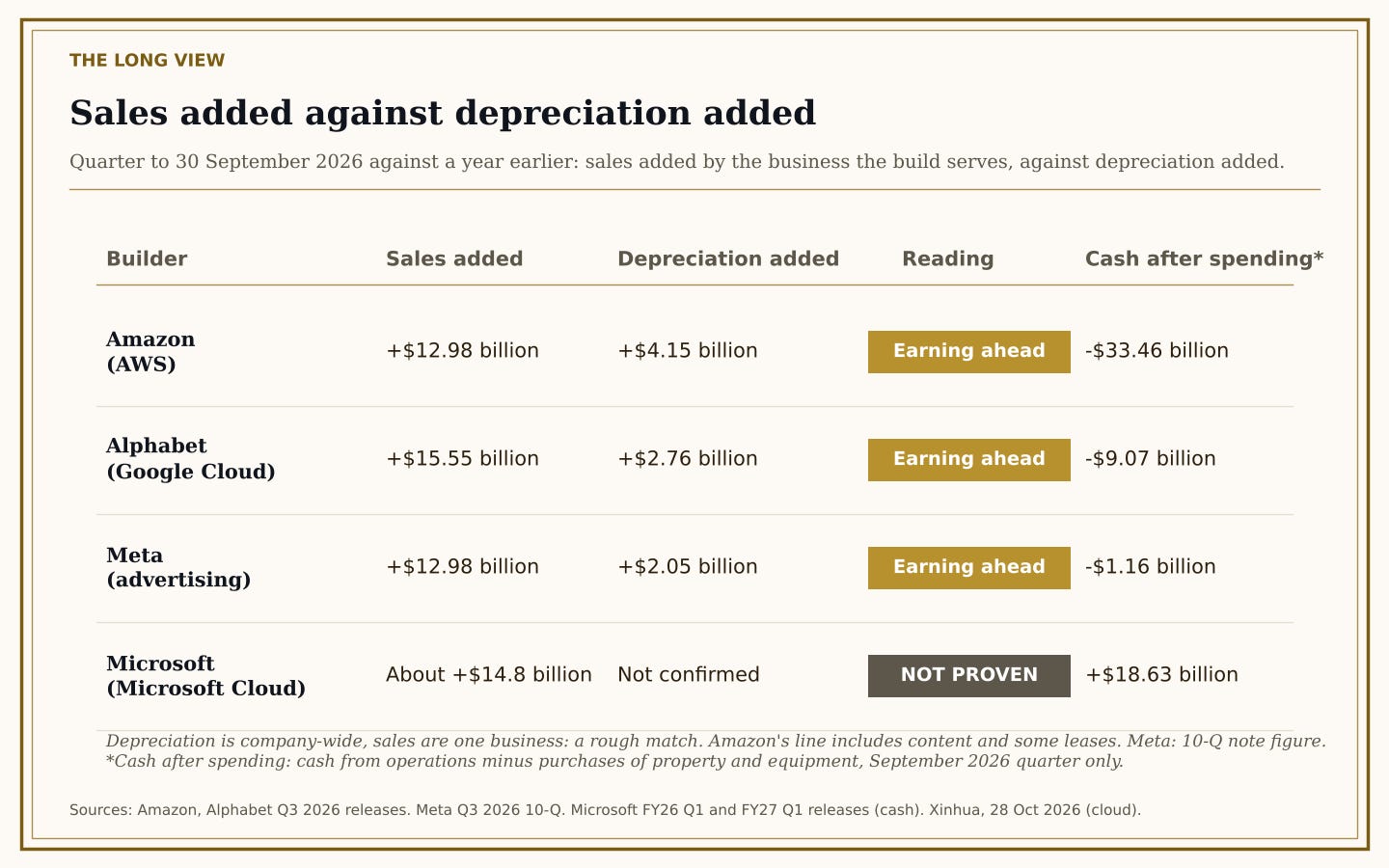
Amazon Web Services added $12.98 billion of sales, while Amazon’s depreciation and amortization rose $4.15 billion. Google Cloud added $15.55 billion, against $2.76 billion more depreciation at Alphabet. Meta’s advertising added $12.98 billion, against $2.05 billion.
All three passed, by three to one or better. Microsoft added about $14.8 billion of cloud sales, but its depreciation sits inside a wider line I have not confirmed at the source, so it stays NOT PROVEN.
One limit sits beside every reading. Depreciation is company-wide, and the sales come from one business, so read each one as a rough match. The filings do not split out sales from AI.
My read: the first half of my doubt got an answer. Right now, sales in the businesses the build serves are growing by more dollars than the wear on the build, by three to one or more. The second half did not. Cash is still short at three of the four, the bill is growing faster than total sales, and the gates slow the earnings while the bills keep their dates. The rest of this piece is about that second half.
Lesson two: the easy part of the test is now
This is what changed my thinking most.
The bill for a build arrives late, by design. A company pays for a server in one quarter and spreads the cost over the years it expects the server to last. My reading: the cost in any quarter is the wear on everything already in service. Most of the 2026 spending has not reached it yet.
Alphabet’s chief financial officer, Anat Ashkenazi, told us how slowly it arrives. About 65 percent of its infrastructure spending in the September quarter went on servers and networking that “generally have useful lives of six years,” she said. The rest went on data centers with lives of seven to 40 years. The spending “will continue to weigh on the P&L in the form of higher depreciation expenses,” she said.
The bill is already growing faster than the companies. At all three that passed, depreciation grew faster than total sales. Amazon’s rose 25 percent against 12 percent for sales. Alphabet’s rose 49 percent against 25. Meta’s rose 43 percent against 26.
My read: the scoreboard looks good now. The hard part of the game has not started.
Lesson three: the profit rests on a guess about how long a machine lasts
This one hit closest to home.
As I said in a note on Tuesday 3 November, the equipment at my work in technology runs on three-year leases, with a refresh at the end of each. That is a lease cycle, not an accounting estimate, but it is a clock, and it is half as long as the one the builders use. Meta depreciates most of its servers over 5.5 years. Alphabet uses six for servers and networking.
That choice sets how big the yearly bill looks. When Meta stretched its server lives at the start of 2025, its own filing put the effect at $2.29 billion less depreciation over the first nine months of that year. Same machines. Same cash. A smaller reported cost.
Is six years right for AI chips? The people who study it disagree. Michael Burry argued that extending lives “artificially boosts earnings,” CNBC’s Yun Li reported on 12 November 2025, and CNBC said it could not independently confirm the practice at the companies. On the other side, CoreWeave has a contract for older Nvidia A100 chips running into 2029, Tom’s Hardware reported on 12 August 2026.
My read: the builders are allowed to make that call, and it may be right. As an investor, I treat their reported profit as only as good as that call.
Lesson four: cash is the check on the estimate
If the useful life is an estimate, you need a number the estimate does not move. That number is cash after spending. Take the cash the business produced and subtract its spending on property and equipment.
For the September 2026 quarter, it told a harder story. Amazon came up $33.46 billion short. Alphabet came up $9.07 billion short. Meta came up $1.16 billion short. Microsoft had $18.63 billion left over after its purchases of property and equipment, a figure that leaves out equipment it rents on finance leases, as the 30 October piece noted.
So three builders pass the sales test and fall short on cash, in the same quarter. Both are true. Depreciation spreads the cost over years. Cash pays it on the day.
Amazon and Alphabet borrowed to cover part of their gaps. Meta drew on its savings.
Profit tells you how the build looks. Cash tells you who is paying for it.
Lesson five: the risk reaches lenders and ratepayers
When a builder borrows, someone lends. Amazon sold $37 billion of bonds in March 2026, Bloomberg reported. Bonds like these end up in funds.
In a piece dated 19 August 2026, Vanguard’s Lucas Baynes put it this way: “a broad ‘core’ bond fund is gradually becoming a larger claim on the AI buildout.” If you own a bond index fund, you may already be one of the lenders.
The power bill is the other route. On Wednesday 4 November we followed it to PJM, a grid serving 67 million people, where its market monitor tied $29.4 billion of capacity charges over four auctions to data center demand. The monitor itself says not all of the increase came from data centers. Axios reported on a review the Data Center Coalition, an industry group, paid for. It found no quantitative evidence to date of data centers being subsidized by other customers in the past.
My read: you do not have to own Amazon, Alphabet, Meta or Microsoft to have a stake in whether the build pays off.
Lesson six: the bills have dates, the earnings do not
Interest is due on schedule, and it is rising. Comparing the September 2026 quarter with a year earlier, Amazon’s interest expense went from $538 million to $1.69 billion, Alphabet’s from $143 million to $967 million, and Meta’s interest on its notes from $205 million to $882 million. Meta by itself has signed about $355.73 billion of leases whose payments begin between 2026 and 2036.
The earnings wait for the gates. Oregon’s governor told regulators to stop issuing air and water pollution permits to new or expanding data centers until July 2027, OPB reported. Amazon operates more than a dozen large data centers in the state. Transformers for power plants took more than 160 weeks to arrive by early 2026, up from 143 weeks in 2024, a Wood Mackenzie analyst told Reuters. On workers, I found warnings and forecasts but no named project delayed. That one stays NOT PROVEN.
My read: a company that is right about demand and wrong about timing still has to make its payments.
Uncertain timing is not the same as unlikely. It is a cost of its own.
What I still doubt: the backlog
Three of the builders point to a backlog of signed contracts. Amazon’s chief executive, Andy Jassy, put AWS’s at $578 billion and called it “well diversified.” Ashkenazi put Google Cloud’s at $561 billion. Microsoft’s commercial backlog was $677 billion at 30 September 2026, up 73 percent, Xinhua reported.
A backlog is a promise of future sales, not cash. It is worth what the customer behind it is worth.
Microsoft gave the clearest look, in my view. In its results for the quarter to 30 June 2026, it said its commercial backlog grew 84 percent. On the call on 29 July 2026, chief financial officer Amy Hood said it grew 25 percent without OpenAI. By my arithmetic, most of that year’s growth came from OpenAI.
Alphabet’s Google Cloud chief, Thomas Kurian, named AI labs among its customers and its work with Anthropic, and said “we have strong diversification across our product lines, industries, and customers.” Alphabet’s call gave no share by customer.
My read: at Microsoft, one AI company drove most of a year’s backlog growth. Alphabet and Amazon say their backlogs are diversified but give no share by customer. Whether the customers behind the backlogs can pay is the doubt I carry into the next quarter.
Where I land on each builder
The hidden assumption behind the AI build is that the earnings will keep outrunning the bills once the delayed part of the bill lands. On the one test I ran, sales added beat depreciation added at three of the four, and the fourth is NOT PROVEN. That covers one bill of three, and it measures sales, not earnings. Whether earnings outrun all three bills is NOT PROVEN. Here is how each builder looks to me.
Microsoft looks the steadiest on cash. In the September 2026 quarter it paid for its purchases of property and equipment from what its business brought in. Its open questions are its depreciation line and how much of its backlog rests on one customer.
Alphabet gave shareholders the most to work with, in my tally. It told us the split of its spending and the life of each part. Its cloud business doubled. It also borrowed to build, and its depreciation is growing at nearly twice the pace of its revenue.
Amazon had the biggest cash gap of the four, $33.46 billion in one quarter, and borrowed to cover part of it. Its cloud sales grew 39 percent. Its depreciation line includes video content and some leases, so the wear on its AI equipment is harder to read than Alphabet’s or Meta’s.
Meta carries the most risk, in my view, and the reason is concentration. Advertising was 97.6 percent of its revenue in the September 2026 quarter, so its build has to pay off mostly through ads. Amazon, Alphabet and Microsoft can also rent their computing to cloud customers. In fairness, Meta had the smallest cash gap of the three that fell short, $1.16 billion, and covered it from savings.
This is not a reason to buy or sell. It is where my reading of the evidence points, and where I will look first when the next quarter’s figures arrive.
What I will watch next
When the December 2026 quarter results are published, I will check three things for each builder. Is depreciation still growing faster than total sales? Is cash after spending getting better or worse? And has anyone changed how long it says its machines last?
If depreciation slows and cash improves, the build is starting to pay its way in cash as well as in sales. If not, the delayed bill is landing faster than the earnings. Either way, you will be able to see it in the same three places I will.
Reply with the builder you think carries the most risk, and why. I read every reply.
Not investment advice. The subscriber decides.
Correction, Nov 9: a reader, Daniel Oliveira, pointed to the property and equipment note in Microsoft's September-quarter 10-Q. Depreciation there was $11.1 billion against $7.1 billion a year earlier, up $4.0 billion. Against about $14.8 billion of added cloud sales, Microsoft passes the sales test at about 3.7 to 1. The original piece left Microsoft NOT PROVEN because that line was unconfirmed at the source. All four builders now pass the sales test. The cash findings are unchanged.
On Microsoft's NOT PROVEN: the property and equipment note in its September-quarter 10-Q states depreciation on its own, $11.1B against $7.1B a year earlier, so up $4.0B. The wider cash-flow line you mention, "depreciation, amortization, and other", is $11.7B against $8.1B. Set against your roughly $14.8B of added cloud sales, that passes your test at about 3.7 to 1. Data: Microsoft 10-Q filed Oct 28, processed by Equibles.