

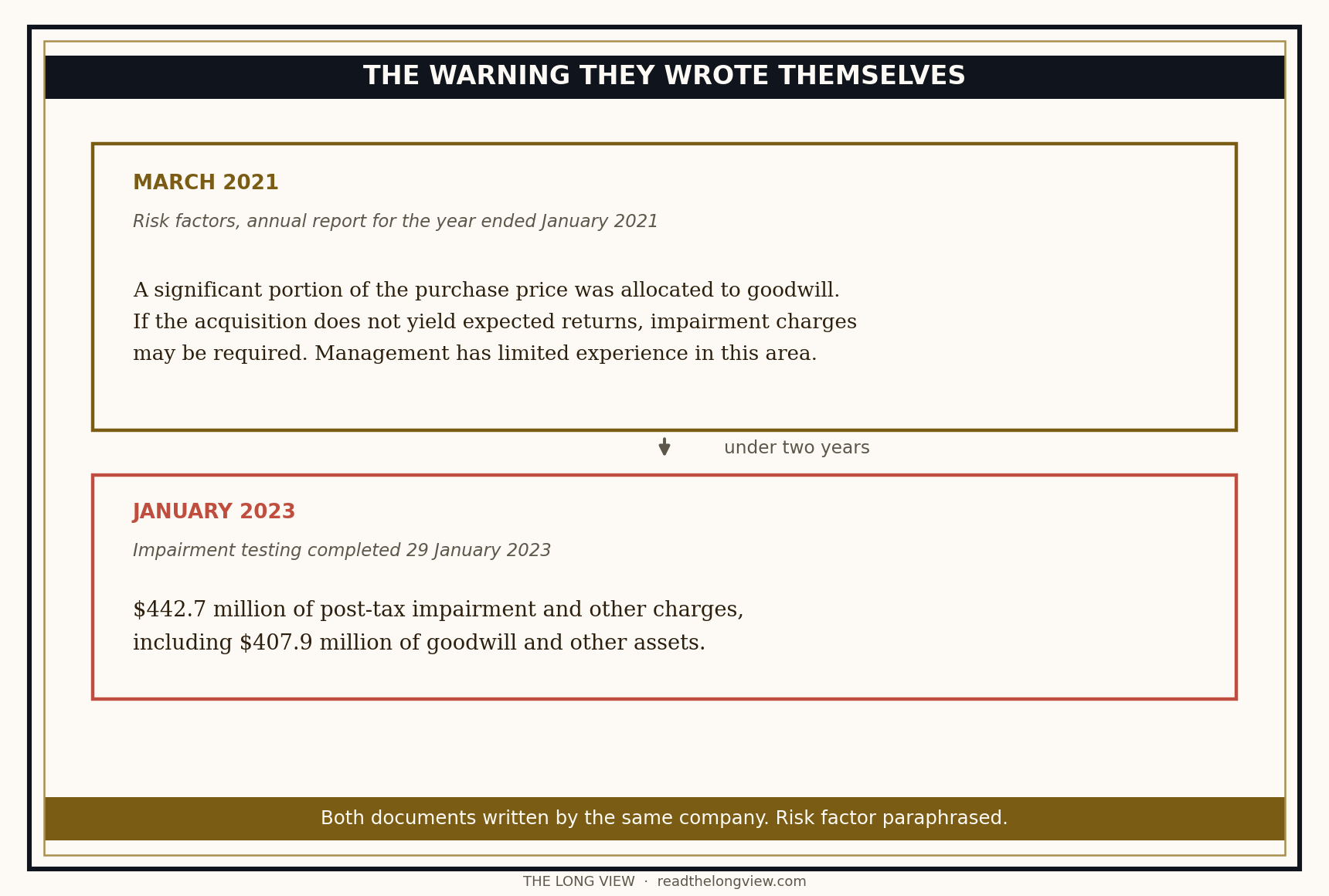
In March 2021, Lululemon filed its annual report for the year just ended. Inside it, among the risks the company is required to disclose, was a warning about the business it had bought the previous summer. A significant portion of the purchase price had been allocated to goodwill. If the acquisition did not produce the expected returns, impairment charges might be required. And the management team had limited experience in this area. Two years later, in the fourth quarter of fiscal 2022, the company recorded $442.7 million of post-tax impairment and other charges against that same business. The warning and the write-off were written by the same company, less than two years apart, and the second one is the reason today is about capital rather than sales.
Yesterday ended on the only evidence left, so here it is. But two words in that paragraph are doing a lot of work, and they are worth ninety seconds before anything else.
Goodwill, and what it means to write it off
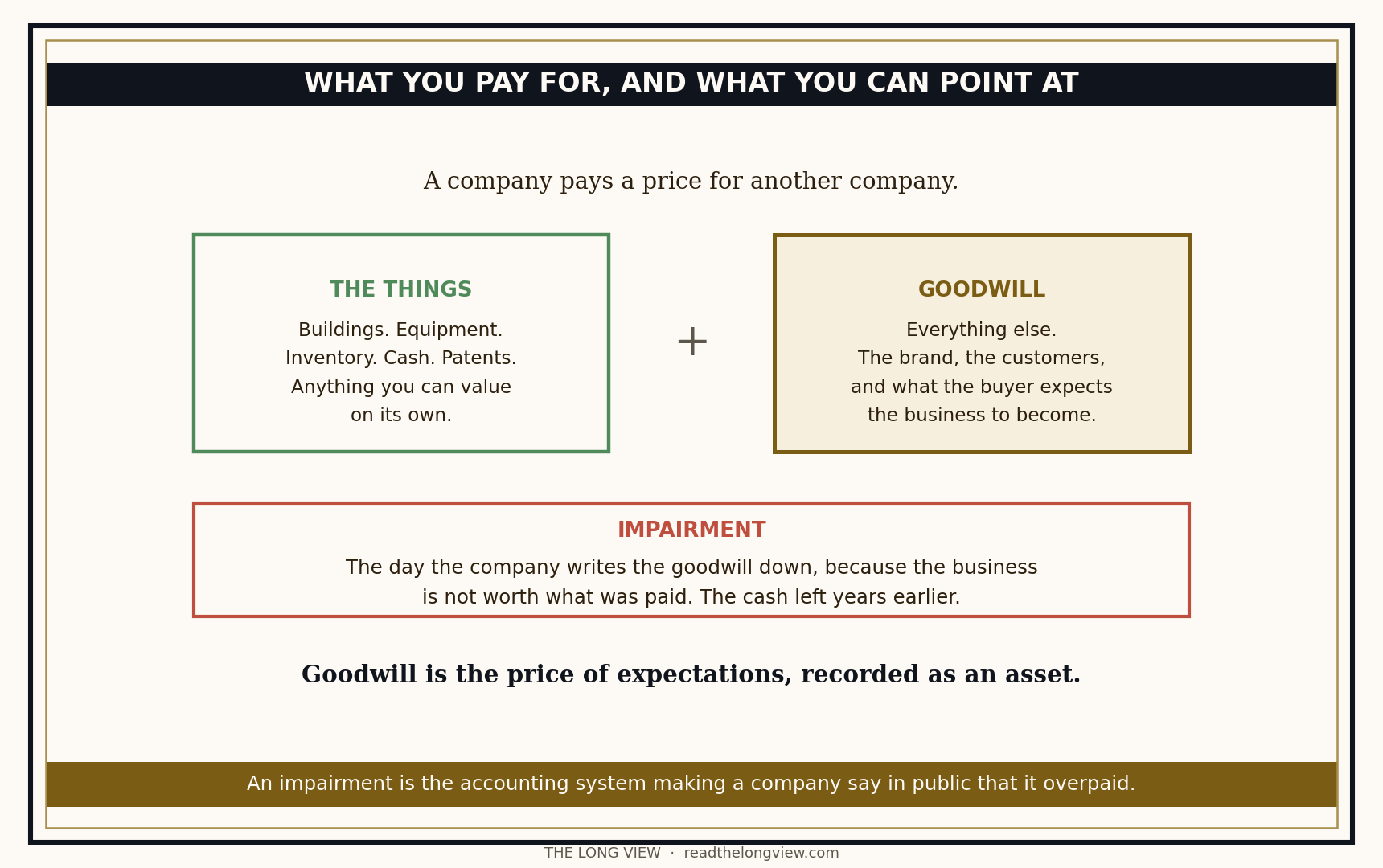
When one company buys another, it pays a price. Then the accountants add up what it bought: the buildings, the equipment, the inventory, the cash, the patents, anything you can point at and value on its own.
The price is almost always higher than that total.
The difference has a name. Goodwill. It is what the buyer paid above the value of the identifiable things, and it stands for everything that is not a thing: the brand, the customer list, the team, and above all what the buyer expects the business to become.
Goodwill goes onto the balance sheet as an asset, and it sits there at the price paid. It is not worn down year by year the way a delivery van is. It stays at full value until somebody decides it should not.
Goodwill is the price of a company’s expectations, recorded as an asset.
That is where the second word comes in. Accounting rules require a company to test that asset regularly and ask whether the business it bought is still worth what was paid. If the answer is no, it has to write the value down, and the write-down is called an impairment.
An impairment is not a cash payment. The money left years earlier, at the moment of purchase. What the charge does is force the company to say so on the record: we paid this much, it is not worth that, and here is the difference.
It is the accounting system making a company admit in public that it overpaid.
So when a filing says a significant portion of a purchase price was allocated to goodwill, it is telling you that most of what was bought was expectation rather than machinery. And when it says impairment charges may be required if the acquisition does not yield expected returns, it is telling you what happens if the expectation does not arrive.
Both of those sentences appear in Lululemon’s own annual report, about this acquisition, before any of it happened.
Why the cash flow statement and not the income statement
A company’s earnings tell you what a year produced. They do not tell you what anyone decided.
Every year a business keeps some of its profit rather than paying it out, and somebody chooses where that money goes. Reinvest it. Buy something. Pay down debt. Pay a dividend. Buy back stock. Those five choices, made repeatedly over years, become the company you own.
Calvin McDonald held the job from 2018 until earlier this year. That is eight years of those choices, and two of them are large enough to see from the outside without any interpretation at all.
The acquisition
In the second quarter of fiscal 2020, Lululemon acquired Curiouser Products Inc., trading as MIRROR, an in-home fitness company selling a wall-mounted screen with live and on-demand classes. The timing is worth holding. This was the middle of 2020, when in-home fitness was a category with an obvious tailwind and gyms across much of the world were shut.
By the fourth quarter of fiscal 2022, the company was running an impairment test on it. Impairment testing was completed as of 29 January 2023, and the result was $442.7 million of post-tax impairment and other charges, including $407.9 million against goodwill and other assets.
A business bought at the top of a category was written down by hundreds of millions of dollars two and a half years later. That is not unusual. What follows is.
They wrote the warning themselves
Go back to that annual report, filed in March 2021 and covering the fiscal year in which the purchase was made, and read the risk factors. Companies are required to disclose what could go wrong, and much of that section is boilerplate.
This part was not boilerplate. The filing stated that a significant portion of the purchase price had been allocated to goodwill, and that if the acquisition did not yield expected returns the company might be required to record impairment charges, which would adversely affect its results. It went on to note that its management team had limited experience in the area.
I want to be careful about what that establishes, because it is easy to overreach.
A risk factor is not a prediction. It is a list of things that could happen, drafted by lawyers, and every company files pages of them. The presence of a warning does not mean anyone expected the outcome.
But it does establish two things that matter for a management assessment.
The risk was identified, in writing, by the people who took it. Nobody can say afterwards that this came out of nowhere.
And the company said, in its own filing, that its management had limited experience in this area. That is an unusually direct statement, and it is the company’s own characterization rather than mine.
The question a management review asks is not whether a decision went wrong. It is what was known when it was made. Here, the company told us what it knew.
What it cost beyond the money
The $442.7 million is the number that gets quoted. The effect on the year is the part that shows what a write-off does to a business.
Operating income in the fourth quarter of fiscal 2022 was $314.4 million, or 11.3% of net revenue, against $590.6 million and 27.7% a year earlier. Adjusted to exclude the impairment, operating income for that quarter was $785.3 million, or 28.3%.
The company’s own annual report puts it more plainly than I could. Lululemon generated approximately 24% of its full-year operating profit in the fourth quarter of fiscal 2022. Excluding the impairment, it would have been approximately 44%.
That is a single decision, made in 2020, removing roughly twenty points of the fourth quarter’s contribution to the year’s profit in 2022.
The second decision
The other place a company’s money goes is into its own shares, and this one is measurable to the cent.
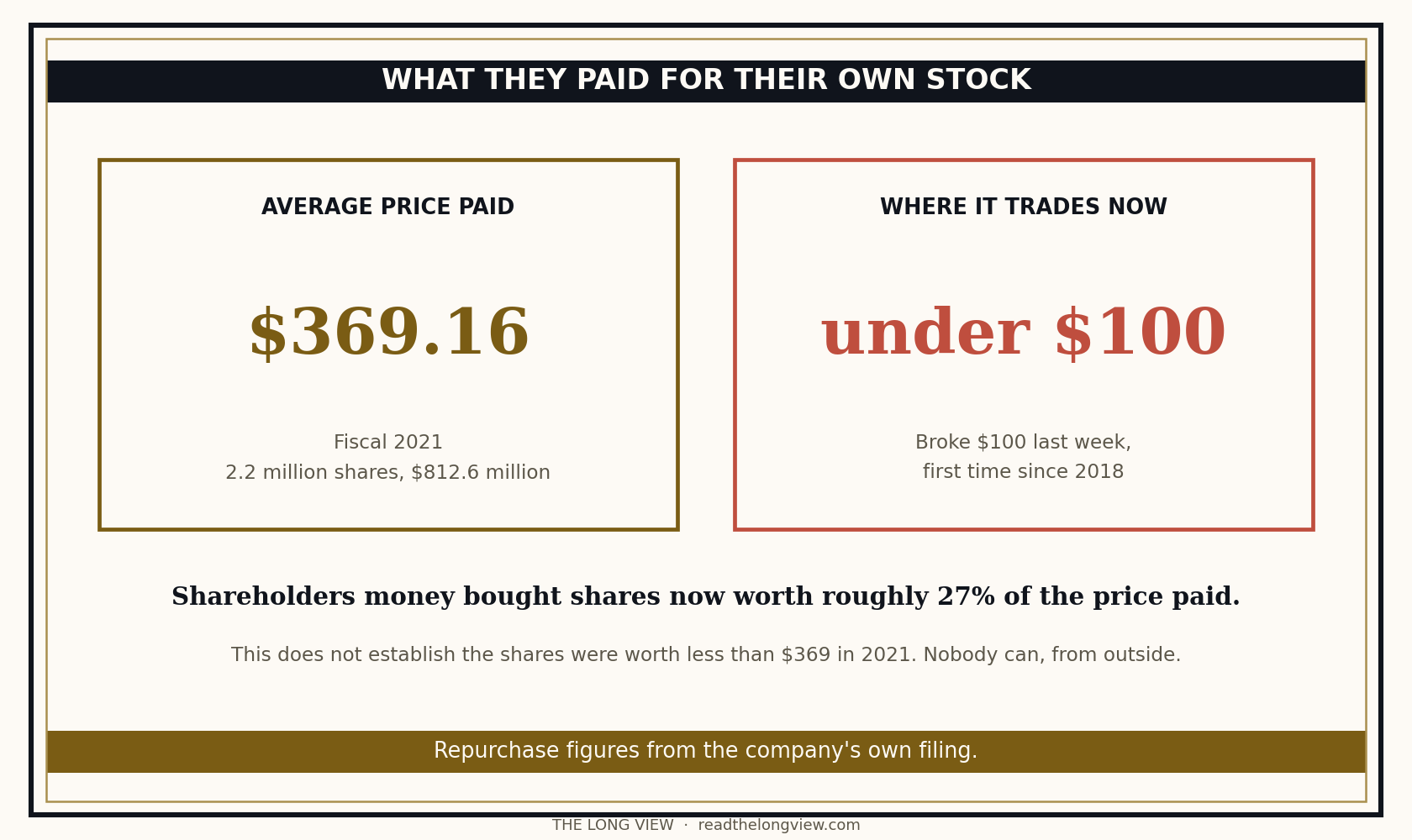
From the company’s own disclosure: during fiscal 2021, Lululemon repurchased 2.2 million of its own shares at an average price of $369.16 per share, for a total cost of $812.6 million. As at 30 January 2022 it had $187.5 million of authorization remaining, which it completed in the following quarter. In March 2022 the board approved a new program for up to $1.0 billion.
Last week the shares traded below $100.
I am not going to tell you the shares were worth less than $369 in 2021. Nobody can establish that from outside, and a management team buying stock in a business growing quickly is doing something defensible on its face.
What I can tell you is the arithmetic. $812.6 million of shareholders’ money bought 2.2 million shares at an average of $369.16. At under $100, those shares are worth roughly 27% of the average price paid.
That is not a forecast that failed. It is a purchase, and the price is a matter of record.
The test I could not finish
Tuesday I said I would run the first test from the management series on this record: whether earnings grew faster than the capital base. A business that adds to its equity every year produces rising earnings almost automatically, so growing profit on a faster-growing balance sheet is not the achievement it appears to be.
I could not assemble that from primary sources in the time I had. The revenue and earnings history is available in aggregators, and under the rule I set this week, an aggregator is a lead and not a citation. The figures I would need sit in eight separate annual reports and I have not read all eight.
So I am not going to give you a return-on-equity number I have not verified. That test stays open, and I will come back to it when the filings are in front of me rather than a summary of them.
What this establishes
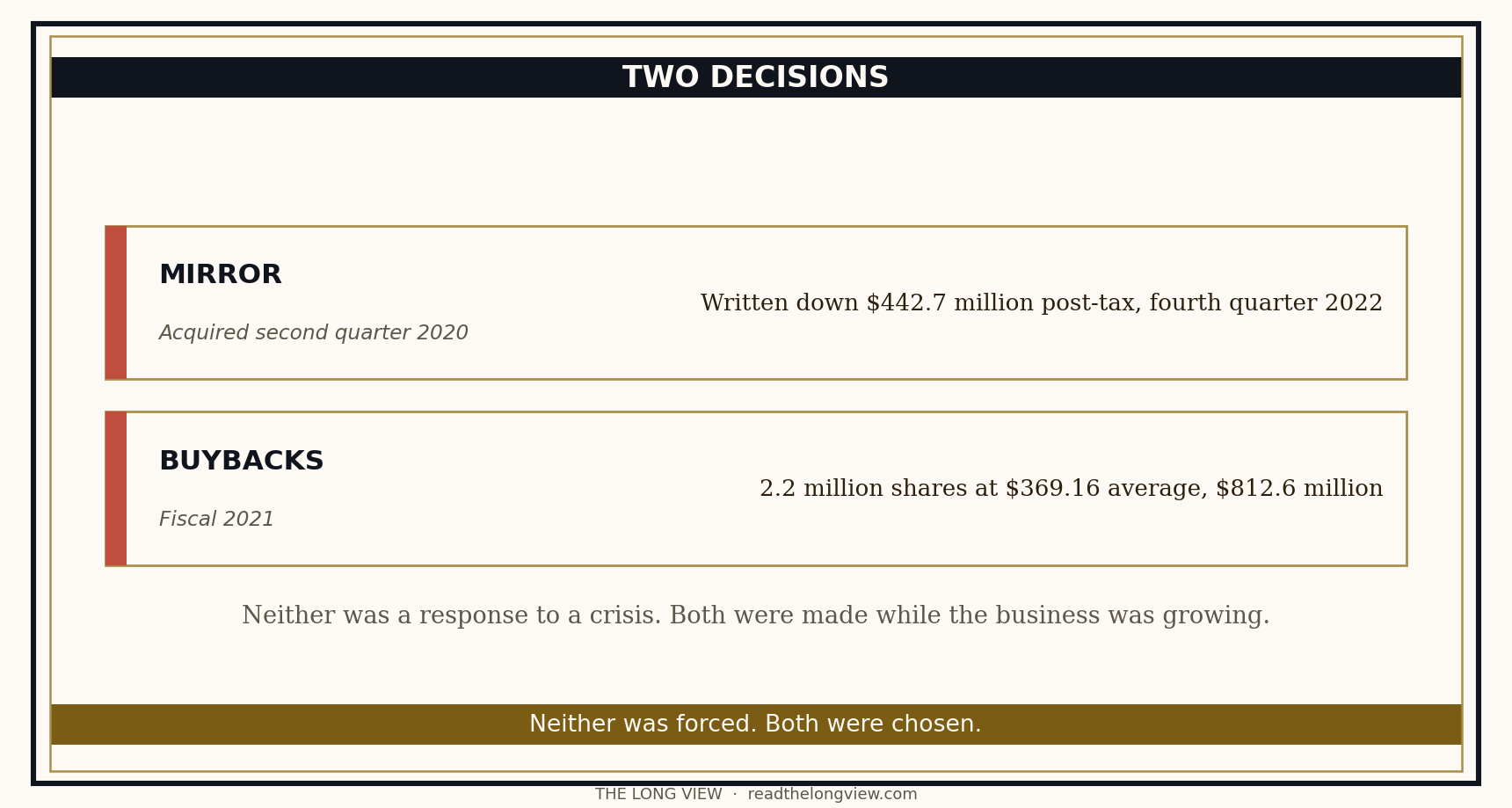
Two decisions, both large, both chosen rather than forced, both made by the same person.
An acquisition made in mid-2020, written down by $442.7 million after the company had itself disclosed the goodwill risk and its own limited experience in the area.
And $812.6 million spent on its own shares at an average price now more than three times the market.
Neither was a response to a crisis. Both were made from a position of strength, in years when the business was growing quickly and revenue was rising.
A record of growth and a record of allocation are different records, and this company has been graded almost entirely on the first one.
Tomorrow
What he said would happen, against what happened.
There is a specific public forecast attached to that acquisition, made at the time of purchase, and it can be checked against the outcome. Then the letter from the year the write-off landed, to see how the company described it in the document it wrote freely.
Not investment advice. The subscriber decides.