

Over the five fiscal years from 2021 to 2025, Lululemon bought 15.2 million of its own shares and paid about $4.62 billion for them. That works out at roughly $304 a share. The stock traded below $100 last week. Every one of those figures comes from the company’s own annual filings, and the average is not an estimate: it is the cost they reported divided by the share count they reported. I have spent this week testing how one management team handled money, and this is the part that took six annual reports to assemble, because it is the part no single year shows you.
Yesterday I said a record tells you how a team behaved but not whether the behaviour is still happening. Before I get to that, the record needs to be complete.
Why one year was not enough
On Wednesday I showed you a single number: 2.2 million shares bought during fiscal 2021 at an average of $369.16, for $812.6 million.
On its own that tells you very little, and I want to be careful about why.
Fiscal 2021 was an excellent year for the business. Revenue grew sharply, the brand was strong, and the shares had risen because the results deserved it. Nothing about the year was bad. What was expensive was the price paid for the stock, and any company can pay a high price once.
What a single year cannot tell you is whether that was a slip or a method, and the difference is everything. So I went back through the annual reports and pulled the same two figures out of each one: how many shares they bought, and what they paid.
Both numbers sit in the Financing Activities paragraph of the annual report, which is where a company explains what it did with cash. Divide the second by the first and you have the average price paid. It is the arithmetic from Wednesday, run ten times.
Eleven years, six filings
Here is what came out, with the implied average alongside.
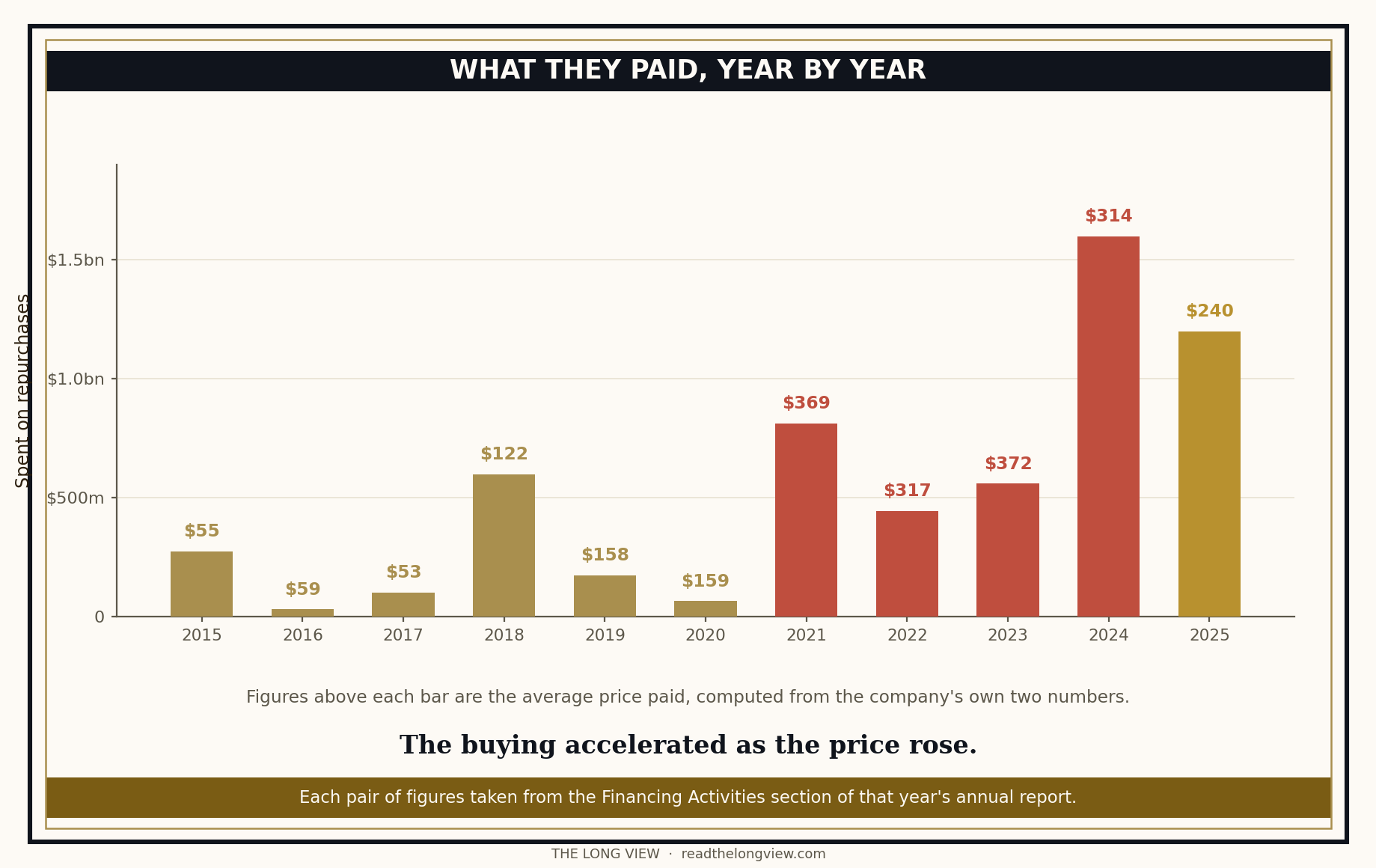
In fiscal 2015 the company bought 5.0 million shares for $274.2 million, about $55 each. In 2016, 0.5 million shares for $29.3 million, about $59. In 2017, 1.9 million for $100.3 million, about $53.
Then the price of the shares began to climb, and so did the buying.
In 2018, 4.9 million shares for $598.3 million, about $122. In 2019, 1.1 million for $173.4 million, about $158. In 2020, 0.4 million for $63.7 million, about $159.
In 2021, 2.2 million shares for $812.6 million. The company disclosed that average directly: $369.16.
In 2022, 1.4 million shares for $444.0 million, about $317. In 2023, 1.5 million for $558.7 million, about $372. In 2024, 5.1 million shares for $1.6 billion, about $314. In 2025, 5.0 million shares for $1.2 billion, about $240.
The company spent more on its own stock in fiscal 2024 than in any other year in the series, at a price close to six times what it paid in 2017.
And fiscal 2025 is the year worth stopping on. That was Calvin McDonald’s last full year. Americas comparable sales fell 3%. Operating margin fell 380 basis points to 19.9%. Earnings per share fell from $14.64 to $13.26.
The company spent $1.2 billion buying its own stock during it.
Three things about those numbers before anyone builds a case on them. From fiscal 2022 onward the reported cost includes commissions and excise taxes, so the implied price is slightly higher than the true purchase price. The share counts are rounded to a tenth of a million, which makes the smallest years imprecise, and I have marked those approximate. And fiscal 2025 comes from the most recent annual report and the full-year results release, both of which state the same figures.
The five years that matter
Take fiscal 2021 through 2025 together. Five full years, each from the same paragraph of an annual report.
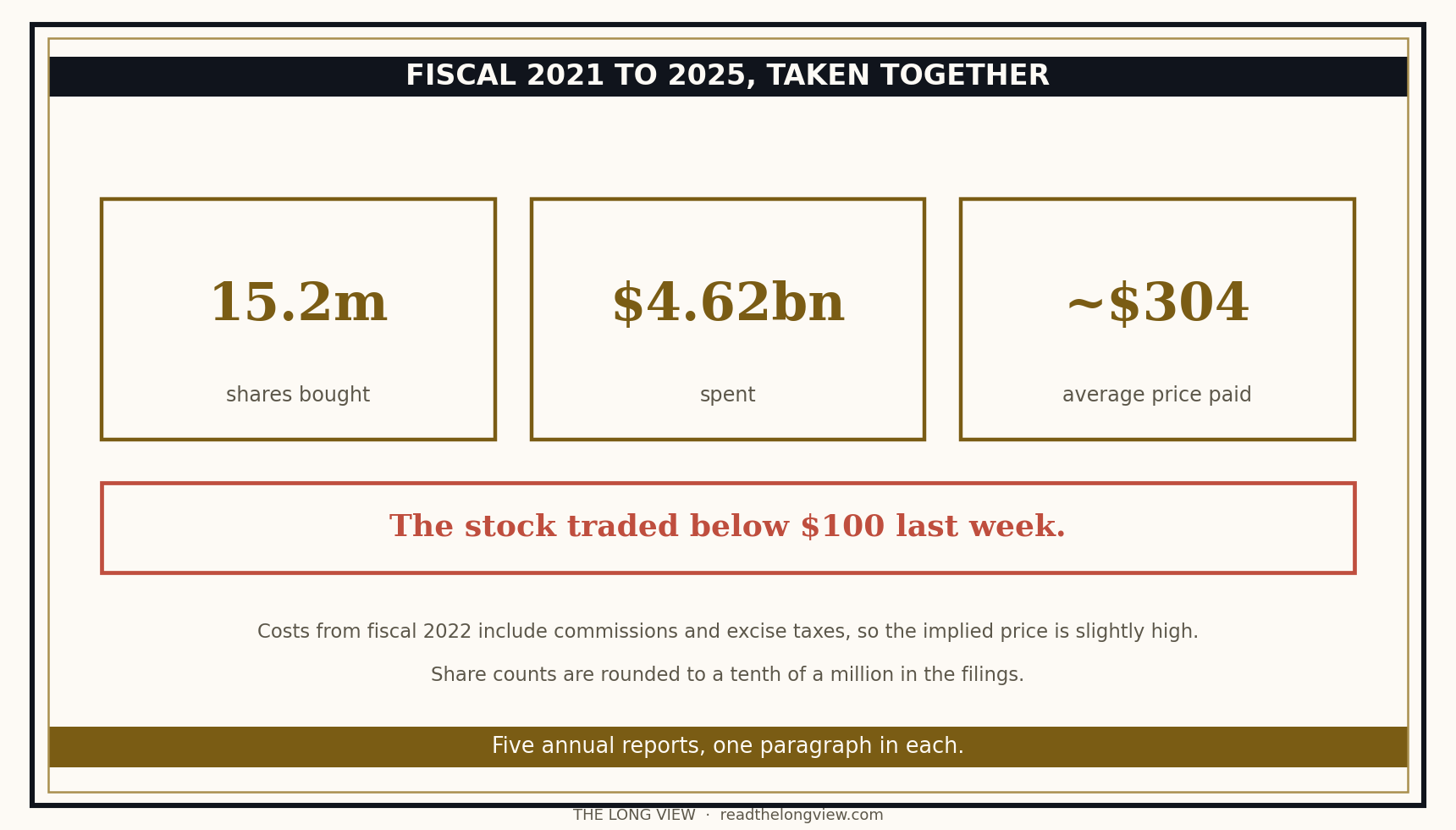
15.2 million shares. About $4.62 billion. An average of roughly $304 each.
The stock traded below $100 last week.
Buying accelerated as the price rose. That is the sentence, and it is arithmetic rather than opinion.
What I am not saying
I am not saying the shares were worth less than $304 when they were bought. Nobody can establish that from outside a company, and I would be pretending to knowledge I do not have.
In 2021 and 2024 this was a business growing revenue at double digits, throwing off cash, with a brand that looked untouchable. Even in 2025 revenue still grew 5%. Buying your own stock in that situation is a defensible decision and thousands of management teams make it.
Nor am I saying returning cash to owners is wrong. It is one of the five things a company can do with a dollar, and often the best one.
What I am saying
Last week I set out the test that decides whether a repurchase helped the owners who stayed. Two conditions, both required. The company has funds beyond what the business needs. And the stock is selling at a material discount to what it is conservatively worth.
The first condition looks comfortably met in the years I pulled: this was a business generating cash with a strong balance sheet throughout. The second is the one that gets skipped, and it is skipped in a specific way: a rising share price feels like confirmation that the business is working, which makes buying feel prudent exactly when it is most expensive.
A buyback is the only capital decision where the price is public before you make it. Which means it is the only one where getting the price wrong is a choice rather than an accident.
That is what a run of filings tells you and a single year does not. In 2023 the company paid its highest average price of the series, about $372. In 2024 it spent $1.6 billion, more than in any other year. In 2025, with the Americas already shrinking and margins falling, it spent $1.2 billion more.
What the interim team did with it
Calvin McDonald left at the end of January. Meghan Frank and André Maestrini have run the company since, and the quarter reported on 3 September is theirs.
In that quarter, the company repurchased 2.7 million shares for $330.0 million. That is about $122 a share, computed the same way.
It is the lowest average price paid since fiscal 2018, and it is still above where the stock traded a fortnight later.
In the same quarter they opened nine net new stores, ending with 825 against 784 a year earlier, and spent $149.7 million on capital projects. Then they cut the full-year outlook for the second quarter running.
On the call, the company said repurchases remain its preferred method of returning cash and that it expects 2026 buyback levels in line with 2025.
They committed to keep buying in the same breath as they told investors the business would be smaller than they thought.
The thing they did decline
One test from last week is what a management team says no to, and this one said no to something.
Net new store openings for the year were cut from 40 to 35. Pop-up stores were cut from 65 to about 40. Both were announced publicly with a reason attached.
That is a real mark in their favour and it belongs here. A team under pressure that reduces its own expansion plan is doing the harder thing, and I would rather report it than leave it out because it complicates the argument.
The bar
Which brings me to the person who started on Tuesday.
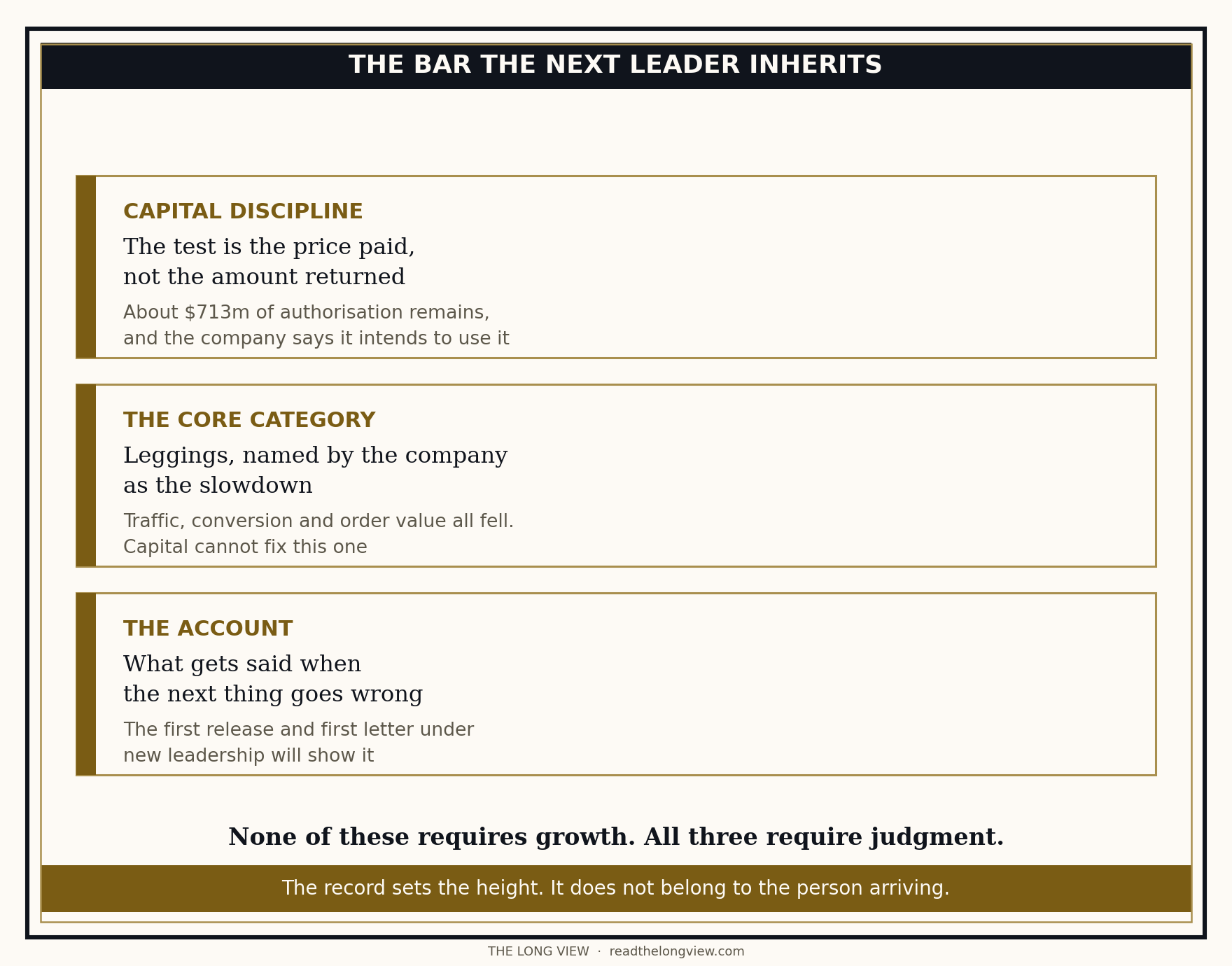
Heidi O’Neill has run this company for days. Nothing in this week’s evidence is hers, and grading her on it would be the error I warned about on Monday. What the evidence does is set the height of the bar, and the bar has three parts.
Capital discipline, measured by price rather than by amount. The company has roughly $713 million of repurchase authorisation remaining and has said it intends to use it. Whether that is a good decision depends entirely on what it pays. If the next annual report shows a large sum spent at a price that later looks high again, nothing has changed. That is checkable, it is dated, and it appears in the Financing Activities paragraph where the rest of this series came from.
The core category, which the company itself named. In the last quarter the company reported a greater-than-expected slowdown in core categories and named leggings specifically. This is not a cost problem or a store problem. Comparable sales in the Americas fell 12% because fewer people came in, fewer of those bought, and the ones who bought spent less. That is a product and brand problem, and it is the one thing on this list that cannot be fixed by allocating capital better.
The account, when the next thing goes wrong. Something will. What this week established is that the record of how this company describes its own failures is mixed: the write-off was disclosed as required, acknowledged when asked, and absent from the paragraph the chief executive wrote freely. The first letter and first results release under new leadership will show whether that changes.
What getting back to good actually requires
Not growth. Growth is what a recovery looks like from outside, not what produces it.
The business still generates cash: $589.3 million from operations in the first half, against $209.7 million a year earlier, with $1.4 billion in the bank. The gross margin is intact. This is not a company fighting for survival, which is precisely why the next few decisions are worth watching. Nobody is forced into anything.
A company with $1.4 billion in cash and a falling share price is a company whose management is about to reveal what it believes.
Tomorrow
The last piece.
What can and cannot be known about the incoming chief executive, where to look for the first evidence, and the documents that will settle it, with dates.
Not investment advice. The subscriber decides.