

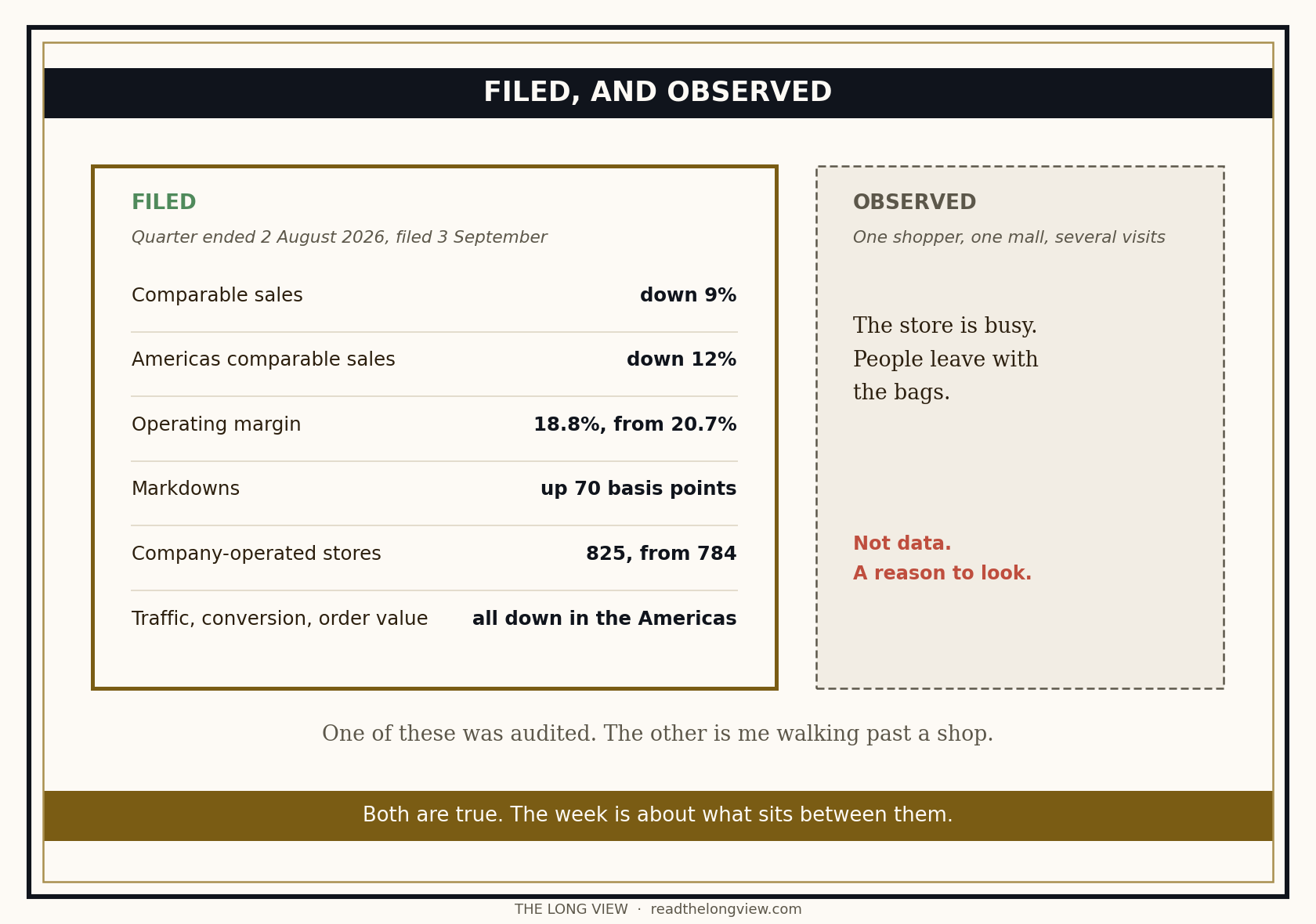
There is a mall near me with a Lululemon in it. I have been in and out of the shops around it several times over the last few months, and every time I pass that store it is busy, with people walking out carrying the bags. On Thursday the company reported a quarter in which comparable sales fell 9%, sales in the Americas fell 12%, and it cut its guidance for the second quarter in a row. The stock dropped about 18% and traded below $100 for the first time since 2018. It is down more than 40% this year and roughly three quarters from its high. Both of those things are true at once, and I want to spend this week working out what sits between them, starting with the test I spent all of last week describing.
Let me be careful about what my own eyes are worth here.
Last week I described a method. This week I run it.
I ended last week on a line I want to pick up this morning. Every position is a bet on people, whether you admit it or not, so the size of the bet should match the evidence you have on them.
That is easy to say. Getting the evidence is the work, and it is the part nobody watches anybody do.
Over five days last week I set out where that evidence lives. Where the retained cash went. What price they paid for their own stock. Whether they named the bad year in the year it happened. What they took while writing it. And what to do when the record is too short to contain a bad year at all.
So this week I go and get it, on a real company, in public, and you watch what it produces.
The company is Lululemon, and the timing is what makes it worth six days. Most reviews of a management team look at people who are in the job. Here the chief executive of the last eight years left in January, two interim leaders have been running it since, and the incoming one starts tomorrow morning. There is no team in place to grade.
That sounds like a reason to wait. I think it is the reason to look now, because a company between leaders is the only time you can see the whole record laid out and nobody has yet started rewriting it.
A method nobody has seen run is a diagram. This is the same method with a company attached and the results printed whether they flatter it or not.
One promise before any of it. Where a test I published last week cannot be run here, or runs and tells me nothing, I will say so. A week that only demonstrates the tests that happen to work is an advertisement, and you would be right not to trust the next one.
What I saw is a reason to look, not a finding
One person, one mall, a handful of visits. That is an anecdote. It is not a sample, it does not represent the country, and I have no idea whether the shop I walked past is typical of the 825 company-operated stores the company reported in its quarterly filing on 3 September.
Philip Fisher had a name for this kind of observation, which I wrote about last Monday. Scuttlebutt. You learn about a business from the people around it rather than only from what the company publishes, and the point of it is not to replace the filings. It is to notice when the outside picture and the official one disagree, because the disagreement is the finding.
Here they appear to disagree, and I bought Dillard’s and Ralph Lauren off the same instinct years ago. Being a customer gave me a reason to look at both. It did not give me the answer. The filings gave me the answer.
So the question this week is not whether I saw a busy store. It is what a busy store and a 12% decline can both be true at the same time.
There is at least one answer that requires nothing surprising. Comparable sales measure what the same stores sold against the same period a year earlier. A shop can be full and still sell less than it did last year, if people are buying fewer items, or cheaper ones, or if last year was busier still. Traffic and spending are different measurements and only one of them is in the release.
That is a possible explanation, not a demonstrated one, and I am not going to pretend I have established it from a car park.
What the company reported on Thursday
These are the company’s own figures, from the quarterly report it filed with the Securities and Exchange Commission on 3 September and the call held the same day.
Net revenue fell 4%, or 5% in constant dollars, to $2.4 billion from $2.5 billion. Global comparable sales fell 9%, or 10% in constant dollars. In the Americas, comparable sales fell 12%. International comparable sales fell 3%, with revenue there up 4%.
Earnings per share came in at $2.92 against $3.10 a year earlier. That figure beat what analysts expected and it is lower than last year, which are both true at the same time and worth holding onto.
Then the numbers that moved the stock. The company cut its full-year outlook for the second consecutive quarter, to revenue of $10.35 to $10.5 billion, a decline of 5% to 7%, from a prior range of $11 to $11.15 billion. Full-year earnings per share guidance came down to $9.48 to $9.73 from $10.95 to $11.15. Third-quarter revenue is guided to fall 10% to 11%.
Operating margin was 18.8%, against 20.7% a year earlier. That figure includes $134.5 million of tariff refunds. Take them out and operating income is roughly $319 million on $2.42 billion of revenue, about 13.2%, which is more than seven points below last year.
The stock fell around 18% and traded under $100 for the first time since 2018.
Three more from the same disclosures, which matter more than they first appear.
Markdowns rose 70 basis points in the quarter, and the company expects them up again in the third quarter. A markdown is a price reduction, and a brand charging a premium for a logo does not usually need more of them.
The company ended the quarter with 825 company-operated stores, up from 811 at the start of the fiscal year and 784 a year earlier. It opened stores through a half in which sales at existing stores fell 9%.
And this, which is the line I keep returning to. The filing says the decline was driven mainly by reduced traffic, lower conversion, and lower average order value in the Americas.
Read that again slowly. Fewer people came in. Of the ones who came, fewer bought something. Of the ones who bought, they spent less than they used to.
Three separate things went wrong at the same time, at three separate points in the same transaction. That is not one problem. It is the whole funnel.
Nor is it confined to a channel or a country. Digital revenue fell 6%. United States revenue fell 8% and Canada fell 11%. Women’s revenue fell 4% and accessories fell 13%. China Mainland revenue rose 4% in reported dollars.
I am not going to tell you whether the price is attractive. I have not done that work and it is not what this week is about.
Why I am spending the week on management
Because a falling price raises a question that price cannot answer.
A brand this strong does not usually stop working overnight, and a business doing $10 billion of revenue with a 60% gross margin is not a broken machine. Something is wrong, and the range of possible somethings is wide: the product, the competition, the consumer, the pricing, the execution, or the people deciding all of it.
Management is one test among several. It is not the whole analysis and I would be misleading you to present it that way. But it is the test I spent last week building, and it happens to be the one that matters most when a company has to change direction, because changing direction is a decision and decisions are made by people.
There is one more reason, and it comes from the company itself. Asked on Thursday’s call about weakness in China, interim co-chief executive Meghan Frank attributed it to brand noise affecting sentiment and a softer Tmall shopping event, rather than to macro issues.
That is management saying this is not the industry and not the consumer. It is a claim about their own brand and their own execution, which is a claim I can test.
And this company has an unusual amount of management to look at.
Three records inside eight months
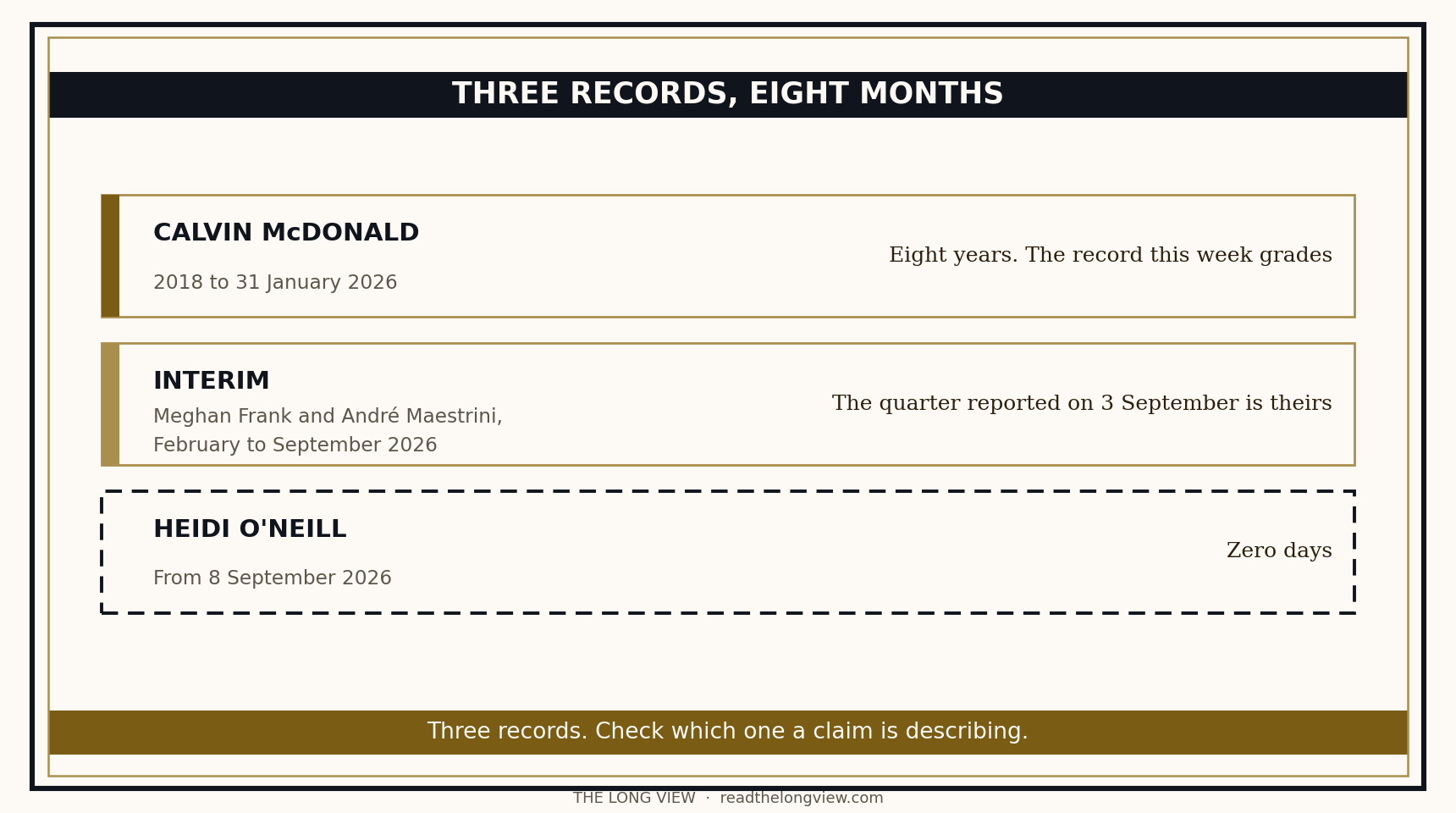
This is the thing to hold onto, and it is a habit worth applying to anything written about this company. When you read a claim about Lululemon’s management, check which of the three records it is describing, because they are separate and they answer different questions.
Calvin McDonald ran the company from 2018 until 31 January 2026. Revenue went from $2.6 billion to $10.6 billion under him. He left, and no filing I have seen explains why, which is a sentence I will come back to on Wednesday.
Meghan Frank and André Maestrini have run it as interim co-chief executives since. Thursday’s quarter is theirs. So is every decision made about capital in the last seven months.
Heidi O’Neill becomes chief executive tomorrow, 8 September. She spent more than twenty-five years at Nike, most recently as president of consumer, product and brand. She has run this company for zero days.
Three people, three records, and they answer different questions. Grading O’Neill on the last eight years is a category error. Grading the company on her Nike years is the opposite one. And the interim period is a real record in its own right. It contains the most recent decisions anyone has made with this company’s money, and it is the one I have seen least written about.
Last Monday I wrote that a projection is a claim about people who have not yet done the thing, and a record is a claim about people who already did. Two of these three have records. One does not, yet.
Tomorrow
Whether this is a Lululemon problem or an industry problem.
Last Monday I wrote that a long record can be luck riding a good industry, and that outcomes can be borrowed from a rising tide. That rule has to work in both directions. A bad record can be a bad industry, and if I skip that check, everything I write for the rest of the week is unfalsifiable.
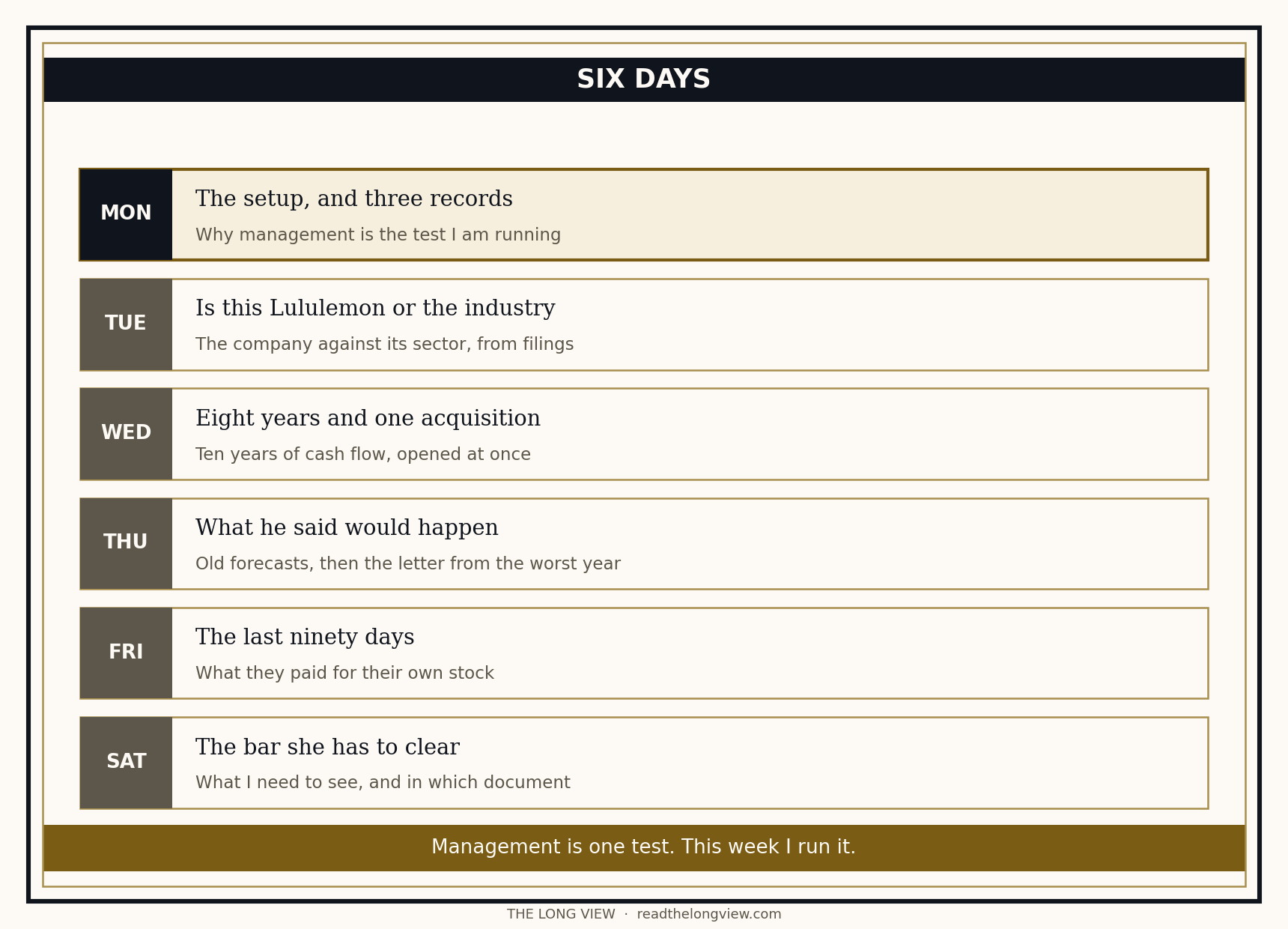
So before I grade anybody, I put this company against its sector, using competitors’ own filings. The rest of the week is in the card above, and I will use notes throughout for figures that would otherwise pack the articles.
What this week is not
It is not a valuation. I have not done that work and I will not blend it into this one, because a low price has a way of making a management team look better than the evidence supports, and I would rather run the two separately and see whether they agree.
It is not a recommendation, and it will not become one by Friday.
And it is not a verdict on a brand. I saw a busy store. That observation survives everything I am about to write, and so does the 12% decline.
A great brand and a capable management team are different things, and a company can have one without the other in either direction.
Not investment advice. The subscriber decides.