

The Long View · Tuesday, 18 August 2026 · IBM, part two, the bar it has to clear
Disclosure: the author has held IBM since March 2020 at an average cost of $113.57 and reinvests the dividend. Independent dividend analysis contributed by Dave Ahern of Dividend School. This is analysis and a bar set before results, not a recommendation.
Yesterday’s piece was the easy one to write, because it had a happy ending. This one is harder, because it refuses to let that happy ending decide anything. The most dangerous thing a long-term investor can do is let a stock’s past generosity buy it a permanent place in the portfolio. A holding earns its spot every year on its current merits, not on what it did for you five years ago. So today I set the bar IBM has to clear, in public, and I grade it against those exact lines when it reports, no more gently for the fact that I own it and it has treated me well.
Why the bar matters more now
IBM is not the company I bought. The 2020 business was a deeply cheap turnaround with a fortress dividend and a new cloud strategy. Today it is a hybrid-cloud and enterprise-AI company, and it has had a punishing year that is worth walking through, because the year itself teaches the lesson.
IBM entered 2026 near its highs, above $300 a share, after a strong 2025 that saw the stock climb roughly 35 percent. Then it took two separate blows. In February, it fell about 13 percent in a single session after a competitor announced an AI coding tool aimed squarely at the legacy-system modernization work that is part of IBM’s core consulting business, a real threat to a real revenue line. Then in July, it fell about 25 percent in a day, its sharpest single-session drop on record, after warning on second-quarter results, weak mainframe sales and a cut to full-year revenue-growth guidance. From above $300 to around $236 now, the stock is down roughly 19 percent on my cost basis for the year, and it sits well off where it started. Shareholder law firms opened the kind of investigations that routinely follow a sharp drop; that is a matter of public record, and I note it plainly and draw no conclusion, because there is nothing yet to conclude.
Here is why that year-to-date decline is not a digression but the whole point. IBM entered 2026 expensive, priced near the top of its range with little margin of safety built into the price. So when the two shocks came, there was no cushion to absorb them, and the stock fell hard and fast. That is the exact mirror of my 2020 purchase, where a rock-bottom price meant bad news had far less room to hurt. The year you are watching, in real time, is a live demonstration of what it looks like to own a good company without a margin of safety when trouble arrives. Which is precisely why the price today, and the bar the business now has to clear, deserve a hard look.
I did not sell into that drop, and to explain why, I have to tell you what kind of investor I am. Warren Buffett put it best, in his 1996 letter to shareholders: if you aren’t willing to own a stock for ten years, don’t even think about owning it for ten minutes. That is not a slogan to me, it is the whole posture. When I buy a business, I buy it as something to hold through good years and bad, crashes and boring stretches, on the assumption that I will own it for a decade or longer. An investor who thinks that way does not sell a good company because it had one ugly quarter, any more than a farmer sells the farm because it did not rain this season. A single disclosure about deferred deals is precisely the kind of near-term noise that a ten-year owner has to be able to sit through.
But, and this is the part that keeps the Buffett quote from becoming an excuse, sitting through noise is not the same as ignoring the signal. Owning for ten years does not mean owning blindly for ten years. It means holding through short-term turbulence while still checking, with clear eyes, whether the ten-year story is intact. The disciplined response to a 25 percent drop on a stock you intend to own for a decade is neither to panic and sell nor to shrug and look away. It is to define, precisely and in advance, what the next report has to show for the long-term thesis to still hold. So let me do that.
What margin of safety looks like, then and now
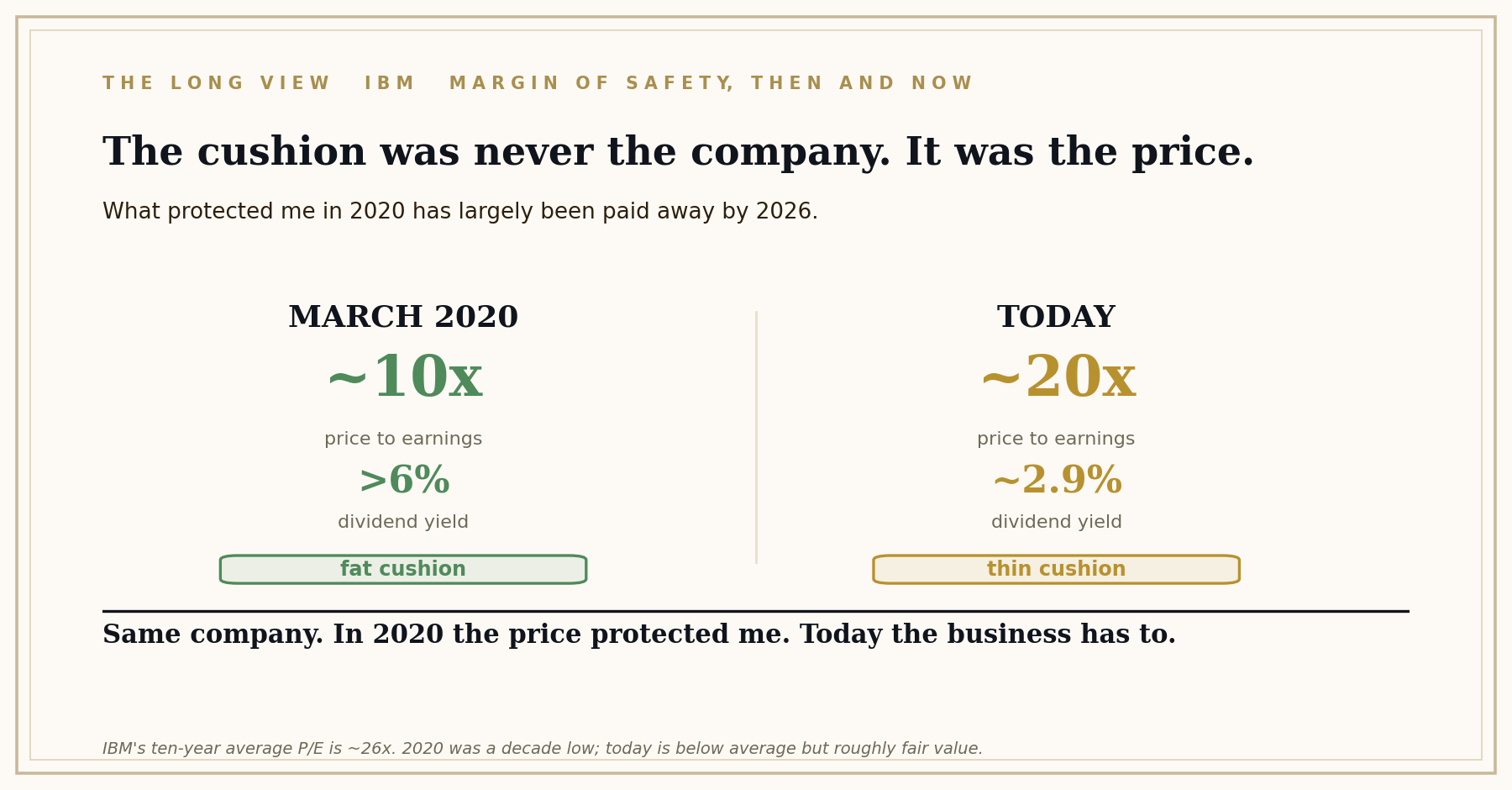
Before I set the bar, look at what has changed about the price, because this is the heart of it. I started buying IBM on March 23, 2020, the worst day of the COVID crash, at $93.49 a share, and I kept buying, which brought my average cost to $113.57. At that first purchase I was paying about ten times earnings, with a dividend yield above 6 percent that was well covered. Against the company’s own ten-year average of around twenty-six times earnings, that was an enormous margin of safety. The price was so low that I did not need much to go right, and when one of my reasons failed, the cheapness absorbed the blow. In 2020, the price protected me.
Today is a different picture, and honesty requires saying so plainly. IBM trades at roughly twenty times trailing earnings, with a dividend yield near 2.9 percent. That is still below its historical average, and by at least one common measure the stock looks roughly fairly valued, neither expensive nor a bargain. This is the crucial lesson, and it is the same company teaching it: the margin of safety was never a property of IBM. It lived in the price. At ten times earnings with a 6 percent yield, IBM offered a fat cushion. At twenty times with a 2.9 percent yield, that cushion is thin. The business is arguably better today, more focused, more profitable, but the protection I enjoyed in 2020 has largely been paid away by a higher price.
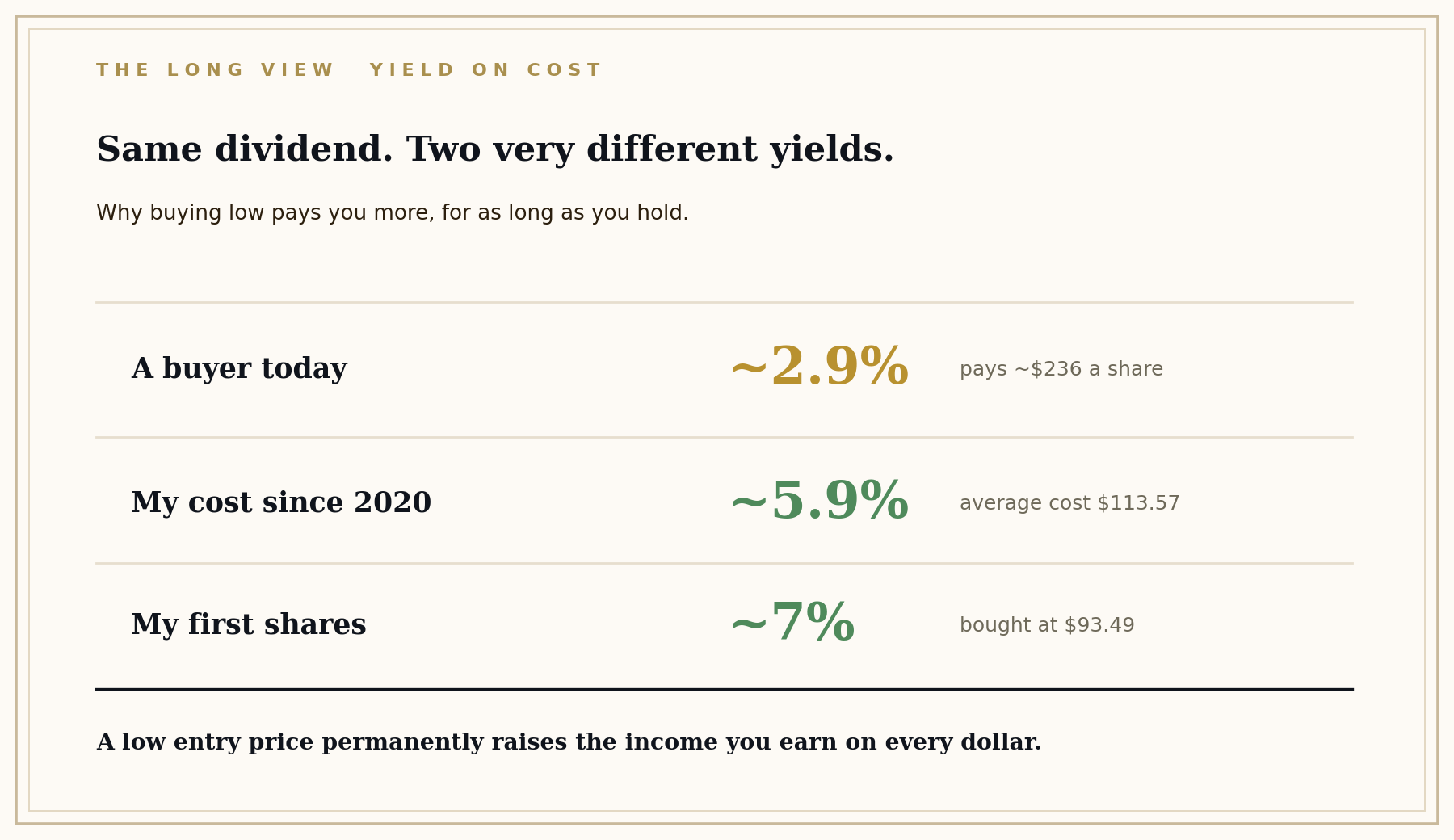
There is one more piece of this worth teaching, because it surprises people and it is the quiet reward for buying low. You will notice IBM’s yield went from above 6 percent in 2020 to about 2.9 percent today, and it is worth understanding why, because it is not what it looks like. The yield did not fall because IBM got stingy. The dividend rose over those years. The yield fell because the price more than doubled, and yield is simply the dividend divided by the price. When the bottom of that fraction grows faster than the top, the yield shrinks, even as the payout climbs. A 2.9 percent yield today and a 6 percent yield in 2020 can be the very same dividend, seen at two very different prices.
But here is the part that rewards the patient buyer. My yield is not 2.9 percent. That is the yield a new buyer gets at today’s price. My yield is measured against what I paid, which is called yield on cost, and against my $113.57 average it is closer to 5.9 percent, and against my first shares at $93.49 it is around 7 percent. Same dividend, but because I bought at a low price, I locked in a high yield that rising prices can never take back. This is one of the most underappreciated rewards of buying with a margin of safety: a low entry price does not just protect you on the downside, it permanently raises the income you earn on every dollar you invested, for as long as you hold. New money buys IBM’s dividend at 2.9 percent. My money, bought in the panic, still earns almost twice that.
Here is why that matters for what comes next. When the price gives you a wide margin of safety, the price does the protecting, and the business can stumble without ruining you. When the price is merely fair, the protection has to come from somewhere else: the business executing. At today’s valuation, I am no longer being handed a cushion. I am paying a fair price and trusting the company to deliver, which means the burden shifts from the price to the performance. That is precisely why the bar matters more now than it did when I bought. In 2020 I could be patient and let a cheap price carry me. Today, IBM has to earn it. So here is what earning it looks like.
The bar for October
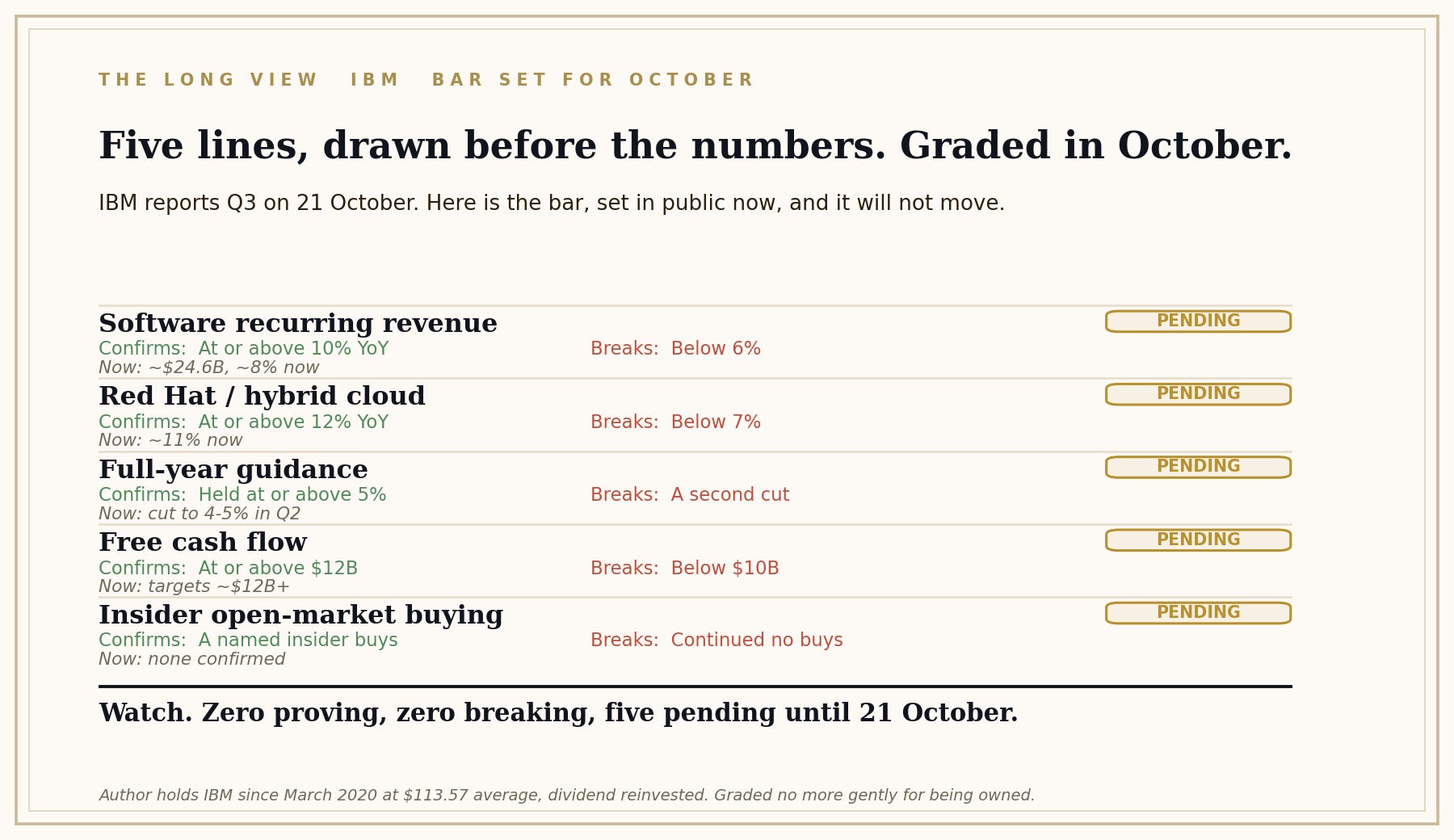
IBM reports its next quarter on October 21. Here are the five lines, set before the numbers exist. Each has a level that confirms the thesis and a level that breaks it.
Software recurring revenue growth. IBM’s software segment carries annual recurring revenue, or ARR, the annualized value of its subscription contracts, currently around $24.6 billion growing about 8 percent a year. Growth at or above 10 percent confirms the compounding lock-in the whole story depends on. Growth below 6 percent signals the stickiness is eroding.
Red Hat growth. Red Hat, the hybrid-cloud engine, has been growing around 11 percent, with OpenShift’s recurring revenue near $2.2 billion. At or above 12 percent confirms enterprises are still adopting the platform. Below 7 percent signals it is being commoditized or pushed aside by bigger cloud rivals.
Full-year guidance. IBM already cut its constant-currency revenue-growth guidance, the growth rate stripped of currency-exchange swings, from above 5 percent to a range of 4 to 5 percent this year. Holding at or above 5 percent confirms. A second cut, or new caveats about enterprise spending, would be a serious credibility problem.
Free cash flow. Free cash flow, the cash a business generates after funding its operations and investments, is what pays IBM’s dividend and services its debt. IBM targets roughly $12 billion or more for the year. At or above $12 billion confirms the cash engine is intact. Tracking below $10 billion annualized signals deterioration.
Insider buying. After a 25 percent drop, the cleanest signal of conviction would be a named insider buying shares in the open market with their own money. Continued absence is not damning, but a purchase would say something no press release can.
Five lines. All pending until October 21. That is the bar, set in public, today.
The dividend I have to keep honest about
The dividend is why I have been content to hold through a bad year, so it is exactly the thing I have to watch most carefully, because comfort is where discipline goes to die. IBM yields around 2.9 percent today, has raised the payout for about thirty consecutive years, and I reinvest it every quarter, which means this year’s decline has quietly been buying me cheaper shares the whole way down. That is the good side. But a long streak is a point of pride companies will stretch to protect, and the honest question is whether it is funded by cash the business earns or partly by borrowing, especially with long-term debt around $56 billion after recent acquisitions.
This is where an outside view matters, because I am too invested to trust my own. Dave Ahern of Dividend School gave me his read, and on the forward question it is reassuring with one flag worth teaching in full, because it applies to any dividend stock you will ever own.
First, the reassuring part. Dave checks three things, and IBM passes all three. The free-cash-flow payout, the share of actual cash the dividend consumes, sits well below his 70 percent threshold for concern, so the cash covering the dividend has real room. Net debt is about 2.9 times EBITDA, a company’s earnings before interest, taxes, depreciation, and amortization, which is a standard way to size debt against a rough proxy for cash earnings, and 2.9 times is a level he considers fine. And interest coverage, how many times over the company’s earnings can pay the interest on its debt, is around 6 times, which he considers good. Together those say the dividend is not being squeezed by the debt today.
Now the flag, and this is the part I want every reader to carry away, because it is the single most useful early-warning sign for a dividend. Dave’s caution is that IBM’s dividend has been growing slightly faster than its free cash flow. Here is why that matters. A dividend is paid out of cash. The room between the cash a company generates and the dividend it pays is the safety cushion. If the dividend grows faster than the cash behind it, year after year, that cushion narrows, slowly, quietly, in a way that looks fine every single year right up until it does not. The payout ratio creeps from comfortable toward stretched, and one bad year can then turn a proud streak into a hard choice between cutting the dividend and borrowing to pay it. It is not a problem when the coverage starts wide, as IBM’s does. It becomes a problem through repetition, a percent or two a year, until the margin is gone.
So here is how you check this yourself on any dividend stock, and it is simple. Find the growth rate of the dividend over the last five years, and find the growth rate of free cash flow over the same period. If free cash flow is growing at least as fast as the dividend, the cushion is holding or widening, and the dividend is being earned. If the dividend is consistently outgrowing the cash, the company is writing checks its business is not yet backing at the same pace, and you are watching a cushion deflate. It does not mean sell. It means watch, and know the number that would turn a watch into a worry. For IBM, that number is free cash flow. If October shows it holding at or above roughly $12 billion, the dividend’s cushion has room and the streak is funded by the business. If it slips toward $10 billion while the dividend keeps climbing, the gap Dave flagged starts to bite, and the safest dividend on my holdings becomes one I have to question. That is the whole discipline of dividend safety in one comparison: is the cash growing as fast as the promise.
What would truly change my mind
Here is the part that keeps this honest. It is easy to say you will grade a holding strictly. It is hard to say, in advance, what would make you let it go. So: if IBM cuts guidance a second time in the same year, if software and Red Hat growth both fall toward their break levels, or if free cash flow drops far enough to put the dividend’s coverage in question, then the thesis I have held since 2020 is weakening in a way that price alone cannot excuse, and I have to treat it as a business in trouble rather than a winner having an off year. I am not predicting that. I am telling you the conditions under which I would change my mind, because an investor who cannot name those conditions is not holding a position, they are married to it.
The through-line from yesterday
Part one was about how a low price forgave a mistake. Part two is about not needing that forgiveness again through carelessness. In 2020 the margin of safety was enormous, ten times earnings, a 6 percent covered yield, and it made me hard to hurt. Today the price is not that, the easy protection is gone, and what replaces it is discipline: a bar set in public, a dividend watched by someone without my attachment, and a written list of what would make me sell. That is how you hold a long-term winner without becoming its hostage.
Run any company through the Stock Story Firewall, free, at firewall.readthelongview.com. Subscribers get the Watch cards, the Evidence tool, and the full Research Tracker, including every bar we set and every grade we publish.
The stock has been good to me for five years. That is exactly why I have to be hardest on it now. In October, IBM reports, and I will grade it against the five lines above, and find out whether the company I own on its history is still the company I would own on its merits.
Not investment advice. The subscriber decides.