

In 1954 a twenty-nine-year-old soap salesman took over a bankrupt television station in Albany. He had never worked in broadcasting. Over the next four decades he turned a dollar into two hundred of them, beating not only the market but the entire media industry he had walked into knowing nothing about. I have spent four days telling you to demand a decade of evidence before trusting anyone with your money, and he had none of it when he started. So this is the piece where the rule meets its exception, and where I have to say plainly what a business and its price have to be before I will hand money to people I cannot check.
Four days of tests, and each one needed a decade of decisions to run on. Plenty of companies have not existed that long, and the ones I find most interesting are often the youngest ones. Treating that as a closed question would be a lie about what I do, because I keep looking at them.
Start with what does not disqualify someone, because this is where the thinking usually goes wrong.
The wrong test is the industry
The soap salesman was Tom Murphy, a product manager at Lever Brothers, and the job came through a friend of his father’s. He took it with no broadcasting experience of any kind.
Seven years later he needed someone to run operations and hired a man from the new products division at General Foods, who had been testing Jell-O on his wife to work out what would sell, and who had never set foot inside a television station.
Murphy and Dan Burke went on to build Capital Cities and to buy ABC, a company several times their size, for $3.5 billion.
Here is the part that matters for our purposes. By William Thorndike’s accounting in The Outsiders, one dollar invested when Murphy became chief executive in 1966 was worth $204 by the time he sold to Disney in 1996. That is a 19.9% annual return against 10.1% for the S&P 500.
And against 13.2% for an index of leading media companies.
That second comparison is the one to hold. On Monday I warned that a long record can be luck riding a good industry, and that outcomes can be borrowed from a rising tide. Broadcasting was a rising tide. Murphy beat the tide by more than six points a year for three decades, which is the version of the evidence that survives my own objection.
A man with no experience in the business outperformed the people who had spent their lives in it. Whatever he lacked, it was not the thing that mattered.
So new to the sector cannot be the disqualifier. If it were, it would have caught the chapter that opens Thorndike’s book.
The right test is whether they have ever decided anything
The disqualification is not the wrong industry. It is the absence of any record of deciding.
You would not hire a head coach who has never coached. Not because he came from another sport, but because nobody has ever watched him choose a play with the game on the line.
Being excellent at the thing is not evidence of being good at deciding where the money goes. A founder whose entire record is technical achievement has demonstrated the first and nothing about the second.
So three questions, none of them about their sector.
Have they ever had to say no to growth that was available to them. Have they run anything through a contraction rather than an expansion. Have they built something and lived with the consequences of their own decisions rather than inheriting someone else’s.
What does not count is the resume. A resume is a list of rooms someone was in.
Murphy and Burke were explicit about this and applied it as employers rather than only as a philosophy. Thorndike records that both men preferred intelligence, ability and drive over direct industry experience, having had the benefit of that judgment themselves. Bill James was thirty-five with no radio experience when he was handed WJR. Phil Meek came from Ford at thirty-two with no publishing background to run a newspaper. Bob Iger was thirty-seven and had spent his career in broadcast sports when he was given ABC Entertainment.
They were not gambling on inexperience. They were declining to treat industry tenure as the qualification.
The exception, and why it is real
There is a version where I back an unproven team anyway, and it rests on something Buffett wrote in 1980.
He observed that with few exceptions, when a manager with a reputation for brilliance takes on a business with a reputation for poor fundamental economics, it is the reputation of the business that stays intact.
That line gets quoted as a warning, and it is one. Read the other direction it is a permission slip. If the economics of a business dominate the quality of the people running it, then an extraordinary business asks less of its managers than a mediocre one does. The moat does work the manager would otherwise have to do.
That is the honest basis for buying a wonderful business with an unproven team. It is the same asymmetry Buffett spent decades exploiting, pointed at a different variable.
It has two limits, and the limits are where I think the current enthusiasm is thin.
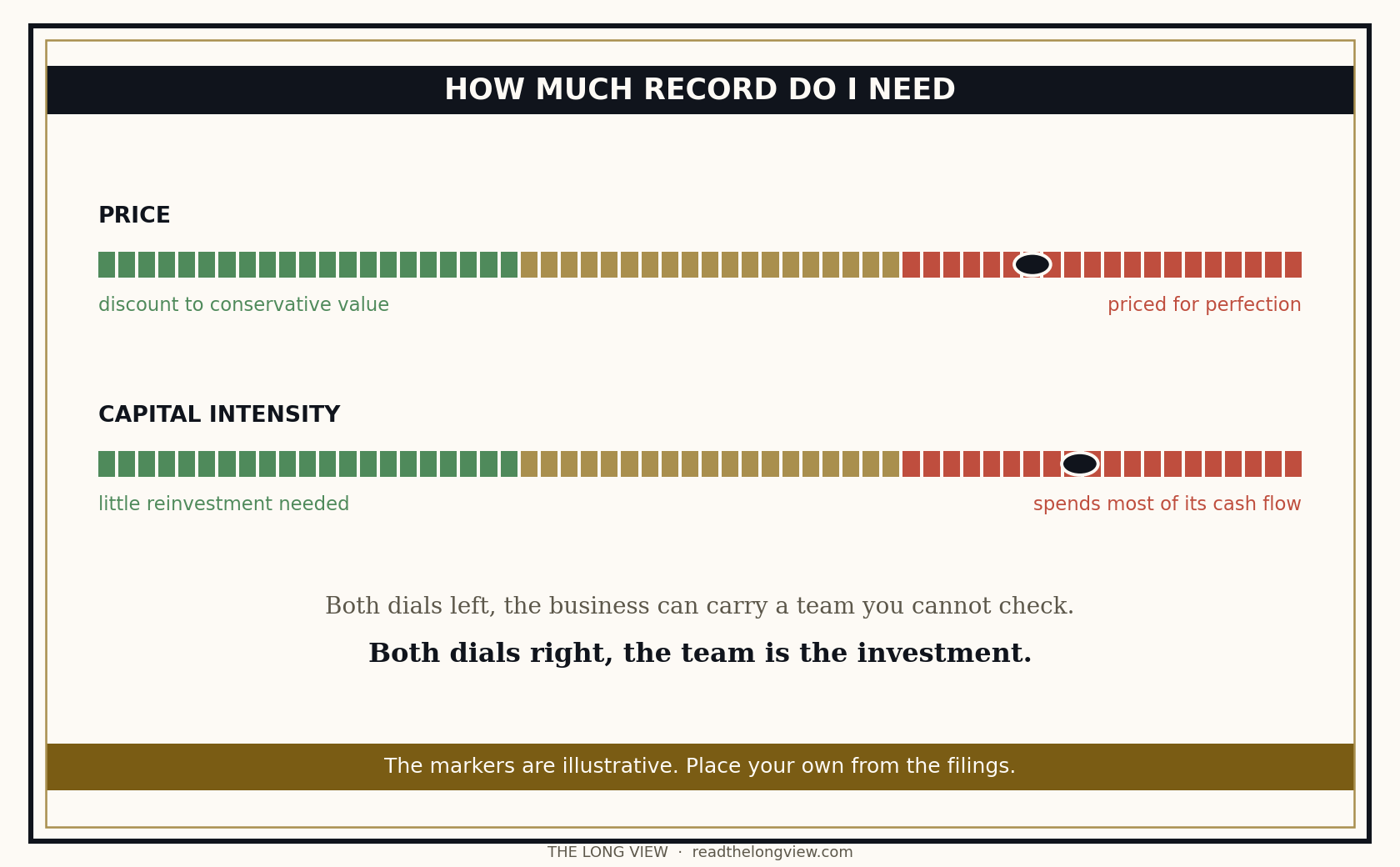
Limit one is the price
Margin of safety is the gap between what you pay and what a business is conservatively worth. In practice that gap is your budget for being wrong.
Management error is one of the things the budget pays for. Buy at a real discount and the team can make an expensive mistake while you still do acceptably. Buy at a price that already assumes everything goes right and there is no budget left, so the first bad allocation decision comes straight out of your return.
Margin of safety is what pays for management mistakes. At a price that requires perfection you are not buying a business, you are underwriting people you have never met.
So price does not only set the return. It sets how much management record you need before acting at all.
Limit two is how much cash the business must spend
This is the limit that gets skipped.
The 1980 logic works cleanly for a business that produces cash and needs little reinvestment to hold its position. There, allocation happens at the edges and the moat does the compounding.
A business that must deploy an enormous amount of capital every year is a different animal. Allocation is not a side activity a strong moat absorbs. It is the main event, and the company you own in ten years is close to the sum of what management chose to build.
You cannot route around a manager whose principal job is spending.
Which is why the two dials belong together. Cheap enough, and undemanding enough of capital, and the business can carry a team you cannot check. Priced for perfection and consuming capital at scale, and the team is the investment, whatever the product happens to be.
I am not reprinting the technology capital spending figures I gave you on Monday. They came forward from an earlier series and I have not re-sourced them this week, which under my own standard means they do not go in again. Look them up in current filings for whichever company you are weighing, and place it on the second dial yourself. The structure is the point, and the structure is checkable.
Every management team has a hidden assumption
I built the Firewall to name the single hidden assumption a stock price depends on. Not the ten things that could go wrong. The one thing that, if false, breaks the case.
It took me until this week to see that management teams have one too.
To be running a large public company there has to be a story. Not a marketing story, a story the team tells itself about why it is the right group for this problem at this size. Underneath it sits one assumption carrying the load.
For a founder whose company grew into something enormous, it is often that the hard part was the invention and the capital deployment is a detail. For an operator brought in from a mature industry, it is the discipline that travels. For a team in a capital-hungry business, it is frequently that money will keep being available on the terms they have grown used to.
Name it, and you can treat it the way we treat a price assumption. Set the confirm line and the break line before the news arrives, so you are reading evidence rather than reacting to it.
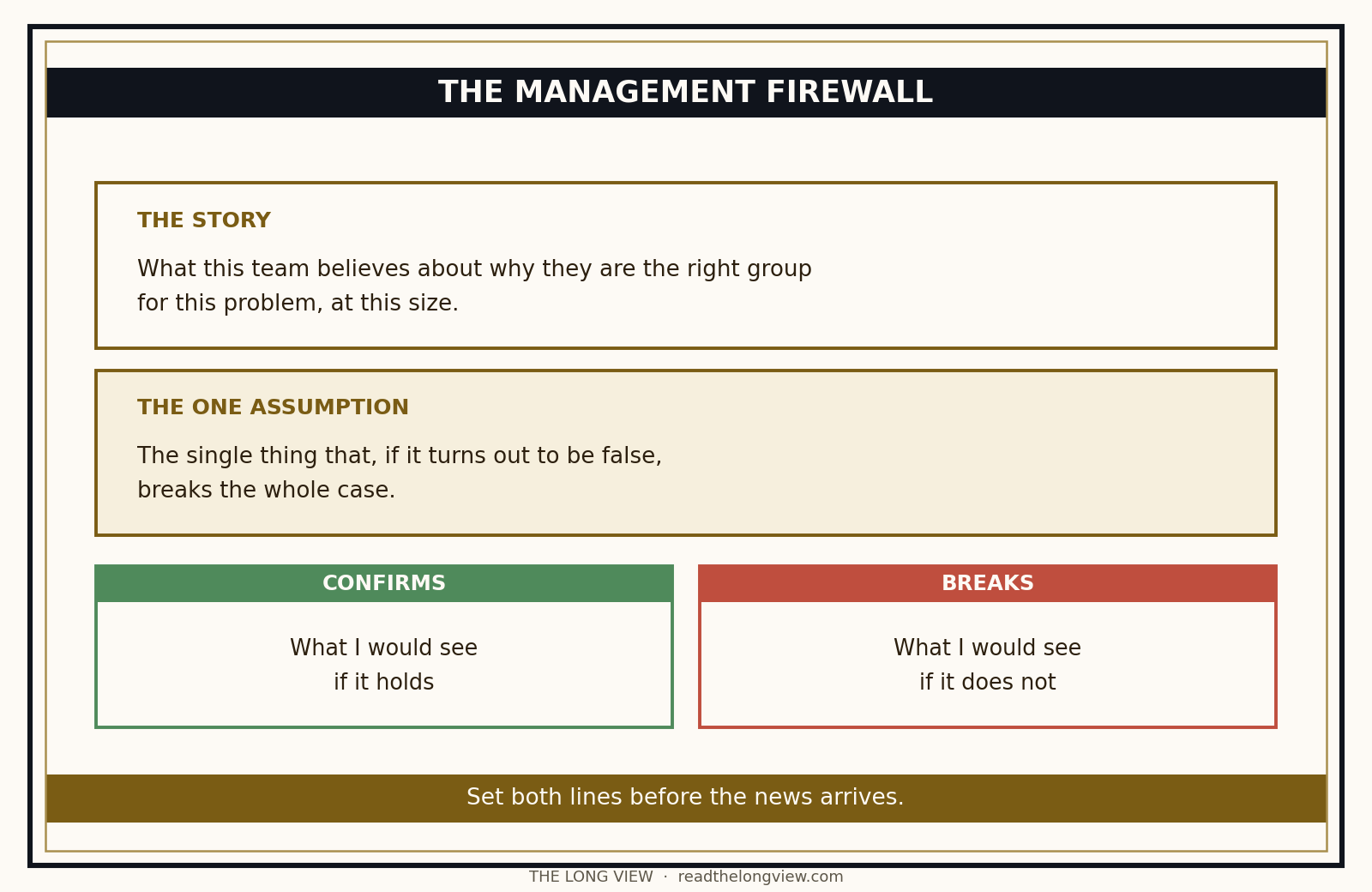
The question is not whether management is good. It is what would have to be true about these people for this to work, and what you would see if it stopped being true.
The one that started this
I graded Nebius, found a business growing around 454% a year, and could not buy it. I said the price was the reason.
Working through this week, I think the price was half my reason and it was the half I could articulate at the time. The other half is that at a price demanding perfection I needed a management record long enough to believe perfection was achievable, and I did not have one to read.
That is a statement about what I can verify, not a criticism of anyone running that company. I could be wrong about it. The point of writing the standard down now is that next time the reasoning is on paper before the decision instead of after.
The scorecard
Five days, five questions, and they run on any company in an afternoon.
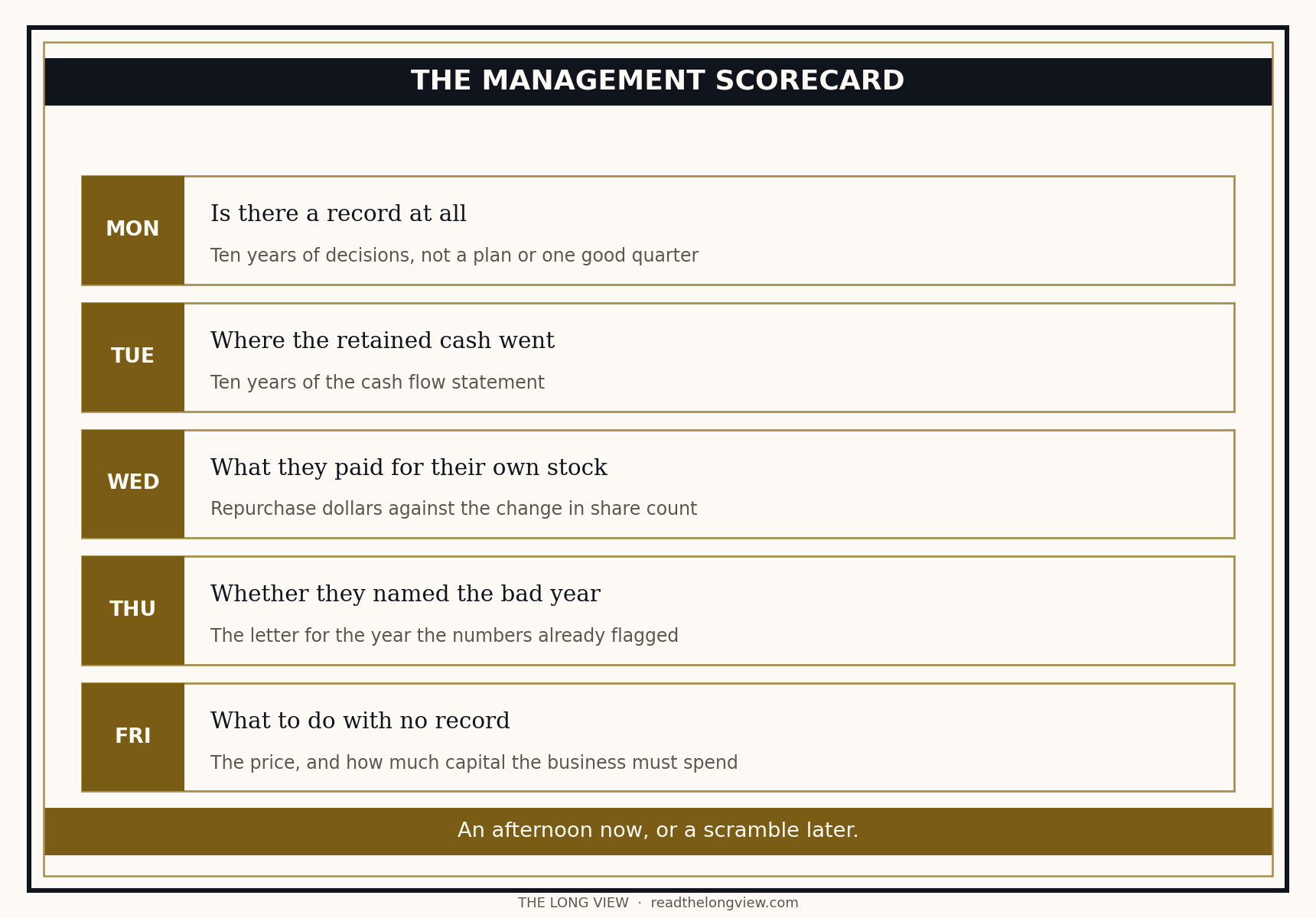
Where the retained cash went, from ten years of the cash flow statement. What price they paid for their own stock, from the repurchase dollars against the change in share count. Whether they named the bad year, from the letter for the year the numbers already told you was bad. What they took while writing it, from the proxy. And when there is no record at all, what the business and the price have to be before you accept that.
Underneath all five is the thing I said on Monday and came back to on Thursday. I am not looking for brilliance. I am looking for people who know what they are not, and who did something about it that cost them.
Run it this weekend on a business you already own. Not one you are considering. One you own.
Two tracks
The short list has always had two columns on it. Quality, and price. This week was about the third one, and it is the column that decides whether the first two survive contact with the people in charge.
When the evidence runs out, and it will, the rule I am left with is short enough to say in one line. Every position is a bet on people whether you admit it or not, so size the bet to the evidence you have on them rather than to how much you like the idea.
You know how I end these. Hunting new ones, and waiting to buy more of the ones I already hold when fear puts them on sale. Same two tracks as always. The difference is that a week ago I could only grade one half of what I was buying.
Not investment advice. The subscriber decides.