

There is a test that takes about ten minutes and works on any company you are considering. Go back three or more years, find something a management team said publicly about its own business, and check it against what happened. Not to catch anyone out. Being wrong about the future is the ordinary condition of running a company. What the exercise gives you is something harder to get any other way: a dated record of how a specific group of people reads its own information, revises when the evidence moves, and describes a decision once the outcome is known. Today I run it on Lululemon, and the answer is in three places, none of which is the number they missed.
Yesterday I set out two decisions this management team made with shareholders’ money, and said today would be the account they gave of one of them. This is that, and the account turns out to have three parts.
Start with why an old forecast is worth anything at all.
Why old forecasts are evidence when new ones are not
Berkshire’s acquisition criteria have said in print since the early 1980s that future projections are of no interest. A plan is a claim about people who have not yet done the thing.
That rule is about not trusting a forecast as evidence about a business. It says nothing about forecasts a company has already made, and those are a different document entirely. They are dated. They are specific. The outcome is known.
A projection is worthless as evidence about a business and valuable as evidence about the people who made it.
Where to find them
Old forecasts live in four places, all free. The transcript of any earnings call, usually posted on a company’s investor relations page and carried by several sites going back years. The press release attached to a results filing, where guidance is usually given in a table near the end. Investor day presentations, which contain the most specific and most forgotten numbers a company ever publishes. And the announcement of any acquisition, where a management team explains what it expects the thing to do.
Pick a decision that is at least three years old and large enough to have been discussed. Write down what they said it would do, with the date. Then find what it did.
The trail, once
Lululemon announced it was buying MIRROR on 29 June 2020, for a purchase price of $500 million.
That same day the chief executive told CNBC the business expected more than $100 million of revenue that year and would break even or be slightly profitable the next. At the results announced in September 2020 the company raised that to more than $150 million. The annual outlook was later set at $250 to $275 million. At the results announced in December 2021 it was cut to $125 to $130 million. In March 2023 the business was written down by $442.7 million after tax.
That is the sequence. Now the part that matters, which is not the miss.
Three things to look for in a revision
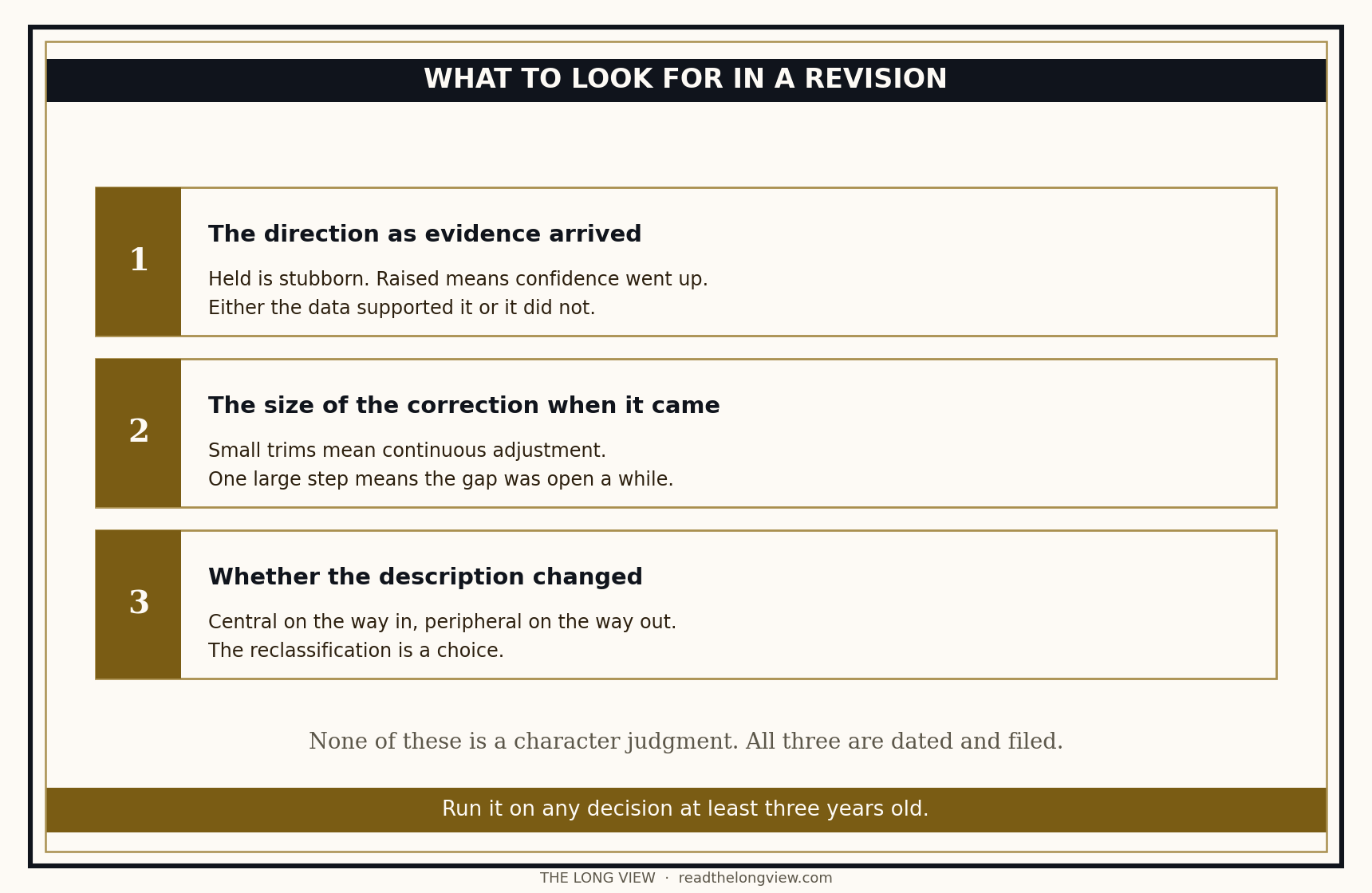
First, the direction as evidence arrived. A team that holds a forecast while the world moves is being stubborn. A team that raises one is telling you its confidence went up. Here the number went up twice before it came down, which means that as data accumulated through 2020 and 2021, the read got more optimistic rather than less.
That is not dishonesty. It is a question about instruments. A management team either had information that supported the raise, or it was reading its own enthusiasm. You cannot tell which from outside, and you do not have to, because the next revision tells you.
Second, the size of the correction when it came. A guidance range moving from $250 to $275 million down to $125 to $130 million is roughly a halving in a single step. Small corrections mean a team is adjusting continuously. One large correction means the gap had been open for a while before it was closed.
Third, whether the description of the decision changed. This is the one worth learning, because it is the least visible and the most telling.
The importance downgrade
When Lululemon announced the purchase, it described the acquisition as building on its vision, strengthening its omni guest experiences, and fueling the Power of Three growth plan. That is a business being placed near the center of the strategy.
When the impairment was explained, the chief financial officer described the business as a very small portion of management’s five-year plan.
Same business. Same management. Between those two statements, its stated importance to the company fell.
Watch for that. A decision that was central when it was made and peripheral when it failed has been reclassified, and the reclassification is a choice about how the record reads.
I am not saying either description was untrue. A business can be strategically central when it is bought for $500 million and marginal after $442.7 million of it has been written off. Both statements can be accurate. What the pair tells you is how this team frames a decision on the way in and on the way out, and framing is the part they control completely.
The second half of the test
You now know what a team predicted and what happened. The remaining question is what they said when the answer arrived.
Yesterday I said I would read the letter from the year the write-off landed. That needs a correction, and the correction is worth more than the original promise.
Lululemon does not publish a shareholder letter. Berkshire’s annual letter is famous partly because writing one at that length is a choice rather than a requirement, and a test built on reading one assumes a document a company may not produce. When it does not, the nearest equivalent is the paragraph attributed to the chief executive in the results release, and it does the same job for the same reason: it is the passage a management team writes freely, in a document otherwise governed by accounting rules.
When a test assumes a document a company does not produce, find the place where the same choice gets made. Do not skip the test and do not pretend the document exists.
Find the results release covering the quarter the loss landed. Skip the headline. Skip the tables. Go to the paragraph attributed to the chief executive, which is the one part of the document a management team chooses the words for, and which is the passage most likely to be quoted everywhere else.
Three outcomes, easy to tell apart. They name the loss and say what they are doing about it. They gesture at it in language general enough to describe any year. Or it is not there.
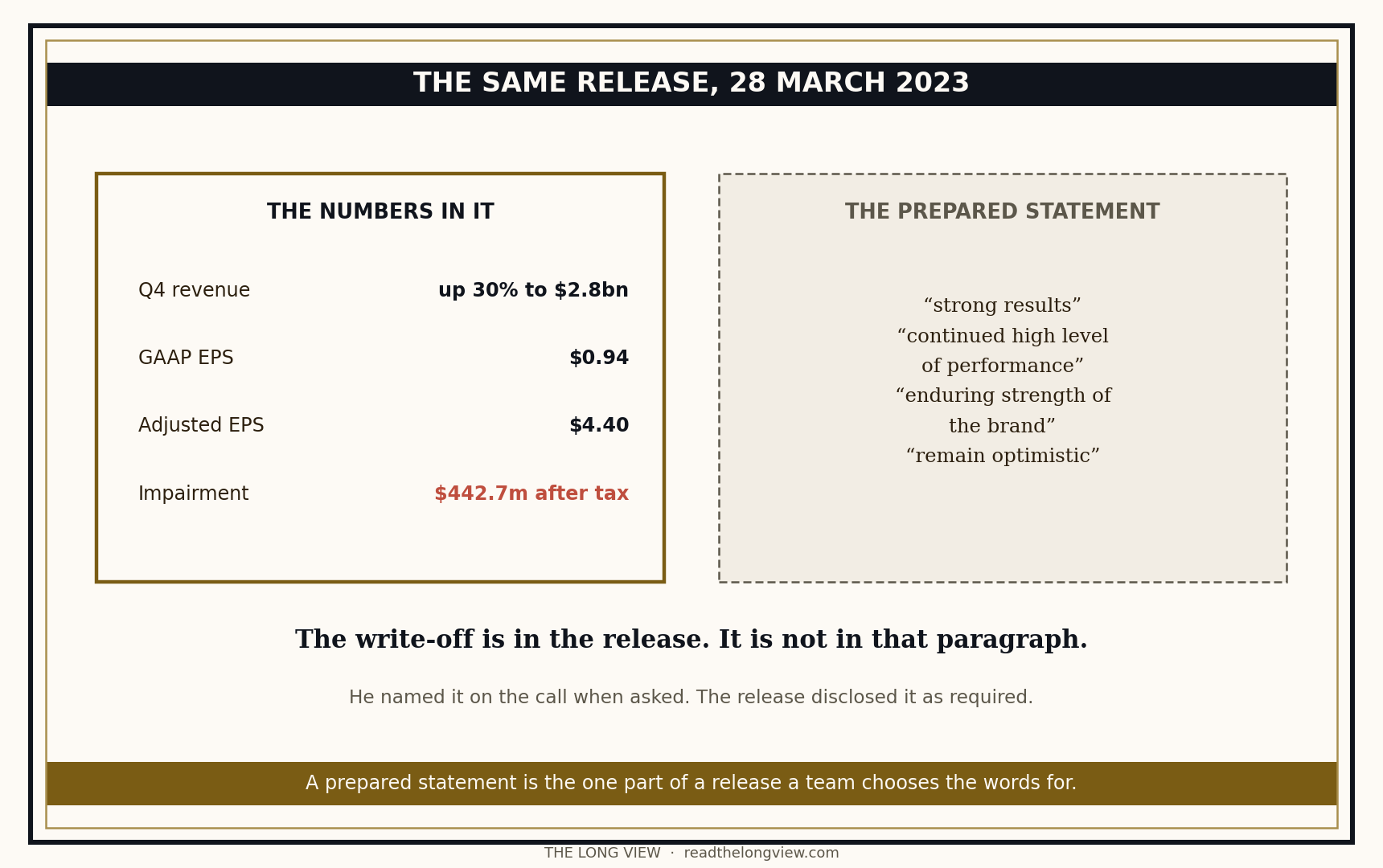
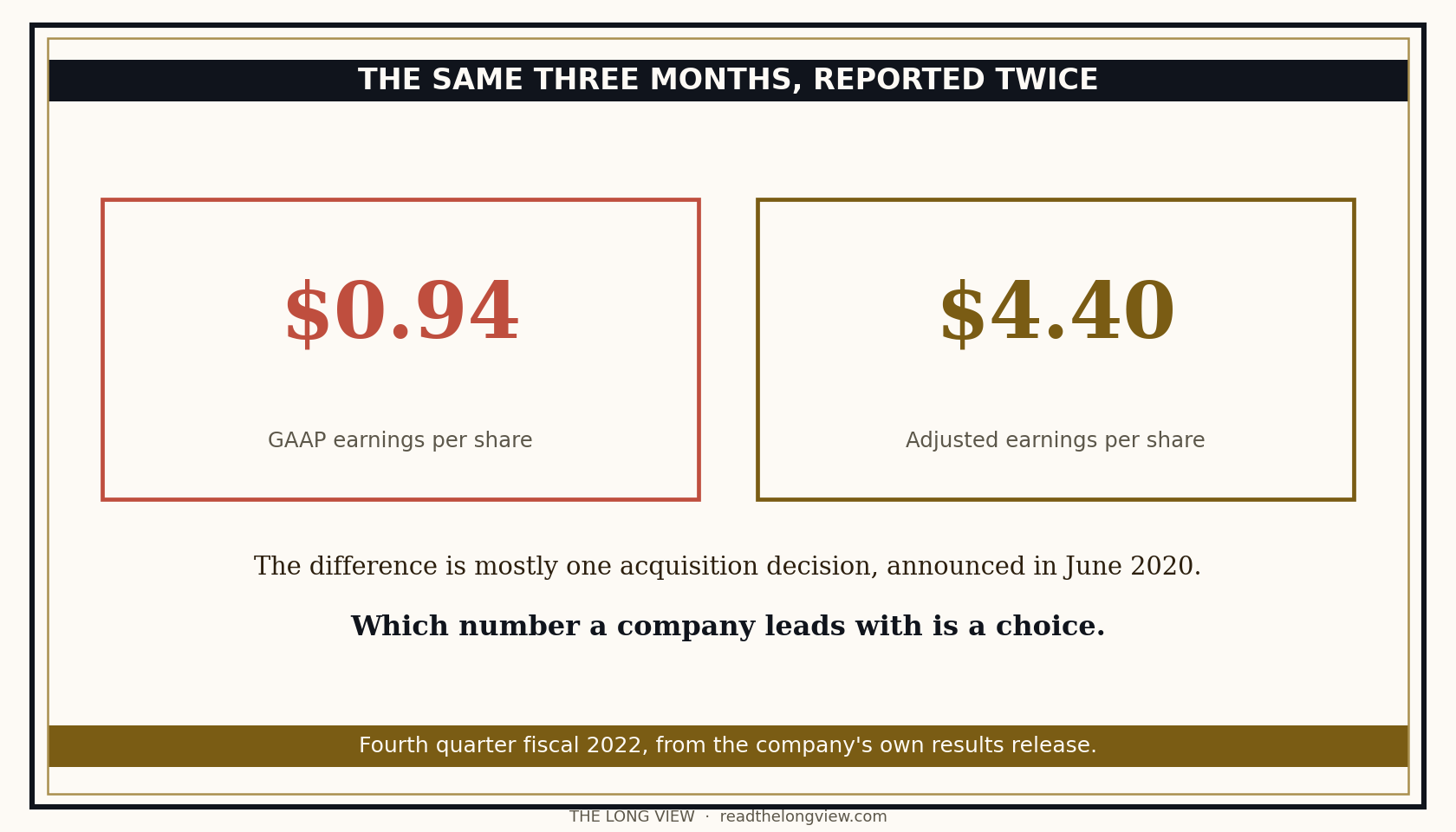
Lululemon’s release of 28 March 2023 reported fourth-quarter revenue up 30% to $2.8 billion, GAAP earnings per share of $0.94 and adjusted earnings per share of $4.40. In his statement, McDonald described strong results across the business, a continued high level of performance, the enduring strength of the brand, and optimism about sustained growth.
The impairment does not appear in that paragraph.
Being fair about this
Three things need saying and leaving them out would make the point stronger and the article worse.
The write-off was disclosed. It is in the release, in the annual report, and in a note of its own. Nobody hid anything, and under the accounting rules nobody could.
McDonald named it on the call. Asked about the quarter, he said the company was taking an impairment charge related to assets and goodwill associated with Mirror. That is an acknowledgment and it counts.
And a chief executive’s statement in a results release is a marketing document. Every company writes them the same way, and none of them lead with the bad news.
So the claim is narrow. The company disclosed what it was required to disclose, and the chief executive acknowledged it when asked. The paragraph he chose the words for did not contain it.
What all this tells you about competence
Not that the acquisition was a mistake. The write-off already told you that and it took no skill to notice.
What the exercise gives you is three readings you cannot get from the financial statements.
How they read their own information. Confidence rose for eighteen months into a category that was turning. Either the data supported that or it did not, and the size of the eventual correction is the clue.
How fast they close a gap. One halving rather than a series of trims.
How they describe a decision once it has gone wrong. Central on the way in, a very small portion on the way out, and absent from the paragraph they wrote freely.
None of those is a character judgment and none requires guessing at anyone’s motives. All three are dated, filed, and available to anyone willing to spend an afternoon.
A management team’s forecasting record is a record like any other. It is just the only one they publish about themselves in advance.
What this cannot tell you
Every document in today’s piece is at least two years old, and the person who wrote most of them left the company in January.
A record tells you how a team behaved. It does not tell you whether the behavior is still happening, and the people running this business today are not the people who bought MIRROR.
So the test has to be run again on the present, which is a harder thing to do, because the results are not in yet and the write-off has not happened.
Tomorrow: the last ninety days. The quarter reported two weeks ago, what the interim team did with the company’s money while the stock was falling, and which number carried the headline this time.
Not investment advice. The subscriber decides.