

Yesterday’s afternoon with the cash flow statements ends on a gap I could not close from inside it. You finish knowing what a management team did with your money and not whether any of it was a good deal. Spending is visible. Judgment is not, because almost every use of a dollar is priced in private, negotiated between the company and a seller you will never see. There is one exception. When a company buys its own stock, the price it pays is quoted in public, every day, in advance, by a market you can look up. That makes the buyback the one decision in the whole capital allocation record that you can grade rather than observe. It is also the one most often described as a reward, which it is not. It is a purchase, made with money that belongs to you.
Start with the standard, because it is stricter than it first appears.
Two conditions, and one of them is not enough
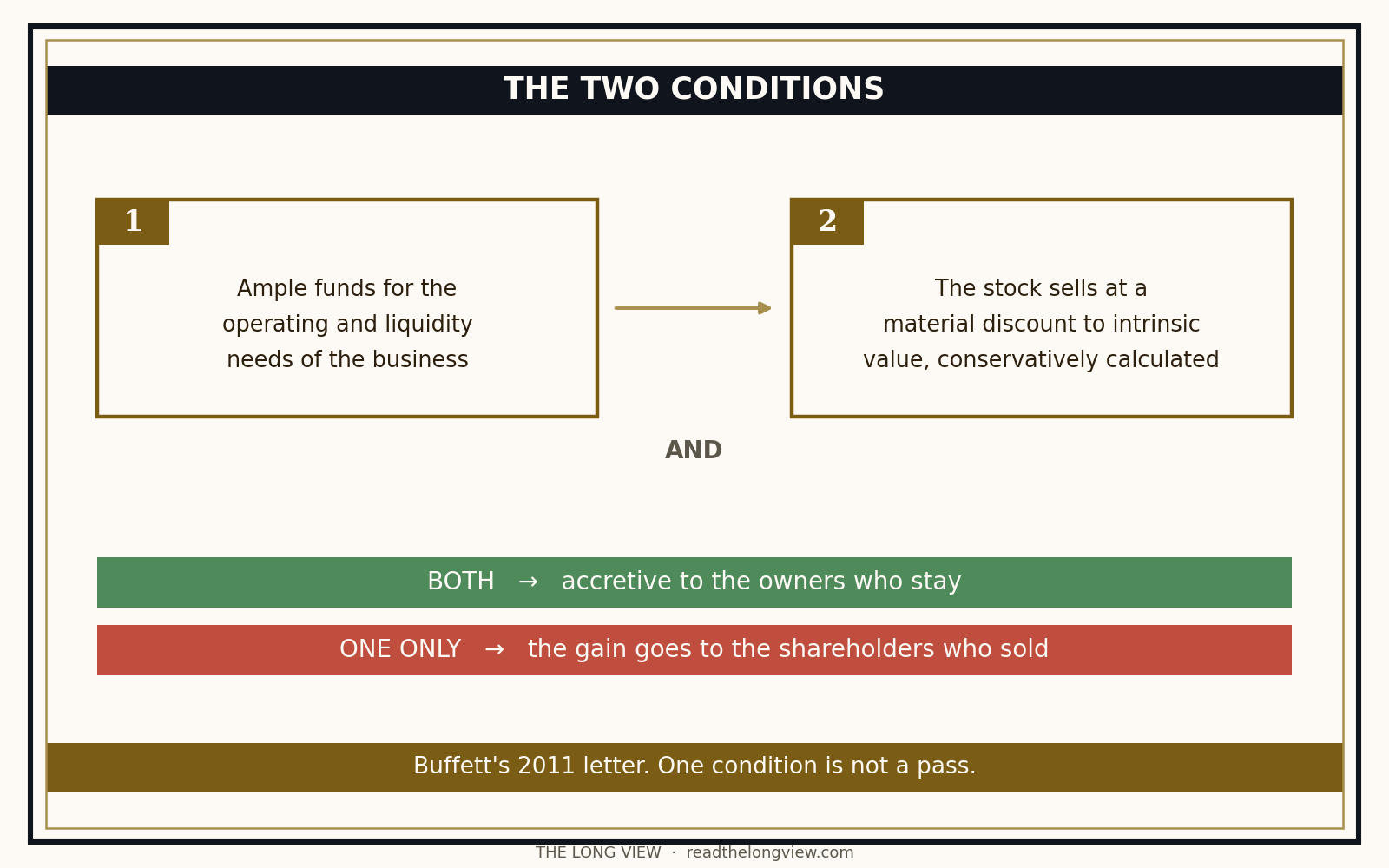
In his 2011 letter to Berkshire shareholders, Buffett set out when he favours repurchases. Two conditions, and he wanted both.
First, the company has ample funds for the operating and liquidity needs of the business. Second, the stock is selling at a material discount to intrinsic business value, conservatively calculated.
Intrinsic value, in plain language, is what the business is worth based on the cash it can produce over its life, as opposed to what the market happens to be charging for it today. Buffett’s word “conservatively” is doing real work in that sentence. A management team that wants a repurchase can always find a valuation that justifies one.
Notice what the second condition does. It makes the buyback a price decision rather than a policy. He put this plainly in his 2023 letter, writing that all repurchases should be price-dependent, and that what is sensible at a discount to business value becomes foolish at a premium.
A buyback is not a way of returning cash. It is management buying one particular stock, and the only stock they are allowed to buy is their own.
He also named who gains when a company overpays. The shareholders who sold, and the banker who recommended it. The owners who stayed are the ones who paid.
The number the announcement never gives you
Here is where I go past yesterday.
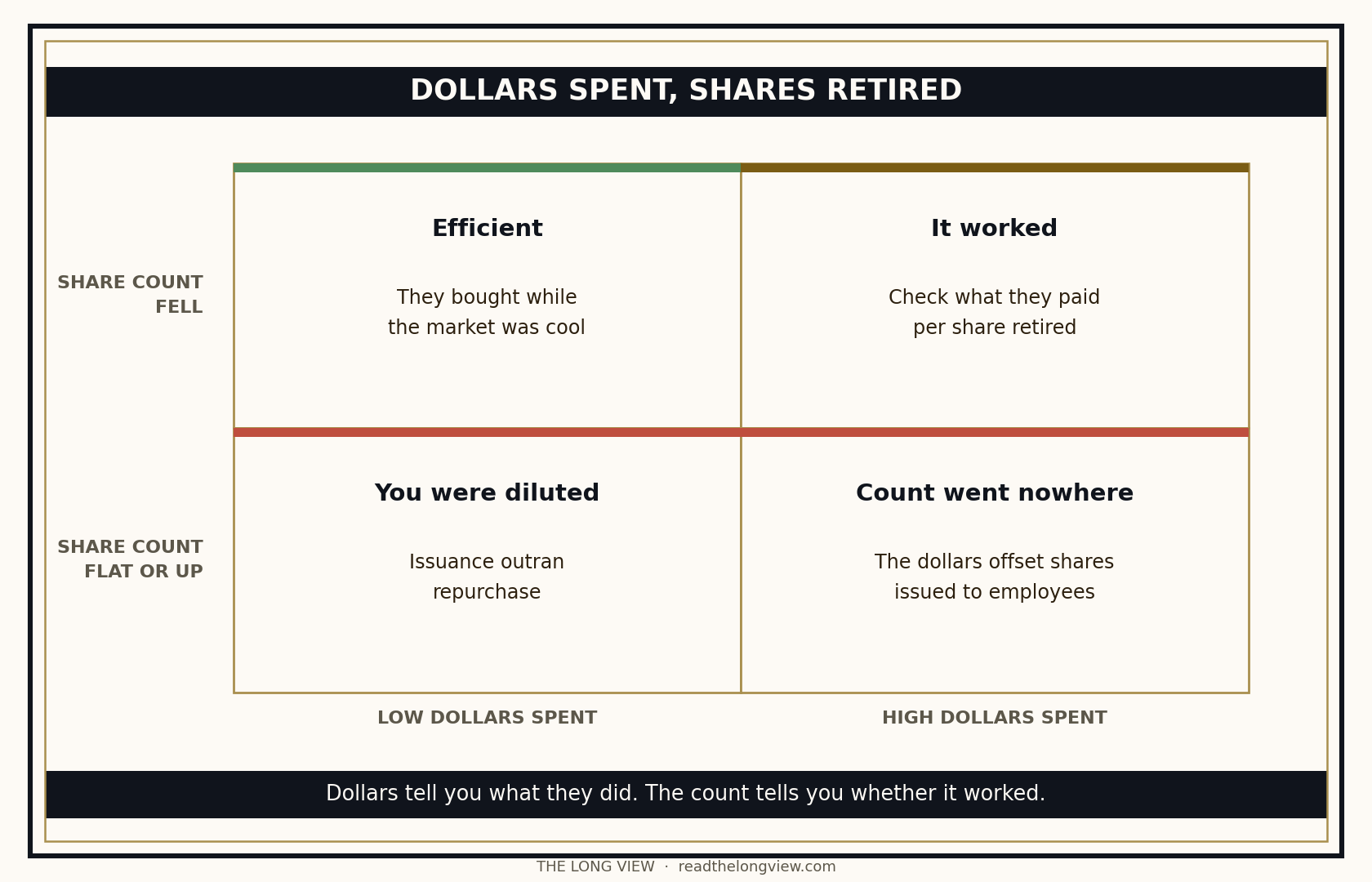
Tuesday I told you to track the share count rather than the buyback dollars. That is the beginning of the test, not the test. The count tells you whether the buyback did anything. It does not tell you whether it was done well.
For that you need the price they paid, and you can compute it yourself from figures the company already publishes.
Take the total dollars spent on repurchases over a period. Divide by the number of shares the count fell by over that same period. That gives you the average price management paid per share retired. Now set that number against the stock’s trading range across those years.
If the average sits in the lower part of the range, this is a team that bought when the market was unenthusiastic. If it sits in the upper part, they bought alongside everyone else, at the prices everyone else was paying.
One caution on the arithmetic. If the company issued shares over the same period, and most do through compensation, the count fell by less than the number repurchased. Your computed average price will be too high. Use the repurchase share figure from the cash flow statement or the equity note when it is disclosed, and treat the divided number as an estimate rather than a measurement.
That caution is also the finding. A company can spend an enormous sum on repurchases and end the decade with the same share count it started with. The dollars went out. Your ownership stake did not move. What was purchased was not your position in the business. It was the offsetting of shares issued to employees.
That is a real and common structure, and it is not hidden. It is visible to anyone who puts the dollars and the count side by side.
What the evidence says about how this goes
I want to be careful here, because this is a point where confident assertions outrun the data.
Researchers at the University of Kentucky examined 5,498 firms that repurchased stock in at least one quarter between 1984 and 2010, in a paper titled “Wiser to Wait: Do Firms Optimally Execute Share Repurchases?” They found strong evidence that share prices were higher, and valuation ratios less attractive, during the quarters when firms were repurchasing than during the quarters when they were not. Their summary was that firms on average buy when they should not.
McKinsey’s own work, published through the Harvard Law School Forum on Corporate Governance, reached a similar conclusion on timing. A majority of the companies they observed bought back shares when prices were high rather than low.
Now the part that complicates it, which I am including because leaving it out would be dishonest. That same McKinsey work found no compelling evidence that share buybacks damaged long-term value creation for investors overall. So the timing finding is robust and the consequence is contested. Poor timing on repurchases is not the same thing as a company being destroyed by them.
There is also a mechanical reason for the pattern that has nothing to do with anyone being foolish. Companies tend to have the most spare cash when business is good, and business tends to be good when share prices are high. The behaviour follows the cash. According to data from S&P Capital IQ reported by CFO magazine, during 2009, with the S&P 500 below 700, only 53 buybacks of $300 million or more were announced.
Buffett has made the sharper version of this charge himself. He has written that American chief executives have an embarrassing record of committing more company money to repurchases when prices have risen than when they have fallen. That is his assessment, and I am attributing it to him rather than adopting it as a measured fact.
What it looks like when someone does it properly
Henry Singleton ran Teledyne, and I mentioned him on Monday only as one of Thorndike’s eight. The record itself deserves its own space.
Through the 1960s Singleton used Teledyne’s expensively priced stock as currency, acquiring roughly 130 companies while the shares traded at high multiples of earnings. Then the market turned, the multiple collapsed, and he reversed direction.
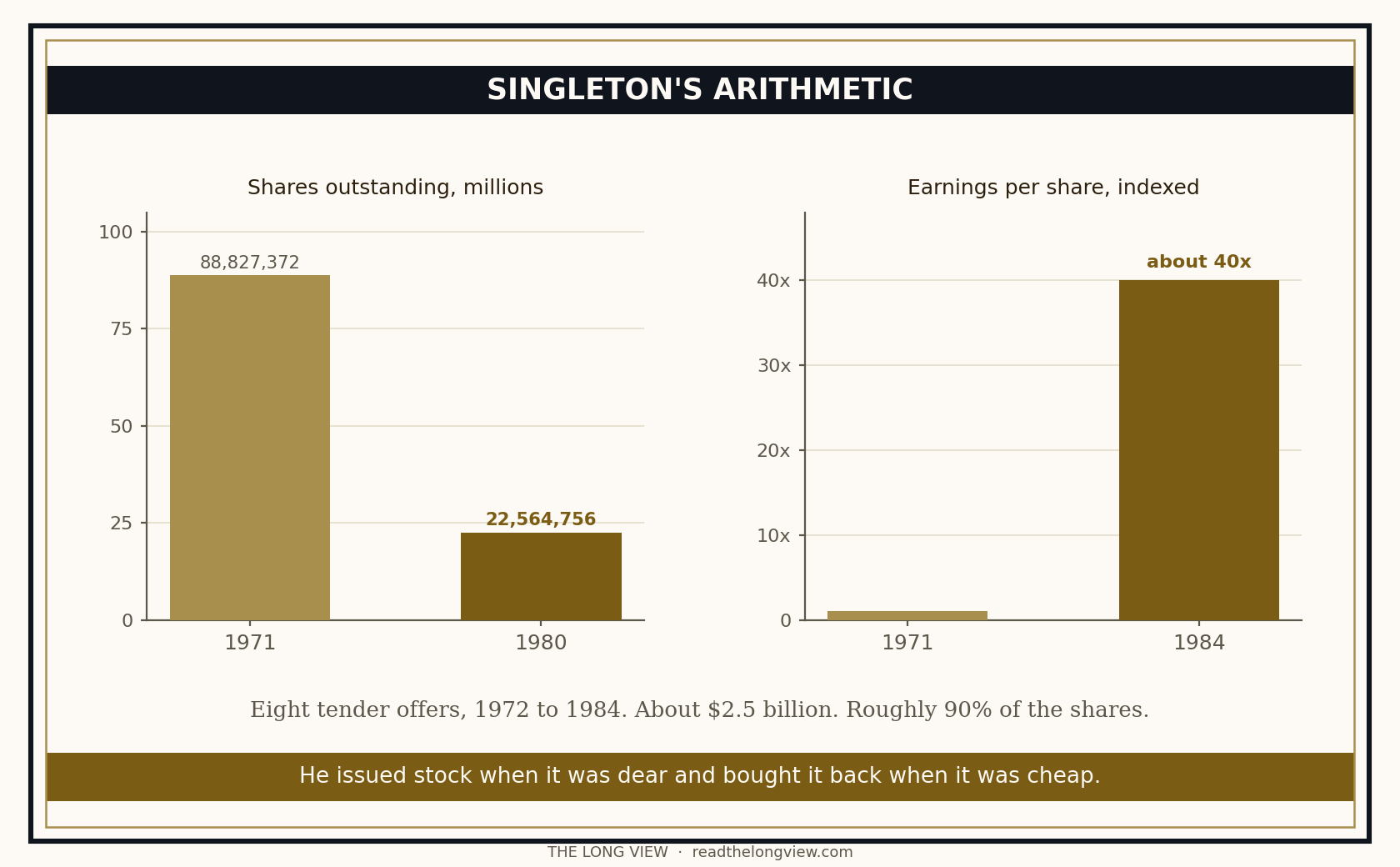
Between 1972 and 1984, across eight separate tender offers, Teledyne repurchased approximately 90% of its outstanding shares, spending on the order of $2.5 billion. Shares outstanding fell from 88,827,372 in 1971 to 22,564,756 by 1980. Earnings per share rose roughly fortyfold between 1971 and 1984.
Read those two phases together, because separately they mean less. He issued stock when it was expensive and bought it back when it was cheap. That is the same discipline applied twice, in opposite directions, which is harder than it sounds and rarer than it should be.
One detail I am including because it cuts against the clean version of the story. The final tender, in 1984, was priced at $200 a share, roughly $30 above the market at the time. Singleton was not mechanically a low-price buyer at every moment across twelve years. The record is excellent. It is not spotless, and a story that has no rough edges usually has had them removed.
He was not right about the price every time. He was thinking about the price every time. That is the part you can check.
The 2026 version
Monday I gave you the buyback figure for the first four months of this year, reported by Bloomberg citing Birinyi Associates as the largest start to any year on record. I gave it without comment because the frame was not built yet. It is now.
A record dollar total tells you about volume. It tells you nothing about price, and price is the entire question. The same headline is consistent with a market full of disciplined allocators buying value, and with a market full of teams buying alongside each other near highs. The number does not distinguish between them.
What distinguishes them is available per company, for free, and it is arithmetic rather than opinion. Dollars spent. Change in share count. Average price paid. Trading range over the same period.
The afternoon, part two
Take the same company you used yesterday.
Find the repurchase line in the financing section of the cash flow statement for each of the last ten years. Find the share count on the cover of each annual report. Compute the average price paid. Put it next to what the stock did in those years.
You will end up with a single number that tells you whether this team treats their own shares as an investment or as a policy.
What this still cannot tell you
The arithmetic gives you the decision. It does not give you their account of the decision.
A team that overpaid and then said so in the next annual letter is a different proposition from a team that overpaid and described the year as a success. The numbers are identical. The management is not.
Tomorrow I leave the financial statements and go to what they wrote, and to the document that records what they took while they were writing it.
Not investment advice. The subscriber decides.