

Every rich AI valuation rests on one quiet assumption: that the economy will grow fast enough to carry the debt underneath it all, the way it grew out of the debt after World War Two. That is the bull case, stated plainly. But the economy that performed the postwar miracle grew by putting millions to work, and the one being asked to repeat it proposes to grow by putting people out of work. That reversal is why the bet may not pay this time, what it means for how you price the risk you are holding, and where the best risk-adjusted return left on the board may not be a stock at all.
The Long View · The AI economy, the debt, and you
The Long View names no positions here. This is analysis, not financial or career advice, and not a prediction of any particular outcome.
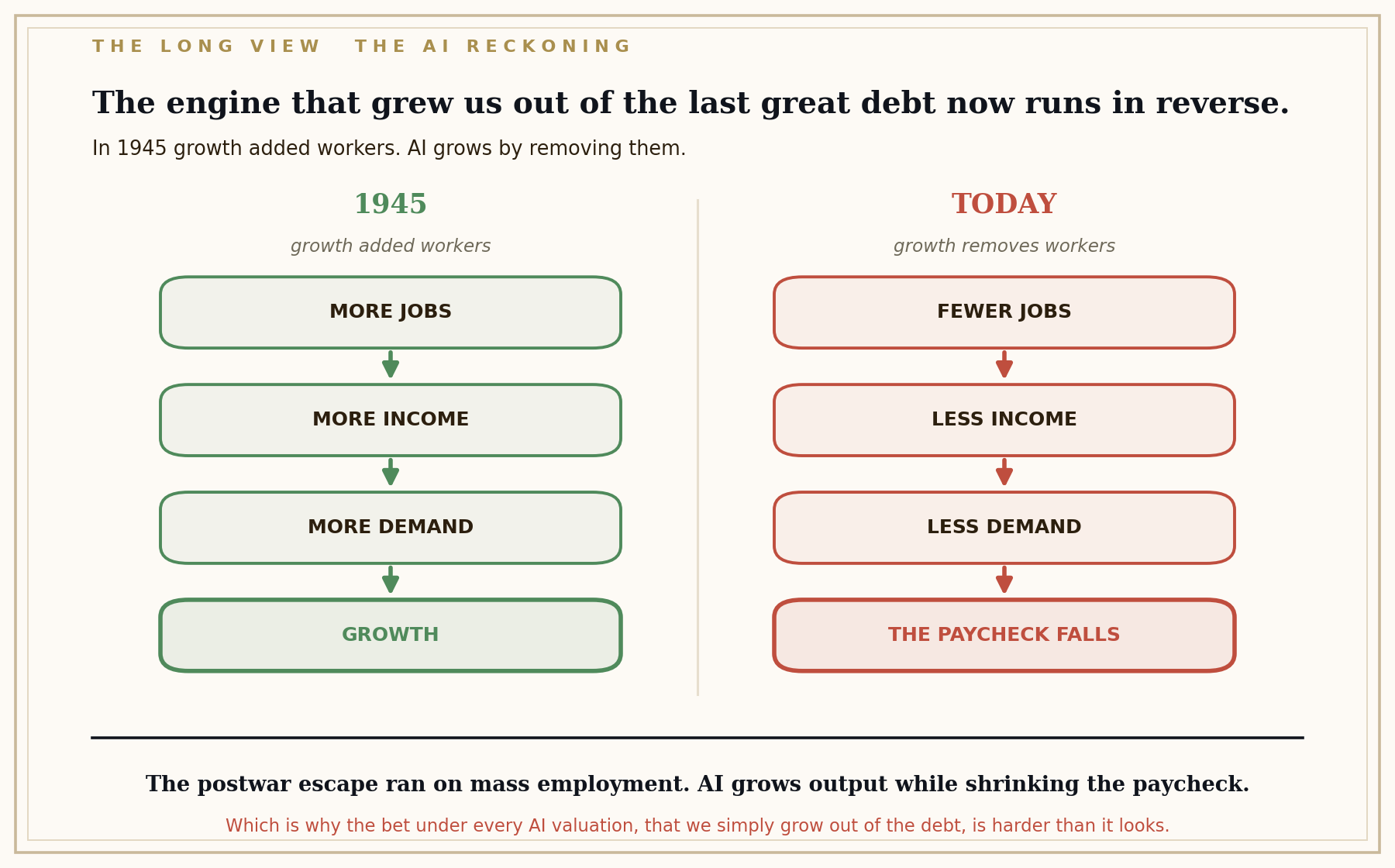
Yesterday I left you with a promise. The whole hopeful case for the debt rests on one piece of history: after the Second World War we carried debt bigger than the entire economy and simply grew our way out of it. We did. So the question that decides everything is whether we can do it again, because the entire plan, the one painless road out of five, is to grow out of this debt the way we grew out of that one.
That is the part of this series’ driving question I want to take up today. If part one was what could make these companies cheap, and part two is what that change would cost, this piece sits right on the hinge between them: can the one painless escape even work anymore? I went back and looked at what really powered the postwar miracle, and then at the economy we would run the same play with now. They are not the same machine. Not even close. And once you see the difference, the hopeful story gets a lot more honest, and it points somewhere useful for what you personally do next.
Let me start by dismantling the comfortable story, because it deserves dismantling.
The precedent everyone leans on
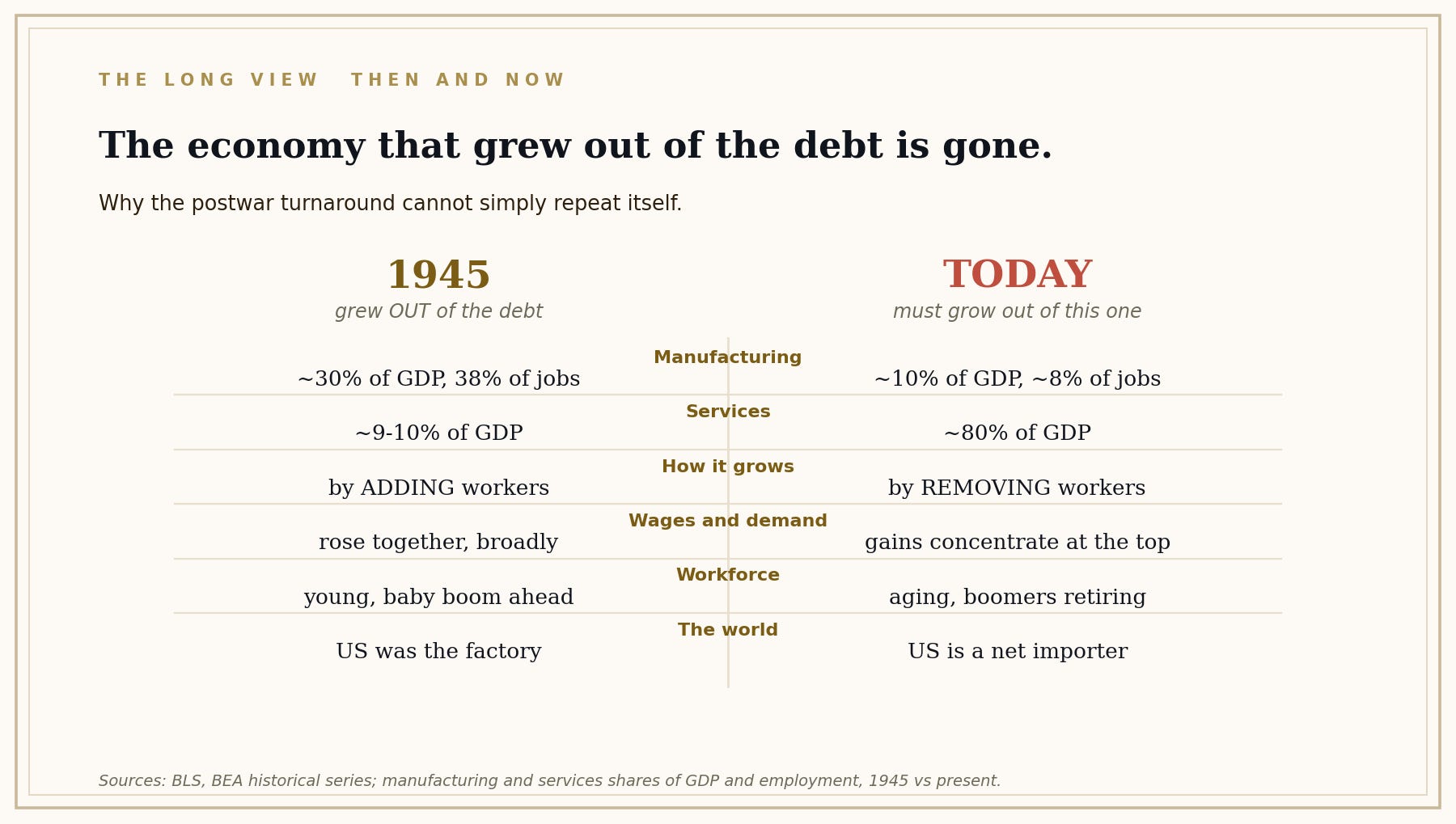
After the Second World War, the United States carried federal debt of more than one hundred percent of its entire economy, a level it would not see again until now. And over the following decades, it did not default, it did not collapse, it grew out of it. The debt shrank against a booming economy until it was a manageable fraction of output. This really happened, and it is the single most cited reason to believe today’s debt is survivable.
But look at what powered that growth, because the mechanism is everything. In 1945, manufacturing was about thirty percent of the economy and nearly forty percent of all jobs. It was a nation that made physical things. And the way you grow an economy that makes things is by employing more people to make more of them. Wages rose across the whole workforce, manufacturing workers gained about a quarter more real income during the war years alone, and those wages became the demand that bought the next round of production. Growth and employment rose together, in a single self-reinforcing circle. More jobs meant more income meant more demand meant more jobs. The tide truly lifted all boats, because the engine of the growth was mass employment itself.
It was also helped by things that will not repeat: a young workforce with the enormous baby-boom generation just ahead, and a world whose factories had been reduced to rubble while America’s stood intact, making the country the workshop of the planet.
The economy that has to do it this time
Now look at the economy that has to pull off the turnaround today. Manufacturing is about ten percent of output and eight percent of jobs. Services are roughly eighty percent of the economy, and consumer spending is around two-thirds of it. We do not primarily make things anymore. We serve each other, and we buy from each other, and the whole machine runs on people having enough income to keep spending.
That difference is not a detail. It reverses the entire logic of the turnaround.
In 1945, you grew the economy by adding workers, and their wages became the demand. The growth shared itself automatically, because it was built from labor. AI grows a service economy the opposite way: by delivering the service with fewer workers. That is not a flaw in the technology, it is the entire point of it, the reason companies spend hundreds of billions on it. But it means the growth engine and the demand engine, which were the same people in 1945, now work against each other. You grow output by removing the workers whose incomes were the demand. The virtuous circle of the postwar boom, more jobs, more income, more demand, more jobs, runs in reverse.
So what does this do to the turnaround
It does not make growing out of the debt impossible. But it removes the thing that made 1945 work: the automatic, broad, self-sharing quality of labor-intensive growth. In 1945 the broad outcome, where the gains reached everyone, was the default, because that was simply how the growth was built. Today the concentrated outcome is the default, because AI growth flows first to the companies that own it and the shareholders behind them, not to the workers it replaces. The gains no longer share themselves. They have to be shared on purpose, through policy, wages, or design, and on-purpose is always harder than automatic.
There are two more headwinds the 1945 economy did not face. A service economy has fewer rungs left to climb to, because services were the rung everyone climbed to when manufacturing left the country. If AI now pressures services, there is no next great labor-absorbing sector visible behind it. And demographics have flipped from tailwind to headwind: instead of a young workforce and a baby boom ahead, we have the baby boom retiring, fewer workers supporting more beneficiaries, which strains the debt no matter what AI does.
So the honest verdict is this. The comforting analogy is broken. The postwar growth was broad, labor-intensive, goods-based, and demographically blessed. The potential AI growth is narrow by default, labor-replacing, service-based, and demographically burdened. It can still help the debt. But left to its natural shape, it produces exactly the least helpful result: concentrated gains sitting on top of a thinning consumer, which is not how you grow your way out of anything durably.
Where do the displaced workers go
Which brings us to the question that really matters to a human being reading this: if the machine grows by shedding workers, and the service rung is the one under pressure, where does a displaced worker go?
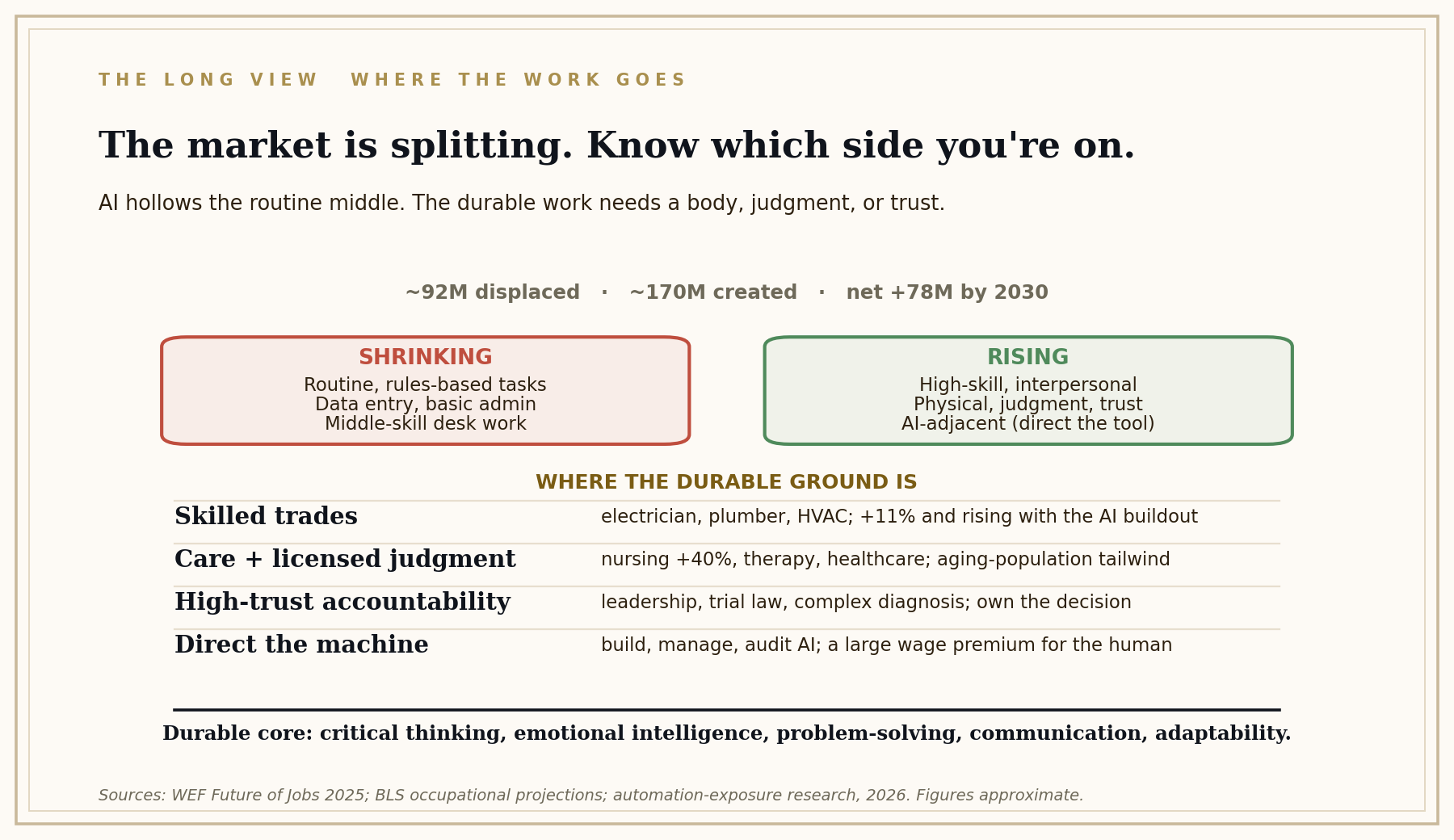
The honest answer is not “nowhere,” and it is important not to overstate the doom. The most cited labor forecast, from the World Economic Forum, projects roughly ninety-two million jobs displaced by the end of the decade, but around one hundred seventy million created, a net gain of about seventy-eight million. Work is not ending. It is moving. But notice the word: moving. The new jobs are not the same jobs, in the same places, for the same people. The labor market is splitting into two tiers, high-skill, high-trust, interpersonal work rising, and routine, rules-based, middle-skill work shrinking. The middle is what hollows out, and the middle is where a great many paycheck-to-paycheck households currently live.
So the answer to “where do they go” is: somewhere different, if they can make the move. And that “if” is the whole ballgame.
What really resists the machine
Here is where the research gets truly useful, because the durable ground is not a mystery. The work that resists automation clusters in a few recognizable families, and they share a logic: AI is extraordinary at routine, digital, predictable tasks, and weak where the job requires a body, a licensed human judgment, or a relationship of trust.
The skilled trades sit near the top, and this surprises people who assume “the future” means sitting at a screen. An electrician, a plumber, an HVAC technician, an elevator mechanic, works with their hands in unpredictable physical environments that defeat automation, and the work cannot be shipped overseas. Demand is rising, not falling, partly because the AI buildout itself, the data centers, the power, the electrification, needs enormous amounts of skilled physical labor. Many of these pay well into the six figures and require a certificate or apprenticeship, not a four-year degree and its debt.
Human care and licensed judgment is the second family: nursing, therapy and mental health, caregiving, the healthcare professions broadly. These combine physical presence, empathy, split-second judgment, and legal accountability, and they are backed by the largest demographic tailwind there is, an aging population that needs more care every year. Healthcare is projected to add tens of millions of roles this decade.
The third family is high-trust judgment and accountability, the roles where a human must own the decision because ethics, liability, persuasion, or leadership are involved. A trial lawyer reading a jury, a leader navigating conflict and values, a clinician making a complex diagnosis. And the fourth is genuine creative direction, not routine content generation, which AI now does, but the taste and vision to decide what should be made and whether it is any good.
There is a fifth path that is not a category but a posture: work alongside the machine rather than against it. The people who build, manage, and audit AI systems command a large wage premium precisely because they direct the tool instead of competing with it. Across all of these, the same handful of human capacities keep appearing as the durable core: critical thinking, emotional intelligence, complex problem-solving, persuasive communication, and adaptability. Those are the things to build, in whatever field you are in.
The gap the data is screaming about
If you want to know where the wealth really gets made in a shift like this, you look for the place where demand has run violently ahead of supply and cannot catch up, because that gap is where fortunes and careers are built. In all the data I gathered for this series, one gap stood out above every other, and it is not subtle. It is the loudest signal in the numbers.
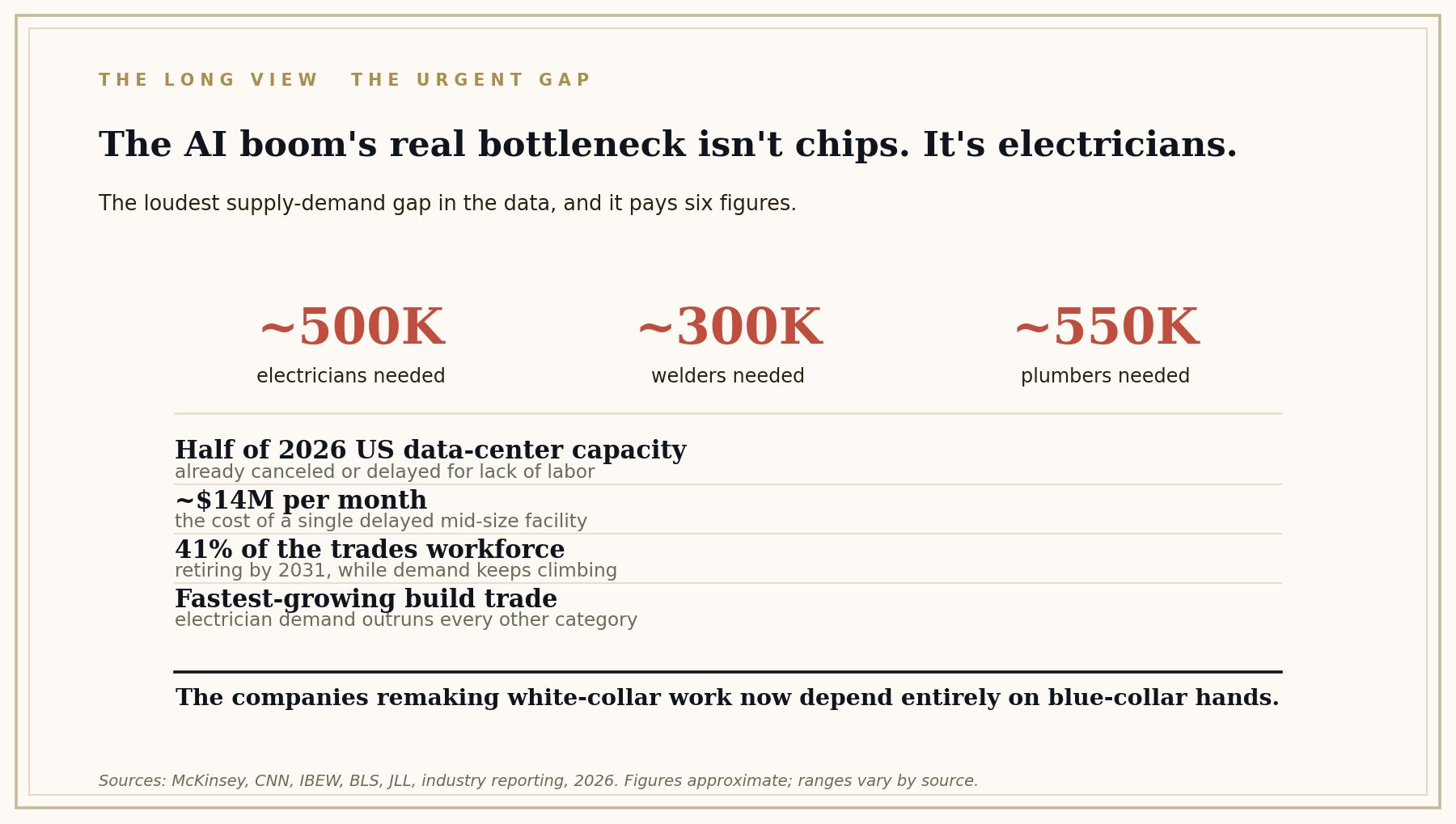
The single biggest bottleneck in the entire AI buildout is not chips, and it is not capital. It is the shortage of electricians and skilled trades to build and power the data centers. This is not my characterization, it is the industry’s. Microsoft’s president has called the electrician shortage the number one problem slowing data-center expansion. Nvidia’s chief executive says the need runs into the hundreds of thousands. The electrical workers’ union calls it a life-or-death situation for Big Tech. The head of the world’s largest asset manager raised it directly with the government.
The numbers explain the panic. McKinsey estimates a gap of one hundred thirty thousand electricians by 2030. Reporting this month put the broader need at roughly half a million electricians, three hundred thousand welders, and five hundred fifty thousand plumbers to keep pace with the build. The country needs over three hundred thousand more electricians while about twenty thousand retire every year, and more than forty percent of the existing trades workforce is set to retire by 2031. Electrician employment is growing faster than any other construction category the government tracks, and demand is still outrunning it.
And the consequence is not theoretical. Roughly half of the data-center capacity planned in the United States for this year, about seven gigawatts out of twelve, has already been canceled or delayed, and a single delayed mid-size facility can cost its owner more than fourteen million dollars a month in lost revenue. Hundreds of billions of dollars of capital are pointed at capacity that there are not enough skilled hands to build. Capital is not the constraint. Labor is.
Sit with the irony, because it is the whole series in a single image. The companies remaking white-collar careers with AI now depend entirely on blue-collar workers to keep their infrastructure growing. The same boom that threatens the routine desk job is desperate, right now, for the electrician, the welder, the pipefitter, the high-voltage crew, the people who work with their hands in the physical world the machine cannot enter. The gap the data is screaming about is exactly the durable ground we mapped a moment ago, made concrete and urgent and extraordinarily well paid.
For a working person weighing where to point their own effort, that is about as clear a signal as economic data ever gives you: six-figure pay, no student debt, more security than most software jobs, and a structural shortage that lasts for a decade or more. And it extends past the electrician into the whole physical layer, the transformer and switchgear makers, the substation crews, the commissioning and controls specialists, the cooling and HVAC engineers, the grid-modernization work that will outlast the data-center build itself. The people quietly making a fortune off the AI boom may turn out to be the ones who never bought a single AI stock, and instead learned to build the thing the stocks depend on.
And here is the part that matters if you are reading this thinking you are too far from a tool belt to benefit. You do not have to be the electrician to profit from the electrician shortage. Every scarce tradesperson on a site needs a schedule to follow, a budget to hit, a design to build to, a quality check to pass, a permit to clear, and equipment to install, and that entire supporting layer is short too, because the build itself is short. Those are analytics and coordination roles: project schedulers who run the critical path, cost estimators, owner’s representatives, commissioning agents who verify the systems work, quality inspectors, the digital-modeling coordinators who build the plan before the concrete is poured. For someone with technical or analytical skills and even an old familiarity with how a job site works, these are among the least crowded and best paid seats in the whole boom, the brains around the build rather than the hands on it. I will lay out that map in more detail in the notes, because it deserves its own space.
The question to ask yourself
There is one diagnostic from the research worth keeping, because it cuts through the noise. Ask yourself: is the work I am doing today essentially the same as the work I was doing two years ago? If the answer is yes, then AI’s improvement curve is catching up to you faster than your own skills are moving, and that gap is the risk. Exposure is rarely about your job title. It is about where in the role you sit. The junior analyst doing repeatable tasks is exposed; the senior one who owns judgment and relationships is not. The trajectory of your skills matters more than the name of your job.
The most undervalued asset you own
Let me bring this home, because this newsletter is about one idea above all others, and it applies here more powerfully than anywhere.
Everything I write is about value: buying an asset for less than it is worth, with a margin of safety, so that being partly wrong does not ruin you. We apply that discipline obsessively to stocks. And almost nobody applies it to the asset that really funds their life, their own capability. The most undervalued, most neglected holding most people own is their own skillset, the thing they stop investing in the day they leave school, while they pour attention into stock tickers they cannot control.
You cannot control the deficit, the bond market, the Treasury, or the shape of the AI buildout. You have almost no influence over whether the macro chain tightens or the growth arrives broad or narrow. But you have complete control over one thing: which side of the polarizing labor market you stand on. And in an economy that grows by replacing routine labor, the highest-margin-of-safety investment a working person can make is not a stock at all. It is making themselves into the human the machine cannot replace, because that protects the income that every other investment, every plan, every bit of security, ultimately rests on.
I have to be honest about the hard part, because the earlier piece in this series demands it. Reskilling is easiest to preach and hardest to do for exactly the people most exposed, the paycheck-to-paycheck, debt-loaded households with no time and no cushion to retrain. That is real, and it is why the systemic answer, that the gains have to be shared, still stands and is not solved by individual effort alone. Not everyone can become a nurse or an electrician, and age, health, geography, and money all constrain the move. This is guidance, not a cure, and I will not pretend otherwise.
But at the level of the individual, the direction could not be clearer. Treat your own capability as your core position. Add to it deliberately, on the durable side of the line, the physical, the human, the judgment-based, the trust-based, the things a model in a data center cannot do. Watch your own skill curve at least as closely as you watch any stock. Because the same force that this whole series has been tracing, the one that could reprice the market, strain the government, and hollow the consumer, is also the one that will decide, household by household, who thrives in what comes next. The market is worth watching. But the best investment on the board, for most people, is the one in the mirror.
Run any company through the Stock Story Firewall, free, at firewall.readthelongview.com. Subscribers get the Watch cards, the Evidence tool, and the full Research Tracker.
We grew out of the last great debt by putting a nation to work. We are being asked to grow out of this one by a machine that works instead of us. Whether that ends well for the country depends on choices far above any of us. Whether it ends well for you depends, more than anyone likes to admit, on what you decide to become before the choice is made for you.
And it points somewhere I did not expect, which is where I am going tomorrow. If the scarce, valuable thing in this whole build is skilled hands, then the businesses that employ those hands are sitting on the rarest asset in the economy. A lot of them are quietly for sale. Tomorrow I follow that all the way to its logical, almost absurd conclusion: the best AI investment I can find might not be a stock at all.
Not investment advice. The subscriber decides.