Last week I ran a series about what would have to happen for a great company to come back to a price I could pay. About a week of research sat behind it, and I never wrote the part that comes after. If the price arrives, I hand my money to a group of people I have never met, and from that day forward they decide what happens to it. They decide whether the cash gets reinvested or spent on a bad acquisition. They decide whether to buy back stock at a smart price or a stupid one. They decide what to tell me when it goes wrong. Warren Buffett has a filter for those people, and it is shorter than most investors assume. It is two questions, and neither one can be answered by a quarter, a conference call, or a plan. They can only be answered by five or ten years of decisions already made.
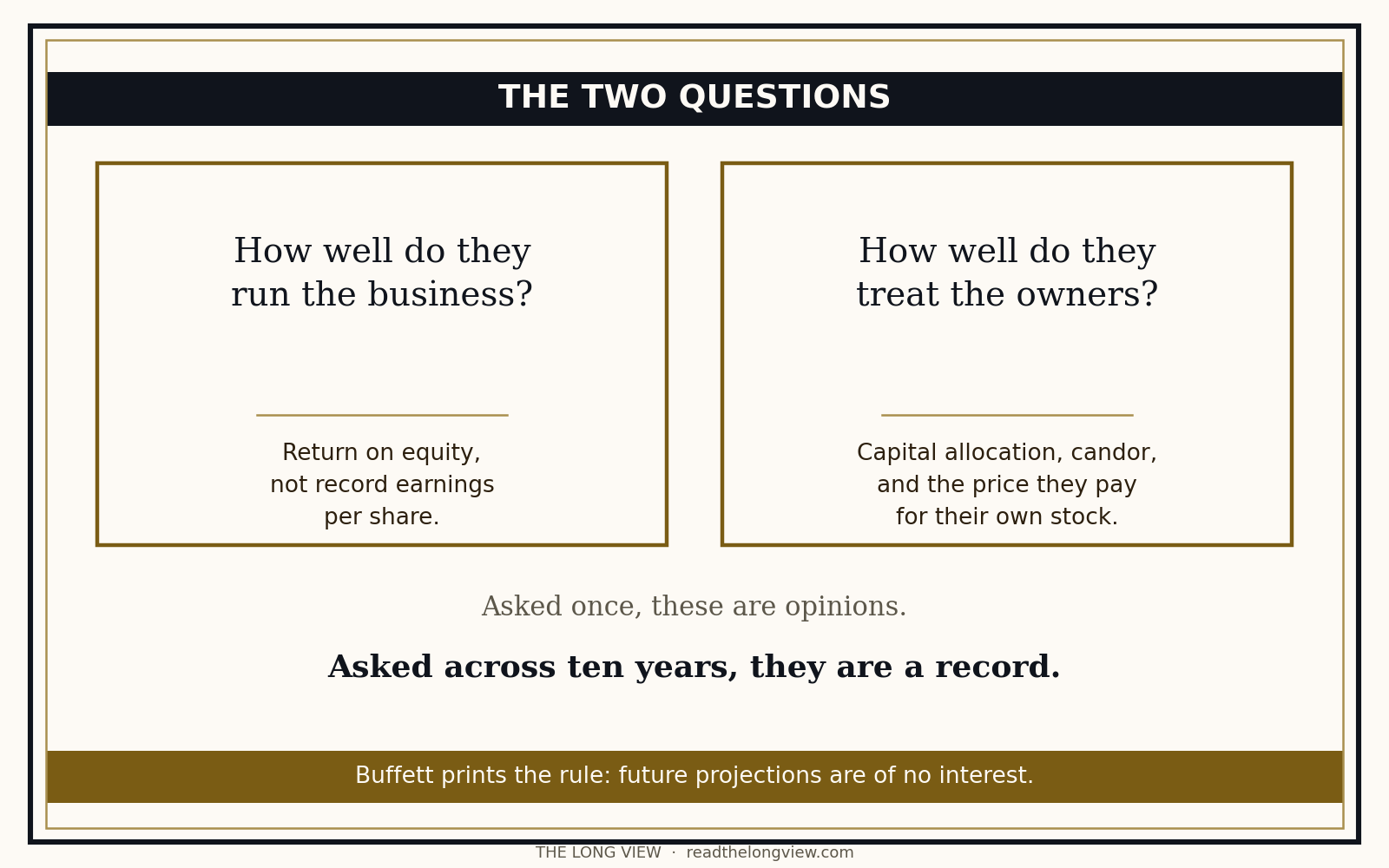
Andrew Kilpatrick spent three decades recording what Buffett and Charlie Munger said at Berkshire annual meetings. In his account, Buffett reduced the evaluation of a management team to two things: how well do they run the business, and how well do they treat the owners.
That is the whole frame. Every other test I will write about this week is a detail hanging off one of those two hooks.
But there is a rule that sits above both questions, and I want to put it first because it decides what evidence you are allowed to use.
Buffett printed the rule in the back of the annual report
Since at least 1983, Berkshire’s annual report has carried a short list of acquisition criteria on the page after the shareholder letter. Six items. Two of them are about people, and both say the same thing.
The second criterion asks for demonstrated consistent earning power, and then adds a clause most readers skim past: future projections are of no interest, and neither are turnaround situations. The fourth criterion is four words long. Management in place. The parenthesis after it explains why: he cannot supply it.
Read those two together and you have a policy, not a preference. Buffett is not saying he prefers a proven team. He is saying that a plan is not admissible evidence, and that he will not underwrite someone’s potential with his own money.
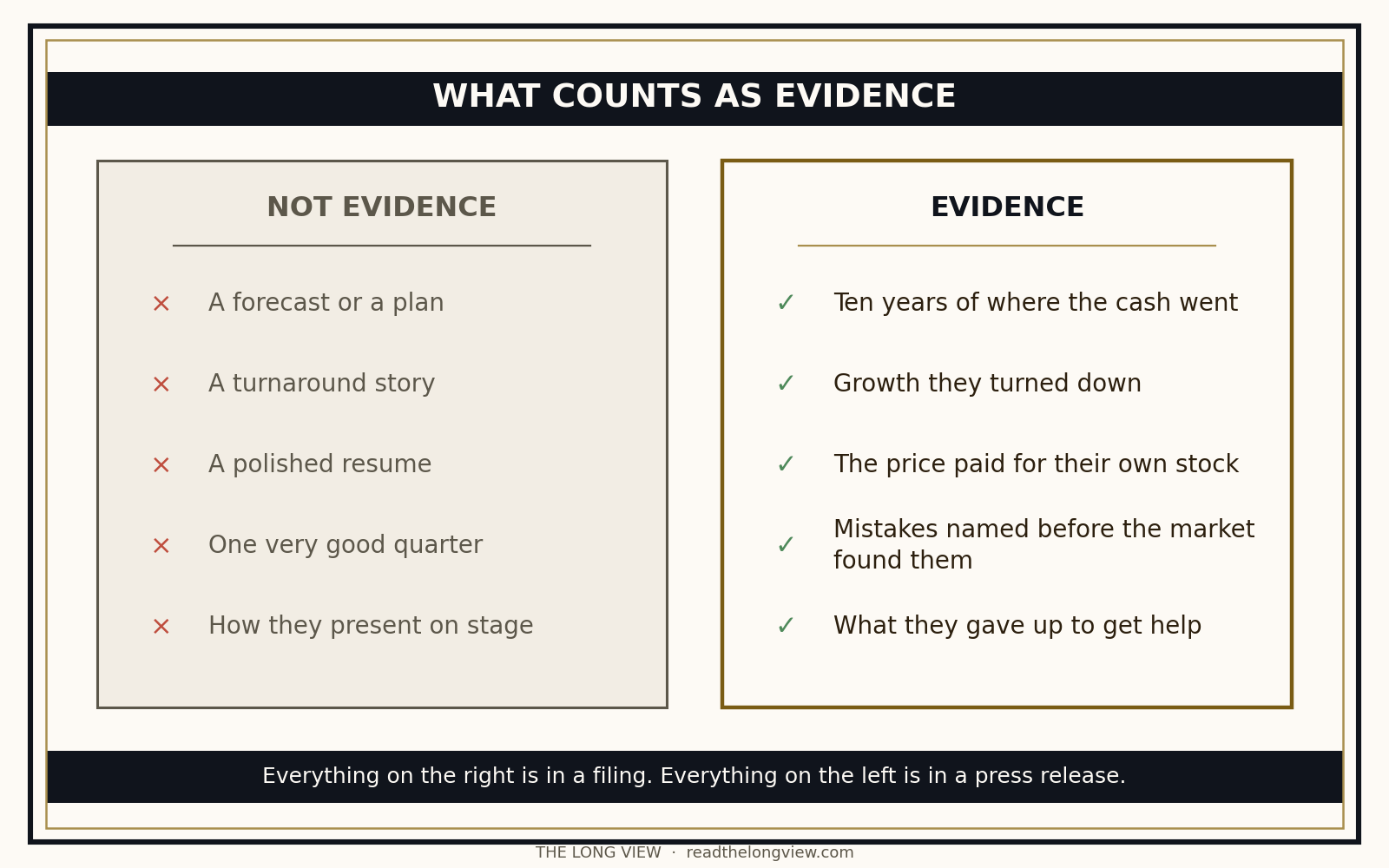
A projection is a claim about people who have not yet done the thing. A ten-year record is a claim about people who already did it, repeatedly, through conditions nobody chose.
I want to be careful not to overstate what a record proves. A long record can be luck riding a good industry. That is why the record has to be read as decisions, not outcomes. What did they do with the cash in the fat years. What did they do in the year the business got hit. Did they buy their own stock when it was cheap or when it was expensive. Outcomes can be borrowed from a rising tide. Decisions cannot.
William Thorndike made this measurable in his book The Outsiders. He studied eight chief executives, including Henry Singleton at Teledyne and Tom Murphy at Capital Cities, and found their companies returned an average of 20.1% a year to shareholders during their tenures against 12% for the S&P 500 over the same windows. Compounded, that gap meant beating the index by roughly twentyfold.
None of the eight is remembered for charisma. What they shared was a long, visible, boring record of deciding where the money went.
There is one more thing worth naming before the week starts, because it is what I am looking for underneath all of this.
A record of decisions is evidence of something narrower than intelligence. It is evidence of whether a person knows what they are not good at, and whether they acted on that knowledge when it would have been easier to bluff. That trait is the one I trust, and it is the thread running through every test in this series.
Where the cash went tells you whether they knew the limits of what they could build. What they paid for their own stock tells you whether they knew the limits of their own optimism. Whether they name a mistake before the market finds it tells you whether they can see themselves clearly at all.
I am not looking for brilliance. I am looking for people who know what they are not, and who have done something about it that cost them.
That last clause is the whole guardrail. A chief executive who sounds humble on a conference call is performing humility, and performance is free. I want it in the form of a decision that gave something up.
The first question is not about charisma
Most coverage of a chief executive is coverage of a personality. The stage presence. The vision. The interview where they seem impressive.
None of that is the first question.
The first question is a number, and Buffett named the number as far back as his 1977 letter to Berkshire shareholders. He pointed out there that companies love to announce record earnings per share, and that a record is close to meaningless on its own. A business that adds to its equity base every year will produce rising earnings almost automatically, the same way a dormant savings account produces rising interest through compounding.
His preferred measure was return on equity capital. Return on equity, or ROE, is simply the profit a company earns each year divided by the money the owners have left in the business. It answers a plain question: for every dollar of mine you are sitting on, how many cents did you make this year.
A record earnings number tells you the company got bigger. Return on equity tells you whether it got better.
That distinction is the entire first question. A management team that grows earnings by 5% while the equity base grows 10% has not run the business well. It has run a larger version of the business worse, and the headline hid it.
The second question is the one almost nobody asks
How well do they treat the owners.
This is not about dividends, and it is not about whether the chief executive seems likable on an earnings call. It is about four concrete behaviors, and I will spend the rest of the week on them.
Do they allocate capital well, meaning do they put the retained profit somewhere that earns a decent return. Do they buy back stock at a price that helps me, or at a price that helps the optics. Do they tell me the truth early when something breaks. And do they take a share of the company for themselves through compensation that I would not have agreed to if anyone had asked me.
Those four are testable from public documents. Not one of them requires access, a conference, or a call with investor relations. They are in the annual letter, the cash flow statement, and the proxy statement.
Why I care about this now, specifically
I did not pick this topic because it is timeless. I picked it because 2026 is, as far as I can tell, the largest capital allocation moment any of us will watch in our investing lives.
Two numbers, both from the reporting I have already cited in this series and in the financial press. The Big Five technology companies are guiding to somewhere in the range of $775 to $800 billion of capital spending this year, most of it flowing to a narrow set of recipients. And according to Bloomberg, citing data from Birinyi Associates, American companies announced $665 billion of share repurchases in the first four months of the year, the largest start to any year on record.
Set aside every opinion about whether that spending is wise. The mechanical fact is enough: an extraordinary amount of shareholder money is being deployed right now by people who will not be asked to justify it for years.
Capital allocation is not a boring corner of governance. In 2026 it is the loudest thing happening, and almost nobody is scoring it.
The job nobody interviews for
Buffett made the sharpest version of this point in his 1987 letter, and it has stayed with me since I first read it.
His observation was that most people reach the top of a company by excelling at something else. Marketing. Production. Engineering. Administration. Sometimes internal politics. Then, on the day they become chief executive, they inherit a job they have likely never done and that is not easy to master, which is deciding where the company’s money goes.
He put a number on how much that job matters. A chief executive whose company retains earnings equal to 10% of net worth each year will, after ten years on the job, have been responsible for deploying more than 60% of all the capital at work in that business.
Read that again slowly. After a decade, the majority of the company you own was assembled by that person’s allocation decisions, not by the founder, not by the brand, not by the moat. By their choices about where the cash went.
Buffett added the part that stings. Chief executives who recognize they lack the skill often turn to their staff, to consultants, or to investment bankers. In his and Munger’s experience, that help tended to make the problem worse rather than better.
What my own record taught me
I own Dillard’s at an average cost of $33.43. It trades around $560 today. I own Ralph Lauren at $73.17, now around $378. Those are the two I point to most, and I want to be careful about why.
They are not evidence that I predicted anything. They are evidence that I was ready when fear put businesses I understood on sale, and that I did the work before the moment arrived rather than during it. The reward was for being ready, not for guessing.
But here is the piece I did not appreciate at the time. I bought a retailer and an apparel brand in a market that had decided both were structurally finished. The reason both worked was not that the market was wrong about the sector. It was that in both cases the people running the business made a long series of unglamorous capital decisions that a different management team would have made differently, and worse.
I shop at Dillard’s. I have bought Ralph Lauren there at deep discounts for years. Once I bought a Herschel suitcase with a $325 tag for $113, and the discount made me happier than the luggage did. Being a customer gave me a reason to look. It gave me conviction when the screen looked ugly. It did not give me the answer. The filings gave me the answer, and the part of the filings I underweighted was the management scorecard.
That is the gap I am closing this week.
Why I am not just copying Buffett
Sam Walton said he spent more time in his competitors’ stores than in his own. He was not there to admire them. He was there to take what worked, bring it back, and improve on it.
That is the method behind this whole week. Find whoever does a thing better than everyone else, understand exactly how, then build your own version that fits your situation. I am not writing a summary of Buffett’s views. I am building a guideline for vetting management that any subscriber can run, and he is the first source because he is the most documented, not because he is the only one.
He also has a specific gap, and it happens to sit exactly where I am hunting.
His own published acquisition criteria include a preference for simple businesses, with a parenthetical admitting that if there is a lot of technology involved he will not understand it. That is an honest limit and it has served him. But I am a value investor who leans toward the picks-and-shovels layer of a technology buildout, and I have some technology background of my own. A framework that routes everything technical to the too-hard pile cannot help me where I most need help.
So the second source is Philip Fisher, and Buffett has said openly that a meaningful part of his own approach came from him.
Fisher was the growth investor, working in technology companies in the 1950s and 1960s, and his fifteen-point checklist is heavily weighted toward management quality: depth of the team beyond one person, whether they plan on a long horizon or a short one, how they treat their people, and whether they are candid when things go wrong.
His research method is the one Sam Walton was practicing without the name. Fisher called it scuttlebutt. You learn about a business by talking to the people around it, meaning customers, suppliers, competitors, and former employees, rather than only reading what the company publishes about itself.
Management has every incentive to describe itself favorably. Their competitors have none. When the outside picture contradicts the official one, the contradiction is the finding.
That is not a soft technique. For most of us it is the only primary research available, and it is more accessible now than it was in 1958. Customer reviews, industry forums, job postings, employee reviews, and trade press are all scuttlebutt, and they are free.
Buffett gives me the discipline about records and capital. Fisher gives me a way to work in businesses that Buffett would decline to analyze at all. The guideline this week is built from both, and I will keep adding sources to it as I find people who do this better than I do.
What this week covers
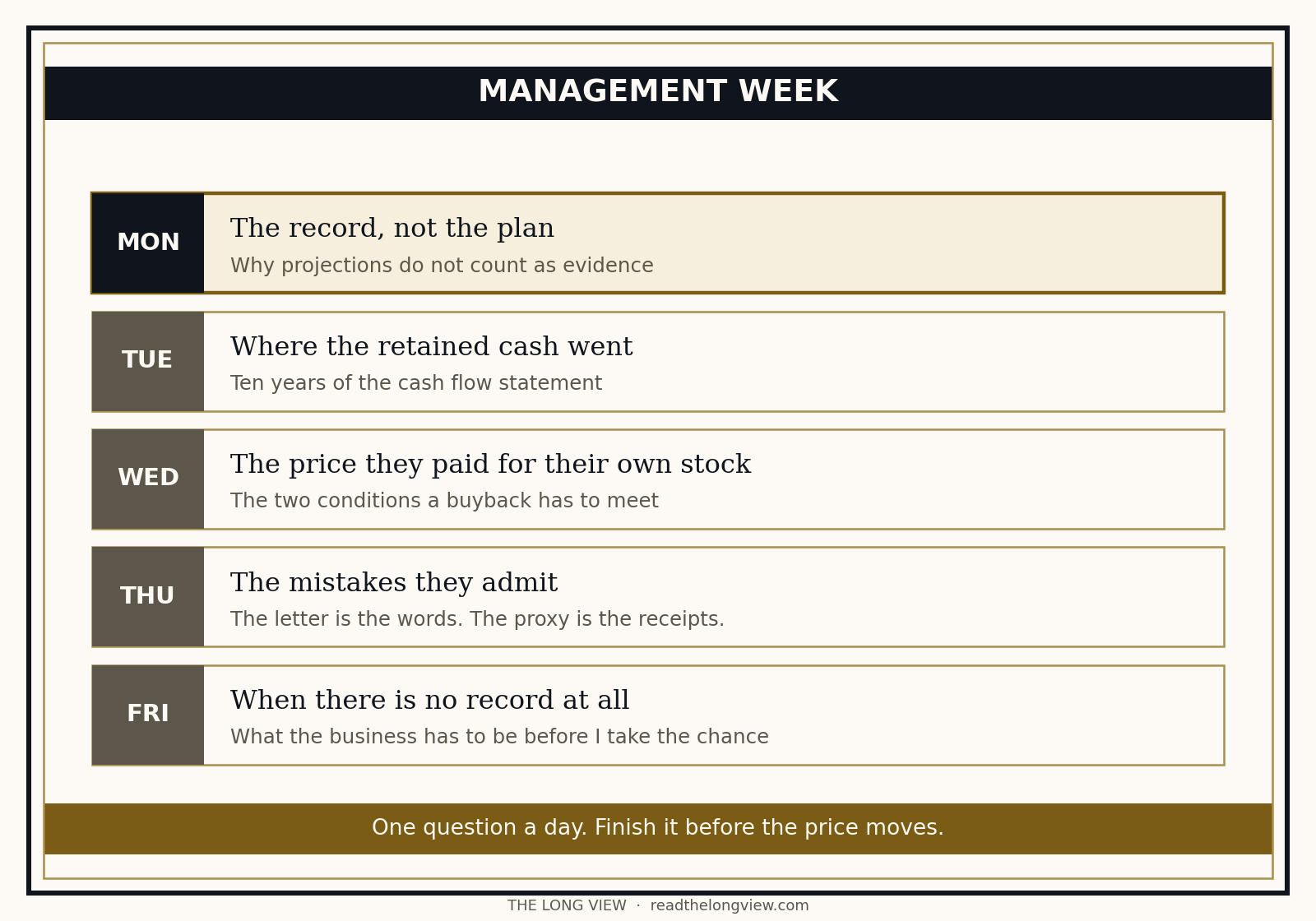
Four places the record shows up, and one piece about what to do when there is no record at all.
Tuesday: capital allocation, the one job that cannot be delegated, and how to read ten years of a cash flow statement to grade it. Plus the force Buffett called the institutional imperative, which explains why decent, intelligent managers spend money badly without any villain in the story.
Wednesday: share buybacks, and the two conditions Buffett has said must both be true before a repurchase helps you. This is the record across a full cycle, and it is where the $665 billion number gets uncomfortable.
Thursday: candor, which is the record in a bad year. How a management team writes about its own mistakes, and what the proxy statement says about them that the annual letter never will. The letter is the words. The proxy is the receipts.
Friday: the exception. Sometimes I want to own a business whose management has no long record to read, because the business itself is extraordinary. That is a real situation and pretending otherwise is dishonest. So Friday asks what the business has to be worth before I will accept an unproven team, where I draw that line, and why the line has to be drawn in advance. The full scorecard closes the week.
The point of doing this before the price moves
I do not forecast crashes. I prepare for them. That means keeping cash ready and keeping a short list of businesses I understand well enough to act on quickly, so that when fear does the pricing I am not starting my research from zero.
A short list built only on business quality and valuation is half a list. The other half is knowing, in advance, which management teams I would trust with a decade of retained earnings and which I would not. That work is slow, it is unglamorous, and it is impossible to do properly in the middle of a panic.
History gives you the setup, not the date. The scorecard is something you can finish before either one arrives.
Two tracks, as always. I am hunting new great companies I do not own yet. And I want to buy more of the great ones I already own when they go on sale, and lower my average on the ones I intend to hold forever. Both tracks run through the same question, which is whether the people inside will treat my money the way I would.
Tomorrow, the one job.