

Yesterday I said that most of a company you own gets assembled by one person’s decisions about money. That claim is useless on its own. It is a reason to go looking, not a way of looking, and if I leave it there I have handed you an anxiety instead of a method. So today is the method. Every decision a management team made about money over the last decade is sitting in a document you can download for nothing. There are only five things they can do with a dollar. Grading ten years of those choices takes an afternoon and no model, and it will tell you things an interview never will.
Yesterday I gave you the figure from Buffett’s 1987 letter without showing the work: ten years in, at an ordinary retention rate, one chief executive has deployed more than 60% of the capital in the business.
I should have shown the work. It is arithmetic and it takes one line.
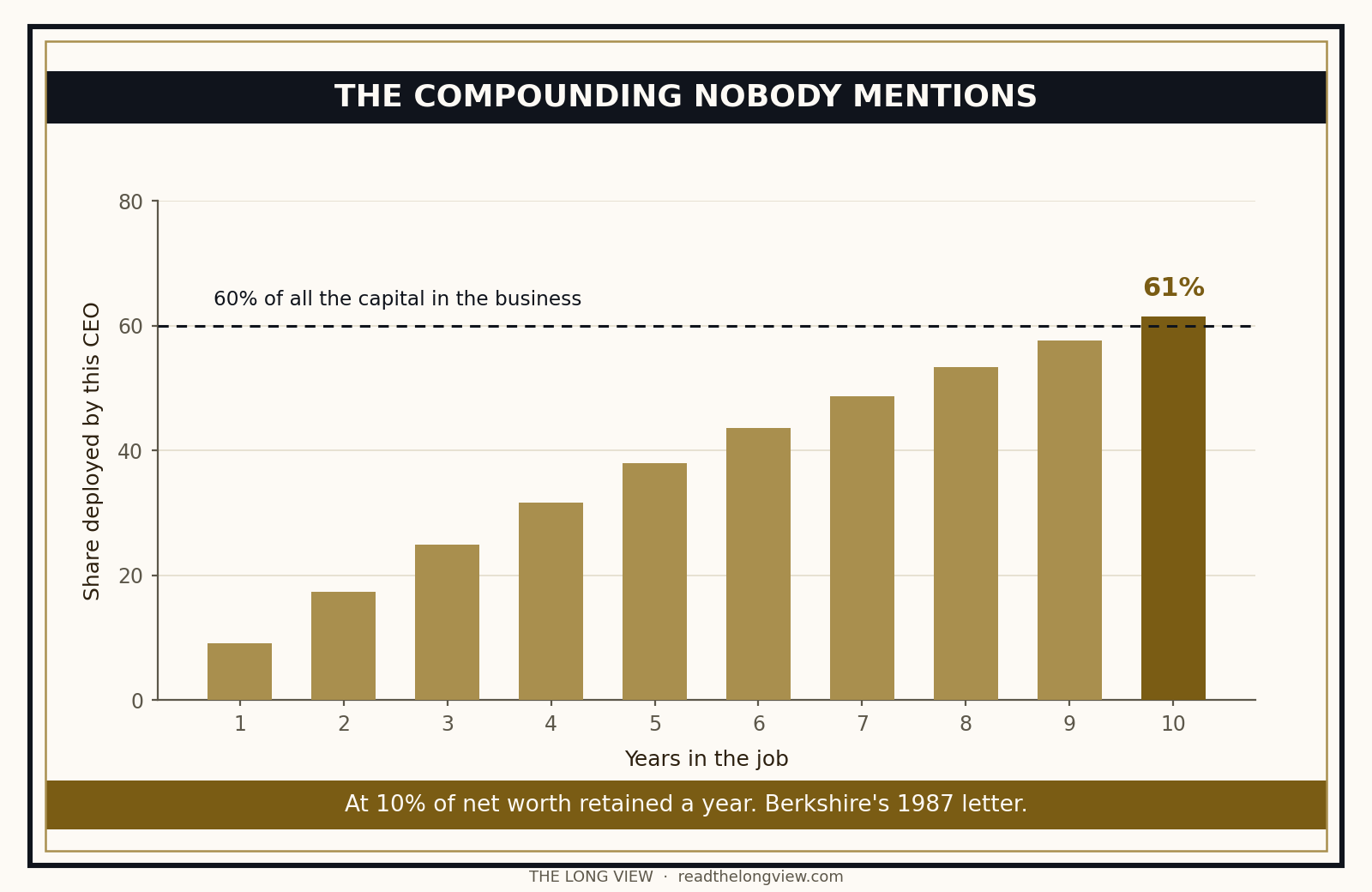
If a company retains 10% of net worth a year, the capital base grows by a factor of 1.1 each year. After ten years it is roughly 2.6 times its starting size, which means the original base is down to about 39% of the total and everything else arrived on this person’s watch. The share is one minus 1.1 to the power of negative ten, or 61.45%. At year five it is already 37.9%.
The number is not a rhetorical flourish. It is a division problem, and you can run it on any retention rate you like.
That is the reason I now open the cash flow statement before the income statement.
The part of that letter I skipped
There is a line in the same letter I let stand yesterday without the qualification it needs.
Buffett’s warning about chief executives who go looking for help with allocation, from staff, from consultants, from bankers, is not an argument against seeking expertise. Read that way it becomes an excuse for exactly the behavior this week is trying to catch, which is a manager bluffing through something they do not understand.
The warning is narrower and better than that. The allocation judgment itself cannot be handed to someone whose incentives differ from the owners’. An investment bank is paid when a transaction happens, so it is structurally in favor of a transaction. That is a fact about the arrangement rather than an accusation about anyone inside it.
Buffett also gave the problem its sharpest image, comparing a manager promoted into capital allocation to a gifted musician whose final promotion is not a performance at Carnegie Hall but the chairmanship of the Federal Reserve.
Hire past your weakness, keep the decision. Those two things together are the test, and either one alone fails it.
Five doors
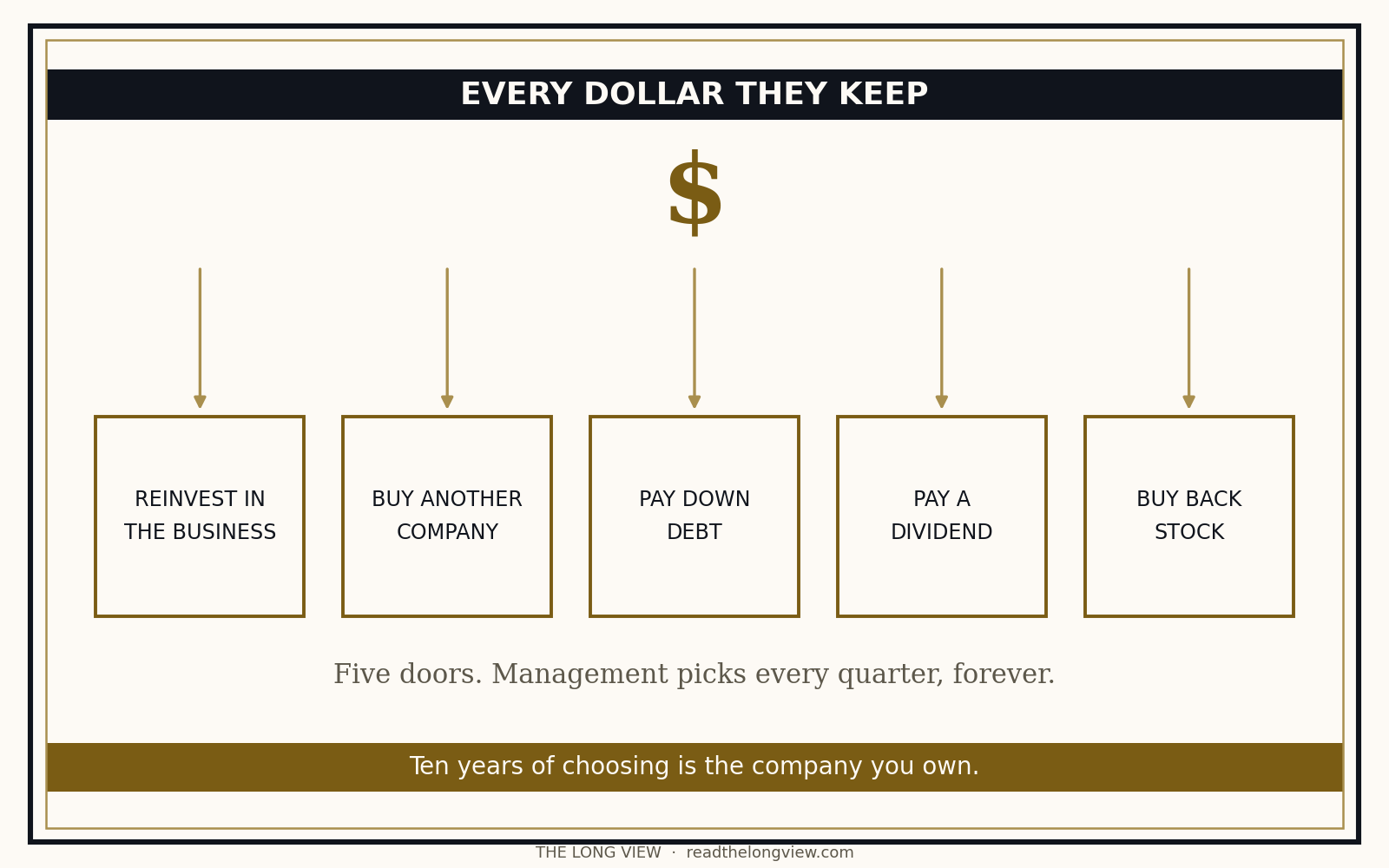
Every dollar a company keeps goes through one of five doors.
It gets reinvested in the existing business. It buys another company. It pays down debt. It goes out as a dividend. Or it buys back the company’s own stock.
That is the entire menu. Management picks, every quarter, forever.
Grading the picks does not require a model. It requires reading ten years of the cash flow statement in one sitting, which takes an afternoon.
It is worth knowing how uncommon that is, and I would rather give you a number than an impression. Tim Loughran and Bill McDonald, writing in the Journal of Behavioral Finance, used the SEC’s own EDGAR server logs covering 2003 to 2012 to count how often investors requested company filings. The average publicly traded firm had its annual report requested 28.4 times in the period immediately after filing.
Not 28,400. Twenty-eight.
Two limits on that figure, because it should not be stretched further than it goes. It counts direct requests to EDGAR, so it misses anyone reading the same document through a broker, a terminal, or a data provider. And the sample ends in 2012. What it does establish is that first-source filings were being pulled far less than the volume of commentary about those companies would suggest.
Here is what I look for.
Total the acquisitions over the decade and compare that total to what the acquired businesses are contributing now. If a company spent $4 billion buying things and the segment those things live in has not grown, that is an answer. Look for goodwill write-downs, which are the accounting admission that a company paid more for something than it turned out to be worth. A decade with several is a decade of overpaying.
Compare capital spending to depreciation. When a company consistently spends far more on plant and equipment than it is writing off, it is either growing hard or running to stand still, and the two look identical in the cash flow statement until you ask which.
Track the share count. Not the buyback dollars, the count. Dollars spent tell you what they did. The count tells you whether it worked.
The number that separates growth from running in place
This is where Buffett gave us a tool, in an appendix to his 1986 letter, and it is the one I use most.
He called it owner earnings. Take reported earnings, add back depreciation, amortization, and other charges that did not involve cash going out the door, then subtract the capital spending the business needs simply to hold its competitive position and its unit volume. That last piece is maintenance capital expenditure, meaning the money spent to keep what you already have rather than to build something new.
What is left is roughly what an owner could take out of the business in a year without weakening it.
The distinction matters because the common measure, free cash flow, subtracts all capital spending and therefore treats a dollar of growth investment the same as a dollar spent replacing a worn-out roof. Those are not the same dollar. One is optional and should be judged on its expected return. The other is a cost of staying in business.
Buffett was direct about why he bothered. Owner earnings, not the reported figures, are the relevant number for valuation, both for investors buying stocks and for managers buying whole businesses.
The catch is that companies do not report the split. Estimating how much of capital spending is maintenance and how much is growth is a judgment call, and two careful people will land in different places. That is a feature rather than a bug. The exercise forces you to ask where the returns are coming from, using a split the company did not choose for you.
A business that must spend heavily every year just to stay where it is has less to give you than its earnings suggest. That gap is not reported. You have to compute it.
The tests travel. The documents change.
Everything I have described so far assumes a particular kind of company. One that generates cash, keeps some of it, and spends it on things you can point at. That describes a lot of businesses. It does not describe all of them.
I want to be direct about this, because a method that only works on Berkshire-shaped companies is not a method. It is a preference.
The five questions generalize completely. Where did the capital go, what return did it earn, how much of the spending was just standing still, what price did they pay for their own stock, and is there a quick way out. Those hold for any company anywhere. What changes is which document answers them.
For a company that has never retained a dollar, the whole thing inverts. There is no retained cash to trace, so the allocation record is what they raised and what they surrendered to raise it. The share count going up is the document, not the share count coming down. Dilution history is the cash flow statement of a business that has not started generating cash yet.
For a business whose main investment is people rather than plant, the spending runs through the income statement as research and sales rather than appearing as capital expenditure. The maintenance-versus-growth question is still exactly right. You will not find the answer in the cash flow statement, because there is nothing to find there.
And the return-on-equity test needs a correction that Buffett’s own framing can obscure. Penalizing a company for growing its equity base is correct for a mature business and wrong for one earning high returns on every incremental dollar, where retaining everything is the right decision. The general form of the question is the return on new capital, not the level of return on all capital.
One more, for anyone holding something listed outside the United States. There is no proxy statement to read. Barclays, to take one I own, discloses the equivalent in a UK remuneration report. Different document, same question.
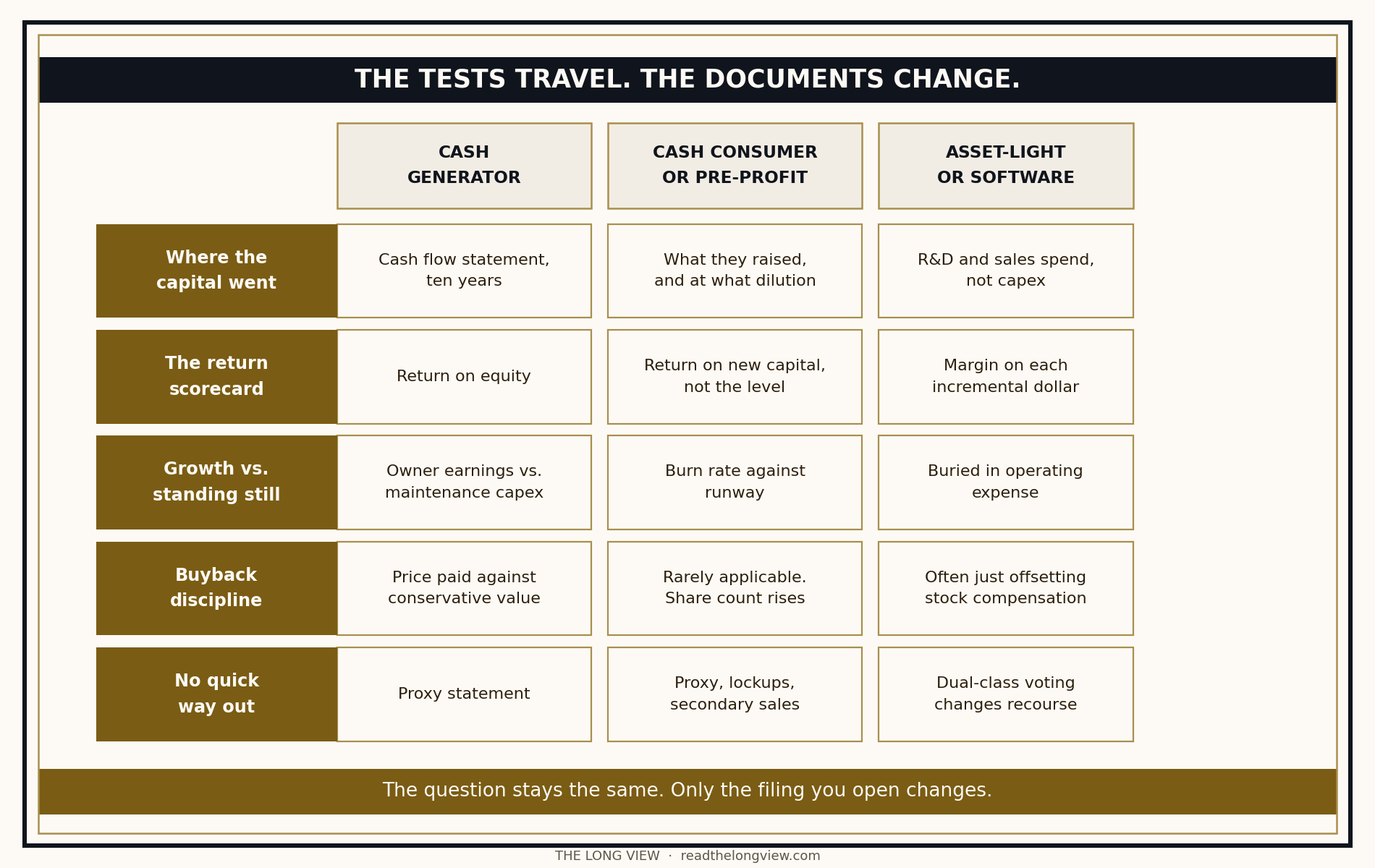
The instrument is not the test. If you cannot find the filing, that does not mean the question stopped applying.
Why decent, intelligent people spend money badly
None of this explains why capital gets misallocated so consistently. Bad managers would explain a few cases. It would not explain the pattern.
Buffett’s answer came in his 1989 letter, in the section reviewing his first twenty-five years of mistakes, and he called it his most surprising discovery. He named it the institutional imperative.
His starting assumption had been that decent, intelligent, experienced managers would make rational business decisions more or less automatically. He learned that this is not so, and that rationality tends to wilt when the imperative comes into play.
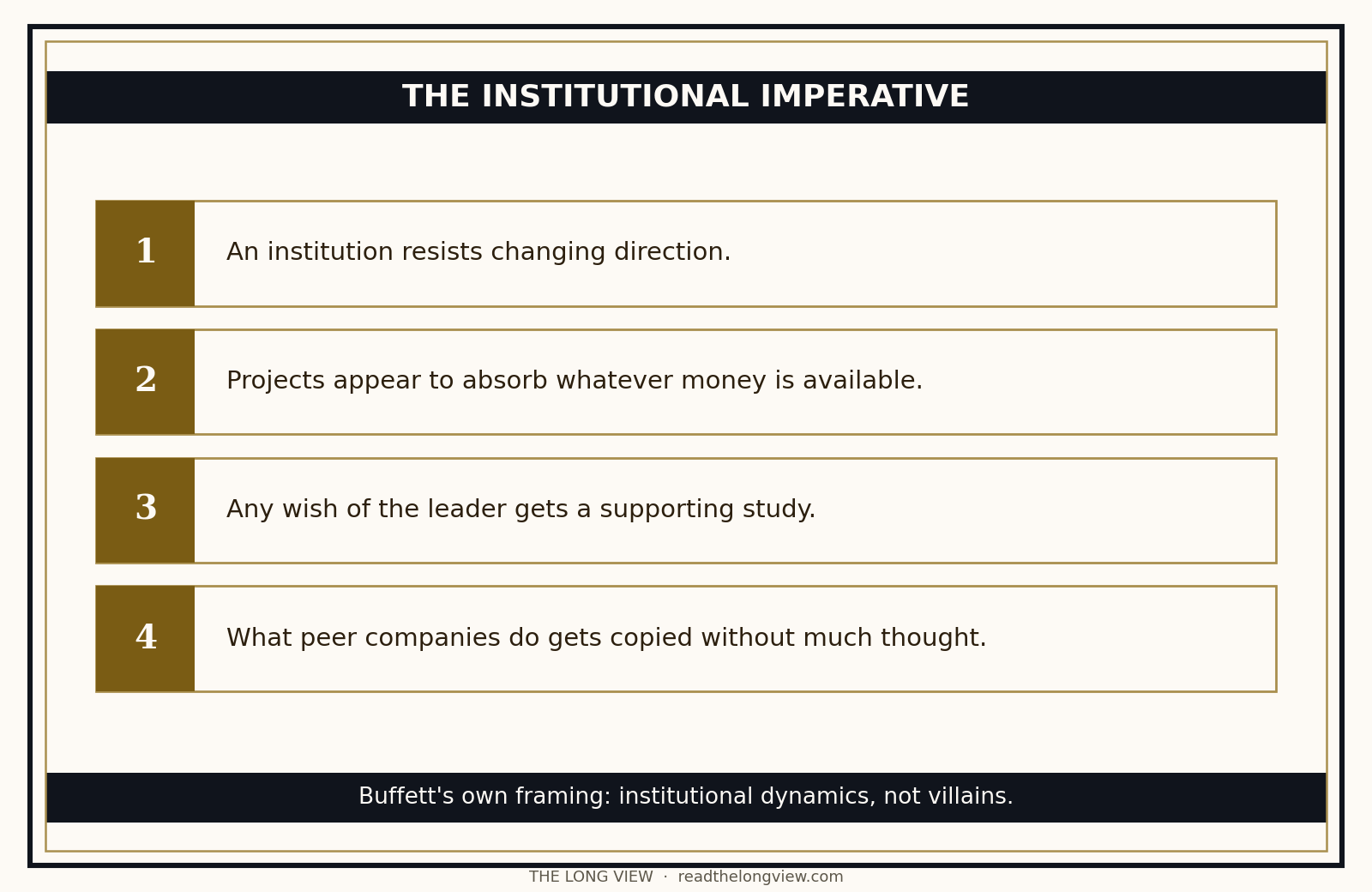
He described four mechanics. An institution resists any change in its current direction, the way an object in motion resists a change in course. Projects and acquisitions materialize to absorb whatever funds happen to be available. Any wish of the leader, however poorly founded, gets supported by detailed rate-of-return studies prepared by the people who work for that leader. And the behavior of peer companies, whether in expanding, acquiring, or setting pay, gets copied with little thought.
Then the line that makes it useful rather than cynical. These are institutional dynamics, not venality or stupidity.
That distinction is why I can write about this without picking a side about anyone. Nobody in this description is a villain. The mechanism runs on ordinary incentives inside ordinary organizations, and it runs hardest when there is a lot of money around and everyone in the industry is moving the same direction at once.
Buffett’s response was structural rather than moral. He wrote that after some expensive mistakes he tried to organize and manage Berkshire in ways that minimized the imperative’s influence, and to concentrate investments in companies that seemed alert to the problem.
That last clause is a management test in five words. Does this team seem alert to the problem.
What that means to look at right now
I will describe the mechanics and leave the conclusions to you.
Yesterday I put two numbers in front of you without comment, the capital spending guidance across the largest technology companies and the record start to a year for buyback announcements. Here is the comment.
Hold those numbers against the second and fourth mechanics. Projects materialize to absorb available funds. Peer behavior gets copied.
I am not saying the spending is wrong. I have no idea, and neither does anyone writing confidently about it. I am saying that this is the exact set of conditions under which the imperative operates most strongly, and that the question worth asking about any individual company in it is narrow and answerable: does this particular management team behave like a group that is alert to the problem, or like a group that is matching its peers.
The difference shows up in what they say no to. A team that has declined something available to it, publicly, and explained why, has told you which one it is.
The afternoon
Pick a company you own. Not one you are considering, one you own.
Open ten years of cash flow statements. Total the acquisitions. Find the write-downs. Compare capital spending to depreciation. Track the share count, not the dollars.
You will finish with a view of that management team built from what they did rather than what they said, and you will have it before the price moves rather than during.
The short list I keep is supposed to be businesses I could act on quickly. For years that list was built on quality and price. This is the column I never filled in.
There is one thing this afternoon cannot tell you, and I want to name it rather than let you find out later.
Everything above reveals what management did. Totals, write-downs, the direction of the share count. None of it reveals whether they got a good deal. A company that spent $4 billion on acquisitions and a company that retired 8% of its shares both show up as activity, and activity is not the same as judgment. The price they paid is a separate question, and it is the one that separates a disciplined allocator from a busy one.
Tomorrow I take the fifth door on its own, because it is the only one of the five where the price is visible to you in advance.
Not investment advice. The subscriber decides.