

Somewhere in the ten years of numbers you pulled on Tuesday there is a bad year. A write-down where a company admitted paying too much for something. A stretch where the buyback dollars went out and the share count did not move. You found it in a document that had no choice about telling you, because the accounting rules made the company put it there. Now go and find that same year’s letter to shareholders, the one the chief executive chose every word of, and see whether the thing you found gets mentioned at all. That comparison is today’s whole test, and it is the first one this week that cannot be done with arithmetic.
There are two kinds of document in a company’s file, and the difference between them is the reason this piece exists.
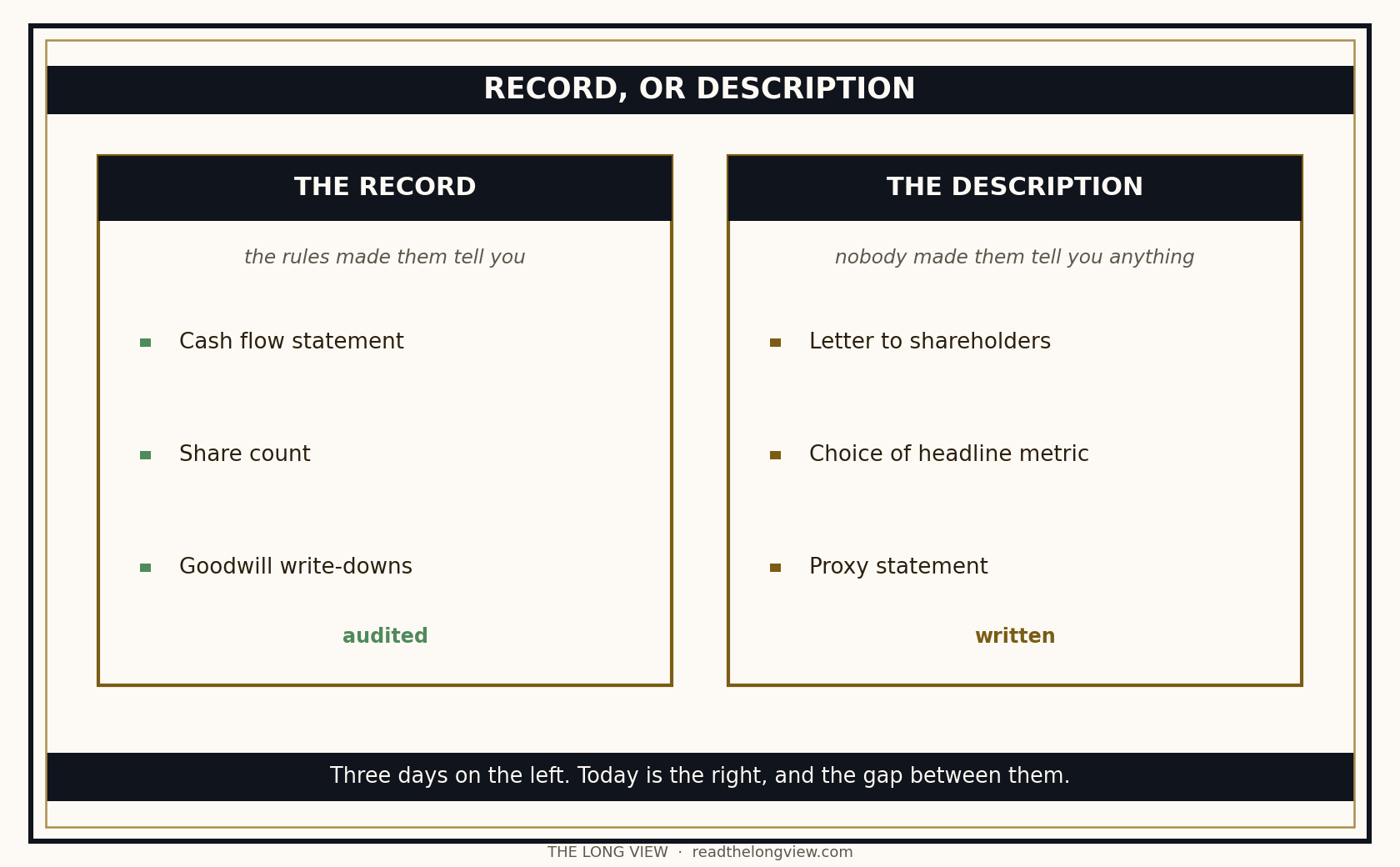
The financial statements are a record. They are governed by accounting standards, audited by someone paid to disagree, and largely not a matter of choice. When a company overpays for an acquisition, the goodwill write-down appears whether anyone wants it to or not.
The letter to shareholders and the proxy statement are self-report. Nobody is required to be interesting, specific, or forthcoming in either. They are the company describing itself, and description is where a management team has the most freedom and therefore reveals the most.
Three days of this week have been spent on what a team did. Today is about what they say they did, and the gap between the two is not a rounding error. It is the finding.
Sixteen
The cleanest version of this comes from Buffett auditing his own vocabulary.
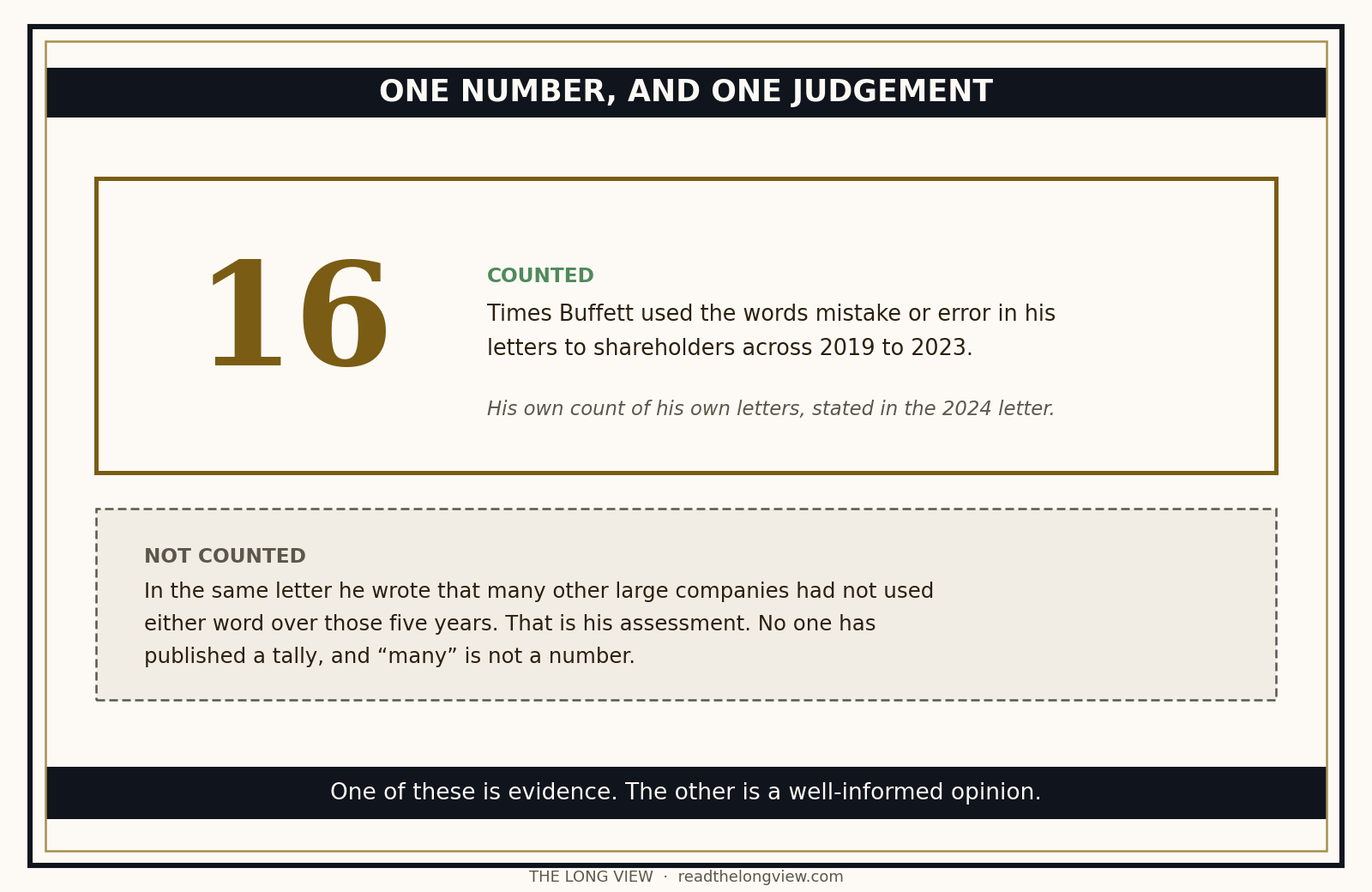
In his 2024 letter to Berkshire shareholders, he reported that across the 2019 to 2023 period he had used the words mistake or error sixteen times in his letters, and added that many other large companies had not used either word once over the same five years.
He named a single exception. Amazon’s 2021 letter, which he credited with some hard observations about itself. The general run of corporate communication to owners he described as pleasant talk and photographs.
Then the detail that gives the count its weight. He wrote that he had served as a director of large public companies where mistake and wrong were effectively forbidden words at board meetings and on analyst calls, and that the implied claim of managerial perfection made him uneasy.
His own qualification stays attached, because he included it. There are circumstances where legal exposure makes limited discussion the sensible course. This is a litigious country and that is a real constraint.
Buffett credited Munger with the harder half. Munger’s position was that the sin is not the mistake, it is delaying the correction of it, which he called thumb-sucking. Problems cannot be wished away and they require action, however uncomfortable that is.
Which tells you what the count is measuring. Naming an error in writing is the cheap part. It matters because a team unwilling to say the word in a letter, where saying it costs nothing but discomfort, is not likely to be the team that moves fast when the same problem shows up in the business, where acting costs real money.
The count is useless without a denominator
Here is where I have to be careful, because a raw number tells you nothing.
Sixteen is meaningful for Berkshire because Buffett published it about himself over a defined period. You cannot take that figure to another company and grade against it. A team with three admissions in five years is not automatically worse than one with eight, and a company with zero might have had an uneventful five years.
The denominator you need is not a benchmark from outside. It is the work you already did.
You have ten years of cash flow statements from Tuesday. You know what they bought, what they later wrote off, and which way the count moved. You have the average price paid for their own stock from Wednesday. Somewhere in that decade there is at least one year where the numbers went badly, and you know which year it was, from a document the company did not get to write freely.
So the test is not how many times they used the word. It is whether they used it about the thing you already found.
Pull the letter for that specific year. Three outcomes, and they are easy to tell apart.
They named it, described what went wrong, and said what they were doing about it. They mentioned it in language so general it could have described any year at any company. Or the year that produced a write-down was characterised as a period of investment, discipline, or repositioning, and the write-down does not appear.
A team that admits a mistake you had not found is candid. A team that admits the one you were always going to find is doing arithmetic of a different kind.
That last distinction is worth holding. Timing is part of the test. An error named in the year it happened is a different signal from the same error acknowledged three years later, once the market has priced it and the admission costs nothing.
What the research supports, and what it does not
There is data pointing the same direction, and I want to state it at exactly the weight it can carry.
Feng Li, in the Journal of Accounting and Economics in 2008, found a statistically significant relationship between annual report readability and company performance. Firms with lower earnings produced reports that were harder to read, and firms whose reports were more readable had more persistent earnings. Researchers in the field call the pattern obfuscation.
The measurement has been challenged. Loughran and McDonald argued in 2014 that the Fog Index used in much of that work scores ordinary financial vocabulary as complexity, which makes it a poor instrument for business text.
So the direction has held up under other measures and the instrument is disputed. That supports a modest claim rather than a sweeping one. How a company writes about a bad year is not noise, and it is not proof.
Two smaller tells, both free
The headline metric. Every company chooses which number to lead with, and Buffett has been blunt about his own choice, dismissing EBITDA as a flawed favorite of Wall Street and reporting operating earnings instead. The tell is not which measure a company picks. It is whether the pick moves. A team that has led with the same number for a decade through good years and bad is reporting. A team whose headline figure migrates to whatever looked best that year is presenting.
The outside account. Monday I introduced Fisher’s scuttlebutt. Here is where it earns its place, because the letter is the company’s version of the year and customers, suppliers, competitors, trade press and job postings are versions written by people with no reason to improve it. Where the two agree you have learned little. Where they diverge, the direction of the divergence tells you which one was managing an impression.
What they took while they were writing it
The proxy statement is the second self-report, and it is the one with numbers in it.
In the United States it is filed as a form called the DEF 14A, ahead of the annual shareholder meeting. It sets out executive compensation in detail, the terms attached, and what shareholders are voting on. It is written by the company about the company, which puts it on the same side of the line as the letter.
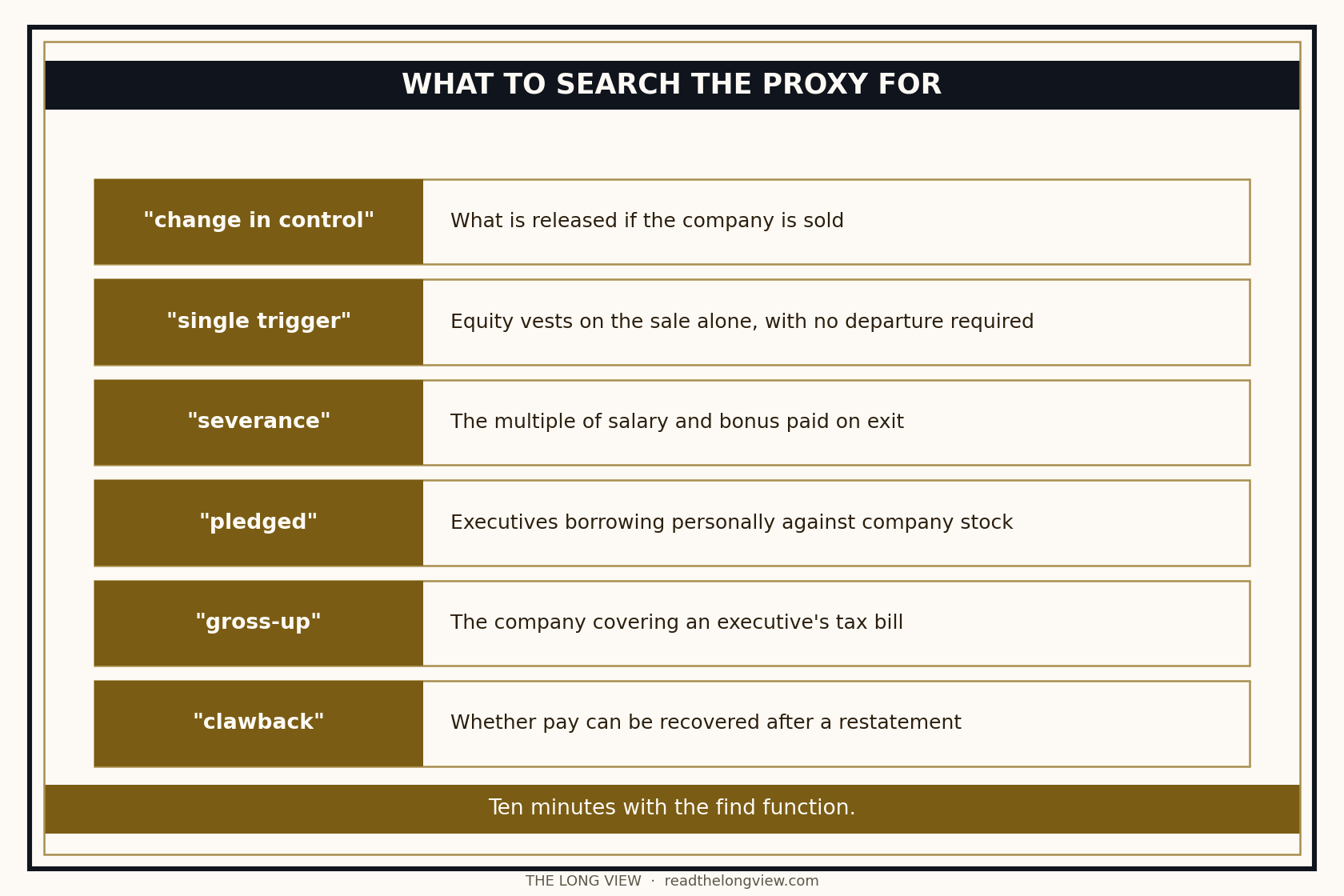
Four things in it are worth ten minutes. Severance multiples and change-of-control provisions, meaning what an executive receives if the business is sold or they leave. Whether equity vests on a single trigger, releasing on the sale alone, rather than a double trigger requiring both the sale and a qualifying departure. Share pledging, where executives borrow personally against company stock, which quietly converts an owner into someone who needs the price to stay up. And how much of the package depends on results that already happened rather than on remaining employed.
Shareholders have been voting on some of this and the votes have moved. According to the Harvard Law School Forum on Corporate Governance’s review of the 2026 proxy season, average support for advisory votes on change-in-control pay fell from roughly 86% in 2024 to about 74% this year, with a record ten of those votes failing.
Then read the two self-reports against each other, because they cover the same twelve months and they can disagree. A letter naming a decision that went wrong, filed alongside a proxy showing the full package paid as though nothing did, is two accounts of one year. So is the reverse.
Why this is the day the week has been pointing at
Monday I said the trait I look for is narrower than intelligence. Whether a person knows what they are not good at, and acted on that knowledge when bluffing would have been easier. I said it was the thread running through every test in this series, and then I spent three days on arithmetic without coming back to it.
Here is why it had to wait.
Self-awareness does not appear in a cash flow statement. It cannot. A write-down records that a company paid too much; it says nothing about whether anyone involved understood why. The share count records that a repurchase happened; it does not record whether the team knew what the shares were worth when they bought them.
The trait only becomes visible at the moment a management team is free to describe itself and chooses to describe itself accurately. That moment is the letter. It is the one document where the cost of honesty is entirely borne by the person writing it, and where the reward for the alternative is immediate.
Every other test this week measures a decision. This one measures whether they can see the decision clearly, which is the thing that predicts the next one.
What this still cannot tell you
Everything so far has assumed a record exists.
A decade of financing lines to total. Enough share counts to see a direction. A shelf of annual letters long enough to compare one against another. A proxy with years behind it rather than a single filing.
Some of the businesses I most want to own have none of that. The company is young, the team is new, and there is no decade to read. That is not a hypothetical and it is where the framework this week has built either holds or breaks.
Tomorrow, the exception.
Not investment advice. The subscriber decides.