

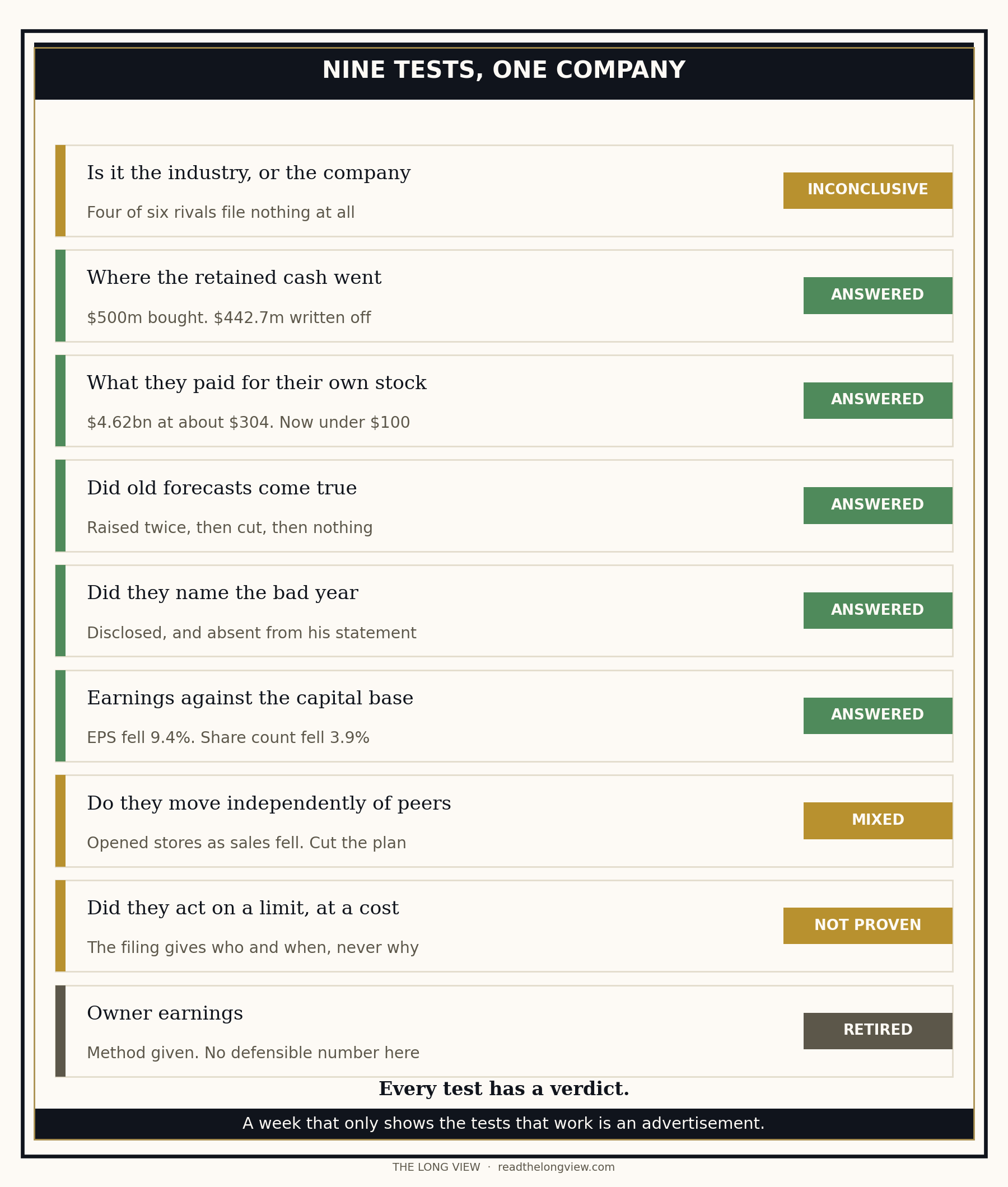
Six days ago I said I would run a management review in public on one company, using the method I had spent the previous week describing, and that where a test could not be run I would say so rather than skip it quietly. That second promise turned out to be the harder one. Nine tests went into it. Six produced a clear answer. Two came back not proven or inconclusive, and in both cases I can tell you the document that would settle it. One I retired, and the reason is more useful than the test would have been. Today is the whole ledger, what it says about the team that just left, what it cannot say about the one that just arrived, and what I would watch from here.
Start with what the week was for.
The method, and why it transfers
Everything this week came out of documents anyone can download, for nothing, without a subscription or a terminal.
The cash flow statement. The annual report. The results release. The proxy. An earnings call transcript. That is the entire toolkit, and the tests run on it are arithmetic rather than judgment: divide this by that, put the answer next to the trading range, read the paragraph the chief executive wrote freely, count what changed.
None of this requires an opinion about a business. It requires the patience to open eight filings instead of one.
That is the transferable part, and it is why the specific company matters less than the sequence.
What they were good at
Start where the evidence is strongest, because a review that only finds faults is not a review.
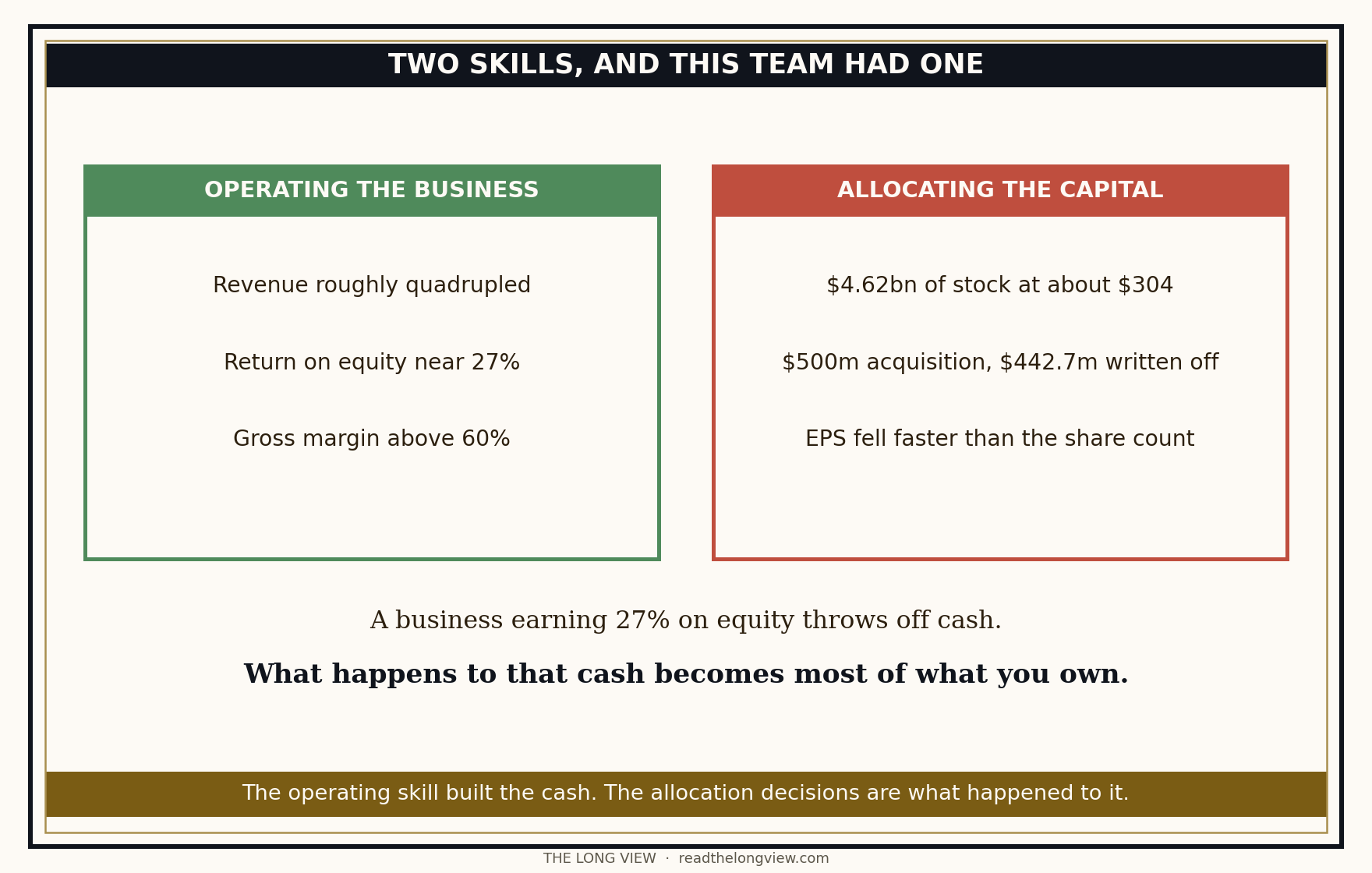
This management team ran the business well. Revenue roughly quadrupled over the departing chief executive’s tenure. In fiscal 2022 the company earned $854.8 million on stockholders’ equity of $3.15 billion, a return on equity near 27%, which is a level most large companies never reach. Gross margin sits above 60%. The brand became strong enough that walking past a store tells you nothing is obviously wrong.
What that tells you: the operating half of the job was done properly. Product, stores, brand, people. Whatever went wrong later did not go wrong because nobody could run a shop.
That matters for what follows, because the rest of this is not a story about incompetence.
What they were expensive at
The other half of a chief executive’s job is deciding where the money goes, and this is where the record separates.
They bought one company and wrote most of it off. MIRROR cost $500 million in 2020. By the fourth quarter of fiscal 2022 it had been written down by $442.7 million after tax. The company had disclosed the goodwill risk itself, in the annual report filed in March 2021, along with the observation that its management had limited experience in that area.
They bought their own stock as it got more expensive. Across fiscal 2021 to 2025, 15.2 million shares for about $4.62 billion, an average near $304. The stock traded below $100 last week. The largest single year, $1.6 billion in fiscal 2024, came at the second-highest price of the whole series.
And the capital base test confirms it from the owner’s side. Between fiscal 2024 and 2025 the share count fell 3.9% while earnings per share fell 9.4%. The buybacks were pushing that number up and it went down anyway.
One fact cuts the other way and belongs here. Through the most recent half, with sales at existing stores falling 9%, the company opened nine net new stores. It also cut planned net new openings for the year from 40 to 35, and pop-ups from 65 to about 40, publicly and with a reason. A team under pressure that reduces its own expansion plan is doing the harder thing.
What that tells you: two different skills, and this team had one of them. A 27% return on equity says the business converts capital into profit efficiently. Paying $369 a share for that business in 2021 was a separate decision, made by the same people.
That distinction is the single most useful thing a run of annual reports will give you, and it is invisible in any one year.
The announcement, and what it did not say
One document from that acquisition is worth reading closely, because it teaches something that outlasts this company.
The 8-K filed on 29 June 2020 says the purchase will advance the company’s strategic vision by strengthening its omni guest experiences through digital sweat, and will bolster its digital sweatlife offerings.
Two phrases there need translating. Omni guest experiences is retail for selling to the same person through more than one channel: shop, website, app, and now a screen on their wall. The sweatlife is the company’s own coined term for its customer’s life around exercise.
Strip both out and the strategy underneath is coherent, and I want to be fair about that. We sell clothes to people who exercise. Today we see them when they need leggings. If we sell them the workout, we are in their house every day and a subscription pays us monthly rather than occasionally. That is a real idea, and Peloton had shown the model could work.
So the purchase was not frivolous in concept. The questions sit elsewhere: $500 million for a business launched two years earlier whose own forecast for that year was $100 million, bought while gyms were shut and home fitness was among the most crowded trades in retail.
And here is what the announcement does not contain. A number. No expected return on the $500 million. No payback period. No revenue or margin target. The only financial expectation attached to the deal that day came in a television interview rather than in the filing.
So a test, and it takes two minutes on any acquisition announcement. Translate the jargon into plain language, then ask what the rationale promises in figures.
The translation matters as much as the figures, because jargon is not merely ugly. It is untestable. “We expect to convert 5% of our guests to a $39 a month subscription” is a sentence you can check in two years. “Deepen our roots in the sweatlife” is a sentence nobody can ever be wrong about.
A rationale you cannot translate into a checkable claim is a rationale nobody can be held to. That is the warning, and it is separate from whether the strategy is any good.
What they said about it
A record tells you what happened. The account tells you how a team handles what happened, and those are separate pieces of evidence.
The forecast. At the acquisition, more than $100 million of revenue that year and break-even the next. Raised to more than $150 million. Raised again to $250-275 million. Cut to $125-130 million. Then written off. It rose twice before it fell, which means confidence increased while the evidence was turning.
The description. At the purchase, the business was fuelling the company’s growth plan. Explaining the write-off, the finance chief called it a very small portion of management’s five-year plan. Same business, same team, the stated importance falling with the value.
The statement. In the release carrying a $442.7 million write-off, the chief executive’s own paragraph described strong results, continued high performance and enduring brand strength. The impairment was disclosed elsewhere in that release and he named it on the call when asked. It is not in the paragraph he chose the words for.
What that tells you: nothing improper, and a consistent preference. Given a choice about emphasis, this team took the favourable one, every time, in the places where the choice was theirs to make.
The three I could not settle
Three tests did not produce a clean answer, and in each case the reason is worth more than the result would have been.
Is the decline the industry’s or the company’s. Inconclusive, because four of the six companies competing for this customer are private and file nothing. The one comparable public business, Athleta, fell exactly the same 12%. What would settle it: filings that do not exist. If you hear someone state confidently that Lululemon is losing share to Vuori or Alo, ask where the number came from.
Did they ever act on a limit, at a cost. Not proven. Form 8-K Item 5.02 records senior arrivals and departures within four business days, and it gives who and when but never why, because the SEC considered requiring reasons and dropped it over defamation risk. What would settle it: an appointment where a leader hands a function to someone who has fixed that exact problem elsewhere, read alongside the letter that explains it.
Owner earnings. Retired. The method is to treat depreciation as maintenance spending and capital spending above it as growth. On this company it does not hold: between $167 million and $183 million a quarter went into a distribution centre project, new stores, relocations, renovations and technology, and a relocation is maintenance and growth at once. What would settle it: a business with a stable asset base, where the proxy works. Not this one, not this year.
Not proven is a verdict, not a gap. It means the evidence does not exist, rather than that it came back against them, and treating those as the same thing is how a framework starts convicting people for being new.
So how do I read this management team
Competent operators who were poor at the part of the job that compounds.
That is not a soft verdict and it is not a harsh one. It is the specific finding that emerges from reading the filings in sequence rather than one at a time, and it is worth being precise about why it matters.
A business earning 27% on equity throws off cash. What happens to that cash is the whole question, because over ten years it becomes most of what you own. Buffett’s arithmetic puts it at more than 60% of all capital in the business after a decade at modest retention rates. This team put $4.62 billion of it into their own shares at roughly three times today’s price, and $500 million into an acquisition that was written down by $442.7 million after tax.
The operating skill built the cash. The allocation decisions are what happened to it.
And the account they gave has a consistent shape. Forecasts revised upward before they were cut. A business described as central on the way in and peripheral on the way out. A write-off disclosed where required and absent from the paragraph written freely. None of it improper. All of it in the same direction.
That direction is the finding. One favourable choice is a coincidence. Three separate ones, across three different documents, over three years, is a disposition. And a disposition is the thing you can expect to continue, because it is the part that does not depend on the business.
What Buffett’s own criteria would say
Last Monday I started with the list Berkshire printed in the back of its annual report for years, because it is the shortest honest statement of what a buyer of whole businesses wants. It is worth finishing the week by running this company against it.
Demonstrated consistent earning power. Passed, historically. Revenue quadrupled, margins were strong for a decade, the record is real. But the same criterion says future projections are of no interest and, in the same breath, no turnaround situations. That is the sentence that bites. A business with comparable sales falling 12% in its largest market, a category shifting underneath it, and a new chief executive brought in to fix it is a turnaround, whatever else it is.
Good returns on equity while employing little or no debt. Passed, and comfortably. A return on equity near 27%, and the balance sheet carries no borrowings under its credit facility.
Management in place. This is the one the whole week has been about, and the answer is the most interesting of the three. The criterion exists because Buffett does not want to supply management. He is buying a team as much as a business. A company that changed chief executive last Tuesday has management in place in the literal sense and not in the sense the criterion means, which is a team whose record you can read.
So the verdict against that list is clean and it is not close. The economics pass. The turnaround exclusion fails. And the management criterion returns the same answer this week has returned throughout: not yet knowable.
That is not a reason to walk away. It is a reason to know which question you are waiting on. Most of what has been written about this company since the announcement is about whether the new leader is the right choice. The criterion says something narrower and more useful: you cannot know yet, and here is what would tell you.
What a change of management does to a review
This is the part I would want if I were reading rather than writing, because the situation is more common than it looks. Somebody leaves, somebody arrives, and every review written in that window is confused about which record it is describing.
Some tests survive a change and some reset.
The business does not change when the chief executive does. Return on capital, gross margin, the strength of the category, the balance sheet, the competitive set. All of that is still true on Wednesday. Everything I found about this business survives the transition intact.
Everything about the people resets to zero. The allocation record, the candour record, the forecasting record, the trait. Not to a bad score. To no score.
The departing record becomes the bar, not the verdict. This is the distinction that took me most of the week to say properly. Calvin McDonald’s capital decisions tell you nothing about Heidi O’Neill. What they tell you is what a good outcome and a poor one look like at this specific company, which is the yardstick you hold up to whatever she does next.
And a transition hands you something you do not usually get. A new chief executive has an incentive that a continuing one does not: problems named early in a tenure belong to a predecessor, and problems named later belong to her. Write-downs, restructurings and honest disclosures cluster early in a tenure for exactly that reason.
Which cuts both ways, and you should know both.
The favourable reading is that you are about to learn more about this business in two quarters than the previous two years disclosed, because it is temporarily in her interest to tell you.
The unfavourable reading is that the same incentive makes early candour cheap. Naming a problem you did not create costs nothing. The test that matters is the second one, when the problem is hers.
That is why the watchlist below runs on documents rather than on the next few months of announcements.
Why this matters if you invest for yourself
Because it is the part of the work that nobody does for you.
Analyst coverage will tell you what the business might earn next year. Nothing in it will tell you what this team did with $4.62 billion, whether they raised a forecast before cutting it, or whether they named a loss in the paragraph they wrote themselves. Those are all knowable, all free, and all sitting in documents that require nothing but the patience to open them.
A self-directed investor’s real advantage is not better information. It is being willing to read the boring documents that contain it.
There is a second advantage, and it is the one this week was really about. You can do this before the price moves. Everything here was available months ago. None of it required knowing what the stock would do. When a price does fall far enough to interest you, the management work is either already done or it is being done in a hurry, and hurried work is how people talk themselves into things.
What happens next
Heidi O’Neill started on Tuesday. She has run this company for days, and nothing in this week’s evidence is hers. I am not going to grade her on a record she did not make.
What I will do is watch four documents.
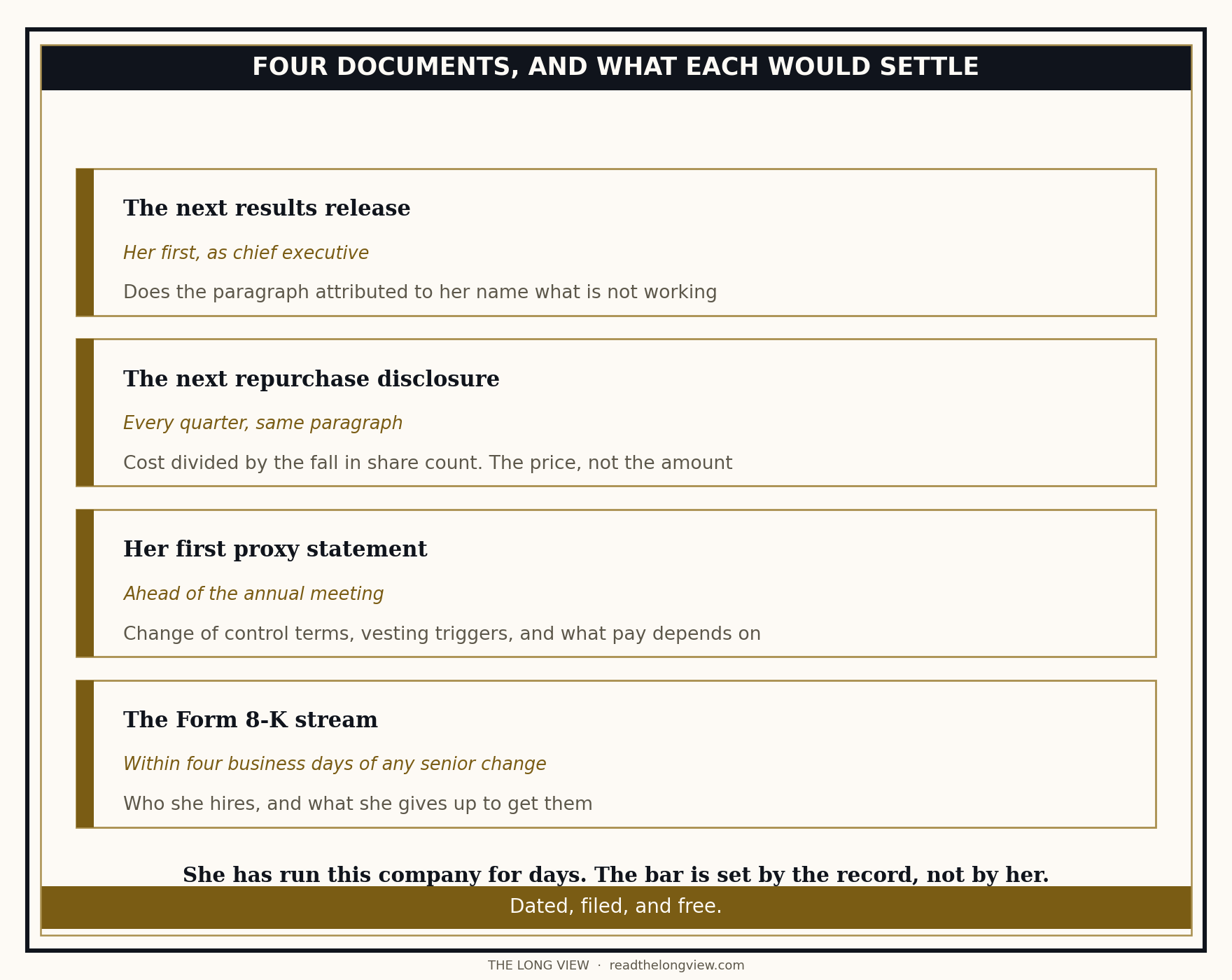
The next results release, and specifically the paragraph attributed to her. Does it name what is not working, in the quarter it happens.
The next repurchase disclosure. About $713 million of authorisation remains and the company has said it expects to keep buying at 2025 levels. The test is not the amount. It is the average price, which is the cost divided by the change in share count, and it appears in the same paragraph every time.
Her first proxy statement, which will set out the terms of her arrangement: what vests on a change of control, what severance looks like, and how much of her pay depends on results that have already happened.
The 8-K stream, for who she hires and what she gives up to get them. The record will not say why, but it will say who and when, and if she brings in someone who has fixed this exact problem elsewhere, that is a decision with a cost attached.
Those four are dated, filed and free. Between them they would answer most of what this week could not.
And one thing this week did not touch at all. I have not valued this business. Everything above is one test of several, run deliberately in isolation so that a falling price could not make the evidence look better than it is. Whether the price is attractive is separate work, and if I do it, it will be its own week with its own standard of proof.
Which leaves the honest summary of six days, in a sentence.
A good business, run well and allocated badly, handed to someone with no record at it, at a price that has fallen far enough to make all of that worth knowing.
Three of those four things I can tell you from filings. The fourth arrives over the next year, in documents that are already scheduled.
Not investment advice. The subscriber decides.