


This quarter the revenue grew on price, the volume barely moved, and the margin fell. The headline was a win. The one thing the valuation needed did not happen.
In June we published a piece on Sherwin-Williams. We did not argue about whether the moat is real, because it obviously is. We named the one thing the price depended on, wrote down what would confirm it, and classified the stock Watch. It reported last week. This is the grade, against that bar.
The price set the height of the bar
Start with the number that defined the test. Sherwin-Williams traded at roughly 29 times earnings going into this print. That multiple is not a description of the company. It is a prediction, that housing normalizes, contractor demand returns, and Sherwin converts that recovering volume into earnings through the operating leverage in its store network. A stock at 29 times is not being asked “is the business fine.” It is being asked “is the business about to compound faster than it has been,” because the price already assumes it.
That is what we mean when we say price sets the height of the bar. At a lower multiple, Sherwin would only have to prove its story was intact. At 29 times, it has to prove something harder: that volume is coming back, and that the volume is converting into expanding margins. Revenue growth alone does not clear that bar. Revenue growth driven by price, with volume flat and margins flat, is a different and far less valuable thing, and it is not what 29 times is paying for.
So we named the one thing precisely. Not “does Sherwin grow.” Does volume return and convert to margin expansion, the way operating leverage is supposed to work. Everything below tests that.
What we said to watch, in June
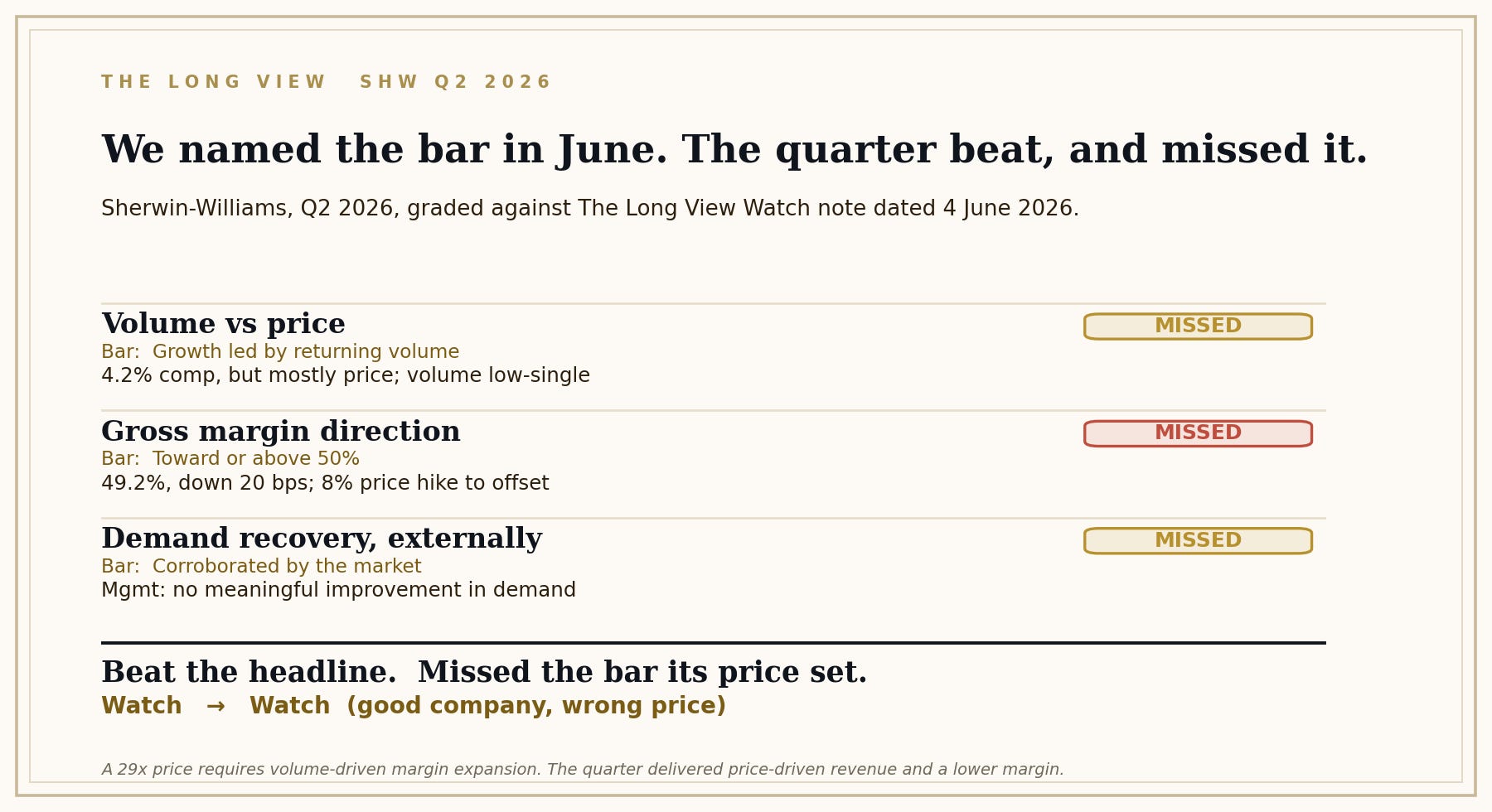
We published three things to watch, in writing, before the quarter: the volume-versus-price split in Paint Stores Group same-store sales, the direction of gross margin, and independent commentary from competitors on whether professional demand was really recovering. Here is what each one said.
Test 1: Is the growth volume, or is it price
Published bar: revenue growing on returning volume confirms the operating-leverage thesis. Revenue growing on price while volume stays flat is the opposite, price offsetting a soft volume base, and it does not clear a 29x bar.
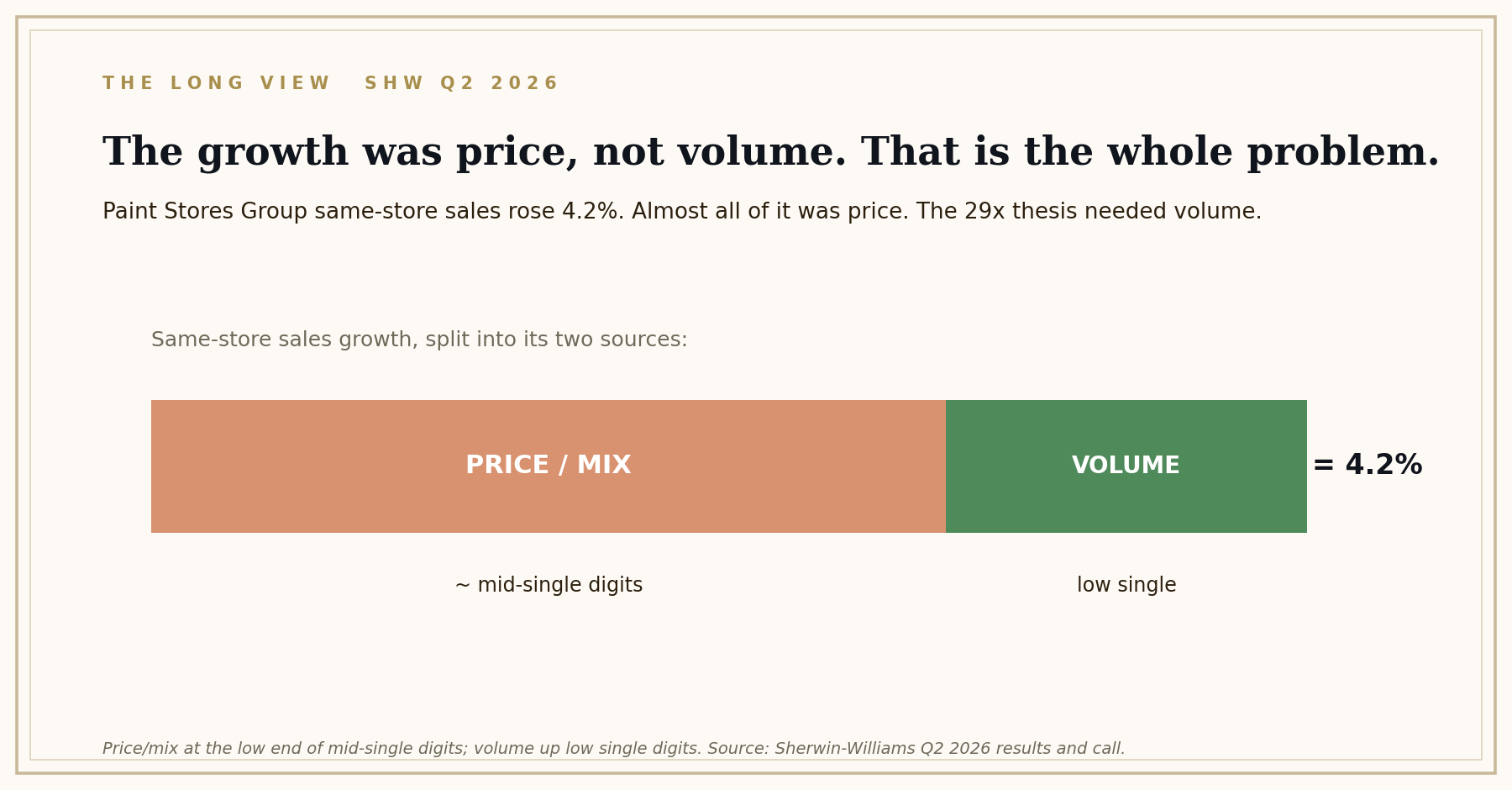
The number: Paint Stores Group same-store sales rose 4.2%. But the split is the whole story. Price and mix contributed the low end of mid-single digits. Volume grew low single digits, barely positive. The growth was mostly price.
This is precisely the pattern we flagged in June. Revenue is up, and if you stop at the headline it reads like a recovery. Look one level down and the store network is not moving materially more paint, it is charging more for roughly the same volume. That is not operating leverage. That is pricing power papering over a demand environment that has not turned. Management said it plainly on the call: no meaningful improvement in demand.
Test 2: Is the margin expanding
Published bar: gross margin moving toward or above 50% signals the cost structure is improving and volume is leveraging the network. Margin flat or falling means the opposite.
The number: gross margin was 49.2%, down 20 basis points from a year ago. It contracted.
This is the load-bearing failure. The entire 29x thesis rests on operating leverage, on volume flowing through a fixed store network and lifting margins. Margins did not lift. They fell, pressured by raw-material inflation. And the company’s response tells you everything: an 8% Paint Stores Group price increase effective September 1, explicitly to offset rising costs. A business generating real operating leverage does not need to push through an 8% price hike to defend its margin. That price increase is not the operating leverage the valuation is paying for. It is the admission that the leverage is not there yet.
Test 3: Is the recovery real beyond Sherwin’s own numbers
Published bar: independent commentary from competitors and the demand environment either corroborates a genuine volume recovery or contradicts it.
The result: Sherwin’s own management described demand as showing no meaningful improvement and framed the full year as assuming no broad demand recovery at all. The volume rebound the thesis requires is not visible in Sherwin’s numbers and is not being claimed by Sherwin’s management. The recovery has not arrived.
The tally: the headline passed, the bar did not
Here is what makes this grade worth reading. Sherwin-Williams beat earnings. Adjusted EPS rose about 10%. It raised full-year guidance. By every headline measure, it was a good quarter, and the stock was treated as such. If you were doing this the normal way, reading the print after the fact, you would file it under “solid” and move on.
But the bar its price set was not “have a solid quarter.” It was “prove the volume-driven margin expansion that justifies 29 times earnings.” And on that specific test, the quarter did the opposite: growth came from price, not volume, and margin fell instead of expanding. The headline cleared. The one thing that mattered did not.
The state change: it stays exactly where it was
Sherwin-Williams remains Watch. Not because it is a bad company. It is a superb company. It stays Watch because the evidence that would justify paying 29 times for it, volume converting to margin expansion, still has not appeared, one quarter later. A wonderful business whose price requires a recovery that has not shown up is not a buy. It is a wonderful business you keep watching and wait.
That is the discipline the whole method exists to enforce. In June, the easy thing was to look at the moat, the brand, the decades of compounding, and write a bullish deep dive. We did not, because the price had set a bar the evidence had not yet cleared. This quarter proved why that patience mattered. Anyone who jumped ahead in June, who saw the quality and paid the 29x on faith, is now holding a full price for a margin expansion that this quarter went the wrong direction.
What we watch next, and when
Q3, for whether the September 8% price increase sticks without killing what little volume growth there is. Pushing price into a soft-demand market is a test in itself: if volume goes negative as price rises, the operating-leverage thesis gets weaker, not stronger.
Then the volume-price split again, every quarter, until volume, not price, is doing the work. That is the number that would move Sherwin from Watch toward Clear for Deeper Research. Until it turns, the bar stays where the price put it, and the stock stays where the evidence put it.
We named the one thing in June, before the print, and set it at the height the 29x price demanded. The quarter beat on the headline and missed on the one thing. That gap, between a good quarter and a quarter that clears the bar, is the entire reason we grade against a number we wrote down in advance.
Run any company through the Stock Story Firewall, free, at firewall.readthelongview.com. Subscribers get the Watch Cards, the Evidence tool, and the full Research Tracker, including every test we have published and how each one scored.
Sherwin-Williams had a good quarter. Its price was not asking for a good quarter. It was asking for proof the volume is back and the margin is expanding, and this quarter the volume stayed soft and the margin fell. Good company. Wrong price, still.
Not investment advice. The subscriber decides.