

Most investing mistakes do not come from a lack of intelligence.
They come from mixing up two different ideas: risk and uncertainty.
The words sound similar. They often feel similar in real time. But professional investors treat them very differently, because confusing them leads to bad decisions.
The distinction
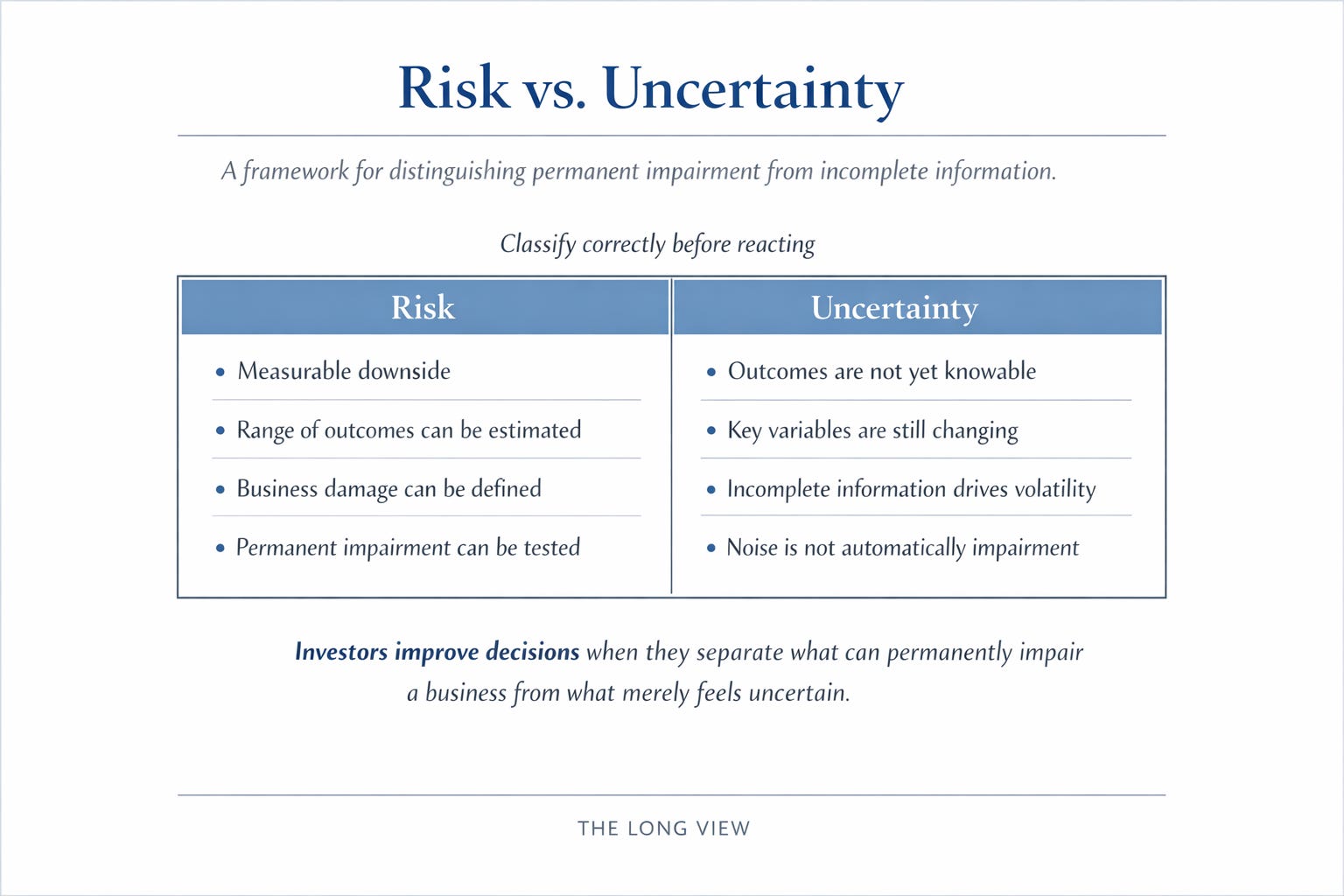
Risk is what can be estimated and analyzed with some confidence. The range of outcomes may be wide, but the underlying system is stable enough that the downside can be framed.
Uncertainty is what cannot yet be measured reliably. The variables are changing, the system is unstable, or the outcomes are too unclear to estimate with confidence.
A simple way to remember the difference:
Risk: “I can estimate the downside.”
Uncertainty: “I cannot yet know what the downside looks like.”
That distinction matters more than it appears.
Why it matters
Most investors experience uncertainty and label it as risk.
A stock falls. Headlines turn negative. A new competitor appears. A new technology emerges. The situation begins to feel dangerous, and the impulse is to act quickly.
Professional investors slow down and ask a better question:
Is this uncertainty — noise, volatility, unknowns — or is it true risk, meaning permanent impairment to the business?
That is the real issue.
Uncertainty often creates volatility.
Permanent impairment is what destroys capital.
The professional sequence
When a thoughtful investor evaluates a difficult situation, the sequence often looks like this:
Identify the fear.
What is the headline concern?Translate the fear.
Is this about short-term volatility and unknowns, or about the business model being damaged?Define permanent impairment.
What specific event would permanently reduce the company’s ability to earn?Decide what would change your mind.
What facts would make the business materially worse?Then look at valuation.
Price matters, but only after the business has been understood.
This is one reason institutional investors can remain calm while headlines are loud: they are not ignoring problems. They are classifying them correctly.
A simple example
Consider a company tied to a fast-moving area such as AI infrastructure, cloud spending, or digital platforms.
The uncertainty is obvious:
adoption rates
competitive changes
customer budget shifts
regulatory changes
technological change
A professional investor does not pretend to know the exact outcome in advance.
Instead, the questions become:
Does the company have a durable position?
Are customers locked in?
Are switching costs meaningful?
Is the advantage structural or temporary?
If the answers point to structural strength, much of what looks like “risk” may actually be uncertainty.
And uncertainty is often where mispricing begins.
If the answers point to structural fragility, then volatility is not the real problem.
The business model is.
The Long View takeaway
Markets price uncertainty every day.
What they often misprice are situations where investors fail to distinguish between uncertainty and true risk.
If you take one thing from this framework, let it be this:
Do not let uncertainty force decisions. Identify what would permanently impair the business. Then decide calmly.
That is the long view.
— The Long View
Educational only. No predictions. No investment advice.