

Rigetti (RGTI) put $16.4 million into property and equipment in the first half of this year, against $8.2 million a year earlier, while customers paid it $9.5 million. IonQ (IONQ) committed about $1.0 billion of cash to buy a semiconductor foundry. Neither of those numbers appeared in a headline this week. The hidden assumption running through five days of reading is that the numbers being quoted at investors all day are the ones that decide outcomes, and the week says otherwise. Today the whole thing gets published as a screen, both companies get marked against it, and I write down what I am watching from here with dates attached.
Disclosure: the author holds a small position in Rigetti and no position in IonQ. This is analysis, not a recommendation.
The problem with the obvious numbers
Start with why any of this is necessary.
The figures quoted at a self-directed investor all day share one property. Each of them is capable of moving in the right direction while ownership of the company gets worse. A revenue line triples and the count of shares underneath it rises. An outlook is lifted and the thing being counted quietly widens. A performance record lands on the smaller machine. An award is announced and the stock that paid for it was issued first.
None of that is deception. It is what happens when a headline reports an event and a filing reports the cost. The event is exciting and arrives first. The cost is boring and arrives a quarter later, one line below where most people stop reading.
That is the whole edge available here, and it is not about being cleverer than anyone. The cover page, the working capital line, the revenue footnote and the utilization assumption are public, free, and take an afternoon.
Whether other people read them is not something I can know, and I am not going to pretend otherwise. What I can say is that I had not. Every number that changed my mind this week was sitting in a document I already had access to and had not opened.
The screen, published as a tool
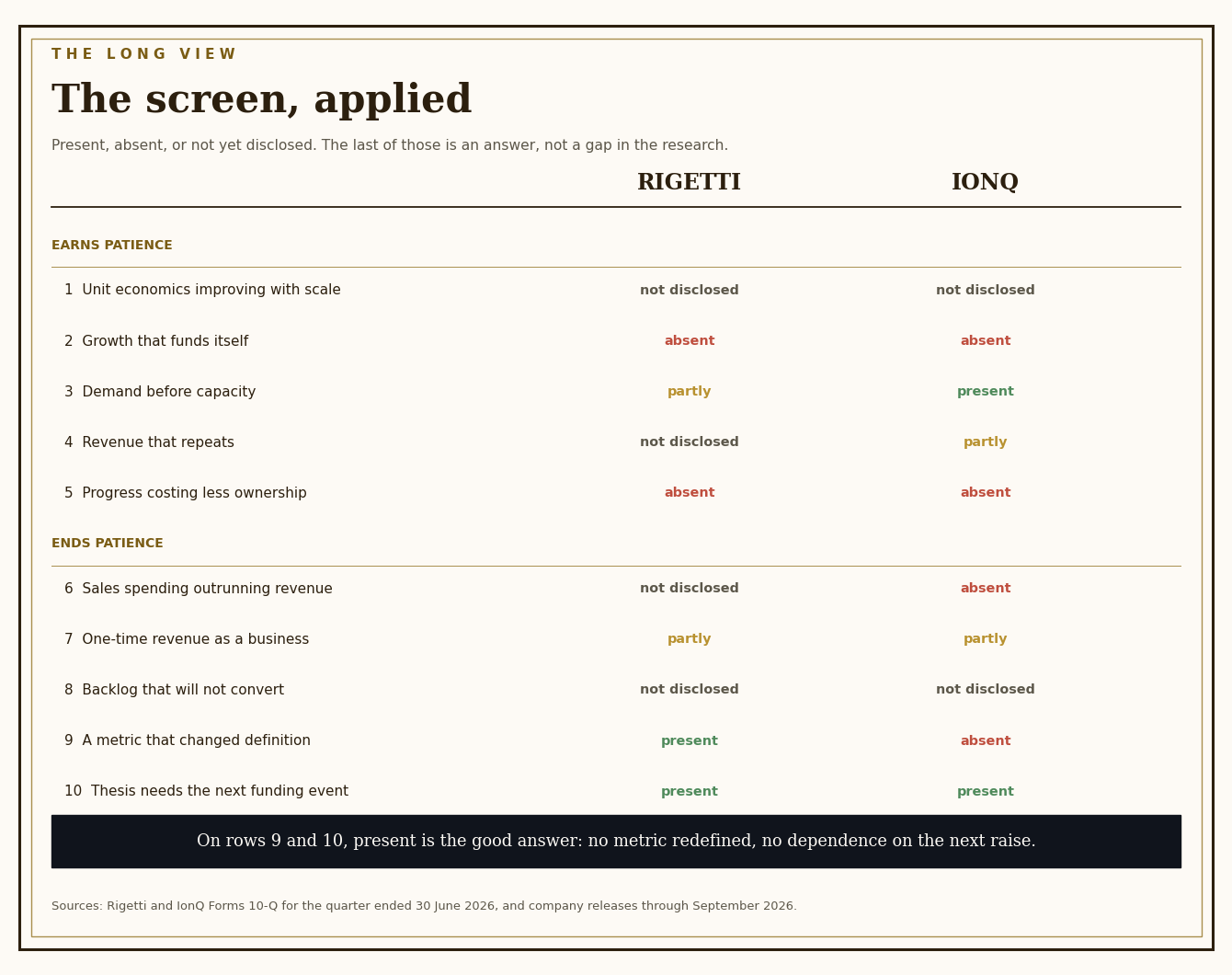
Five characteristics that earn patience, five that end it. Everyone is markable as present, absent or not yet disclosed, and not yet disclosed is a real answer.
Earning patience: unit economics improving with scale, growth that funds itself, demand arriving before capacity, revenue that repeats, and progress costing less ownership over time.
Ending it: sales spending outrunning revenue with no leverage, one-time revenue dressed as a business, backlog that will not convert, a headline metric that changed definition, and a thesis that depends on the next funding event.
Numbers one, two and five are the load-bearing ones, because they decide whether time works for the owner or against. A company where time is an asset can survive being early. A company where time is a liability has to be right on schedule.

Rigetti, marked
Unit economics improving with scale: not yet disclosed. The company does not publish what a system costs to build.
Growth that funds itself: absent. The loss from operations was $54.0 million in the first half, and capital spending was $16.4 million on top.
Demand before capacity: partly present. Systems are sold to identified buyers rather than built into inventory, but capital spending is rising faster than the revenue those sales produce.
Revenue that repeats: not yet disclosed. No repeat purchases are reported, and an $8.4 million order from C-DAC expected later this year would be a first sale, not a second.
Progress costing less ownership: absent, and moving the wrong way. The company issued 7.74 million shares to the Commerce Department in September, about 2.3 percent, before the research was done.
On the counter-signals: the thesis does not depend on the next funding event, because $541.3 million and no debt is real independence. No metric has changed definition. That matters, and it is the strongest thing on Rigetti’s side of the page.
IonQ, marked
Unit economics improving with scale: not yet disclosed.
Growth that funds itself: absent. Operating cash outflow with a foundry now attached, and depreciation and amortisation for the half at $89.2 million against $17.2 million a year earlier.
Demand before capacity: present, with a caveat. IonQ did not build empty capacity, it bought a foundry with existing customers and revenue. The caveat is that some of those customers are competitors who now buy from a rival.
Revenue that repeats: partly present. Foundry revenue recurs. Whether quantum revenue does cannot be determined, because the two are not reported separately.
Progress costing less ownership: absent. Roughly 24.1 million new shares issued for SkyWater, alongside $741.3 million of cash.
On the counter-signals, two are live. Sales and marketing grew 242 percent year on year, which is the leverage test failing so far. And a headline metric changed definition when the September outlook became the first to include a semiconductor foundry.
The record at Rigetti, and what it shows
Look back at the marks above and notice what they have in common. Unit economics, growth that funds itself, and the cost of progress in ownership are not conditions that happen to a company. They are the residue of decisions somebody made, and the same person will be making the next ones.
So track record matters here, and written as character it is useless. Written as a record of decisions with results attached, it tells you what someone is likely to do next.
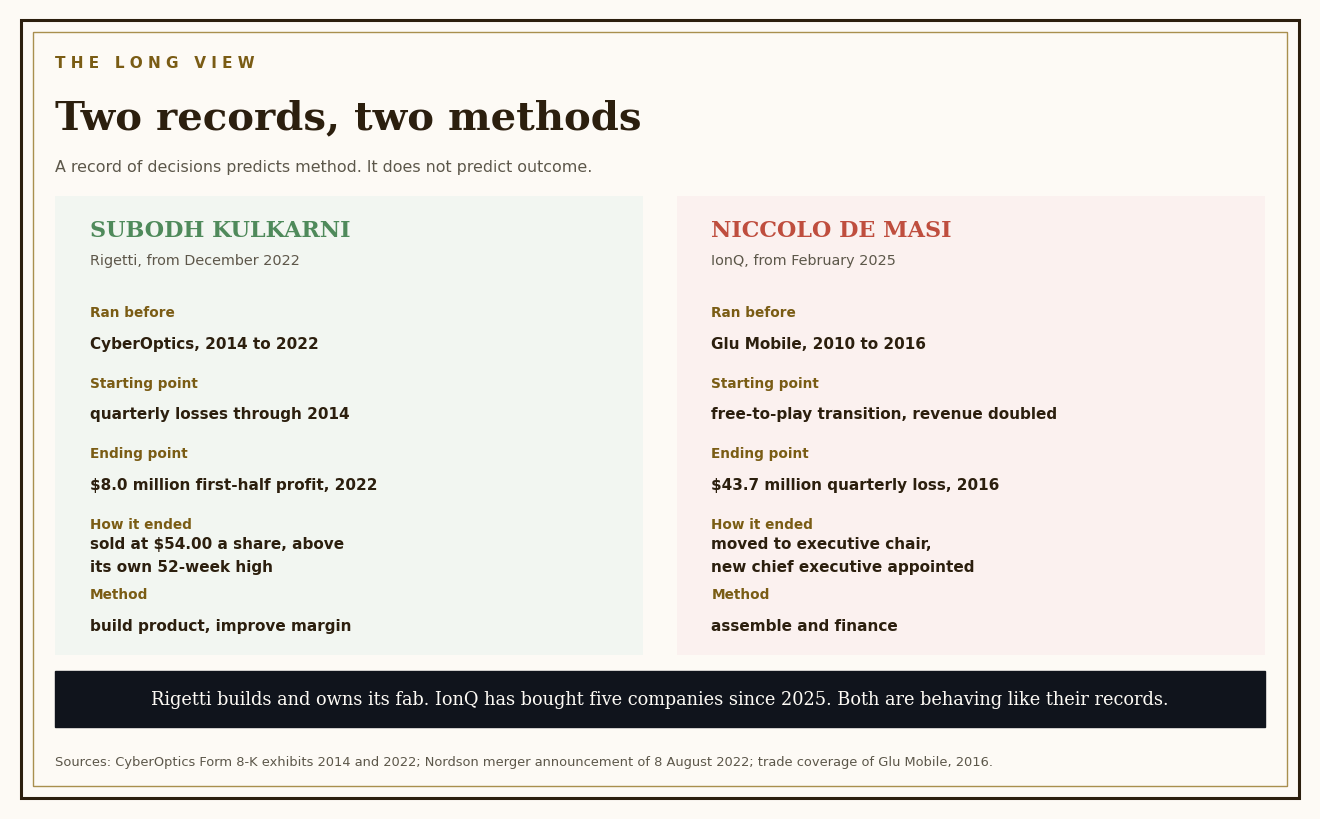
Subodh Kulkarni became chief executive of Rigetti on 12 December 2022, succeeding the founder Chad Rigetti, who also left the board that month. Before that he ran CyberOptics, a maker of precision sensors and inspection systems for chip and electronics manufacturing, from 2014 until it was sold.
What happened in between is the part worth having. When he took over, CyberOptics was losing money every quarter. The first quarter of 2014 showed a net loss of $0.8 million, the second a loss of $0.3 million, the third a loss of $0.4 million, on revenue growing at double digits from a small base. He said at the time that the goal was sustainable profitable growth.
By the first half of 2022 the company reported revenue of $51.8 million, up 21 percent, net income of $8.0 million, up 75 percent, a record backlog of $55.5 million, and it was on track for its first year of revenue above $100 million. In August 2022 Nordson agreed to buy it for $54.00 a share, about $380 million, a 47 percent premium to the average price of the previous month and 11 percent above the 52-week high.
So the answer to whether this management has moved a company from losses to profit is documented rather than asserted. It took eight years, it was done by selling more of a physical product at improving margins, and it ended with a sale above the stock’s own high.
The record at IonQ, including the part that went wrong
Niccolo de Masi became chief executive of IonQ on 26 February 2025, having joined the board in 2021 as head of the blank-cheque company that took IonQ public. Peter Chapman, who had run the company since 2019, moved to executive chair.
His main operating record is Glu Mobile, which he ran from January 2010 to November 2016. He moved it to a free-to-play model, and trailing revenue more than doubled between late 2013 and mid-2015, carried substantially by one title, Kim Kardashian: Hollywood, reported to have generated around $180 million.
Then the harder half, which matters more. The hits churned and were not replaced. Celebrity titles were a deliberate strategy and several failed. By the third quarter of 2016 revenue had fallen to $51.4 million from $63.3 million a year earlier, and the company reported a net loss of $43.7 million against roughly break-even a year before. Around a hundred jobs went. In November 2016 he moved to executive chairman and a new chief executive took over.
One correction worth making, because it is repeated everywhere. Electronic Arts bought Glu in April 2021 at an enterprise value of about $2.1 billion, and that was five years after he had stopped being chief executive. He was chairman, not the operator who delivered it.
Since then his record is capital markets rather than operations: a series of listings through blank-cheque vehicles, one of which brought IonQ public.
So on the profitability question, the honest answer for IonQ’s chief executive is not yet demonstrated. He has grown revenue sharply, handled public markets expertly, and presided over a decline that cost him the job.
The capital spending line, which is the one I will be watching hardest
This is the number that changed my mind about what to track, and it deserves its own section.
The ratio is what matters rather than the amount. Sixteen point four against nine point five means the business is putting more into hardware than it takes in from customers, and the prior year’s eight point two means that gap widened rather than closed. Add the $10.1 million still sitting unpaid in accounts payable at the end of June and the $21.0 million of equipment commitments, and the committed figure is larger than the spent one.
The direction is not a guess either. Rigetti’s own filing sets out an intention to raise capital expenditure substantially, naming an upgrade to its fabrication facility, a possible second facility, and more refrigerators, and saying plainly that this needs a significant amount of cash.
Now the honest scale check. Webvan spent $259.8 million in a single year against about $178.5 million of revenue, and before that $64.3 million against a far smaller base. Rigetti is spending sixteen million dollars. This is not Webvan, and saying so would be alarmism.
But the shape is the same shape, and the shape is what the week was about. Capital spending ahead of revenue, rising, on assets that cannot be unbuilt, funded by a cash pile rather than by customers. That road has a record, and the record is why this is now the first thing I check each quarter rather than the last.
The number neither of them discloses
Cost per system, and whether it is falling.
Tesla’s turn came when the margin on each car went from negative to positive and kept climbing with volume. That is the same question here in different clothes: does the tenth machine cost less to build than the first. It is the difference between a research program that sells its output and a manufacturing business.
Neither company publishes it. Rigetti reports revenue from system sales and never the cost of producing one. IonQ now owns a fab and does not separate what quantum costs from what the foundry earns.
So the first item on my watchlist is a disclosure that does not exist. If either company ever starts publishing it, that decision will tell me something on its own, because companies publish the numbers that flatter them.
What I am watching, with dates
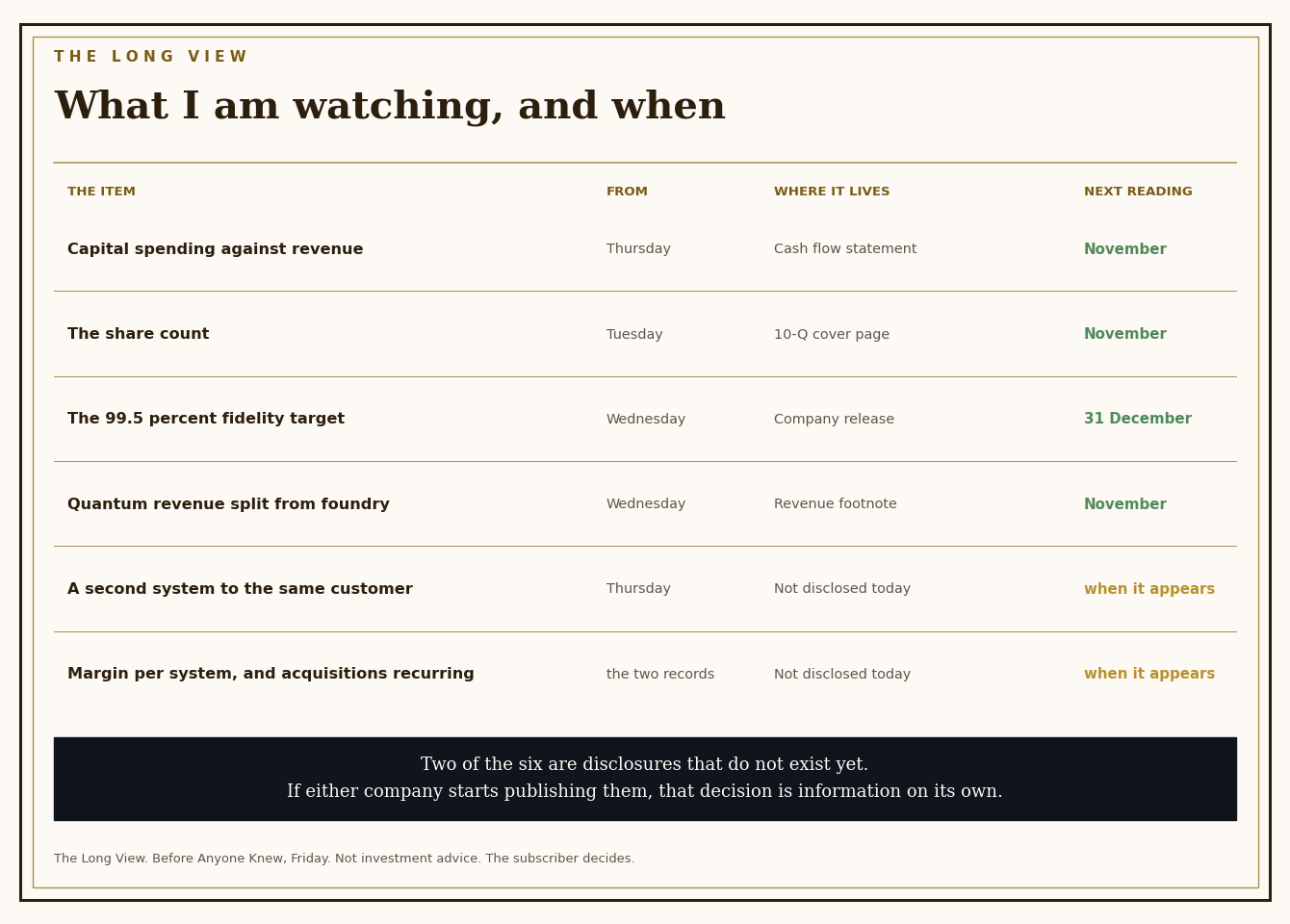
Five things, each traced to the day that produced it.
Capital spending against revenue, every quarter. From Thursday. The next reading arrives with the third-quarter filings in November.
The share count on every cover page. From Tuesday. ASML’s customers funded a build and the existing holders were made whole through a buyback. Rigetti’s issuance had no offset. The count is the receipt, and it is on the first page of every 10-Q.
Whether the 99.5 percent fidelity target lands by 31 December. From Wednesday. Management named the number and the date, and about ninety days remain.
Whether IonQ separates quantum revenue from foundry revenue. From Wednesday. Until it does, the September outlook cannot be read as evidence about quantum demand.
A second system sold to the same customer. From Thursday. Amazon published repeat-purchase share when it had nothing else worth publishing, because a second order proves the product rather than the marketing.
And one item that comes straight out of the two records. At CyberOptics, Kulkarni’s evidence of progress was margin improving on a physical product sold in volume, which is exactly the disclosure Rigetti does not yet give. At IonQ, de Masi’s method is acquisition, so the thing to watch is whether the five companies bought since 2025 show up as revenue that recurs rather than as a larger cost base. Both of those are visible in the same filings as the other five.
None of those five is what I was watching a week ago. That was the fidelity headlines and the award announcements, both real news, neither of which tells you what it costs to own the company while the news happens. The new five are duller and harder to find, four of them sit in documents anybody can pull in an afternoon, and the fifth does not exist yet. That is the entire return on a week of reading old filings: a shorter list worth looking at, and a longer list to ignore.
The limit, and what happens next
This is not statistics. A handful of cases, chosen partly because we know how they ended, and the survivors get written about while the failures are forgotten. What this week produced is roads with known hazards, not probabilities. It cannot tell you whether the technology arrives either. A company can do everything on the screen correctly and fail because the physics takes another decade.
The management records have the same limit, and a sharper one. A record predicts method, not outcome. Kulkarni’s says he will build and sell product patiently. De Masi’s says he will assemble and finance. Either can work here, and the setback in de Masi’s record may be worth more than a clean one, since a chief executive who has watched a hit-driven business churn is unlikely to bet this one on a single title again, and the acquisitions suggest he has not.
And on fairness: Rigetti is a holding of mine, and the screen marks it absent or not yet disclosed on four of the five traits that earn patience. I would rather publish that than defend it.
Third-quarter filings land in November for both companies. That is when capital spending against revenue, the share count and the revenue split get their first reading under the new list, and the fidelity target has until 31 December.
Nothing in this week was a forecast. It was an argument about which four or five lines to open when the filings arrive, and about how much of what gets quoted in between can be left alone.
Run any company through the Stock Story Firewall, free, at firewall.readthelongview.com.
Not investment advice. The subscriber decides.