

Rigetti (RGTI) told the market in April that its 108-qubit system would reach 99.5 percent median two-qubit fidelity during 2026. One quarter is left. IonQ (IONQ) has published four different revenue outlooks for the same year, each higher than the last, and the most recent one measures something different from the first three. Two companies, two scoreboards, and the hidden assumption buried in both is that the number a company chooses to publish is the number that measures it. Amazon settled that question in the 1990s by publishing something nobody had asked it for.
Disclosure: the author holds a small position in Rigetti and no position in IonQ. This is analysis, not a recommendation.
What Amazon chose to put in front of people
In the 1997 letter to shareholders, Jeff Bezos did something unusual. He named the measures he wanted the company judged by, before anyone could judge it on them.
Customer and revenue growth, the degree to which customers kept buying on a repeat basis, and the strength of the brand. Not earnings, which did not exist. Not the multiple, which everyone else was arguing about.
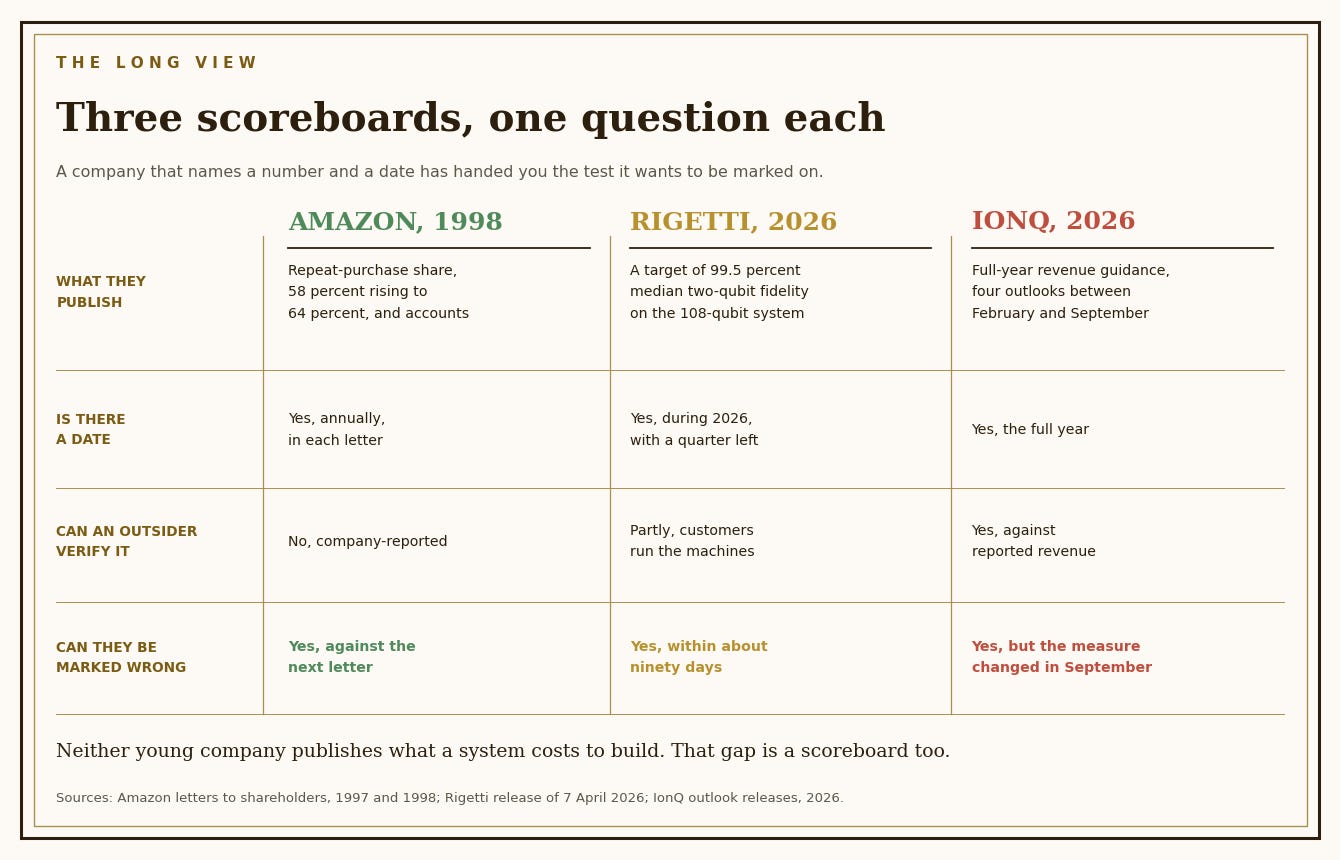
Then he published the number. In the 1998 letter: over 58 percent of orders in the fourth quarter of 1997 came from repeat customers, rising to over 64 percent a year later. Customer accounts went from 1.5 million to 6.2 million across the same year.
Notice what that pairing does. Accounts rising on their own could be marketing spend buying strangers. Accounts rising while the repeat share also rises means the new customers are staying. One number checks the other, and both were published by a company with no earnings to show instead.
That is a company handing the market a test it can be marked against, in public, with a date on it. The test happened to be the right one, and that is the part worth slowing down for.
Why repeat purchase was the right number
A first order tells you the marketing worked. A second order tells you the product worked.
That is the whole logic, and it is why repeat-purchase share is worth more than revenue growth in a young company. Revenue can be bought. Repeat business has to be earned, one customer at a time, and it compounds without further spending.
The market spent 1999 arguing about whether Amazon deserved its price. A reader watching the repeat rate climb from 58 to 64 percent had a different question in front of them, and a better one.
It is worth being clear that this was not a prediction. The repeat rate did not say Amazon would be worth a trillion dollars. It said the thing customers were buying was working well enough that they came back, which is the narrowest useful claim available about a company that loses money.
Rigetti’s number, and its date
Now the live version, and this is the cleanest scoreboard of the three.
On 7 April 2026, Rigetti announced general availability of Cepheus-1-108Q, a 108-qubit system with approximately 99.1 percent median two-qubit gate fidelity, and said it expected to reach approximately 99.5 percent later in the year.
A number, and a deadline, both chosen by the company. The 36-qubit system already ran at 99.5 percent, so the target is a return to a level the smaller machine had reached rather than a leap into the unknown. One quarter of 2026 remains, and no announcement of reaching it has appeared.
There is a detail worth pinning down before the quarter closes, because it decides what counts as a hit. The figure is a median across the machine, not the best result on the best chip, and it applies to the 108-qubit system rather than to a smaller prototype. A press release announcing 99.5 percent on something else would not be the same claim.
Rigetti has also published a longer target: roughly 99.9 percent at about a thousand qubits within about three years. That one cannot be marked yet. The 2026 number can, in about ninety days, and the result will be information about the forecaster as much as the machine.
IonQ’s four numbers
IonQ publishes a different kind of scoreboard, and it has published it four times this year.
The 2026 outlook opened at $225 million to $245 million in February. It went to $260 million to $270 million in May. It went to $280 million to $290 million on 5 August. On 8 September it went to $450 million to $460 million.
Three raises in seven months reads as a company outrunning its own expectations. Look at the last one more closely. It is the first outlook that includes SkyWater, the semiconductor foundry IonQ bought for about $1.8 billion and closed on 31 July 2026. The jump of roughly $170 million is largely a foundry business being added to the total, not quantum demand arriving faster than expected.
The number went up. What the number measures changed at the same time.
Guidance is also the one scoreboard management controls completely. A company sets the bar, then reports against the bar it set. That is not a criticism of IonQ specifically, it is the structure of the instrument, and it is why guidance is worth less as evidence than a number an outsider can verify.
When the scoreboard changes shape
This is the counter-signal, and it is the strongest warning in the whole screen.
A company that redefines its own metric is telling you the old definition stopped flattering it, or that the business underneath has changed enough that the old series no longer means what it did. Either way the history breaks, and comparisons to last year quietly stop working.
IonQ’s revenue line now contains a semiconductor foundry. That does not make it a worse company. It makes the 2026 outlook something other than a measure of quantum demand, and anyone treating the raise as evidence about quantum adoption is reading a number that has changed underneath them.
The same caution applies to algorithmic qubits, the performance measure IonQ devised and reports against. A metric a company invented and grades itself on is not fraud. It is also not a benchmark.
What neither of them publishes, which is also a scoreboard
Silence is a choice too, and both companies make it in the same place.
Neither publishes what a system costs to build. Rigetti sells 108-qubit machines to labs and universities and reports the revenue. It does not report the cost of producing one, or whether that cost is falling as more are made. That single series would tell an owner more about the future than any fidelity figure, because it is the difference between a research program and a manufacturing business.
Neither publishes repeat purchases either. A second system sold to a customer who already owns one is the strongest evidence available that the product works, and it is exactly what Amazon chose to publish when it had nothing else to show. Both companies could disclose it. Neither does.
And IonQ does not separate quantum revenue from foundry revenue, which is the disclosure that would settle what the September outlook really contains.
None of that is misconduct. Companies disclose what they are required to disclose and what they want to. The point is that the gaps are as informative as the numbers, and a reader who notices which questions cannot be answered is already ahead of one who only reads the answers that are offered.
How to grade a scoreboard
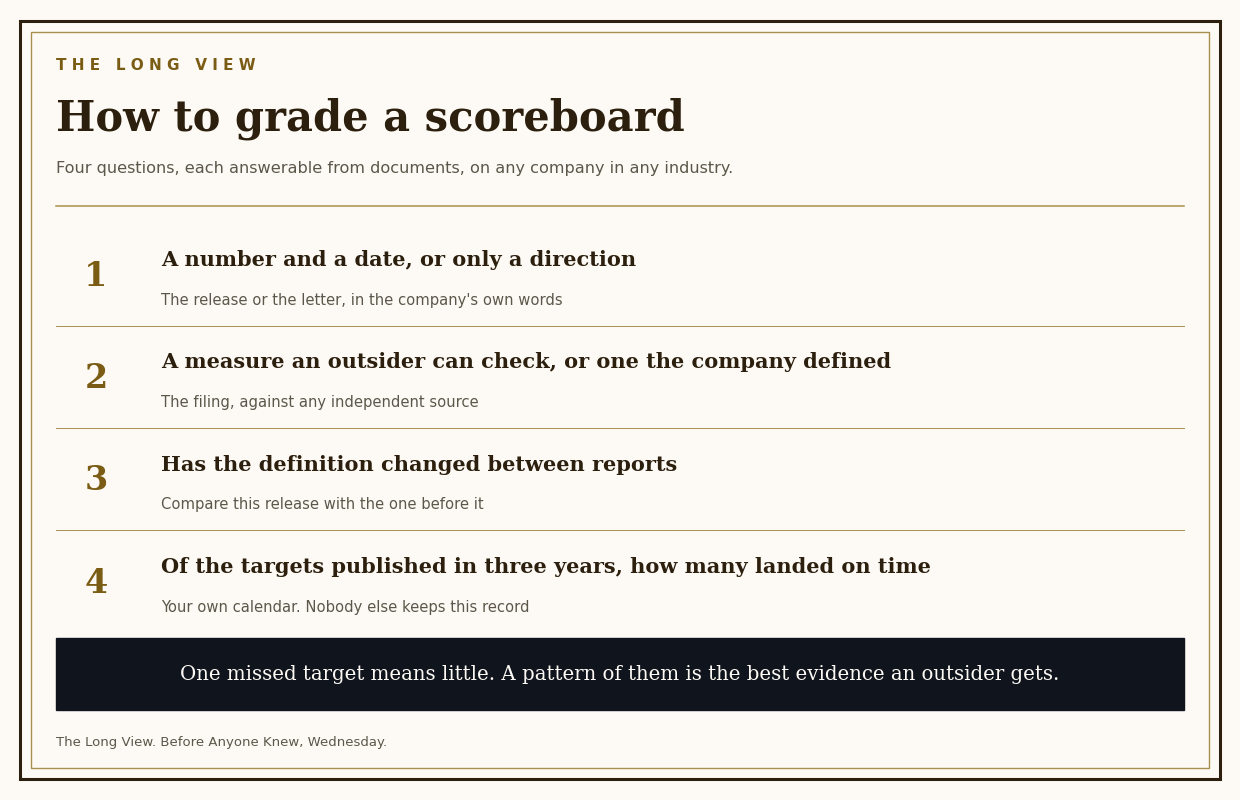
Four questions, each answerable from documents, and they work on any company in any industry.
Did the company name a number and a date, or only a direction. Is the measure one an outsider could verify, or one the company defined. Has the definition changed between reports, and does the filing say so. And what is the record: of the targets published in the last three years, how many arrived on time.
That last one is the whole value of the exercise. A single missed target means very little, because forecasting a laboratory is hard and honest people get it wrong. A pattern of them is different, and it is the most reliable evidence about management available to an outside shareholder. Keeping the record costs nothing. A note on a calendar three times a year builds it.
The reverse case matters too. A management that hits its published numbers repeatedly has earned something that does not show up in any financial statement, and it is the closest thing to a moat a pre-profit company can have.
What this does not tell you
A published target is not a promise, and missing one is not dishonesty. Engineering slips. ASML’s EUV schedule moved by years, as yesterday’s piece laid out, and the machine still ended up defining an industry.
Nor does publishing more make a company better. A business can disclose a great deal and still be worth nothing, and plenty of companies that disclosed very little turned out fine.
What a published, dated number does is narrower. It converts a story into something that can be marked, and it puts the marking on a calendar rather than leaving it to opinion.
Tomorrow
Webvan was operating in nine markets while its distribution centres ran at 25 to 30 percent of the utilisation they needed to break even. Iridium put a constellation of satellites in orbit before it had subscribers to use them.
Tomorrow is the road with the worst record in the whole archive: committing fixed costs before one unit works.
Not investment advice. The subscriber decides.
Your distinction between a rising number and a changing measurement is useful far beyond quantum computing. I’d add a wrinkle to the Amazon comparison: repeat-order share can rise because existing customers buy more, but also because fewer new customers arrive, so cohort retention would help separate those explanations. For these businesses, what would you consider the strongest evidence of customers finding lasting value—repeat purchases, paid usage, or renewals after the initial research contract?