

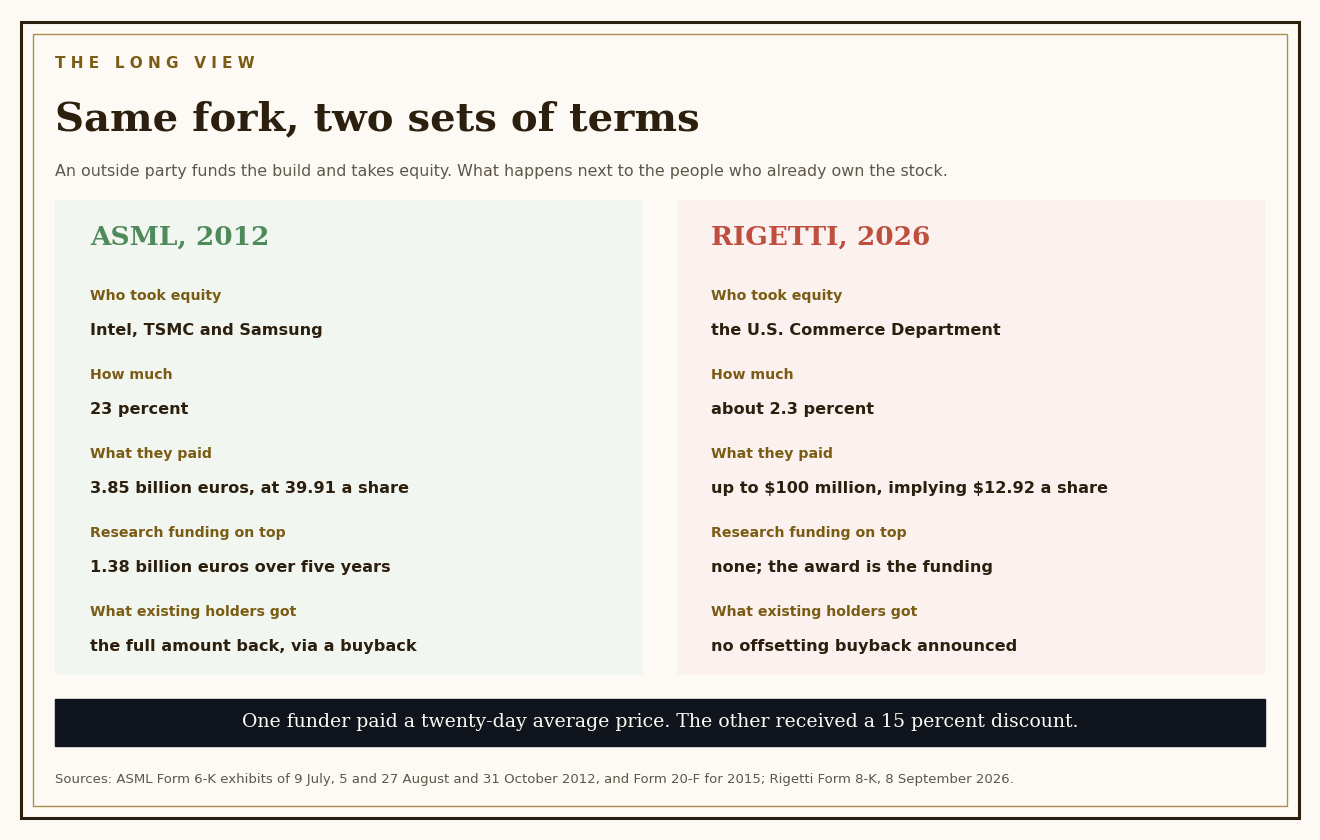
In July 2012, Intel, TSMC and Samsung agreed to buy 23 percent of ASML (Nasdaq: ASML) for 3.85 billion euros in cash, and to hand over another 1.38 billion euros for research, to accelerate a lithography machine that did not work yet. Rigetti (RGTI) did a version of the same deal last month, issuing 7.74 million shares to the U.S. Commerce Department for an award of up to $100 million. The hidden assumption in both is identical: that an outside party funding your development is good news for the people who already own the stock. At ASML it was, and the reason is a detail almost nobody remembers.
Disclosure: the author holds a small position in Rigetti and no position in IonQ. This is analysis, not a recommendation.
What ASML agreed to, in its own filings
The terms are in the filings, and they are worth reading slowly.
Announced on 9 July 2012. Intel took 15 percent of ASML for 2.51 billion euros and committed 829 million euros of research funding. TSMC followed on 5 August with 5 percent for 838 million euros and 276 million euros of research money. Samsung completed it on 27 August with 3 percent for 503 million euros and another 276 million euros.
The subscription price was 39.91 euros a share, the average of the twenty trading days to 6 July 2012. The shares went into Dutch foundations and came back to the customers as depositary receipts that were non-voting, except in exceptional circumstances.
Add it up and three customers owned 23 percent of their supplier, while the supplier held 3.85 billion euros of cash plus 1.38 billion euros of committed research funding over five years.
Two details are worth pausing on. The equity was capped: ASML said it might issue up to 25 percent to customers and no more, so the program had a ceiling written into it from the start. And the research money was separate from the share purchase, which means the customers were paying twice, once for a stake and once for the work, and only the first of those bought them anything they could sell.
The detail that changes the deal
Here is the part that matters, and it is one sentence in the press release.
The entire 3.85 billion euros raised from selling those shares was returned to ASML’s other shareholders through a synthetic buyback, structured with a reverse split so that no dilution occurred from the program.
Read that again. Customers bought almost a quarter of the company. Existing owners were not diluted, because the cash from the share sale was handed straight back to them and the share count was neutralized. The customers got exposure and a seat at the technology. The existing holders got cash and kept their proportion of the company.
That is not how these deals normally work, and it is the whole reason this one is worth studying.
It also tells you what ASML’s board thought its job was. Faced with a chance to raise almost four billion euros from three of the largest companies in its industry, it took the money and passed it through, rather than keeping it on the balance sheet. The research funding, the part it needed, came separately and did not cost its owners a thing.
What they were funding, and how long it took
The money went to two projects. Extreme ultraviolet lithography, and 450-millimetre wafer technology.
Take the second one first. Intel’s statement in July 2012 said the investment would enable 450-millimetre prototype systems as early as 2015. At the annual meeting in 2014, ASML’s chief executive was asked why the 450-millimetre programme had been suspended, and answered that the decision followed a consensus in the industry, and that the programme would restart when the industry needed it. One of the two projects the money was raised for had been put down inside two years.
The first one slipped. In its first-quarter 2013 results, ASML confirmed its expectation of a ramp of production using EUV in 2015. At its investor day in 2014 the language had moved to enabling cost-effective manufacturing from 2016 or 2017. The scanner built for volume manufacturing, the NXE:3400B, first shipped in 2017. The customers who paid in 2012 kept paying through all of it.
Sit with what that would have felt like for an ordinary shareholder through those years. A company taking money from its customers to build something repeatedly late, with one of the two funded programs suspended. Every quarter the case rested on a machine that was not yet in volume production. The difference between holding that and holding a pre-profit quantum company today is smaller than it looks from here.
Why being the buyer changes everything
A financial investor funding development wants a share price. A customer funding development wants a machine, and will keep funding through delays that would make an investor sell. That is not loyalty. It is that the customer has no alternative source for the thing it needs, so abandoning the supplier means abandoning its own roadmap.
That distinction is worth holding on to, because it is the question to ask of any co-investment. Is the money coming from someone who needs the product, or from someone who needs the stock to go up. The first kind survives a slipped schedule. The second kind does not.
ASML’s participants were the three companies that would have to buy every machine it ever built. Their incentive and the company’s incentive were the same thing.
Rigetti’s version of the same fork
Now the live case, and the terms are public.
On 8 September 2026, Rigetti issued 7,739,938 shares to the Commerce Department as an inducement to enter an award agreement worth up to $100 million. Divide one by the other and the implied price is $12.92 a share, set by a formula from May that took the lowest of three reference closes and discounted it by 15 percent.
Rigetti had 333.8 million shares outstanding at the start of August, so the issuance added about 2.3 percent to the count. No offsetting buyback was announced alongside it, and nothing was returned to existing holders. The ownership moved on day one and the money is up to $100 million, for research not yet done.
Is the funder also the buyer, the way Intel was? Partly. The government is a customer of quantum research and a major funder of the field, and it has an interest in the capability existing on home soil. It is not buying quantum computers by the hundred the way Intel buys lithography machines, so the alignment is real but weaker than ASML’s.
There is one more difference worth naming. Intel, TSMC and Samsung paid 39.91 euros a share, set on a twenty-day average before the announcement. Rigetti’s formula took the lowest of three reference prices and then cut 15 percent off it. One funder paid an average. The other received a discount.
IonQ took the third route
IonQ (IONQ) funded its build by buying rather than by issuing to a funder. It paid $741.3 million in cash and 24.1 million new shares for SkyWater, a foundry, closing on 31 July 2026.
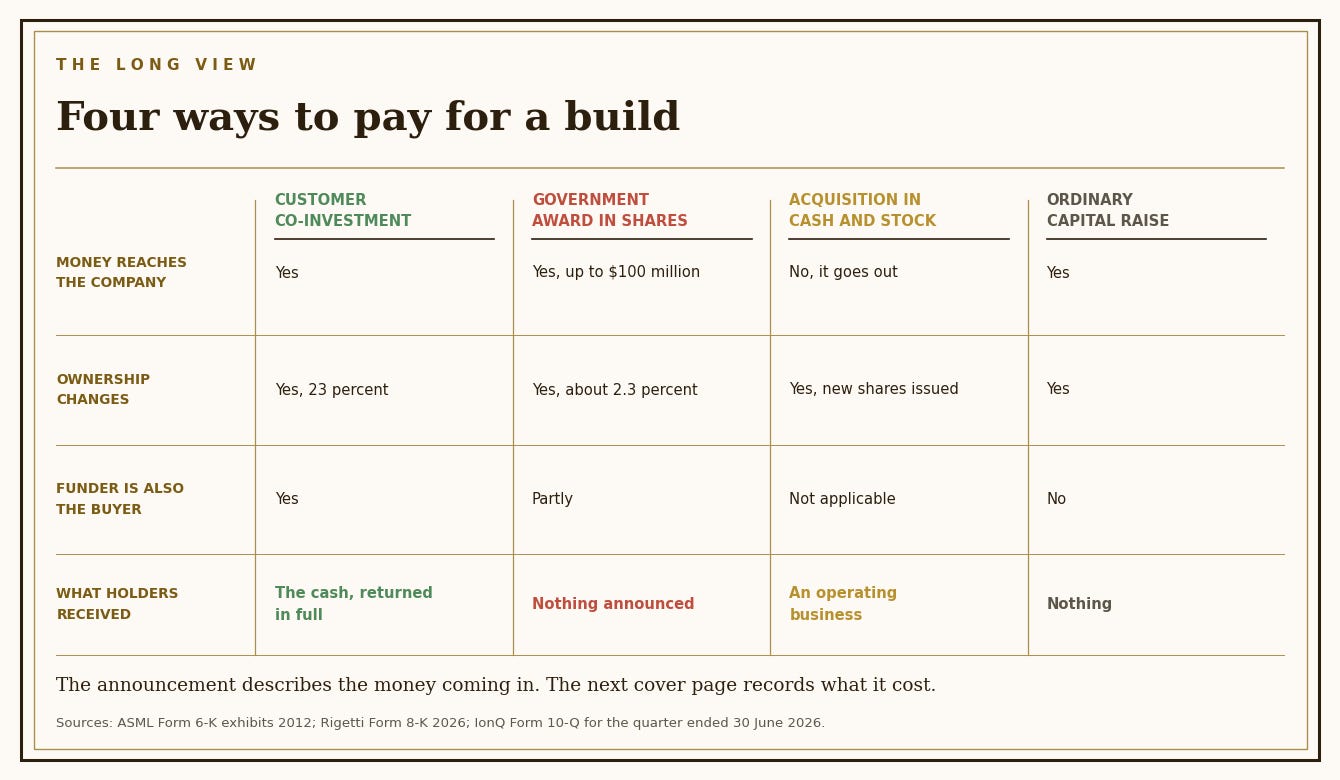
Same fork, third answer. ASML’s owners were protected by a buyback. Rigetti’s owners absorbed the issuance. IonQ’s owners paid with both cash the company had raised and a slice of the company itself, and got an operating business in return.
Which of the three is best depends on what the money buys, and that is the honest answer rather than a dodge. Paying with stock for an asset that produces revenue is a different transaction from paying with stock for a research award. One is buying a business. The other is buying time.
What to check when a company does this
Four questions, all answerable from documents, and they work on any company announcing outside funding.
What did the funder get, and at what price against the market at the time. What came back to existing holders, if anything. Is the funder also the buyer of the product. And what happened to the share count on the next 10-Q cover page.
The last one is the discipline. Announcements describe the money coming in. The cover page records what it cost.
None of these four requires an opinion about the technology, which is the point. You can run them on a company whose product you do not understand and still learn whether the deal was struck on terms that treat you as an owner.
What this does not tell you
ASML worked, and that makes this a dangerous case to reason from. Most companies with customer co-investment do not become the only supplier of a critical machine on earth.
The structure did not cause the outcome either. The machine worked because the engineering worked. What the structure did was keep the existing owners whole while the engineering took years longer than promised, and that is a separate thing from success.
Nor is it fair to read Rigetti’s terms as evidence of a bad outcome. They are evidence of a cost, paid up front, by people who owned the stock in August. A company with $541.3 million of cash and no debt was not forced into those terms by desperation, which means somebody decided the award was worth 2.3 percent of the company. That decision can be right. It is still a decision, and it is now on the record where it can be marked in a year.
One more limit. ASML in 2012 was an established supplier whose customers were the largest chipmakers on earth, which is why three of them could be persuaded to fund it. Rigetti is not that, and the structure available to a company depends on what it already is. Comparing the terms is fair. Expecting identical terms is not.
Tomorrow
Amazon published its repeat-purchase rate while the market argued about its multiple. Rigetti published a dated target for fidelity this year, with one quarter left to hit it.
Tomorrow is about the scoreboard a company chooses for itself, what it means when management publishes a number with a date attached, and what it means when a company publishes nothing at all.
Not investment advice. The subscriber decides.