

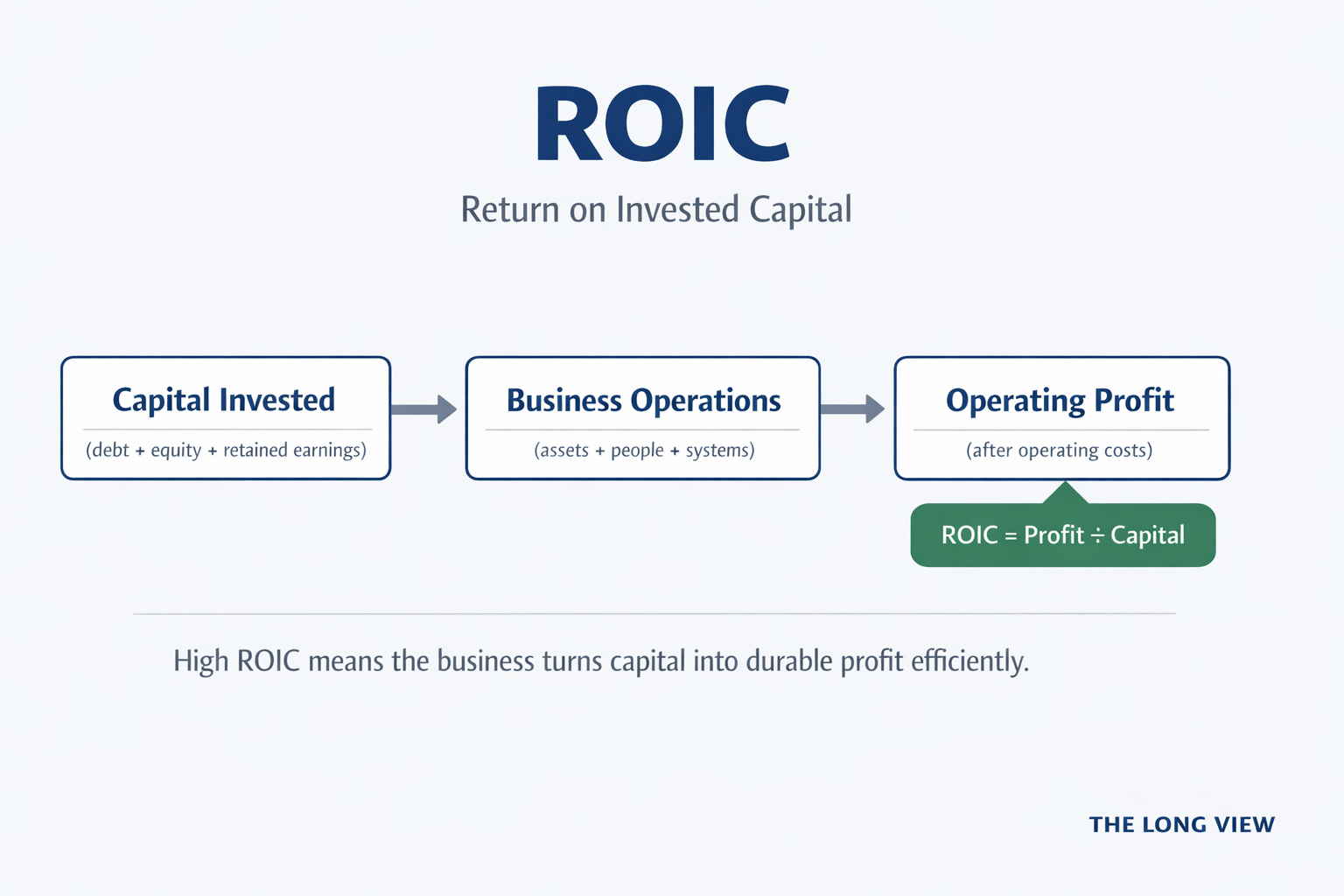
Return on invested capital, or ROIC, sits at the center of long-term investing because it answers a simple question:
how well does a company turn the money it invests into real, lasting profit?
Growth by itself does not create value. A business can grow quickly and still destroy wealth if each new dollar earns poor returns. What matters about a company is not how fast they are expanding, but whether that expansion produces strong, repeatable profits. This is why professional investors focus so closely on ROIC. It reflects both the strength of a company’s position and the discipline of its management.
When returns are high, it usually means new investments are strengthening the business. When returns are low, it often signals that money is being pushed into projects that add little long-term value.
Apple shows what happens as great businesses mature. As companies grow larger, truly attractive reinvestment opportunities become harder to find. At that stage, discipline matters more than ambition. Returning cash to shareholders through buybacks or dividends can be a smart choice when it prevents money from being forced into low-return projects. In mature businesses, restraint often protects value better than constant expansion.
Microsoft illustrates a different model. Its cloud and software platforms support many products at once. Each dollar invested strengthens the entire ecosystem. Because of this structure, reinvestment continues to earn strong returns. High ROIC in this case reflects a business that can scale efficiently, not just grow bigger.
Visa represents structural efficiency. Its network processes transactions with very little additional capital. As volume increases, costs grow slowly. Revenue rises much faster than investment. This is why network businesses often produce strong, durable returns over long periods.
Adobe highlights how software businesses can compound quietly. Subscription revenue creates stable cash flow. Continued investment in products and distribution strengthens margins over time. When done with discipline, this model allows returns to remain high for many years.
When evaluating ROIC, three questions matter most.
First, sustainability: are strong returns built into the business model, or are they temporary?
Second, reinvestment runway: can the company continue finding good places to invest as it grows?
Third, discipline: does management resist the temptation to pursue growth that earns weak returns?
ROIC is not a one-time number. It reflects thousands of capital decisions made over many years. Over time, companies that protect capital efficiency tend to outperform those that chase growth at any cost. Long-term results usually follow this process.
That is why frameworks like ROIC remain useful regardless of market cycles or headlines.
Frameworks allow investors to move beyond headlines and opinions and toward consistent evaluation. They provide a way to level-set a company’s long-term investability based on structure, discipline, and durability.
The Long View’s weekly case studies are designed to help readers learn how to apply these frameworks across different businesses and market environments.