

Five days ago I said I would not add to IBM (NYSE: IBM) until I knew why it fell 25 percent in a day. I know now. The mainframe shortfall and the software shortfall were one event, the engine that funds everything is intact, and the quantum program that put IBM in the same paragraph as two companies a fraction of its size is being paid for out of surplus cash rather than out of shareholders’ ownership. Today the Stock Story Firewall goes over IBM itself, the hidden assumption buried in its price gets named, and the bar for 21 October goes in writing while the numbers are still unknown. Then the part that matters more than the verdict: what would have to change before either small company could be owned on these terms, because all three are not one bet and treating them as one is how people lose money in new technology.
Disclosure: the author has held IBM since March 2020, is up about 100 percent on the position, and reinvests the dividend. He also holds a small position in Rigetti. No position in IonQ. This is analysis, not a recommendation.
The Firewall run, and the assumption underneath the price
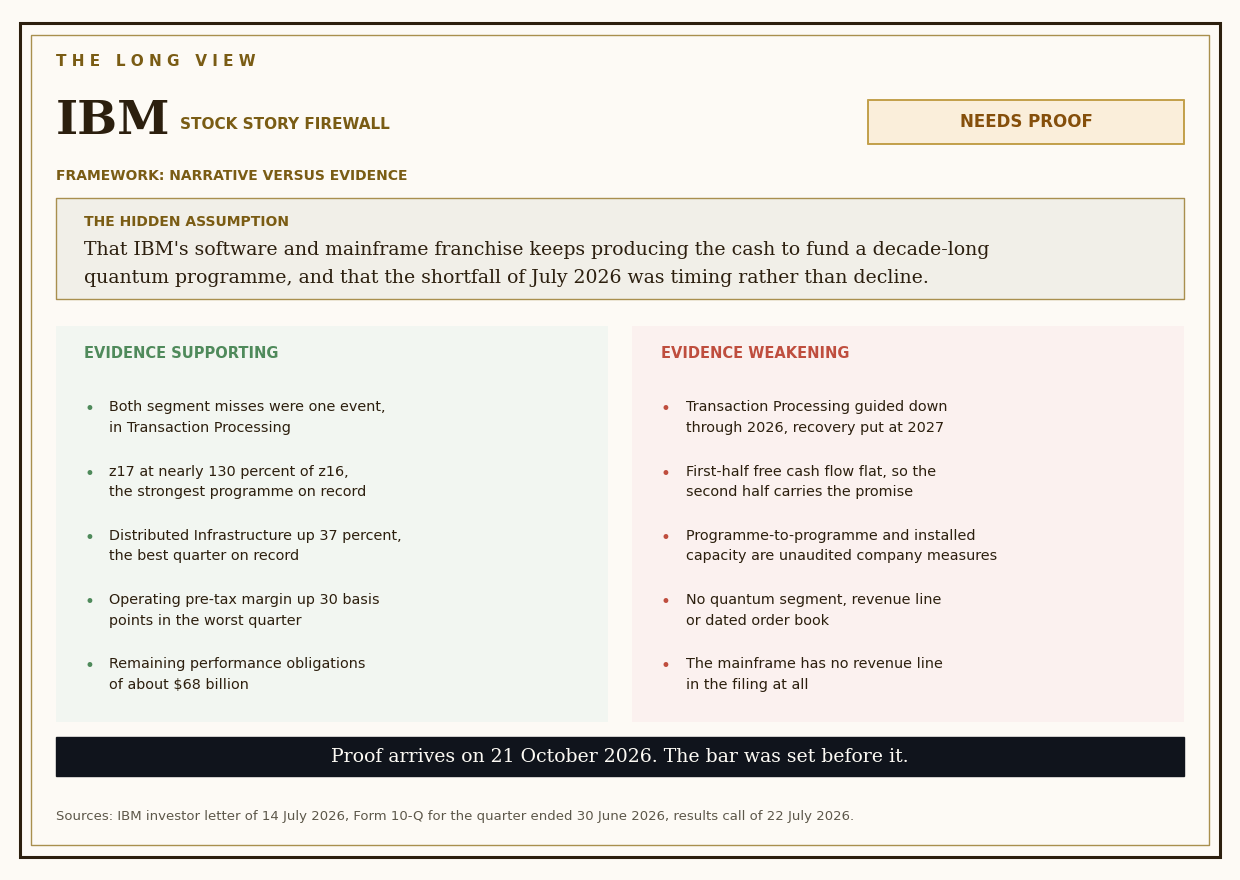
Run IBM through the Firewall and the hidden assumption it surfaces is not about quantum at all.
The bet a buyer makes at today’s price is that IBM’s software and mainframe franchise keeps producing the cash that funds a decade-long research program, and that the shortfall of July 2026 was a timing event rather than the front edge of a decline.
Classification: needs proof. Not because the evidence is thin, but because the specific thing that would settle it has a date on it and the date has not arrived.
The framework the Firewall prescribes here is the same one it prescribed for Rigetti in May and IonQ this week: narrative against evidence. What makes IBM different is that the narrative and the evidence sit in different parts of the company. The quantum story is narrative with almost no disclosed economics. The engine is evidence with almost no story attached. Most coverage this year has valued the first and ignored the second.
What the week proved for that assumption, and against it
For it: the two segment misses were one event, because the software shortfall was in Transaction Processing, the stack that runs on the mainframe. The z17 program is running at nearly 130 percent of z16, which was the strongest on record. Clients representing 85 percent of installed capacity are maintaining or growing it. Distributed Infrastructure had its best quarter on record, up 37 percent, so the money that skipped the mainframe partly went to other IBM hardware. Operating pre-tax margin expanded 30 basis points in the worst quarter IBM has had in years, which is not what a company discounting to hold volume looks like. And remaining performance obligations stood at about $68 billion.
Against it: management has guided Transaction Processing down low to mid single digits for the second half and called recovery a 2027 opportunity, so the mainframe software multiplier sits idle for roughly eighteen months. First-half free cash flow was flat, which leaves the second half carrying the promise of about a billion dollars of growth on its own. And the measures that look most reassuring, program-to-program and installed capacity, are defined and reported by IBM, audited by nobody.
That is a case with a hole in it, and the hole closes or widens on one date.
What nobody will tell you, which is its own finding
Four days of reading produced a tally worth publishing on its own.
The mainframe has no revenue line of its own in the accounts. That 42 percent everyone repeated is management’s description of a product the filing never isolates, and the nearest audited figure fell about 10 percent.
Quantum has no segment, no revenue line and no dated order book anywhere in IBM’s reporting. One number exists, quoted from a slide rather than a filing: signings approaching a billion dollars accumulated since 2017.
Widen the lens and the sector has no shared yardstick either. Each of the three publishes a different measure of its own devising, on hardware of its own choosing, verified by nobody outside. Thursday laid out all three side by side.
So the company with the most quantum revenue discloses the least about it, and the two with almost none disclose everything, because for them it is the whole business. That is not a scandal. It is a reason to value IBM on the parts it does disclose and to treat the rest as a free option.
What quantum costs an owner, at each of the three
Here is the sentence this week was built to earn, and it is an ownership sentence rather than a technology one.
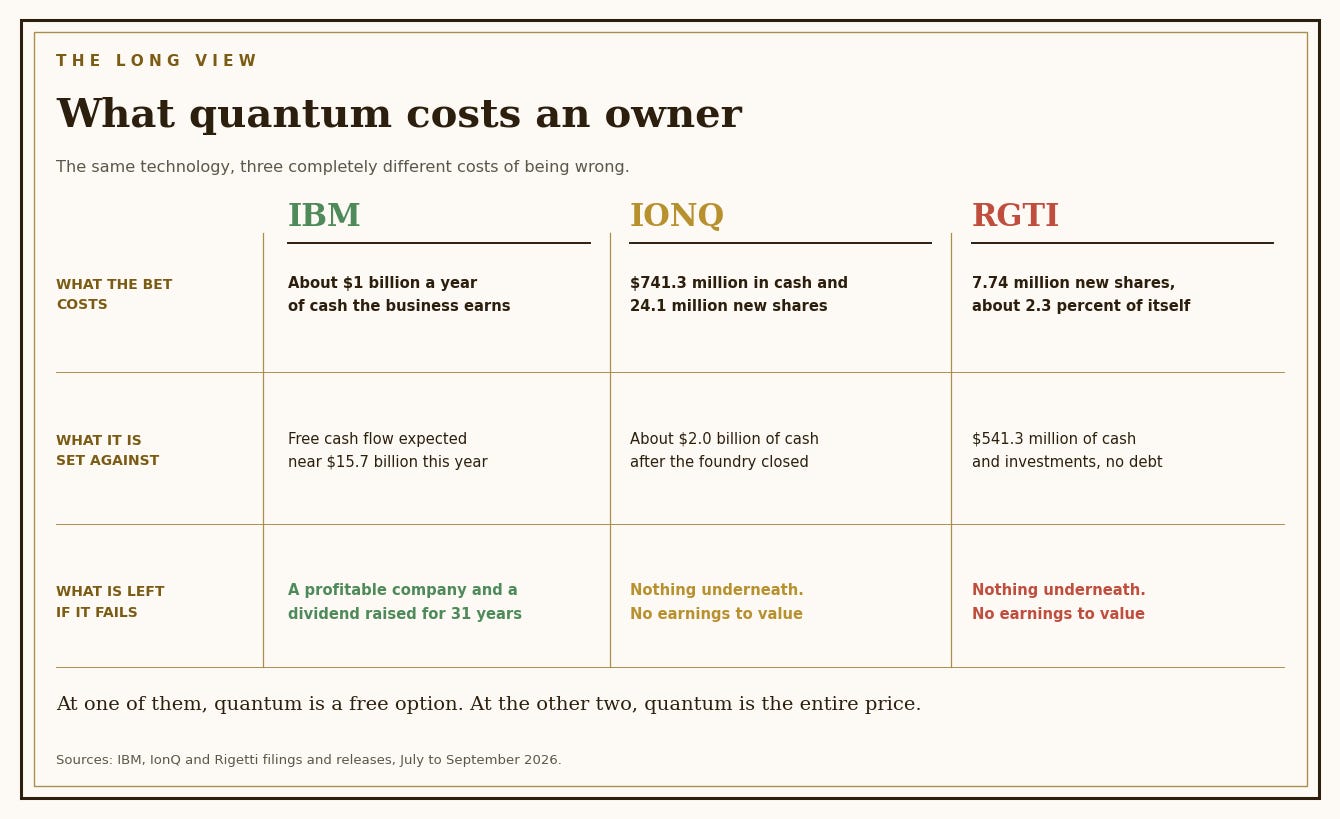
At IBM I am not paying for quantum. The program costs about one billion dollars a year against free cash flow the company expects near $15.7 billion, the dividend is paid either way, and no outside equity was disclosed as the price of the government’s billion. If quantum fails entirely, I own a business that produced $4.76 billion of free cash flow in half a year and still pays me to wait.
At Rigetti and IonQ, quantum is the entire price. Rigetti paid for its award with 7.74 million new shares handed over in full before the research was done, about 2.3 percent of the company. IonQ paid $741.3 million in cash and 24.1 million new shares for its foundry, using roughly a third of its cash pile. If quantum fails at either, there is nothing underneath.
That is the difference, and it is not a judgement about which technology wins. It is arithmetic about who carries the cost of being wrong.
The bar for 21 October, in writing
IBM reports third-quarter results on 21 October 2026. Four things, set now so I cannot move them later.
One. Transaction Processing falls no faster than the low to mid single digits management itself forecast. Demanding growth from that line would be demanding something IBM has already said waits for 2027.
Two. Hybrid Infrastructure, the line the filing does disclose, prints above $2.57 billion. I use it rather than the mainframe figure everyone quotes, for reasons the disclosure tally above makes obvious.
Three. Software lands inside the band the cut guidance set, 6 to 8 percent.
Four. Cash generation in the quarter is heavy enough that the full-year commitment of about a billion dollars of extra free cash flow is arithmetic rather than hope.
[AUGUST BAR] Part two of the August piece set a forward bar for this same quarter. Where it matches the four above, say so. Where it has moved, say what moved it and why, in one paragraph. A bar that quietly changes between August and September is worth nothing.
Four out of four and the July shortfall was a bad three months. Two misses or more and it was something structural, in which case the market got the price right in July and I was the one arguing with it.
My rule for adding, written before the numbers
Not advice, and not a recommendation. A rule, with the reasoning shown, so you can disagree with the reasoning rather than the conclusion.
At $229.55 across 942.1 million shares, the market values IBM near $216 billion. Set that against the roughly $15.7 billion of free cash flow the company expects this year and the yield is about seven percent, with a dividend covered around two and a half times and raised every year for three decades.
Fair, then. Not cheap, and the gap between those two words is where the discipline lives. Six years ago the market had written this company off and priced it accordingly. What is on offer today is a company the market liked a great deal until July and then punished for a single quarter. Those two setups earn different prices from me.
So the rule is this. I add nothing before 21 October. If the four bar items land, the risk in the position falls and I will add at whatever the price is then, because a fair price on a proven engine is a trade I am willing to make. If two or more miss, I do not add at any price until Transaction Processing stops falling, because at that point the question is no longer timing.
The dividend pays me to wait either way, which is what makes waiting cheap.
Rigetti is a sizing question, not a value question
The company I hold, on the only terms available.
Rigetti has no earnings, so nothing here can be called cheap or dear. What can be decided is size and conditions, and the conditions come from this week rather than from the story.
Fidelity: the 108-qubit system runs at 99.1 percent median two-qubit fidelity against 99.5 percent on its own smaller machine and its own target for 2026. One quarter remains. Dilution: the share count is now the thing to watch each quarter, because every milestone bought with equity splits the eventual payoff further. Cash: $541.3 million with no debt, falling about $27.7 million in the quarter, which is years of runway rather than quarters.
My rule for it: the position stays small enough that a total loss changes nothing about my year, and it does not grow on good news about awards or partnerships. It grows only on evidence that each system costs less to build than the last. That is the number that turns a research program into a business.
One more thing, said plainly because it is circulating. There is speculation about Rigetti as an acquisition target, and I can find no filing, no named source and no approach behind it. The government now holding about 2.3 percent makes a deal harder rather than easier. A takeover thesis is a prediction about someone else’s behavior on a timetable you do not control, and this publication does not run those.
IonQ, the one I do not own, which is why it is the cleanest test
No position, nothing to protect, and the most interesting machine of the three.
IonQ builds trapped-ion systems, which is a different physics from IBM and Rigetti: ions held in a vacuum and manipulated by lasers, at room temperature, with every qubit able to talk directly to every other one. Its published two-qubit fidelity is 99.99 percent, the highest of the three by a distance. Its distribution is the broadest, across three clouds. And its $1.87 billion quarterly loss is mostly a non-cash warrant mark against $120.3 million of actual burn.
What would have to become true for it to be ownable on my terms is narrow and checkable. Sales and marketing growing slower than revenue rather than 242 percent faster. Revenue that recurs rather than arriving as milestones, which now needs reading carefully with a foundry inside the company. And the foundry producing a disclosed cost advantage rather than an announced one.
Until then it is the control case for this week’s method, and it earned that role by being the company where I had nothing at stake.
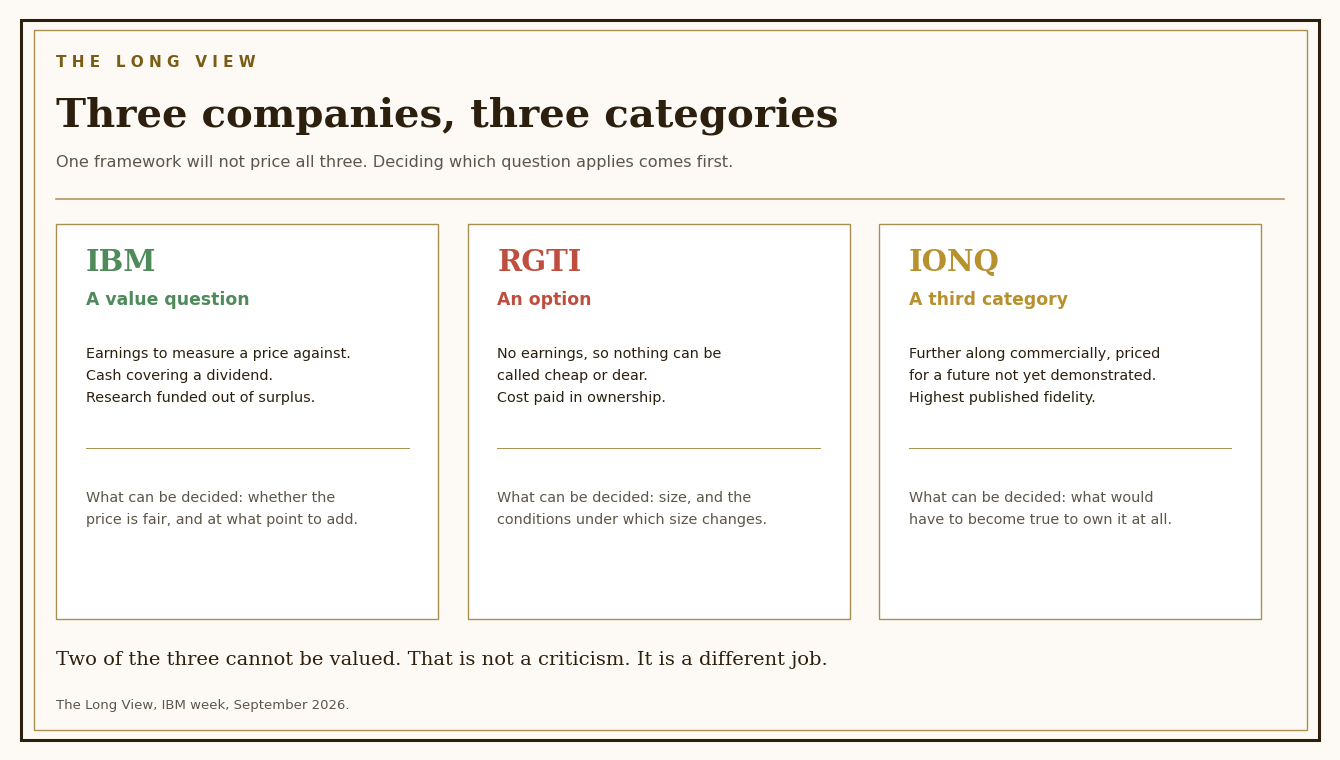
The mistake this week was built to avoid is treating the three as versions of one bet. IBM is a value question, with earnings to measure a price against. Rigetti is an option, where the only decisions are size and conditions. IonQ is a third category again, further along commercially and priced for a future neither has demonstrated. Getting that classification right comes before everything else. Price an option like a business and you overpay for a story. Price a business like an option and you miss the only one of the three that can be valued at all.
What happens now, with dates on it
A week of reading is worth nothing if it ends in a view. So here is the machinery it leaves behind, and every item has a date or a trigger.
21 October 2026. IBM reports. The four bars above get graded in public that week, item by item, including the ones I get wrong. The rule decides what I do, not how I feel about the result.
Every quarter, on Rigetti. Two numbers, tracked in the same place each time: the share count on the 10-Q cover page, because dilution is the cost of every milestone, and any disclosure that bears on what a system costs to build. The fidelity target of 99.5 percent has one quarter left to arrive.
Every quarter, on IonQ. Sales and marketing against revenue, which is the leverage test it is currently failing, and the revenue recognition footnote now that a foundry sits inside the company.
The disclosure tally becomes permanent. Every week from here, when a company stops an answer from being found, it gets recorded and whose wall it was gets named. This week produced three entries and one of them, the mainframe line that does not exist, changed how I read the whole quarter.
Next week. The comparison every investor in young technology reaches for is Amazon and Tesla, and it is incomplete rather than wrong, because nobody writes the patient-holder essay about the companies that did not make it. What the survivors had in their filings before anyone knew they would survive is a checkable question, and the answer is a screen you can run in an afternoon. That is the next framework piece, and it is the one that would have told me more about Rigetti in May than anything I wrote at the time.
What the week changed
I came into Monday thinking the question was whether quantum works. It is not, and that is the thing I will carry out of this week.
Whether quantum works is a question for physicists, and on the evidence it will be years before anyone can answer it with confidence. The question an owner can answer today is who pays while we find out. IBM pays out of surplus and hands its shareholders a dividend throughout. Rigetti pays in ownership, handed over in full before the research is done. IonQ pays with capital it raised and stock it issued. Same technology, three completely different bills, and all three of those facts sat in filings anybody could have read.
That is also why the week ends without a purchase. The price is fair, the engine looks intact, and fair is not the same as cheap. I have the bar written down, the date is three weeks out, and the dividend pays me to wait for it.
Five days, three companies, eleven filings, one decision deferred on purpose and written down in public so it cannot be quietly changed later. That is the job.
Run any company through the Stock Story Firewall, free, at firewall.readthelongview.com.
Not investment advice. The subscriber decides.