

Yesterday I said the trail started with who owns the floor the store is standing on. Here is what I found when I went and looked. One of these two companies owns almost everything it trades out of. The other rents more than half of it. You would expect that to show up in the property section of the annual report, and it does, in a form that makes the two companies impossible to compare. It shows up properly somewhere else, in a line I had never bothered to open, and the gap there is larger than anything I expected.
What each company says it owns
Yesterday I gave you the headline split for each company, so I am not repeating it. What I want today is the sentence underneath it, because that is where the two companies stop looking alike.
Item 2 of the Dillard’s Form 10-K for the fiscal year ended 31 January 2026 says its third-party leases typically set rent as a percentage of net sales with a guaranteed minimum, and that the company generally pays the insurance, the maintenance and the property taxes.
Read that twice. On the leases it does have, Dillard’s rent moves with its own sales. A bad year costs it less rent. That is a very different obligation from a fixed monthly figure, and it is disclosed in one sentence that carries no number at all.
Item 2 of the Macy’s Form 10-K for the same year end says something the property table does not. Shopping center agreements oblige the company to keep certain stores trading for periods of up to 15 years, and some of those agreements require the store to operate under a particular name.
That is not a rent obligation. It is an operating obligation. A landlord has bought the right to have a department store in that spot, under that sign, whether or not the store is the best use of the space by then.
Both of those paragraphs are true, and neither of them can be set against the other, because one describes what rent costs and the other describes what the company promised to keep doing.
The comparison you cannot make
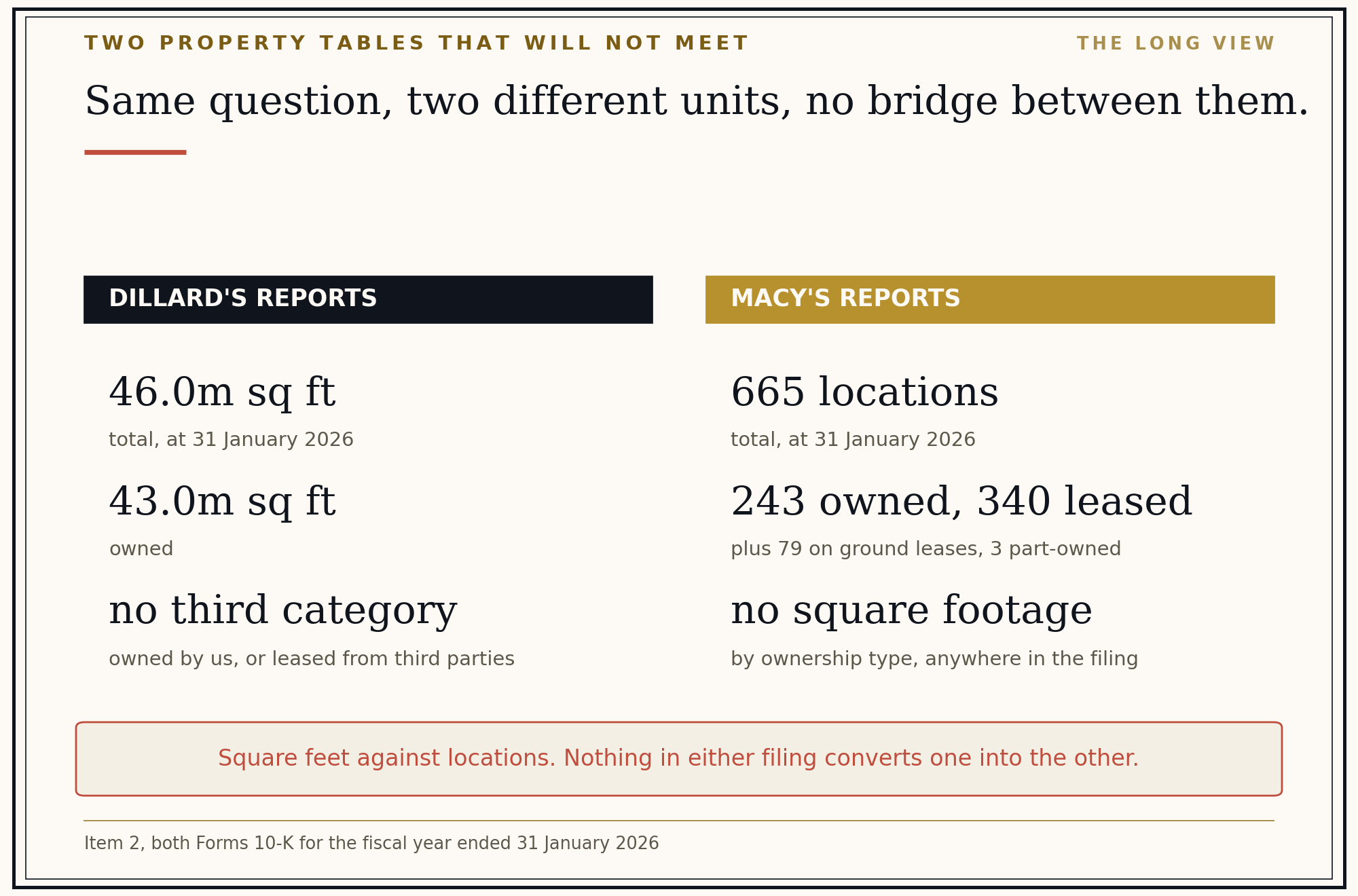
Dillard’s tells you how many square feet it owns. Macy’s tells you how many locations it owns. Nothing in either filing converts one into the other, because Macy’s does not publish square footage by ownership type and Dillard’s does not publish a count of owned stores.
You could guess. Macy’s owns 243 of 665 locations, so you could assume the owned share of its 98 million square feet is about the same proportion. That assumption would be doing a lot of work for free. A flagship in a city center and a Bluemercury unit in a strip mall are both one location, and Bluemercury’s 172 shops are all leased.
So the answer is that the test cannot be run on the property tables, and I am not going to run it anyway. What would settle it is a schedule of square footage by ownership type, and neither company publishes one.
The category with no name
There is a third arrangement in the Macy’s property table that most comparisons drop, and it is the most interesting one.
Seventy-nine of its locations are buildings the company owns standing on land it leases. It owns the store and rents the dirt.
That is neither ownership nor tenancy. It is a building whose value depends on a ground lease with an end date, and a landlord who eventually gets the land back with whatever is standing on it. Three more locations are partly owned and partly leased, which is a sentence the filing does not expand on.
Dillard’s discloses no equivalent category. Its Item 2 says its stores are owned by it or leased from third parties, with no third arrangement named.
So one company’s footprint sorts into two buckets and the other’s sorts into four. A reader who compares “owned” against “owned” is comparing a clean number to a number that has been cut three different ways.
Where the same choice shows up anyway
When a method fails, the thing to do is find where the same decision gets recorded somewhere else. Renting a building is a decision that leaves a mark on the balance sheet, and both companies have to record it the same way.
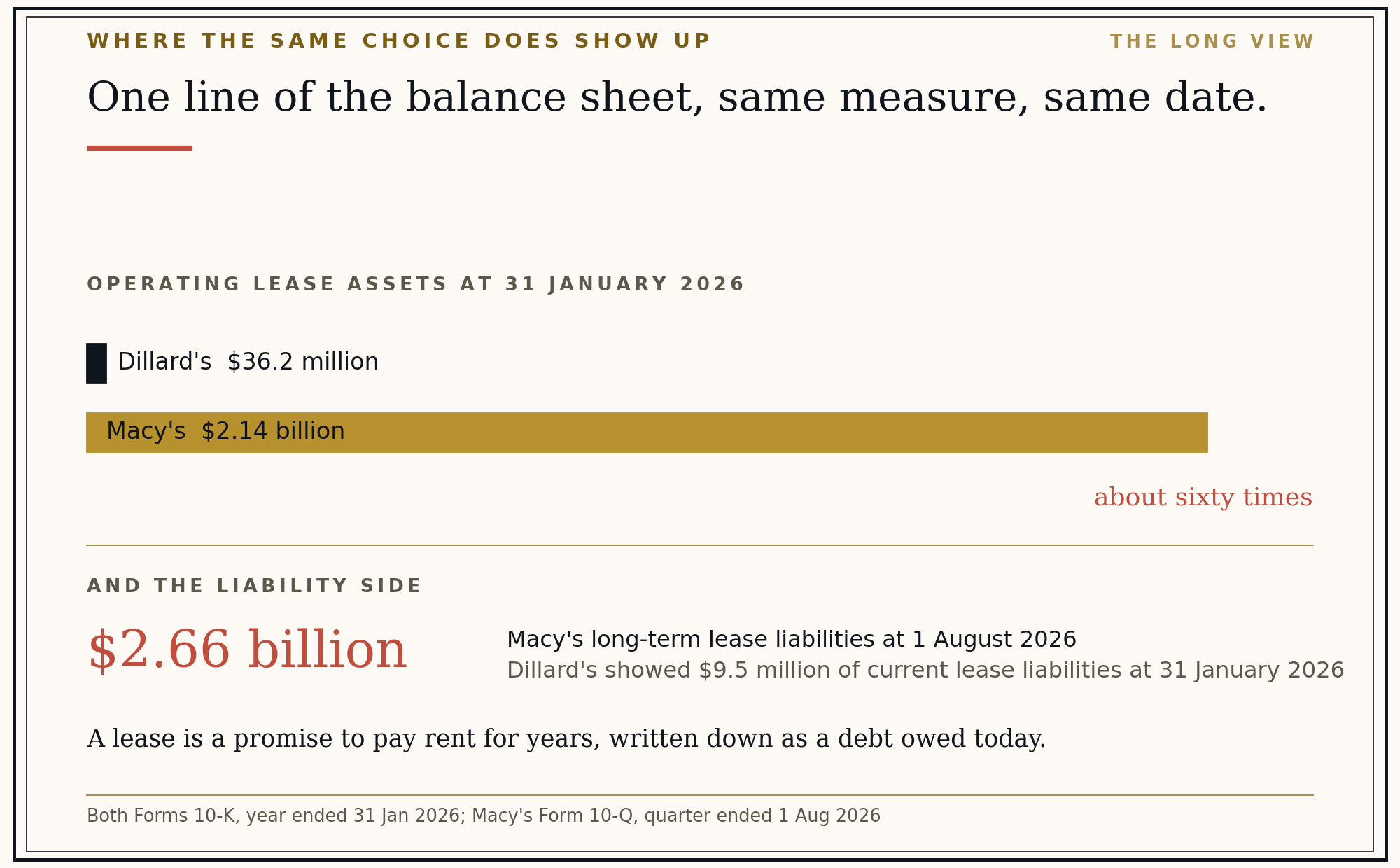
At 31 January 2026, Dillard’s carried operating lease assets of $36.2 million.
At the same date, Macy’s carried right-of-use assets of $2.14 billion.
Those are the same measure, at the same date, for two companies in the same business. One is about sixty times the other.
The liability side is worse. At 1 August 2026, Macy’s carried long-term lease liabilities of $2.66 billion. Dillard’s showed current operating lease liabilities of $9.5 million at 31 January 2026 and reported no finance lease obligations at all during its last three fiscal years.
That is the comparison the property tables would not give you, and it took one line of a balance sheet rather than a paragraph of prose.
One caution before you go and check. Both of those liability figures are the long-term portion. There is a current portion sitting in current liabilities as well, so the full obligation at each company is larger than the number above. The gap between the two is the point, and it does not narrow when you add the current portion in.
What a lease actually is, on a balance sheet
A lease is a promise to pay rent for years, which the accounting rules make a company write down as a debt it owes today.
That is worth saying slowly, because it is the whole point of the day. Macy’s has not borrowed $2.66 billion. It has agreed to occupy buildings it does not own, and the present value of what it must pay for them sits on its balance sheet as a liability with a number attached.
Dillard’s has made almost none of those promises, because it bought the buildings instead. The cost of that decision was paid decades ago and is not on any statement you can read today. The benefit turns up every quarter, in an expense line, forever.
This is the part worth taking away even if you never look at either company again. A balance sheet does not reward a company for owning things. It records what a company owes. So the business that made the expensive decision years ago looks light, and the business that kept its money and rented instead looks heavy, and the numbers are correct in both cases.
Which means the lease line is not a verdict. It is a measure of how much of each company’s future is already committed before a single customer walks in.
The part that goes the other way
Here is where the easy story breaks, and it broke on me while I was writing.
Owning the buildings has not made Dillard’s debt-free. Its Form 10-Q for the quarter ended 1 August 2026 reports $425.7 million of total debt: an $80.0 million maturity due May 2027, $145.7 million of long-term debt and $200.0 million of subordinated debentures. It also reports cash of $763.1 million and short-term investments of $497.7 million, and it repaid a $96 million maturity during the quarter.
Macy’s carries long-term debt of $2.43 billion at the same date, which is the larger number. But its 10-K states that its owned properties are held free and clear of mortgages, so the company that rents more has not pledged the property it does keep.
So ownership did not remove borrowing at one company, and renting did not force a mortgage at the other. Those two facts sit awkwardly beside the story I have been telling myself about department store real estate.
Where the leftovers go
There is a second property decision inside all of this, and the two companies answered it in opposite directions.
Dillard’s operated 272 stores at 1 August 2026, and 28 of them are clearance centres. Aged stock leaves the main store and goes to a different building.
Macy’s runs its off-price business, Backstage, inside stores it already has. Note 1 of its Form 10-Q for the quarter ended 1 August 2026 lists Macy’s Backstage and Bloomingdale’s The Outlet among seven operating divisions, and none of them appears as a separate line in the store count, because they sit within the 432 and the 61.
One company pays for extra square footage to keep the discounted goods away from the full-price ones. The other reuses square footage it is already paying for and lets the two assortments share a roof.
How to run this yourself, on any two retailers
Three documents, about twenty minutes, no subscription.
Open Item 2 of each company’s Form 10-K. Read past the store count to the sentence about lease terms, because that sentence tells you whether rent is fixed or moves with sales, and who pays the taxes and the maintenance.
Then open the balance sheet in the most recent Form 10-Q and find two lines: operating lease assets, sometimes called right-of-use assets, and lease liabilities. Those two lines exist at every public company in the same form, which is exactly why they work where the property tables do not.
Then check the dates match. Two companies reporting a week apart is fine. Two companies reporting two quarters apart is not a comparison, it is a coincidence.
What I could not do today
I could not tell you what either off-price channel earns. Macy’s aggregates all seven divisions into one reporting segment on the stated basis that they have similar economic characteristics. Dillard’s does not break out its clearance centres. The test cannot be run, and what would settle it is divisional reporting that neither company provides.
I could not tell you what any of this property is worth. Both companies carry it at cost less depreciation and neither filing contains an appraisal. A building bought decades ago is not carried at anything resembling what it would fetch. That gap is Friday’s work.
What owning is worth, and what it is not
Owning the floor is worth real money. Macy’s pays rent on 340 locations and Dillard’s does not pay rent on buildings it already owns. That difference lands in an expense line every quarter for as long as both companies exist, and it never appears in a property table.
Now the part I have to say plainly, because the easy version of this week stops here and the easy version is wrong.
Ownership does not explain where these two companies ended up.
It removes one cost. It does not set what a company charges for a coat, what it pays the vendor, what it costs to staff and light and run the store, or what is left at the end. Those are separate decisions made by different people, and they are where these two businesses come apart.
A reader who stops reading today will conclude that Dillard’s is the better business because it owns its real estate. That conclusion might even turn out to be right. It will not be right for this reason, and the next two days are about the real ones.
Tomorrow
Both of these companies closed a quarter on 1 August 2026, so the comparison is exact rather than approximate. Both of them collected a tariff refund inside it, so neither set of headline earnings survives without saying so. Tomorrow I strip that out of both sides and we find out what each of these businesses keeps from a dollar of sales. It is not where I expected it to be.
Not investment advice. The subscriber decides.