

In the week of 12 October, six stocks tied to artificial intelligence fell between 15.8 and 25.2 percent in five trading days. News reports tied the selling to worry about debt at one company, CoreWeave (Nasdaq: CRWV), which borrowed heavily to build AI data centers. When a scare like this hits, every investor asks the same thing: is this the start of something bigger, or is it contained? You do not need a forecast to answer that. You need four numbers that are published on a schedule. Here they are, in plain English, with what each one said.
Disclosure: the author holds none of the companies named here.
What happened, in two minutes
CoreWeave rents out computer power to companies building AI. To build its data centers, it borrowed. Its latest quarterly report, called a 10-Q, shows $35.07 billion of debt at 30 June 2026. A 10-Q is the report every US public company files with regulators every three months.
That report shows something else. In the three months to 30 June, CoreWeave paid $640 million in interest on that debt. Its loss for the same three months was $626 million. In other words, the interest bill alone was enough to wipe out the quarter.
Lenders noticed. In the week of 12 October they started charging much more to carry CoreWeave’s risk, and its stock fell 25.2 percent between the 9 and 16 October closes. Five other AI-related stocks fell with it, including Fabrinet (NYSE: FN), a parts maker with no debt at all.
That raised the real question. Was the fear spreading through the whole lending system, or stuck on one company?
Why one company’s debt can reach other companies
Think about what happens when a bank gets nervous about lending.
It charges more. Companies that depend on borrowing slow down their building. The suppliers that sell them parts and power see fewer orders. That is how a problem at one borrower could, in theory, reach companies that borrowed nothing.
So the test is simple. If the fear is spreading, the cost of borrowing should rise for many companies, not just one, and the big AI spenders should start cutting back. Four numbers show whether that is happening.
Number one: the price of insuring a loan
Lenders can buy insurance against a borrower not paying them back. It is called a credit default swap. The buyer pays a yearly fee, and if the borrower fails to pay, the insurer covers the loss.
The fee is a good thermometer. When lenders are calm, it is low. When they are scared, it jumps.
CNBC reported on 16 October that insuring CoreWeave’s debt cost more than 1,000 basis points a year. A basis point is one hundredth of one percent, so 1,000 basis points is 10 percent.
Put simply, a lender paid more than $10 a year to protect every $100 it had lent to CoreWeave.
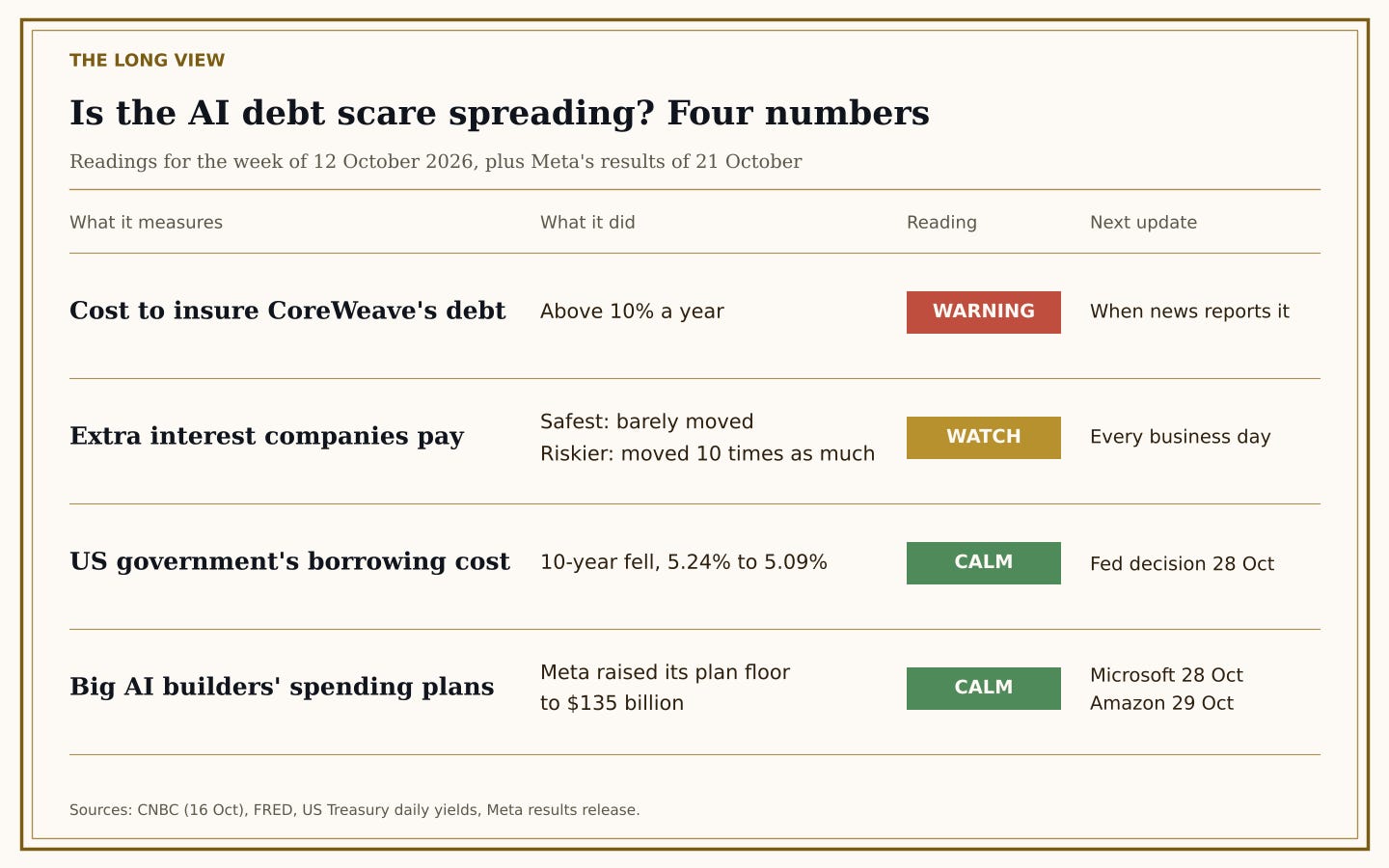
Reading: warning, for one company. These prices sit behind paid professional services, so this is the one number you cannot check for free. News outlets report it when it moves.
Number two: the extra interest companies pay
Every company pays more to borrow than the US government does, because the government is treated as the safest borrower there is. That extra amount is called a credit spread.
Here is how it works in dollars. If the government pays 5 percent and a company pays 5.85 percent, the spread is 0.85 points. The company pays 85 cents more a year for every $100 it borrows.
The safest companies, called investment grade, saw their spread move from 0.83 to 0.85 points between 9 and 16 October. That is almost nothing.
Riskier companies, called high yield, saw theirs rise from 3.11 to 3.31. That move was ten times bigger.
Reading: watch. Worry reached the riskier borrowers. It did not reach the strongest ones. Both numbers are free every business day on FRED, the St. Louis Federal Reserve’s public data website.
Number three: what the US government pays to borrow
The interest rate on a 10-year US government bond is called the 10-year Treasury yield. It matters to almost every borrower, because many other loans are priced off it, from company debt to home mortgages.
If the debt scare were spreading through the whole system, you might expect this rate to rise. It did the opposite. It fell from 5.24 percent on 9 October to 5.09 percent on 16 October, according to the Treasury’s own daily figures. CNN reported money moving out of chip stocks and into government bonds, which pushes the rate down.
Reading: calm, during the scare. One caution. A rate above 5 percent is still expensive money. It just did not get worse during the scare. The Treasury publishes this number free every business day.
Number four: what the big AI builders plan to spend
Capital spending is money a company spends on buildings and equipment. For the biggest AI companies, it means data centers. That spending flows to the companies that supply data center parts, such as Fabrinet, whose customers include Nvidia and Amazon.
So this is the number that decides whether a debt scare reaches the suppliers’ actual sales, not just their stock prices.
Meta reported on 21 October. It spent $34.91 billion on buildings and equipment in the three months to 30 September 2026. It raised the low end of its plan for the year to $135 billion, with the top still at $145 billion. In July the plan started at $130 billion.
Reading: calm, for spending. Microsoft reports on 28 October and Amazon on 29 October. Each will update this number.
One thing to watch inside Meta’s report. Free cash flow is the cash a business has left after paying for its buildings and equipment. Meta’s was negative $2.12 billion for the quarter. In plain terms, it spent more on building than its business brought in. A gap like that has to be covered from cash on hand or new borrowing. In the quarter before, it had $784 million left over.
What the four numbers say together
One number gave a warning, one said watch and one stayed calm. The fourth, the AI builders’ spending, kept growing, though Meta now spends more than its business brings in.
Put plainly, the fear was real but narrow. The stock prices of six companies fell together, as if one company’s debt problem belonged to all of them. The lending numbers say the trouble stayed mostly with one heavy borrower and the riskiest corner of the loan market.
The hidden assumption this week tested was that a debt problem at one company spreads to every company near it. The share prices acted as if it had. The four numbers say that, so far, it has not.
That is a reading of one week, not a prediction. Any of these numbers can change, and each one is published on a schedule you can follow.
The lesson: a falling price is a question, not an answer
A falling price tells you that people are afraid. The company’s own reports tell you whether they are right.
Fabrinet shows why. Its annual report shows no debt. It still fell as far as CoreWeave, which owes $35.07 billion. The stock chart could not tell the two apart. The reports could, in an afternoon.
Corning (NYSE: GLW) shows the second half of the lesson, which is about timing. A common way to judge a stock’s price is to ask how many dollars you pay for each $1 of the company’s yearly profit. On 6 October, a Corning share cost about $59 for every $1 of its yearly profit. By 16 October it cost about $46.
The investor Peter Lynch used a simple rule of thumb: a fair price is roughly equal to how fast profit is growing. A company growing profit 30 percent a year is fairly priced at around $30 for every $1. Corning’s profit grew about 30 percent in its latest reported quarter, using the adjusted measure Corning reports, which it calls core earnings. So the scare made Corning cheaper. It did not make it cheap by that rule.
An investor who had worked that out before the scare knew within a minute whether the drop mattered. One who had not was doing the math in a hurry, which is how people talk themselves into bad decisions.
One thing I got wrong
In August I wrote that the US government’s borrowing cost was the place this kind of pressure would show up first, partly because foreign governments had been selling US bonds. During the scare, that number went the other way. The Treasury’s latest monthly report, released 16 October, shows foreign governments bought $18.1 billion of US government bonds in August.
I am printing that because the method only works if I show you the numbers that disagree with me, not just the ones that agree.
How to watch this yourself
You can follow all four from here. Three are free.
1. The price of insuring CoreWeave’s debt: reported by CNBC and other outlets when it moves.
2. Credit spreads: free on FRED every business day. Search “ICE BofA US Corporate” and “ICE BofA US High Yield.”
3. The 10-year Treasury yield: free on the US Treasury’s website every business day.
4. AI builders’ spending plans: Microsoft on 28 October and Amazon on 29 October, in each company’s quarterly results.
The Federal Reserve, which sets short-term interest rates, also meets on 27 and 28 October. Its decision moves number three.
One question to carry into the weekend: which of these four numbers would have to change before you felt comfortable buying any of these companies?
Not investment advice. The subscriber decides.