

On 12 November 2026, Nvidia (Nasdaq: NVDA) announced that Jensen Huang had resigned. He co-founded the company in 1993 and had run it since. The stock closed at $186.64 on 6 November, the last trading day before the board’s 8 November statement, and at $162.85 on 13 November. The price moved. The profit behind it has not been tested, because Nvidia has not reported since. It reports on Tuesday 17 November. Before those numbers land, I wrote down what they have to show, so neither of us can move the goalposts afterwards.
Disclosure: the author holds no individual shares in any company named here. He owns broad index funds that include some of them.
What Nvidia said, and when
Three documents tell the story, all from Nvidia itself.
On Sunday 8 November 2026, the board said it was opening an independent investigation “in light of recent reporting that founder and CEO Jensen Huang has been the target of a foreign intelligence effort.” A committee of independent directors, with outside counsel, oversees it. The same statement said the board had “no reason to believe that either national security or NVIDIA secrets were compromised.”
The reporting it referred to had started earlier. The New York Times published its story on 29 October 2026. So the 6 November close is the last price before the board spoke, not a price untouched by the news.
On Thursday 12 November, the board announced that Huang had resigned. Its filing with regulators says the board accepted the resignation on 11 November. The resignation, as President, Chief Executive Officer and a board member, was “effective immediately.” Colette Kress, chief financial officer since September 2013, is interim CEO and stays CFO. The board is searching for a permanent CEO and “will consider internal and external candidates.” Harvey C. Jones became its first-ever Chair.
The company’s release gives no reason for the resignation. This piece sticks to what Nvidia published, because that is what you can check.
The price fell. The profit has not moved yet.
In the four quarters to 26 July 2026, the last it has reported, Nvidia made $6.95 a share on its adjusted count. That count leaves out items such as gains and losses on shares Nvidia owns in other companies, and acquisition costs. From its quarter to 26 April 2026, the count includes stock paid to employees, and Nvidia recast its earlier quarters to match. I use the recast figures.
On standard accounting, which keeps those investment gains in, the same four quarters came to $7.91 a share, so the P/E on that measure is lower. I use the adjusted count because gains on other companies’ shares are not chip sales.
That $6.95 was the same on 13 November as on 6 November. Nothing new had been reported.
What changed is what you pay for it. Price divided by a year of profit is the P/E, short for price-to-earnings, which I walked through on 11 November. At $186.64 you paid about $26.85 for each $1. At $162.85, about $23.43. The stock fell about 12.7 percent. Same profit, lower price.
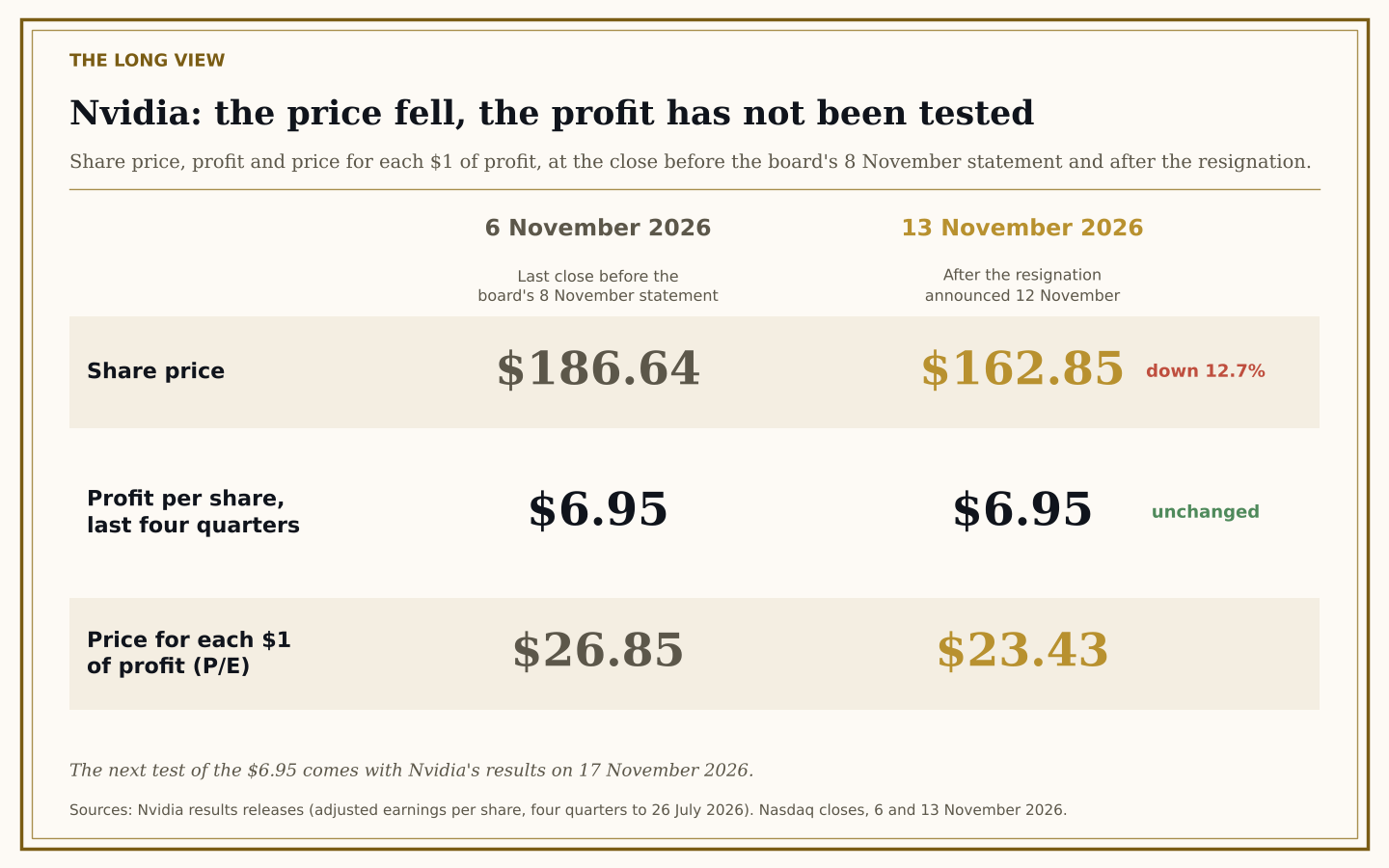
Prices here are Nasdaq closing prices for 6 and 13 November 2026. A correction: my 11 and 13 November pieces used $186.44 for the 6 November close. The close was $186.64. The difference changes no conclusion in either piece.
The hidden assumption
A lower price for the same profit looks like a discount. Whether it is one depends on a question the price cannot answer.
Buying Nvidia at $162.85 because it fell carries a hidden assumption: that the $6.95 a share was earned by the company, not by the man who left, and that it keeps rising without him.
If that holds, the drop is a discount. If it does not, the lower price may be a fair price for a smaller future.
The documents available on 16 November cannot prove the assumption either way. What you can do is decide in advance what evidence would support it, and what would weaken it. That is what the rest of this piece does.
The drop is a discount only if the profit belonged to the company, not to the founder.
What Nvidia’s own annual report warned
Nvidia’s annual report for the year ended 25 January 2026, its 10-K, lists the risks the company itself sees. In the part about keeping its people, it says: “we are highly dependent on the services of our longstanding executive team.”
The next sentence reads: “Failure to ensure effective succession planning, transfer of knowledge, and smooth transitions involving executives and key employees could hinder our strategic planning, execution, and long-term success.”
So the company named this risk in writing. The filing answers whether the risk was known. It does not answer what it would cost. That risk factor gives no number.
The 12 November release offers an expectation from the new Chair, Harvey C. Jones: “we expect the company’s operations, customer commitments and product roadmap to continue without interruption.” An expectation is not a result. The first results since the resignation arrive on Tuesday.
Your $5000 at $162.85
The usual what-if: a hypothetical $5000, not a recommendation. Swap in $500 or $50000 and every percentage stays put.
At $162.85, $5000 buys about 30.7 shares. By November 2031, the share price you need not to lose money is $162.85. The price you need to make 10 percent a year is about $262.27. That is $162.85 multiplied by 1.1 five times. 1.1 to the fifth power is about 1.6105. Your $5000 would then be worth about $8053.
Now tie that price to profit. Suppose buyers in 2031 pay what they paid on 13 November, $23.43 for each $1 of profit. Then the share price can only rise as fast as profit does.
To break even, profit has to stay at $6.95 a share. To make 10 percent a year, it has to reach about $11.19 a share: $6.95 times 1.6105.
That is what the company has to do. Whether it can is your call, and Tuesday gives you the first evidence.
Why a lower price only helps if the reason fades
Here is the part the drop hides. Run the same sum from 6 November. At $186.64 and $26.85 for each $1, profit also had to reach about $11.19 for 10 percent a year. The bar on profit did not move.
If buyers keep paying $23.43 for each $1 of profit, your return from $162.85 depends only on profit growth, the same as it did from $186.64 when buyers paid $26.85.
The drop pays you one way: if buyers go back to paying what they paid before. Say profit stays exactly at $6.95, and in 2031 buyers pay $26.85 for each $1 again. The price returns to $186.64. Your $5000 becomes about $5730, about 2.8 percent a year, from no growth at all.
If losing its founder means buyers pay less for each $1 of Nvidia’s profit for good, there is no discount to collect. That is the question under the hidden assumption.
A lower price is a bargain only if the reason for it fades.
How $6.95 changes on Tuesday
Nvidia’s $6.95 is four quarters added together, on its restated adjusted measure: $1.27 for the quarter to 26 October 2025, $1.59 to 25 January 2026, $1.87 to 26 April 2026, and $2.22 to 26 July 2026.
On Tuesday the oldest quarter, $1.27, drops out. The quarter to 25 October 2026 comes in.
So the arithmetic is short. Take $6.95, subtract $1.27, add the new quarter. Any new quarter above $1.27 lifts the total. If the new quarter only matches the $2.22 before it, the total becomes $7.90.
That makes “is $6.95 a floor?” an easy bar to clear on Tuesday. It is the wrong place to stop, for the reason two sections down.
Three checks, written down before the numbers
Nvidia set its own targets in its results release for the quarter to 26 July 2026. I use those, not analysts’ estimates, because the company is the one accountable for them.
Check one, sales. Nvidia said revenue for the quarter to 25 October would be “$108.0 billion, plus or minus 2%.” That is $105.84 billion to $110.16 billion. Inside or above the range passes. Below it fails. The same outlook assumed no data center computing revenue from China.
For scale, look at the two quarters of its fiscal 2027 reported so far. Nvidia guided $78.0 billion, plus or minus 2%, for the quarter to 26 April 2026 and reported $81.6 billion. It guided $91.0 billion for the quarter to 26 July and reported $96.2 billion. Both landed above the top of the range. Landing inside the range would pass my check and still fall short of those two reports.
Check two, gross margin. Gross margin is what is left of each $1 of sales after the cost of making what was sold. Nvidia guided 74.0 percent, plus or minus half a point: 73.5 to 74.5 percent. Below 73.5 means it kept less of each sale than it planned.
Check three, the next forecast. If the release carries an outlook for Nvidia’s fourth fiscal quarter, which ends on 31 January 2027, as its last two releases did for the quarter ahead, it will be the first Nvidia has set since Huang resigned. The test is simple: does the middle of that outlook call for more revenue than the quarter just reported?
What Tuesday cannot tell you
The quarter Nvidia reports on Tuesday ended on 25 October 2026. The board’s statement came on 8 November. The board accepted Huang’s resignation on 11 November, and Nvidia announced it on 12 November. Checks one and two cover a quarter that closed while he was still in charge.
So if sales and margin pass, that shows the quarter was solid under him. It does not show the profit holds without him. Only check three looks past his departure, and even that is a company forecast, not a result.
Huang was CEO from 26 October to 11 November 2026, the opening weeks of the quarter that ends 31 January 2027. Its results come long after Wednesday’s scoring.
This is where the test breaks. I would rather tell you that on Monday than let Tuesday’s headline numbers settle a question they cannot reach.
What I will do with the answers
On Wednesday 18 November I will score the three checks against the ranges above, rebuild the four-quarter profit figure, and rerun the $5000 at the new numbers. If check three disappoints, the lower price for each $1 of profit may be the market reading the future correctly, not a discount.
Reply with the one number you will look at first on Tuesday, and why. I read every reply.
Not investment advice. The subscriber decides.