

On the same day, 2 March 2026, Nvidia invested $2 billion apiece in Lumentum Holdings (Nasdaq: LITE) and Coherent Corp. (NYSE: COHR), two makers of the lasers and optical parts that put light into AI networks. Both deals came with what each press release called a multibillion-dollar purchase commitment from Nvidia. Neither company passes Monday’s bar, and they miss it for opposite reasons. Coherent fails on cash. Lumentum cannot be measured on its own standard accounts at all. By the end you will see why, and what each one’s customers say about who is really paying for this buildout.
Disclosure: the author holds no position in LITE or COHR.
Friday’s Corning piece promised that Coherent’s own filings would come first when its day arrived. So Coherent goes first.
The Firewall’s hidden assumption is the same for both companies: that AI demand for their optical parts stays above their capacity long enough to turn scarcity into durable, high-margin growth. The filings can test today’s half of that sentence. Neither can test the long half.
Coherent, from its own filings
Coherent sells what its Nvidia release calls “advanced laser and optical networking products.” In its fiscal year ended 30 June 2026, its Datacenter and Communications segment brought in $5.27 billion, up 40 percent, and its Industrial segment $1.84 billion, down 10 percent. Datacenter and Communications was 74 percent of revenue.
Nvidia bought 7,788,161 Coherent shares at $256.80 each, according to Coherent’s 8-K. The 10-K adds terms the 8-K left out: a six-month lock-up from the closing date, and a price protection provision for the same period. The press release describes “an NVIDIA multi-billion-dollar purchase commitment” but gives no amount and no length, and the filings I read add none.
Coherent closed at $288.02 on 12 October 2026, per CNBC, 12.2 percent above what Nvidia paid.
Who pays the light makers
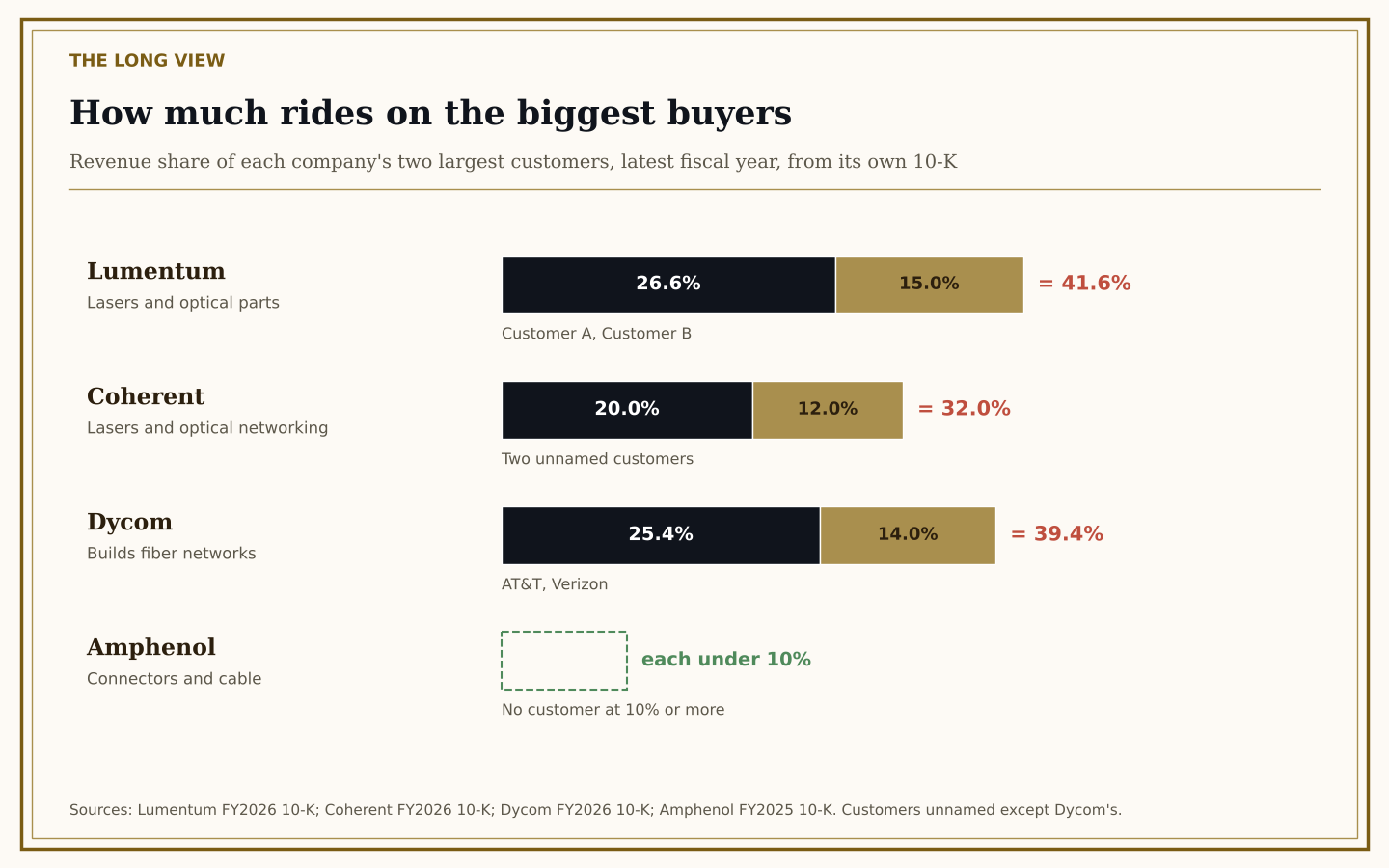
Coherent’s 10-K: “One major customer accounted for 20%” of revenue in fiscal 2026, and “a second major customer accounted for 12%.” Revenue from them “was primarily attributable to our Datacenter & Communications segment.” Neither is named.
Lumentum’s is steeper. Its largest customer, named only as Customer A, accounted for 26.6 percent of its revenue in the year ended 27 June 2026, up from 15.4 percent the year before. Customer B was 15.0 percent. Two buyers, 41.6 percent of the company.
Set that beside the rest of the week. Dycom’s largest customer, AT&T, was 25.4 percent of its revenue. Amphenol says no customer reached 10 percent.
In this week’s filings, the closer a company sits to the light inside a data center, the fewer buyers it depends on.
That is the answer this week has been building toward. The optical layer is where customer concentration shows up in these filings. Neither company names its customers, so whether they are hyperscalers, Nvidia or someone else is NOT PROVEN.
Coherent’s earnings and its cash
Wednesday’s piece said Coherent’s cash flow tells a different story from its earnings. Here it is.
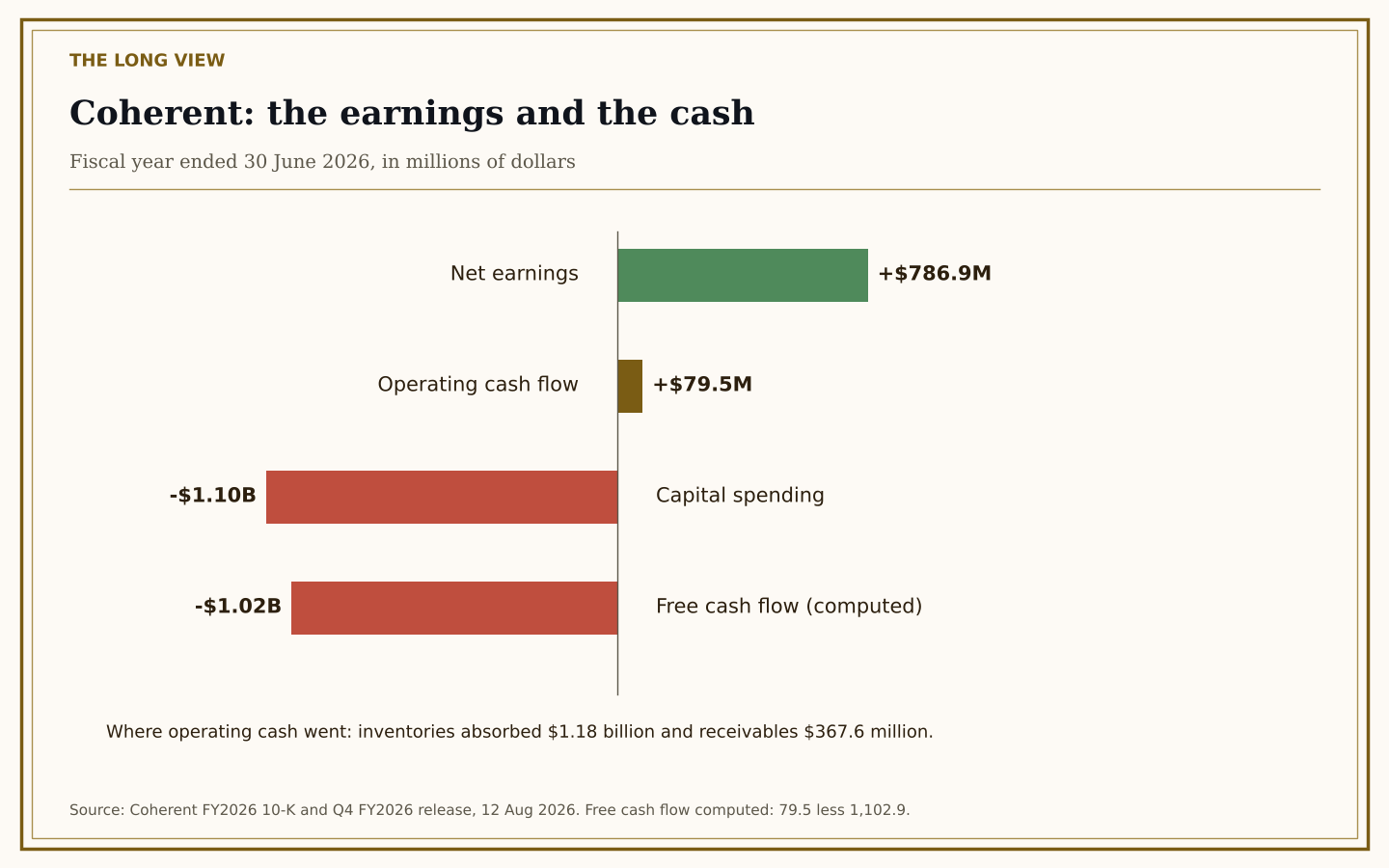
Coherent’s net earnings for fiscal 2026 were $786.9 million. Its operations brought in $79.5 million of cash. The year before, operating cash flow was $633.6 million.
The cash flow statement shows where it went. Inventories absorbed $1.18 billion and receivables $367.6 million. Then Coherent spent $1.10 billion on property and equipment, up from $440.8 million, with another $371.8 million of equipment received but not yet paid for. Operating cash minus capital spending comes to negative $1.02 billion, by my arithmetic. The release does not explain the swing, and I could not reach the part of the 10-K that would.
The earnings also include one-off gains: $124.1 million from selling businesses, including its aerospace and defense unit, and $74.0 million from selling an investment.
Coherent earned $786.9 million and its operations produced $79.5 million of cash. Both numbers are true, and they answer different questions.
The hidden assumption, tested
The scarcity shows up in Lumentum’s numbers. Revenue rose 83 percent in the year to $3.01 billion. Fourth-quarter revenue was $1.006 billion, and the company guides to $1.225 billion to $1.275 billion for the quarter after. Gross margin under standard accounting was 47.4 percent in the fourth quarter, against 28.0 percent for the year before.
Coherent’s numbers are less clear. Datacenter and Communications grew 40 percent, but gross margin under standard accounting was 38.5 percent in the fourth quarter, up 2.77 points from a year earlier. Inventory rose from $1.44 billion to $2.58 billion, most of it work in progress. That can mean parts waiting for demand or parts racing to meet it. The filings I read do not say which.
Coherent against the bar
Test one, defensible earnings: $4.12 a share under standard accounting, gains included. Test two, price against growth: Coherent lost $0.52 a share the year before, and growth from a loss cannot be measured as a rate, so this test cannot run. Test three, cash: negative $1.02 billion. It fails.
Coherent is classed keep on watch. A company that is building as fast as this one may be making the right decision. The bar does not judge that. It measures what a buyer gets for the price today.
At $288.02, Coherent is valued at about $56.7 billion, 69.9 times its standard earnings. A 10 percent return on those earnings supports about $41.20 a share. Five thousand dollars buys 17.36 shares. Ignoring any dividend, a total gain of 30 percent by October 2031 needs about $374.43, and 30 percent a year needs about 3.7 times today’s price.
The balance sheet can carry the build for now. At 30 June 2026, Coherent held $1.16 billion of cash and $825.0 million of short-term investments, against $3.22 billion of debt. Its outlook for the September quarter calls for revenue of $2.2 billion to $2.4 billion, against $1.58 billion a year earlier. If that arrives, the inventory may be turning into sales. The next cash flow statement is the one to read.
Lumentum, the same deal at a higher price
Lumentum’s version of the Nvidia deal was 2,876,415 shares of convertible preferred stock at $695.31 each, according to its 8-K. Lumentum closed at $995.41 on 12 October 2026, per CNBC, 43.2 percent above that price.
The purchase commitment is harder to find. Its press release says “the non-exclusive agreement includes an NVIDIA multi-billion purchase commitment and future capacity access rights.” The 8-K’s own items say nothing about it, and neither do the notes to the 10-K that I read. The $2.40 billion of “legally-binding purchase commitment obligations” in Lumentum’s 10-K is Lumentum’s own commitment to its suppliers, not Nvidia’s to Lumentum.
Which earnings for Lumentum
For the year ended 27 June 2026, Lumentum reported a loss of $92.96 a share under standard accounting. Its operating income was positive, $524.8 million. The loss came from a $7.76 billion charge when convertible notes were swapped for shares, which its release calls “one-time, non-cash.” On its own adjusted basis, Lumentum earned $8.67 a share.
The bar has used standard-accounting earnings for every company this week. On that basis Lumentum has no earnings to divide by, so the price test cannot run. That is the same answer Lumen got on Tuesday, for a very different reason.
A cyclical in a fast grower’s clothes
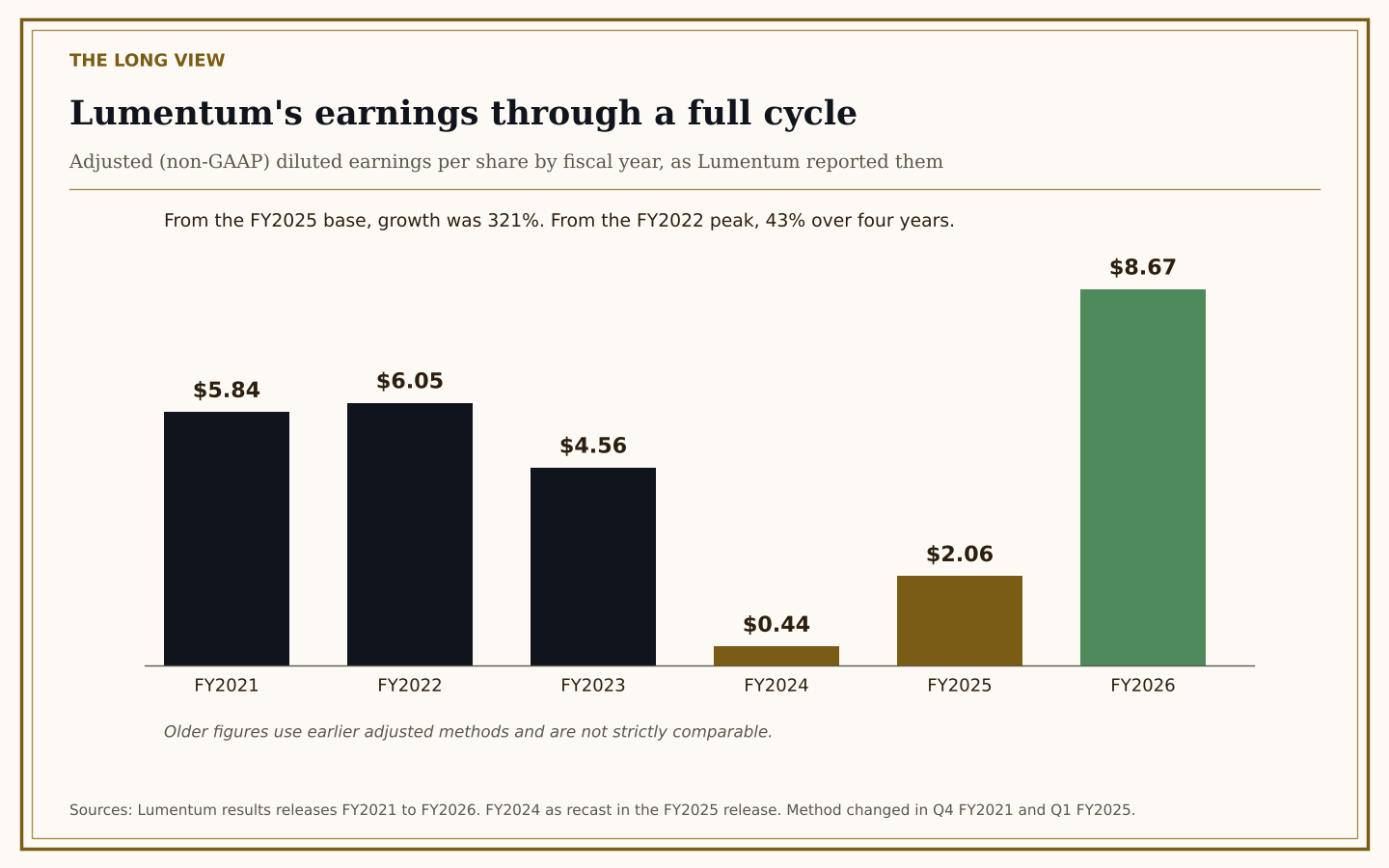
Run the adjusted figure anyway and Lumentum looks remarkable. Adjusted earnings rose from $2.06 to $8.67, up 321 percent. At $995.41, that is 114.8 times adjusted earnings, or 0.36 times the growth rate, comfortably inside the bar.
The longer record says why that number cannot be trusted. Lumentum’s adjusted earnings were $5.84 a share in fiscal 2021 and $6.05 in fiscal 2022. They fell to $4.56 in 2023 and to $0.44 in 2024, as later restated. Revenue went from $1.77 billion in 2023 to $1.36 billion in 2024. Standard-accounting operating income swung from $527.0 million in 2021 to a loss of $434.0 million in 2024.
Measured from fiscal 2022’s $6.05 instead, adjusted earnings grew 43 percent in four years. Lumentum changed its adjusted method twice in that span, so the older figures are not strictly comparable. The shape is clear anyway. Measured from the bottom of a cycle, a cyclical looks like a fast grower. Lynch’s price-to-growth yardstick was built for fast growers, and my reading is that it misleads here.
Lumentum against the bar
Test one, defensible earnings: a standard-accounting loss, almost all of it one non-cash charge. Test two: cannot run. Test three, cash: operating cash flow of $751.4 million less $451.3 million of capital spending leaves $300.1 million, positive.
Lumentum is classed NOT PROVEN. At $995.41, it is valued at about $92 billion counting Nvidia’s preferred as converted. Even on its own adjusted figure, a 10 percent return supports about $86.70 a share. Five thousand dollars buys 5.02 shares. Ignoring any dividend, a total gain of 30 percent by October 2031 needs the shares 30 percent higher, and 30 percent a year needs about 3.7 times today’s price.
Beside the price sit two more figures. Lumentum’s outlook for the September quarter is adjusted earnings of $4.05 to $4.35 a share, about half of last year’s total in a single quarter. And its adjusted share count for the June quarter, 101.1 million, already counts about 14.0 million shares from convertible notes that have not yet converted.
Tomorrow
Tomorrow is the verdict on all five. Dycom and Amphenol passed the bar. Lumen and Lumentum could not be measured on it. Coherent failed on cash. Friday asks whether a bar that passed two of five was set too loose, and sets the customer filings beside the industry figures to answer who is paying for this buildout.
One question to sit with until then: would you rather own the company with one customer at 26.6 percent of revenue, or the one with no customer above 10 percent, if both cost the same?
Not investment advice. The subscriber decides.
Even Nvidia’s billion dollar bets don’t automatically make an overpriced business a bargain.