

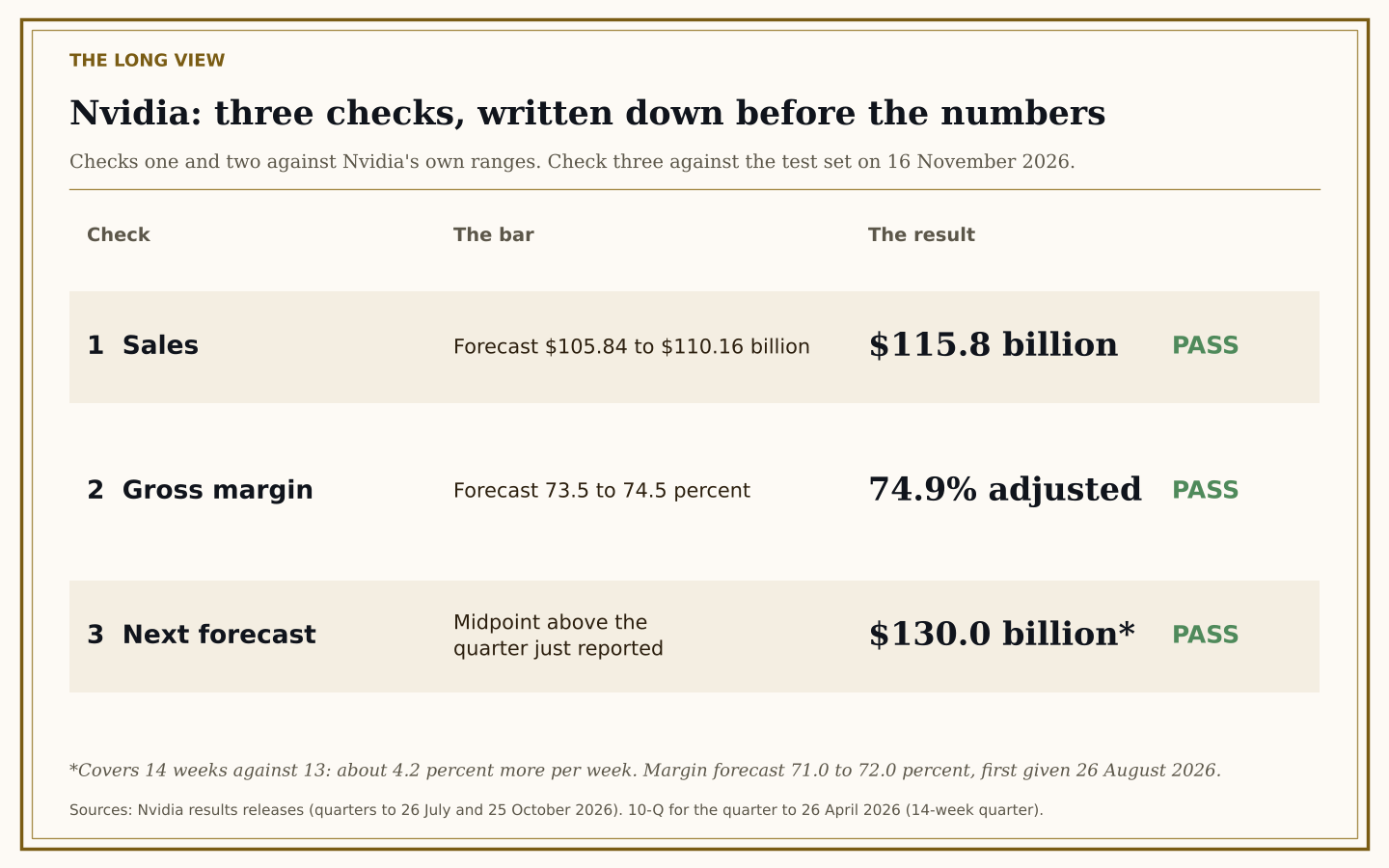
On Monday I wrote down three things Nvidia (Nasdaq: NVDA) had to show in its first results since Jensen Huang resigned. On Tuesday 17 November it reported. Sales, margin and the next forecast all cleared their bars: two against ranges Nvidia set itself, one against a test I set on Monday. If you stop there, the story is simple: the founder left and the machine kept running. The forecast hides a detail that changes the size of that story. It covers an extra week. Here is how to read it, and what else sits beside the checks.
Disclosure: the author holds no individual shares in any company named here. He owns broad index funds that include some of them.
The first forecast since Huang left: a pass
I promised to judge the outlook first, because it is the only number in the report set after Huang’s resignation. Nvidia forecast revenue of $130.0 billion, plus or minus 3%, for its quarter ending 31 January 2027. That is $126.1 billion to $133.9 billion.
The quarter just reported, to 25 October 2026, brought in $115.8 billion. So, the middle of the forecast is higher. By the test I set on Monday, check three passes.
The release says the January quarter includes an additional week. That matters, and the next section shows why.
The forecast passed. The extra week means it passed by less than it looks.
Divide by the weeks before you compare
Nvidia’s 10-Q for the quarter to 26 April 2026 says fiscal 2027 is a 53-week year and that its fourth quarter, ending 31 January 2027, “will be a 14-week quarter.” The October quarter ran 13.
So put both quarters on the same footing. $115.8 billion over 13 weeks is about $8.91 billion a week. $130.0 billion over 14 weeks is about $9.29 billion a week.
On the headline numbers, the forecast is about 12.3 percent higher. Per week, it is about 4.2 percent higher. Both figures are my arithmetic on Nvidia’s numbers.
That is still growth. It is not the growth the headline suggests. When a company’s quarters change length, divide by the weeks before you trust the comparison. It takes ten seconds and it changes the story.
The margin Nvidia warned about in August
Gross margin, Nvidia’s cut of each sale once the cost of making the product is paid, was 74.9 percent on Nvidia’s adjusted count and 74.8 percent on standard accounting.
For the January quarter, Nvidia forecast 71.0 to 72.0 percent, on both counts. That is about 3 to 4 points lower than the quarter just reported.
On $130.0 billion of sales, each point of margin is about $1.3 billion. At 71.0 to 72.0 percent, Nvidia would keep about $3.8 billion to $5.1 billion less of those sales than at 74.9 percent. That is my arithmetic on its forecast.
The 17 November release gives no reason. Nvidia gave one on its 26 August call, while Huang was still chief executive. Kress tied it to memory prices and said Nvidia was “resetting expectations.” She said Nvidia expected “margins to bottom in Q4 in the 71% to 72% range before settling at 72% to 73% in fiscal year ‘28.” The new forecast keeps the range she gave.
The thinner margin is not news from the new team. It is a warning Nvidia gave in August, kept on schedule.
Check one: sales, a pass
The bar was Nvidia’s own forecast range, $105.84 billion to $110.16 billion. It reported $115.8 billion, clear of the top.
Data center sales, the business that sells Nvidia’s AI computing and networking hardware, were $107.6 billion of it.
That makes three quarters of fiscal 2027 out of three in which revenue landed above the top of Nvidia’s own range. Earlier in the year it guided $78.0 billion and reported $81.6 billion, then guided $91.0 billion and reported $96.2 billion.
Check two: margin, a pass
The bar was 73.5 to 74.5 percent, Nvidia’s own range. It reported 74.9 percent adjusted and 74.8 percent on standard accounting. Both are above the top of the range.
The October quarter did better on margin than Nvidia expected. The lower January range was already on the record from August. A strong quarter and a lower forecast can sit in the same release, and here both were known in advance.
The $6.95 becomes $8.36
On Monday I showed how Nvidia’s four-quarter profit figure would change. The oldest quarter, $1.27 a share, drops out. The new one comes in.
Nvidia earned $2.68 a share on its adjusted count in the October quarter. So the four quarters become $1.59, $1.87, $2.22 and $2.68. Added up, that is $8.36 a share, about 20 percent more than $6.95.
The new quarter rose $0.46 a share from the one before. The three steps before it were $0.32, $0.28 and $0.35. Repeating even the smallest of those would have given about $2.50. The quarter beat that too.
On standard accounting, which counts gains on shares Nvidia owns in other companies, the same four quarters come to $9.31 a share. Those gains are Friday’s subject.
What the quarter still cannot show
The October quarter closed on 25 October 2026, while Huang was chief executive. A strong quarter shows the business he ran was strong. It does not show what the business does without him.
The release names Colette Kress as interim chief executive, still chief financial officer. Her quote in it: “Our momentum is real.” That is her view, and the October quarter supports it. It is a statement about the business he ran. Its forward-looking statements list the leadership transition, the search for a new chief executive and an independent board committee’s investigation. It does not mention Huang by name.
On 17 November, Forbes’ Alison Durkee published Huang’s first statement since resigning. If the board decides his return is in the best interest of shareholders, employees, the company and America, he wrote, he “would be honored to answer these calls and return as CEO.” She reported no indication the board was considering it. So the hidden assumption has grown two branches: the profit holds without him, or he comes back.
Customer habits or delivery timing
A reader, Close to Close, asked on Monday what would separate a change in customer behavior from delivery timing. The forecast alone cannot. The balance sheet helps.
Accounts receivable is money customers owe Nvidia that it has billed. It was $40.71 billion on 26 April 2026, $63.06 billion on 26 July and $81.03 billion on 25 October.
In the October quarter, sales rose about 20 percent. Receivables rose about 28.5 percent. By my arithmetic, that is about 64 days of sales waiting to be collected, up from about 60.
In August, Kress tied the earlier rise to “extended payment terms for large purchases by certain investment-grade customers to be shipped over multiple quarters.” Her reason mixes both: longer terms, on goods that ship over several quarters. The October release gives the number, not a reason. Which one drove the October rise is NOT PROVEN. I also looked for customer prepayments, money paid before delivery. The balance sheet in the release has no separate line for them, so that test cannot be run from this document.
Inventory sits beside it. Nvidia’s balance sheet put inventory at $21.40 billion on 25 January 2026 and $31.6 billion on 26 July. On 25 October it was $39.72 billion, up about 26 percent in the quarter. The release says its Vera Rubin systems have shipped. Inventory and money not yet collected both rose faster than sales in the October quarter. Neither proves a problem on its own. Both are worth watching in January.
Two ways to call Nvidia cheap
Yahoo Finance’s Brian Sozzi, on 17 November 2026, quoted two analysts. Bank of America’s Vivek Arya put Nvidia at 11 times forward earnings. Forward means profit analysts forecast, not profit reported. UBS’s Tim Arcuri wrote on Monday 16 November, before the results, that the market was assuming calendar 2028 is the peak, with “no growth thereafter,” an assumption he called “incredibly draconian.”
My number is different. At $155.46 on 17 November, you paid about $18.60 for each $1 of the $8.36 Nvidia has reported over four quarters.
Most of the gap between 11 and 18.6 is the analysts’ forecast. Here is the working, if 11 were measured at the 17 November close: $155.46 divided by 11 is about $14.13 a share of forecast profit, against $8.36 reported. Calling Nvidia cheap at 11 assumes profit grows about 69 percent from here. That is a hidden assumption too. The January forecast is the newest company number that bears on it.
The hidden assumption, after the numbers
Monday’s hidden assumption was that the $6.95 belonged to the company, not to the founder, and keeps rising without him.
Here is what one release can and cannot say about it. The part he ran, the October quarter, came in above both ranges Nvidia set.
The January forecast still rises per week, by about 4.2 percent. Its revenue figure is the first set without him. Its margin range was given in August, while he was chief executive.
So the assumption survived its first test. It did not get stronger. The evidence that matters next is in the January quarter itself: revenue per week against $9.29 billion, and margin against 71.0 to 72.0 percent.
The quarter he ran was strong. The first forecast without him is smaller per week than it looks.
Your $5000, rerun at the new numbers
A hypothetical $5000, not a recommendation. At $155.46, it buys about 32.2 shares.
For 10 percent a year, by November 2031 the price you need is about $250.37: $155.46 multiplied by 1.1 five times.
Tie it to profit. If the 2031 price still works out to $18.60 for each $1 of profit, profit has to reach about $13.46 a share for that 10 percent: $8.36 multiplied by 1.6105. To break even, it has to stay at $8.36.
That is what Nvidia has to do. The October quarter says it was doing it. The margin it warned about in August says the next quarter keeps less of each sale. Whether the profit gets there is your call.
A pass on every check, and a forecast that grows about 4 percent a week, not 12.
On Friday 20 November, I take out the gains on Nvidia’s shares in other companies and look at what is left. Reply with the number from this release you would watch hardest in the January quarter. I read every reply.
Not investment advice. The subscriber decides.