

Nvidia (Nasdaq: NVDA) beat its own sales and margin ranges on 17 November. On 18 November its shares fell 2.89 percent, CNBC reported. On 19 November, Anthropic, which runs on Nvidia chips through cloud providers and which Nvidia agreed to buy shares in, opened 34 percent above its offer price. Nvidia is a chip seller, an investor and a guarantor. By the end of this piece you will know where to find each role in the filing, which profit figure to price, and five habits one week taught me.
Disclosure: the author holds no individual shares in any company named here. He owns broad index funds that include some of them.
What Nvidia owns besides chips
Start with the balance sheet in Nvidia’s 17 November results release. Two lines matter.
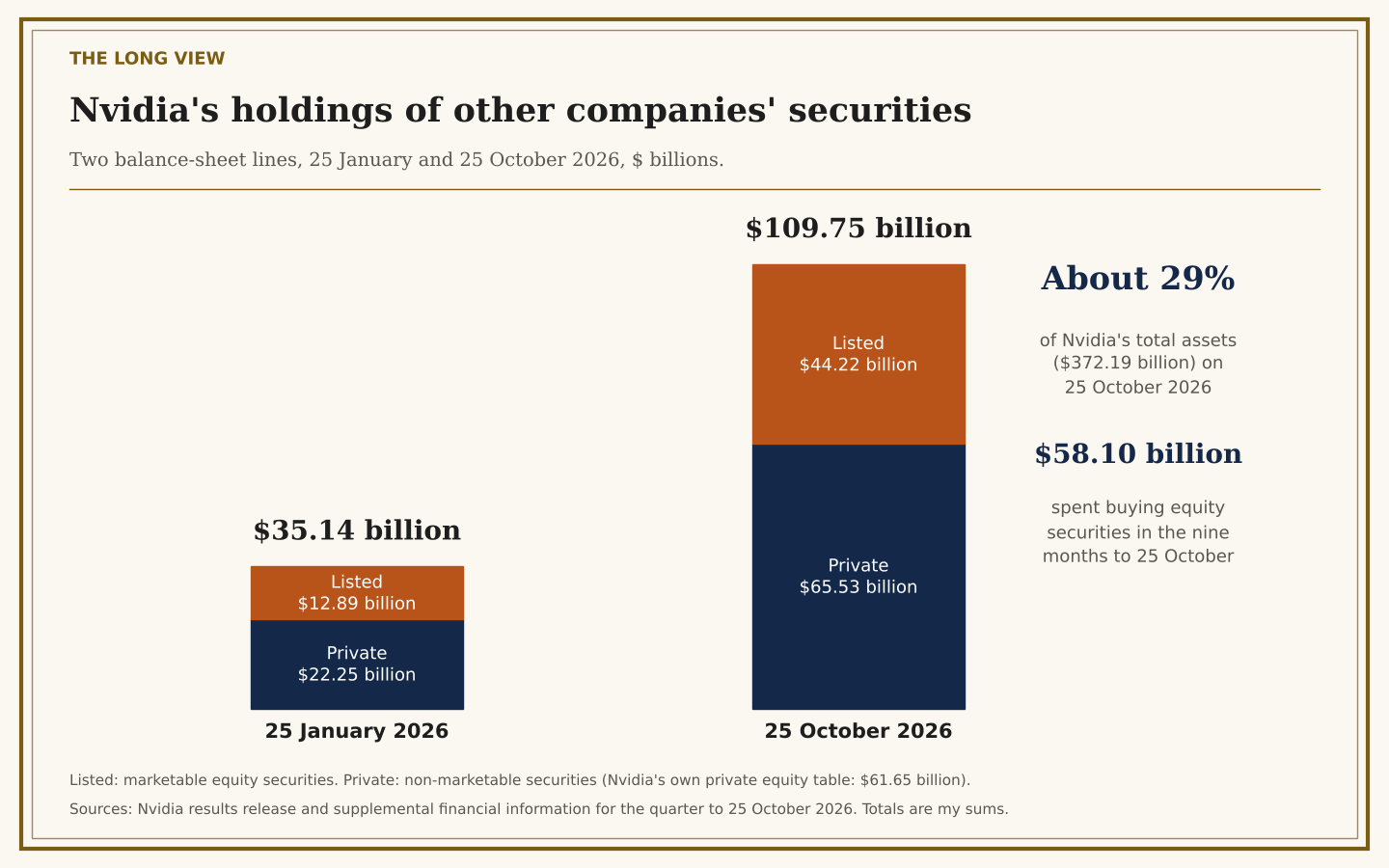
Marketable equity securities, shares in listed companies, were $44.22 billion on 25 October 2026. Non-marketable securities, mostly holdings in private companies, were $65.53 billion. Together, $109.75 billion.
On 25 January 2026 the same two lines came to $35.14 billion. Between those two dates the total roughly tripled, by my arithmetic. Nvidia’s cash flow statement shows $58.10 billion spent buying equity securities over the nine months to 25 October.
Nvidia’s total assets were $372.19 billion on 25 October. About 29 percent of that sits in those two lines.
About 29 percent of what Nvidia owns sits in other companies’ securities.
Where to find them yourself
I promised on Thursday to show where Nvidia reports its stakes. Three documents, all on its investor site.
The balance sheet, in the results release, gives the two totals above.
The supplemental financial information breaks them down. One table lists listed holdings by how they are priced. Another walks the private equity holdings through the quarter: the opening balance, additions, gains, write-downs, reclassification and the closing balance. That table ends at $61.65 billion, not $65.53 billion. The balance-sheet line is wider, and the documents I read do not reconcile the two.
The CFO commentary explains the quarter in plain words. For the quarter to 25 October, it says net gains from equity securities were $1.8 billion: $2.8 billion of gains on listed holdings and a $1.0 billion net loss on private holdings, including impairments of $1.8 billion. An impairment is a write-down, Nvidia saying a holding is worth less than it carried it at.
What the documents do not give you is names. The CFO commentary says its equity investments are “focused on frontier labs, infrastructure financiers, and other private companies.” I found no list of which companies, or how much in each.
Gains arrive in lumps
Here are Nvidia’s net gains from equity securities, from its reconciliation tables. $5.49 billion in the quarter to 25 January 2026. $15.94 billion to 26 April. $7.77 billion to 26 July. $1.77 billion to 25 October.
Between the quarters to 26 April and 25 October, that fell from $15.94 billion to $1.77 billion. Nvidia’s revenue rose in every one of those quarters.
The October quarter shows the other side. The private holdings lost $1.0 billion, net, after write-downs. The supplemental records cumulative gross unrealized gains of $9.9 billion on private holdings, against $2.2 billion of cumulative unrealized losses and impairments.
Gains like these depend on what someone else will pay for a holding. They can turn into losses without Nvidia selling a single chip fewer.
Which profit figure I price
Standard accounting counts the gains and losses on Nvidia’s holdings. Nvidia’s adjusted count leaves them out, along with items that push the other way, such as acquisition costs and a $107 million legal settlement in the October quarter.
Over the four quarters to 25 October 2026: $9.31 a share standard, $8.36 adjusted.
Here is the working on the gap. $0.95 a share across roughly 24.3 billion shares is about $23 billion. Gains on holdings over those four quarters were $30.97 billion before tax. So the gains more than account for the difference, and the other adjustments work against them.
$8.36 is what the business earned with the investment swings taken out. Whether it earns it again is the January quarter’s question. Repeating $9.31 needs that, and the holdings to rise again as well.
Nvidia earned $8.36 a share without its stakes. Everything above that depended on other companies.
Your $5000 on each figure
The usual what-if: a hypothetical $5000, not a recommendation. Nvidia closed at $145.98 on 19 November 2026. At that price, $5000 buys about 34.3 shares.
On standard profit, you pay about $15.68 for each $1. On adjusted profit, about $17.46. The lower number makes Nvidia look cheaper. It is also the one that counts gains on other companies.
Now the bar. If the 2031 price works out to the same amount for each $1 of profit, profit has to grow 10 percent a year for your $5000 to become about $8053. On adjusted profit, that means about $13.46 a share by 2031. On standard profit, about $14.99.
The second bar asks the business to grow and the holdings to keep producing gains on top. The bar I hold Nvidia to is the first one. If the holdings add to it, that is a bonus I did not pay for.
What Nvidia has promised beyond its chips
Owning shares is one role. Guaranteeing other people’s bills is another.
Nvidia’s CFO commentary for the October quarter puts its maximum gross exposure under guarantees at $118.0 billion. Of that, $105.0 billion is credit support for land, power and shell at SB Energy’s campus in Ohio, which it says “will exclusively host NVIDIA infrastructure under 20-year leases to OpenAI.” The commentary says the exposure builds as each building comes online, with the first expected in fiscal 2029, and declines over each lease term as OpenAI makes lease payments. It also says: “To date, we have not made any payments related to our guarantees.”
A guarantee is a promise to pay if someone else does not. It is not a line in either profit figure in the release. You find it in the commentary.
The filing answers how big the promise can get. It does not answer how likely it is to be called. That depends on OpenAI paying its leases.
Anthropic: three roles in one week
On the 17 November call, interim chief executive Colette Kress said she expected the major frontier labs to contribute about 15 percent of Nvidia’s data center revenue this year, CNBC reported. Nvidia’s release says it expanded Anthropic’s access to its chips through cloud providers.
Bloomberg reported on 12 November that Nvidia had agreed to buy about $10 billion of Anthropic shares in a private placement alongside the offering. CNBC reported that Anthropic priced at $83 a share on 18 November and opened at $111.50 on 19 November.
If that placement closes, Nvidia will hold a listed stake whose price moves every day. Listed holdings are carried at market value, so a rise can lift Nvidia’s standard profit, and a fall can cut it. I have not found a document confirming the placement closed, or one showing how much of Nvidia’s $109.75 billion is Anthropic. NOT PROVEN is the right label for any claim about what this listing does to Nvidia’s next quarter.
The share count, for a reader who asked
On Tuesday a reader, Close to Close, asked whether Nvidia’s recast figures changed the number of shares as well as the cost. It is the right check before trusting a per-share change.
Nvidia’s release uses one share count for both profit figures: 24.186 billion diluted shares in the October quarter, 24.483 billion a year earlier. The recast changed the cost, by counting stock paid to staff, not the share count. For the quarter to 26 October 2025, recast adjusted profit of $30.98 billion divided by 24.483 billion shares gives $1.27, the recast figure.
The count did shrink, by about 1.2 percent. Nvidia spent $22.12 billion buying back shares in the October quarter alone. Adjusted profit rose about 109 percent from a year earlier. Per share, about 111 percent. The smaller share count explains the gap. Buybacks are one cause.
The hidden assumption, at the end of the week
On Monday, before any numbers, the hidden assumption was that Nvidia’s profit belonged to the company, not to founder Jensen Huang, and keeps rising without him.
After a week, here is where it stands. The quarter he ran beat Nvidia’s sales and margin ranges. The first forecast set without him is about 4.2 percent higher per week than the quarter just reported, with a margin 3 to 4 points lower that Nvidia had flagged in August. Board chair Harvey Jones said on the call the board does not intend to reinstate Huang, CNN reported. That part of the assumption survived its first test.
The week surfaced a second assumption, and it is the one I would carry forward. Valuing Nvidia on standard profit assumes the companies it invests in, and guarantees, keep doing well enough to add gains, not losses. That is a bet on other companies’ results, inside a chip stock.
Five lessons from one week
Here is what I would keep doing, or do differently, the next time a founder leaves or a giant reports.
1. Write the test down before the numbers. Three checks on Monday kept Wednesday honest, even when all three passed.
2. Divide by the weeks. A 14-week quarter made a 4.2 percent rise per week look like 12.3 percent.
3. Check when a number was first announced. The lower margin looked like news. Nvidia gave that range on its 26 August call.
4. Read the call, not only the release. I missed the board’s statement on Huang because I stopped at the release.
5. Know which profit you are pricing. Standard profit includes other companies’ share prices. Adjusted profit leaves them out.
What the week promised, where it broke, and your turn
The week promised three checks before the results. All three were scored, outlook first. It promised the $6.95 rebuilt: it became $8.36. It promised the $5000 rerun, the holdings, where to find them, and an answer on the share count. All are above.
Where the method broke: the October quarter ended before Huang left, so it could not test life without him. The prepayment test I promised a reader could not be run, because neither the balance sheet in the release nor the supplemental has a separate line for customer prepayments. I promised to show what Nvidia’s stakes are, and the documents I read do not name them.
Kress’s 26 August remark that AI labs Nvidia backs would “contribute toward roughly a quarter of our business next year” and her November figure of 15 percent of data center revenue this year are different measures for different years. I cannot compare them, so I have not.
The Stock Story Firewall at firewall.readthelongview.com does the first step of all this in two minutes: it finds the hidden assumption inside a stock story. When I ran Nvidia through it on 15 November, it came back Watch. Run your own stock through it before you read its next earnings release.
Not investment advice. The subscriber decides.
That $8.36 versus $9.31 split is the part I will keep coming back to. I have been pricing Nvidia on the headline number like everyone else, and this week showed me why that is lazy: the shares fell after a beat, Anthropic popped 34 percent on its open, and meanwhile nearly a third of Nvidia's balance sheet is other companies' paper. The guarantor role worries me more than the stakes. If the labs Nvidia backs ever stop paying, the guarantee gets called at exactly the moment the stakes are falling too. That is the hidden assumption I will be testing from here.