

Nebius (Nasdaq: NBIS) rents out computing power for artificial intelligence, the way a landlord rents out apartments. It closed at $128.64 on 12 November, the day it reported results, and at $81.31 on 20 November, down 37 percent. Charles Schwab’s Joe Mazzola named one worry that week: the financing of the AI build. Nebius’s own filing answers that question for one company, and the answer is not the one its shareholder letter leads with. You will finish with three tests, the math behind each, and what to look for in Nebius’s next report.
Disclosure: the author holds no individual shares in any company named here. He owns broad index funds that include some of them.
Why Nebius fell, and what the market is asking
Nebius did not fall alone. Joe Mazzola, a markets writer at the brokerage Charles Schwab, wrote on 20 November that “mounting doubts about the financing of the AI buildout” helped fuel a brutal tech sell-off. He also named Anthropic’s falling shares. He wrote that the sell-off left the Nasdaq Composite, a broad index of Nasdaq-listed shares, below where it started 2026, and that Nebius dropped 16.1 percent that Friday alone.
That covers Friday. I found no named source giving a cause for the rest of the fall.
The share price shows the fear. The filing Nebius published on 12 November shows where the money came from.
The landlord problem: build first, collect later
Nebius buys AI chips, fills data centers with them, and charges AI companies to use them. Microsoft is one of its customers.
Like any landlord, Nebius pays for the building before the tenants move in. The bigger the building, the bigger the gap between spending and collecting.
Nebius is planning a very big building. Its shareholder letter of 12 November 2026 targets sales of $12 to $13 billion in 2027, and spending of $40 to $45 billion on data centers and chips that same year. That is more than three dollars spent for every dollar of hoped-for sales.
That gap has to be filled by someone. The main candidates are three: customers paying in advance, lenders, or people buying new shares. The three tests below show which one has been doing it.
Test one: October to December needs a 58 percent jump
Start with the nearest deadline. Nebius forecast 2026 sales of $3.0 to $3.4 billion. It now expects the low end. The letter says “a portion of this year’s revenue” is moving into early 2027.
Sales for the first nine months of 2026 were $1.96 billion. To reach $3.0 billion, the October to December quarter needs about $1.04 billion. That would be more than any quarter Nebius has reported in 2026.
There is a catch. The September quarter, July to September 2026, had $980.8 million of sales, but $325.1 million of that came from one-off partner deals, explained below. Without them, the quarter was $655.7 million.
The exact gap is $1.038 billion. That is about 1.58 times $655.7 million, which is 58 percent more. That is the bar for regular sales if no new one-off deals land before the year ends. If another quarter of one-offs the size of September’s did land, total sales would need to rise only about 6 percent.
To hit even the bottom of its own 2026 range, Nebius needs its regular sales to grow 58 percent in three months, or more one-off deals.
What the one-off deals are
The shareholder letter says: “In Q3, we recognized approximately $325 million of non-recurring revenue as part of our asset-light model.”
In plain words, Nebius was paid about $325 million for putting its own data-center design and cloud software onto capacity that partners funded. Capacity here means the computing power a data center can supply. Asset-light means the partners, not Nebius, paid for it. A second report filed with the results, the operating review, gives $325.1 million and says such sales “are by their nature non-recurring.”
It was not the first such deal. The operating review shows $409.1 million of them over nine months. Take away the $325.1 million and $84.0 million came earlier in 2026. Nebius also expects more. The letter says it expects them “to become a more regular part of our business,” while the operating review says their timing and size “are hard to predict.”
That gives the fairest growth figure. Total sales in the June quarter, April to June 2026, were $582.3 million, so headline growth to September was 68 percent.
The June-quarter filings I read do not split the earlier $84.0 million by quarter, so I can give a range, not one number. If none of it fell in June, regular sales that quarter were $582.3 million. If all of it did, they were $498.3 million. Against the September quarter’s $655.7 million, regular sales grew between 12.6 and 31.6 percent in three months. The 58 percent bar for October to December sits well above that.
These are real sales. They are a type of sale that can arrive in big, uneven lumps. That makes the regular sales underneath the number to watch.
Test two: 2027 needs three to five times the September pace
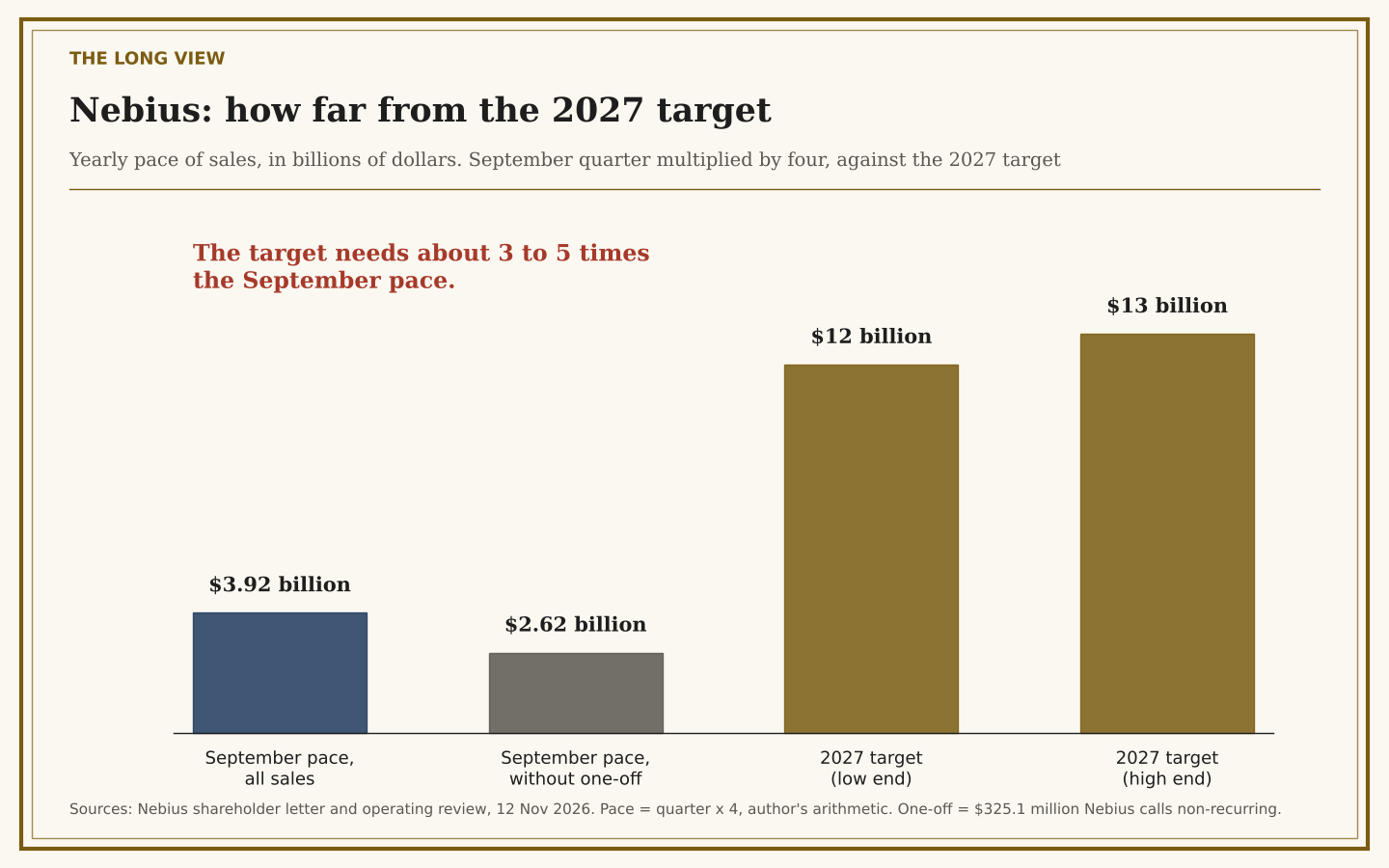
Multiply the September quarter by four to get a yearly pace: $980.8 million times 4 is about $3.92 billion. The $12 to $13 billion target is about 3.1 to 3.3 times that.
Without the one-off deals, the pace is $655.7 million times 4, about $2.62 billion. The target is about 4.6 to 5.0 times that.
Test three: who has paid for the build so far
Nebius’s answer to the funding question is customer deposits, which it calls prepayments. A deposit is money a customer pays up front, before the service starts. The letter says deposits on deals signed in the September quarter “covered over 100% of associated capital expenditures,” meaning more than the equipment cost for those deals.
On those deals, on paper, customers pay for the build. That claim covers only deals signed July to September. The cash records below cover every dollar spent in the first nine months.
When a customer pays a deposit, the money shows up in the operating activities part of the cash flow statement, which I call cash from running the business. Over the nine months to 30 September 2026, that cash came to $4.23 billion. Spending on data centers and chips was $15.43 billion. Divide one by the other and you get about 0.27.
Over nine months, cash from running the business covered about 27 cents of every dollar Nebius spent on its build.
That left a gap of $11.20 billion. Financing brought in $16.62 billion over the same nine months, more than the gap, and the extra sits in cash. Most of it was notes, a form of borrowing that can later turn into shares, plus share sales. Debt on the balance sheet, the company’s list of what it owns and owes, rose from $4.13 billion on 31 December 2025 to $14.19 billion on 30 September 2026.
July to September: cash went negative, and customers owed $4.04 billion
The September quarter alone was weaker still. Nebius reports cash flow as running totals from 1 January. Subtract the six-month total from the nine-month total and you get July to September alone. Cash from running the business was negative $273.0 million in those three months. So the whole nine-month total, and more, came in between January and June.
If customers paid deposits worth more than the equipment, why was that number negative? Part of the answer sits in money customers owe Nebius. It went from $288.6 million on 30 June to $4.04 billion on 30 September. One customer, labelled Customer D in the statements, accounted for 75 percent of the 30 September total.
The section of Nebius’s statements on deposits says they rose mainly from “prepayments received in advance,” which means money already paid. Paid money shows up as cash, yet cash from running the business was negative. One possible explanation: some deposits were billed but not yet paid by 30 September, so they sit in the money owed rather than in cash.
I looked in that section and the section on customers and found no line tying the $4.04 billion owed to specific deposits, so that link is NOT PROVEN. What is proven is simpler: $4.04 billion was owed and not yet collected. If it is collected, cash from running the business rises.
The buildings are late, and a few customers carry a lot
A landlord cannot collect rent on an unfinished building. The letter says delivery dates “at a number of colocation sites shifted into the first half of 2027.” Colocation means space Nebius rents inside someone else’s data center. The remaining Microsoft capacity in New Jersey is now “scheduled for 2Q27,” which is April to June 2027.
Demand is there on paper. Nebius had $38.7 billion of signed orders not yet delivered on 30 September, up 3 percent from 30 June. My reading: delivery is the bottleneck, and every late month pushes sales further out.
The customers are concentrated. Nebius’s financial statements label its biggest customers by letter. Customer D is one. Another, Customer E, made up 33 percent of the September quarter’s sales. I looked in the section on customers and found no names behind the letters.
The hidden assumption
Every investment story rests on something that must be true for it to work. Here is the hidden assumption in the Nebius story.
The buildings open on time, and the customers pay the deposits they have signed for.
If both hold, the deposits fund the build and the 2027 target comes into reach. If the buildings slip, sales slide later while the bills arrive on schedule. If the deposits arrive late, the gap gets filled with more borrowing, or with more shares that shrink each existing owner’s slice of the business.
The September quarter does not prove the assumption wrong. It shows both halves under strain at once.
What I got wrong in August
I wrote about Nebius on 19 August and got three things wrong. I put its signed orders at about $40 billion. The June filing says $37.49 billion. I said it did not show how fast those orders turn into sales. Its June statements did: they expected 36 percent of them to become sales within 24 months.
I also wrote that the fear of Nebius having to sell new shares to raise money looked “materially weaker” than in May. In the September quarter it sold $1.06 billion of new shares and borrowed $5.75 billion through notes.
Three numbers to check when Nebius reports again
You do not need to predict anything. You need to know where to look.
First, regular sales without the one-off partner deals. The operating review breaks those deals out. Compare the October to December quarter with $655.7 million. Growth near 58 percent puts the 2026 range in reach without new one-offs.
Second, cash from running the business. If the quarter’s figure turns positive while spending stays high, the deposits are arriving. If it stays negative, financing is still carrying the build.
Third, the delivery dates in the shareholder letter, especially the Microsoft capacity in New Jersey. If those dates slip again, the 2027 calendar gets tighter.
Reply to this post and tell me which of the three numbers you will check first. I read each reply.
Not investment advice. The subscriber decides.