

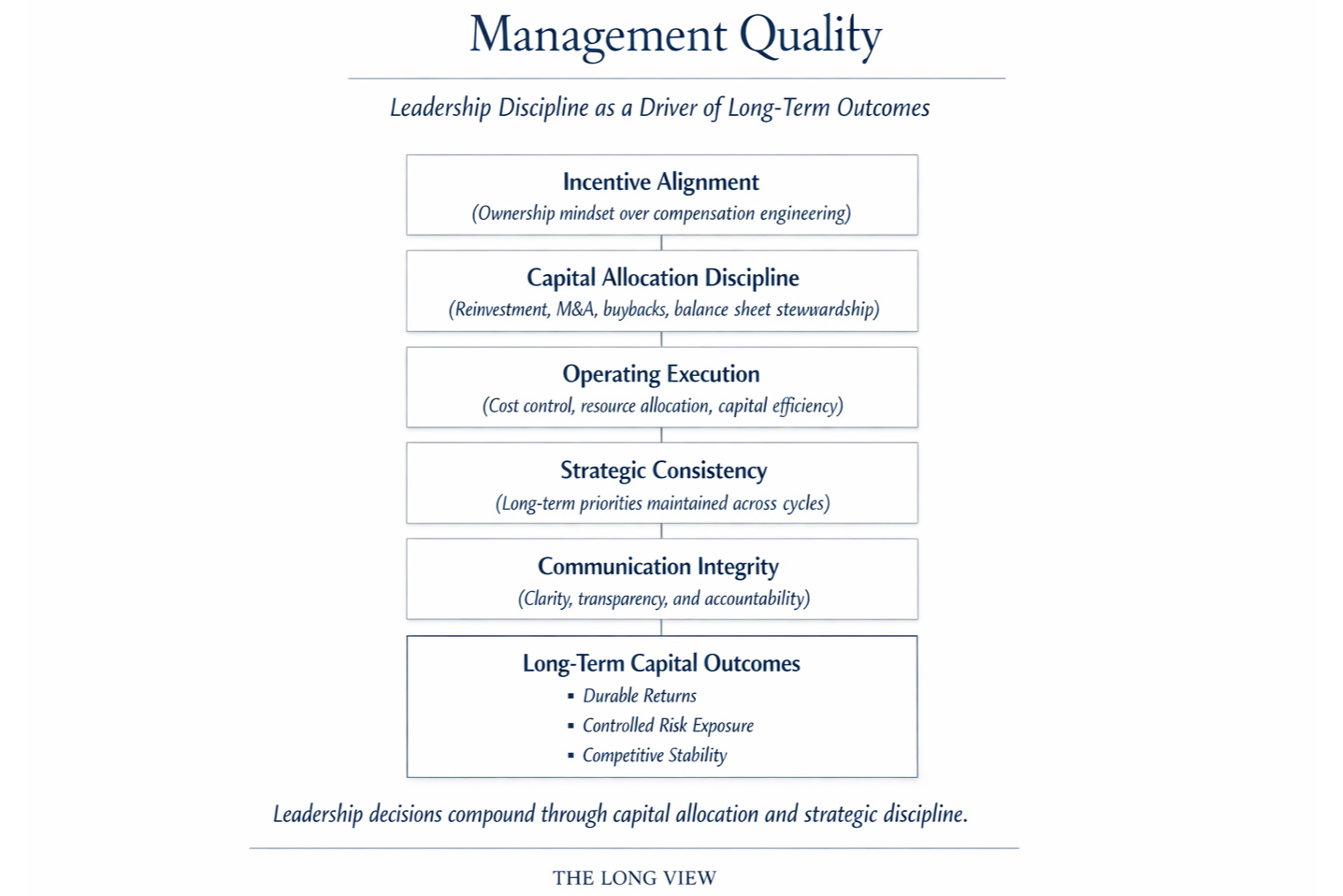
Leadership quality becomes visible in capital allocation consistency, incentive alignment, communication clarity, and resilience under transition. Durable businesses are rarely accidental; they are governed.
Company Cases:
Amazon demonstrates governance transition discipline. The shift from founder-led expansion to profitability focus illustrates structured capital restraint. Leadership recalibrated cost structures without undermining platform dominance.
LVMH reflects centralized capital oversight paired with decentralized creative control. Management quality is expressed through patient acquisition integration and brand-level autonomy within a coherent capital framework.
Accenture highlights incentive architecture. In human-capital-driven enterprises, leadership discipline manifests through structured promotion pathways, compensation alignment, and governance continuity.
ARM represents capital-light governance. Licensing neutrality and ecosystem expansion reveal leadership restraint in a capital-intensive industry.
Evaluation Checklist:
When assessing management quality, ask:
Does leadership allocate capital with multi-year consistency?
Are incentives aligned with durable value creation?
Is governance resilient during leadership transitions?
Does communication emphasize structural priorities over short-term results?
Frameworks allow investors to move beyond headlines and opinions and toward consistent evaluation. They provide a way to level-set a company’s long-term investability based on structure, discipline, and durability.
The Long View’s weekly case studies are designed to help readers learn how to apply these frameworks across different businesses and market environments.