

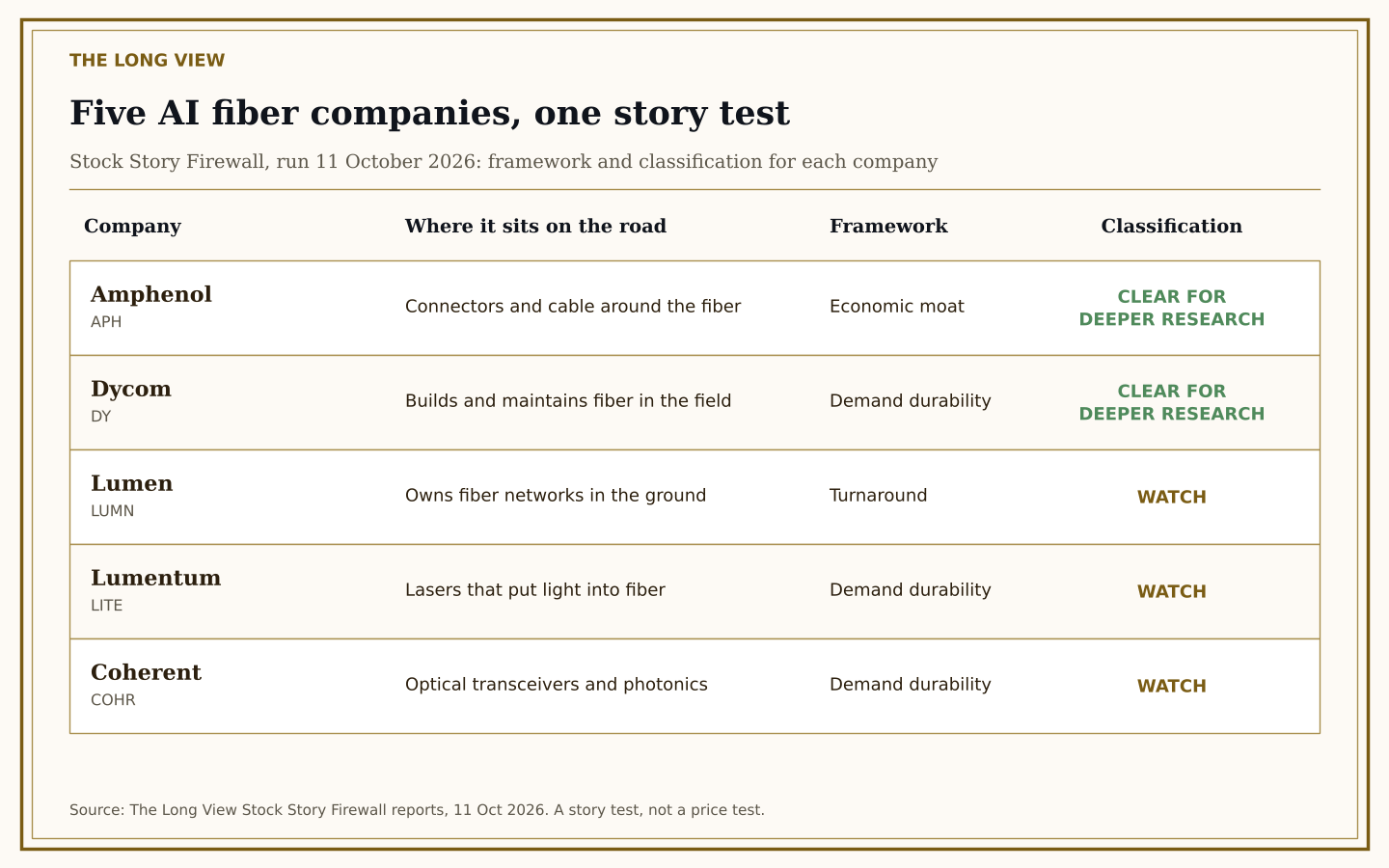
Five companies sit along the fiber road behind the AI buildout: Lumen (Nasdaq: LUMN), Dycom (NYSE: DY), Amphenol (NYSE: APH), Lumentum (Nasdaq: LITE) and Coherent (NYSE: COHR). I ran all five through the Stock Story Firewall on 11 October 2026. Two came back clear for deeper research. Three came back watch. None of that says anything about the price, and one of them shows why the price test cannot start until the earnings are chosen: Lumentum reports a loss of $92.96 a share and adjusted earnings of $8.67 for the same fiscal year. This week tests the price, against a bar set today, before any company faces it. By Friday you will know whether one of them earns a deep dive, and you will have the routine to run the same test yourself.
Disclosure: the author holds no position in LUMN, DY, APH, LITE or COHR.
The obvious company on this road is Corning, and at its 6 October 2026 close its share price stood at 58.9 times the core earnings of the prior four quarters. The question for this week: is there anywhere else along the same road that a value investor could take seriously at today’s price?
What Friday promised, and where each promise lands
Friday’s piece on Corning made seven promises about this week. Here they are, with the day each one is kept.
• Five companies, the same five thousand dollars, and one of three classifications for each: deserves serious review, keep on watch, or NOT PROVEN. All week.
• The first question for Lumen, what it still owns after selling its consumer fiber business to AT&T. Tuesday.
• Whether Dycom’s own filings support Google’s AI calling it the largest restoration provider in North America. Tuesday.
• Coherent’s own filings, read before anything said about it. Thursday.
• The spending figures for Amazon, Alphabet and Microsoft, checked against the companies’ own documents. Today, below.
• Whether fiber demand reaches beyond the hyperscalers. Each company’s own customer disclosures, Tuesday to Thursday, and industry-wide figures on Friday.
• The closing question, which of the five comes closest to the Buffett and Lynch playbook at today’s price. Friday answers it.
What this week is looking for
This week is not looking for a stock to buy. It is looking for a company that earns a deep dive.
A deep dive is the work I do before money moves. A decade of annual reports, the proxy, the people running the business, what they paid for every share they bought back, and a price I would pay written down in advance. It takes weeks, and most companies never earn it.
So this week is a filter. Five companies go in. At most one comes out with a reason to do the long work. If none does, that is the answer.
The hidden assumption under the whole week: that somewhere along the AI fiber road, at least one company offers the buildout at a price the numbers can defend.
The story test: two clear, three on watch
The Firewall names the hidden assumption inside each company’s story, the thing that has to be true for it to hold, and classifies what the evidence supports.
Amphenol makes the connectors and cable systems that join a data center together. Its hidden assumption is that demand stays structurally elevated for years. Dycom builds and maintains fiber networks in the field, and since December 2025 also does electrical work inside data centers. Its hidden assumption is that a backlog of $12.24 billion at 1 August 2026 turns into double-digit organic growth for three to five years. Both came back clear for deeper research.
Lumen owns fiber networks in the ground and was run as a turnaround: can strategic revenue outgrow the legacy decline. Lumentum makes the lasers that put light into fiber, and Coherent makes optical transceivers. For both, the assumption is that AI demand outruns their capacity long enough to hold prices up. All three came back watch. Watch is not a fail. It means real ingredients and unresolved risks.
A story test is not a price test
The Firewall asks whether the story holds together. It does not ask what you are paying for it. That is how it is built to be used: it gets you to the right questions, and to a first decision about whether the evidence gives more reason to move forward or only to watch. The filings then answer the questions.
Its own reports say so. On Dycom: “The classification does not mean the stock is cheap or that the growth will last.” On Amphenol, it says an investor needs to separate structural moat from cyclical tailwind “before committing at a valuation that already prices in continued exceptional growth.”
A company can pass the story test and still be the wrong purchase. The price gets its own test.
The earnings you start from decide the answer
Every price test divides a price by some measure of what a business earns. Choose the wrong measure and the test answers a different question.
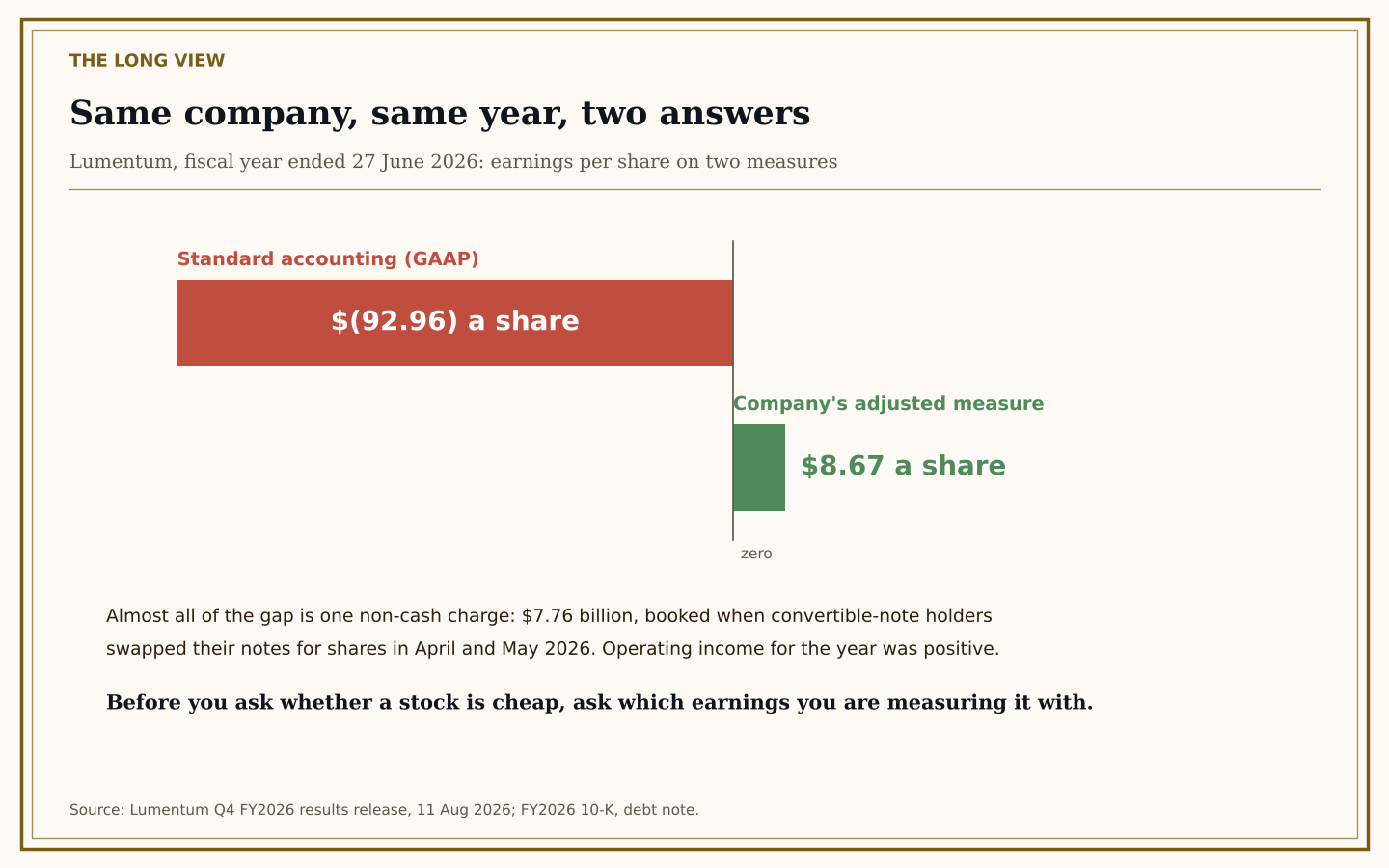
Lumentum shows how far apart the choices can sit. Its results release for the fiscal year ended 27 June 2026 reports a loss of $92.96 a share under standard accounting, called GAAP, the rules every US company must report under. On its own adjusted basis it earned $8.67 a share. Almost all of the gap is one non-cash charge of $7.76 billion, booked when holders of its convertible debt swapped their notes for shares.
The others need the same care. Lumen’s 2026 free cash flow guidance includes $729 million from the AT&T deal, by its own footnote. Amphenol declared a two-for-one share split in August 2026, so earlier per-share figures must be halved. Dycom changed how it calculates adjusted earnings from its fourth quarter of fiscal 2026. Coherent’s version is Thursday’s.
Before you ask whether a stock is cheap, ask which earnings you are measuring it with.
The bar, set before any test runs
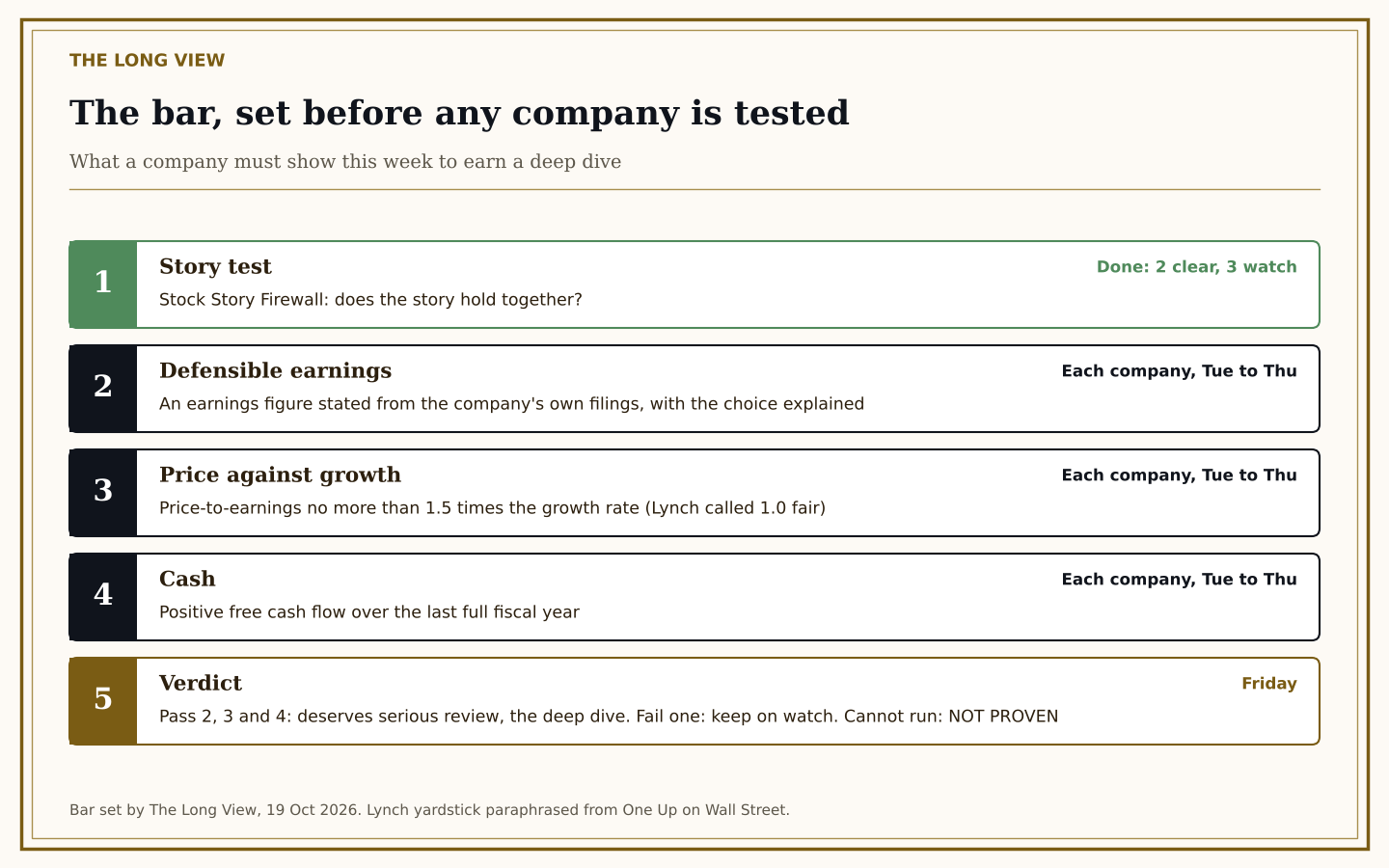
A bar set after the results is not a bar. So here it is, before Tuesday.
A company is classed deserves serious review, and earns the deep dive, only if three things are true. Its earnings can be stated in a figure I can defend from its own filings. Its price-to-earnings ratio is no more than one and a half times its growth rate. And it produced positive free cash flow over its last full fiscal year.
In One Up on Wall Street, Lynch wrote that the price-to-earnings ratio of any fairly priced company will equal its growth rate. I am allowing half again above his line. That is my choice, not his. For reference, Corning scores about 3.1 against its own 19 percent growth plan.
A company that fails a test is keep on watch. Where a test cannot run, the result is NOT PROVEN, not a pass. Lumen still reports losses, so it has no price-to-earnings ratio. Lynch judged turnarounds on whether the company can survive long enough for the fix to work, and Tuesday applies that question too.
Friday’s spending figures, checked at the source
Friday’s piece set four 2026 spending plans beside the 2000 buildout and said two of the figures came from reporters, not the companies. I went to the companies.
Meta’s results release of 29 July 2026 states $130 billion to $145 billion. Microsoft’s chief financial officer, Amy Hood, said on its 29 July 2026 earnings call, in the transcript on Microsoft’s site, that the calendar 2026 figure adjusts to “approximately $175 billion” after a lease accounting change. Both confirmed.
Amazon’s and Alphabet’s second-quarter results releases give no 2026 figure. Their numbers were given on earnings calls, and I could not find a transcript on either company’s own site. They stay attributed to Fortune and Bloomberg. Amazon’s release does say its purchases of property and equipment over the trailing twelve months rose by $66.1 billion, and that the increase “primarily reflects investments in artificial intelligence.” None of the four documents mentions fiber.
Who is paying: the hyperscalers or everyone else
In 2000 I watched ordinary businesses rewire their own buildings with fiber, and that spending never made a headline. Today the hyperscalers’ budgets are counted every quarter. If ordinary companies are upgrading too, the demand under these five stocks is wide. If a handful of data center owners are the buyers, it is narrow, and every price this week carries that concentration.
The early numbers lean narrow. Cisco’s results slides for its fiscal year ended 25 July 2026 report $9.3 billion of AI infrastructure orders from hyperscalers, against $1.3 billion from neocloud, sovereign and enterprise customers combined. And a figure that looks like ordinary demand often is not: Corning’s 10-K counts hyperscale data centers inside its Enterprise Networks business.
So each day this week reads one more thing in each company’s filings: who the customers are, and how much of the revenue they account for. Friday puts those disclosures beside the industry figures and answers how much of this buildout rests on a few buyers.
How the week runs
Tuesday takes Lumen and Dycom together, the fiber in the ground and the company that builds and maintains it. Lumen was 10.8 percent of Dycom’s revenue in its last fiscal year, according to Dycom’s 10-K. Lumen’s chief executive, Kate Johnson, bought 178,685 Lumen shares with her own money in February and August 2026, according to her Form 4 filings. Lumen’s Investor Day release of 25 February 2026 says it plans to expand to approximately 58 million fiber miles by 2031. Tuesday asks what the income statement says beside both.
Wednesday is Amphenol. Thursday pairs Lumentum and Coherent, which both took $2 billion from Nvidia under 8-Ks dated 2 March 2026. Friday is the verdict against today’s bar, and the answer on who is paying.
Nothing here is a buy or sell call. The week does not put a value on Lumen’s network, and its figures come from second-quarter filings. Amphenol reports again on 28 October and Lumentum on 5 November.
Before Tuesday, put any of these five, or a company of your own, into the free Stock Story Firewall at firewall.readthelongview.com. Then hold its hidden assumption up against the price test this week runs.
Not investment advice. The subscriber decides.