

On the earnings call last week, Lululemon’s interim chief executive was asked why sales in China had slowed. Her answer was about the brand rather than the economy. Noise around it affecting sentiment, and a weaker online shopping event. That is a company telling you the problem is its own, and it is the most checkable statement anyone at that business made all week. So I checked it, and two things came back that I did not expect. The closest comparable public company reported a decline identical to Lululemon’s, to the percentage point. And the market she was explaining is roughly a sixth of the business, while the two thirds that fell harder has a different explanation sitting in the filing.
Start with why any of this matters before I get to the numbers.
The rule has to work in both directions
Yesterday I wrote that a long record can be luck riding a good industry, and that outcomes can be borrowed from a rising tide.
If I will not credit a management team for growth the whole sector enjoyed, I cannot blame one for a decline the whole sector is suffering. Same test, opposite direction. Without that check there is no argument I could make this week that could be proved wrong. Every poor number would count against management and every decent one would count for them, which is not analysis, it is decoration.
Two of six
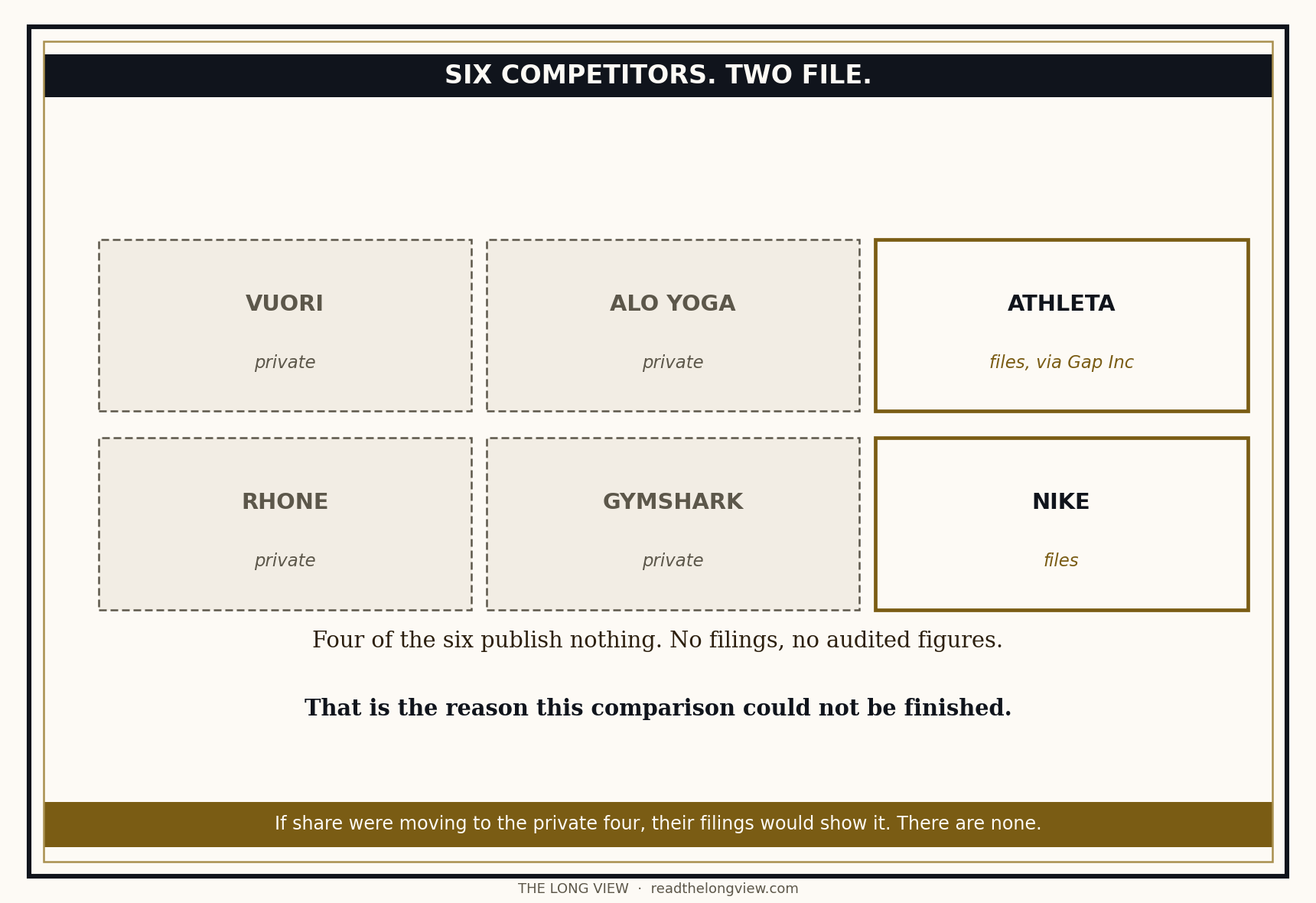
The companies competing for this customer are Vuori, Alo Yoga, Athleta, Rhone, Gymshark and Nike.
Vuori, Alo Yoga, Rhone and Gymshark are all private. They file nothing. Everything published about their growth comes from the companies themselves, from funding announcements, or from trade estimates, and none of it is audited or filed. I have no way to check any of it, so none of it is in this piece.
That leaves Athleta and Nike.
Four of the six brands most often named as taking this customer cannot be examined at all. That is not a footnote. It shapes everything below.
The closest comparison reported the same number
Athleta is owned by Gap, which reports it as a brand within its results. Women’s activewear, sold mainly through American malls, to broadly the same customer.
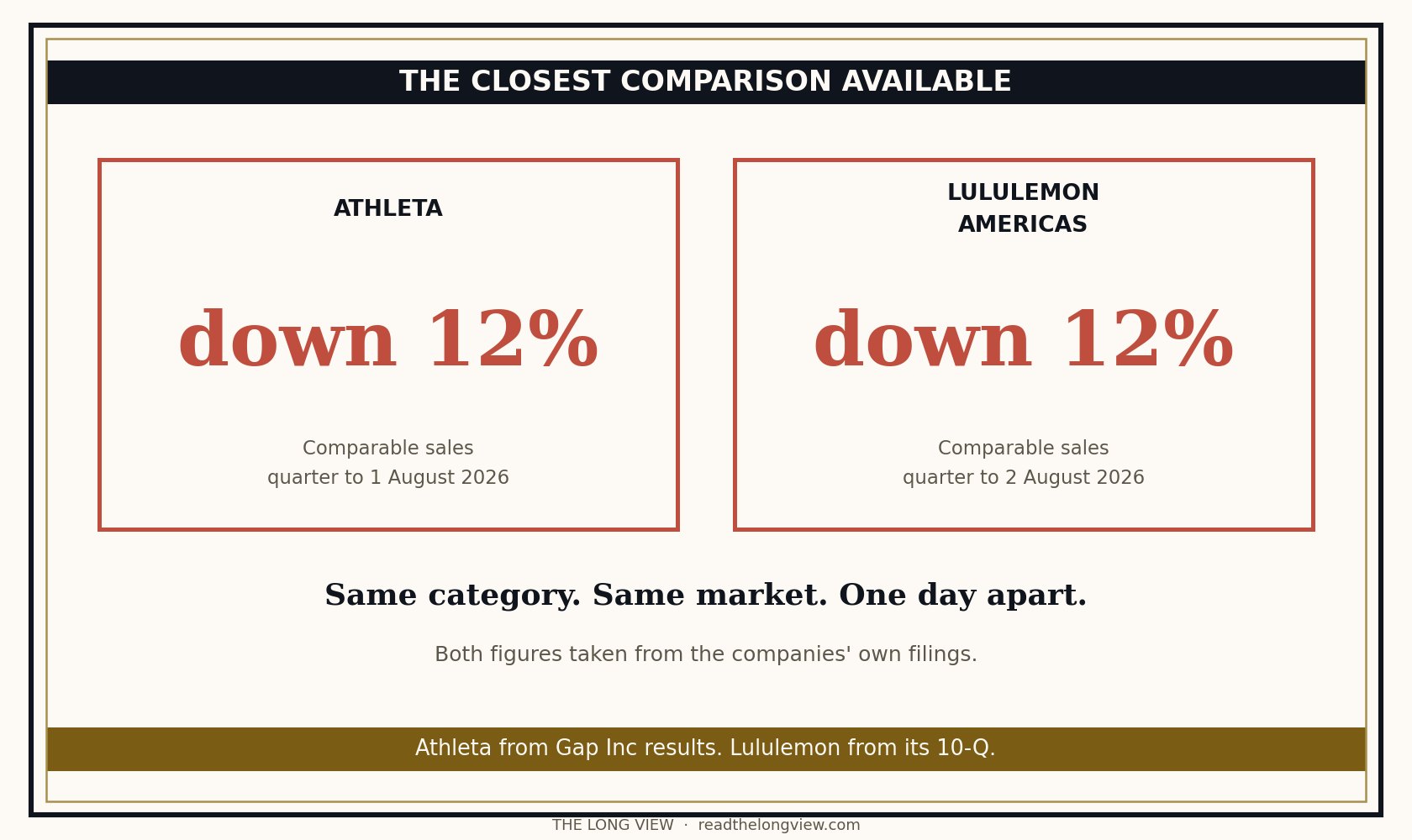
For its quarter ended 1 August 2026, Gap reported Athleta net sales of $264 million, down 12%, with comparable sales down 12%.
Lululemon’s Americas comparable sales, for its quarter ended 2 August 2026, fell 12%.
Same category. Same market. Quarters ending one day apart. The same number.
I did not set out to find that and it complicates what I expected to write.
The consumer did not stop buying clothes
Inside Gap, in the same quarter, Gap brand comparable sales rose 10% and Banana Republic rose 3%. Old Navy fell 4%. The company’s overall comparable sales fell 1%.
One retailer, one quarter, the same malls and broadly the same shoppers. The denim brand grew double digits and the activewear brand fell 12%.
I want to be careful about what that proves, because I nearly claimed more than it does. Denim and activewear are not the same category. The research firm Circana, whose data the industry runs on, separates them: activewear on one side, non-active apparel including jeans on the other. So Gap brand growing tells you nothing directly about whether activewear is soft.
What it does establish is narrower and still useful. People were in the malls and they were spending. The consumer did not stop buying clothes. Whatever happened to Lululemon in the Americas, it did not happen because Americans stopped shopping for apparel.
The category itself is shifting
For the category, there is separate evidence, and it is a step further from the source than I would like.
Retail Dive, citing Circana’s Consumer Tracking Service, reported earlier this year that United States activewear apparel sales were up 2% against the prior year while non-active apparel was down 2%. Jeans, in the second group, grew 4%.
So activewear overall was still outrunning the rest of the wardrobe. Not collapsing.
But in the same reporting, a Circana apparel analyst, Kristen Classi-Zummo, described a clear shift away from leggings, sports bras and other performance products, even as activewear continued to outpace the apparel market.
That figure is from earlier in the year, not from the August quarter, and it comes through a publication rather than from the firm directly. I am giving it the weight that deserves, which is directional rather than precise.
Nike sits between the two. For its fiscal year ended 31 May 2026, Nike Brand apparel revenue rose 2% in constant currency, and North America apparel rose 4%. North America comparable store sales fell 2%, not 12%. But Nike apparel is a far wider basket than tights, and I am not presenting Nike as healthy either: the same filing shows Nike Direct down 6%, brand digital down 12%, Converse down 31% and net income down 3%.
Activewear did not stop working. The performance products at the centre of it appear to be where the softness sits, and that is most of what this company sells.
The explanation covers a sixth of the business
Yesterday I set out the geography without comment. Here is the comment, and I want to be careful with it because the numbers can be made to say more than they do.
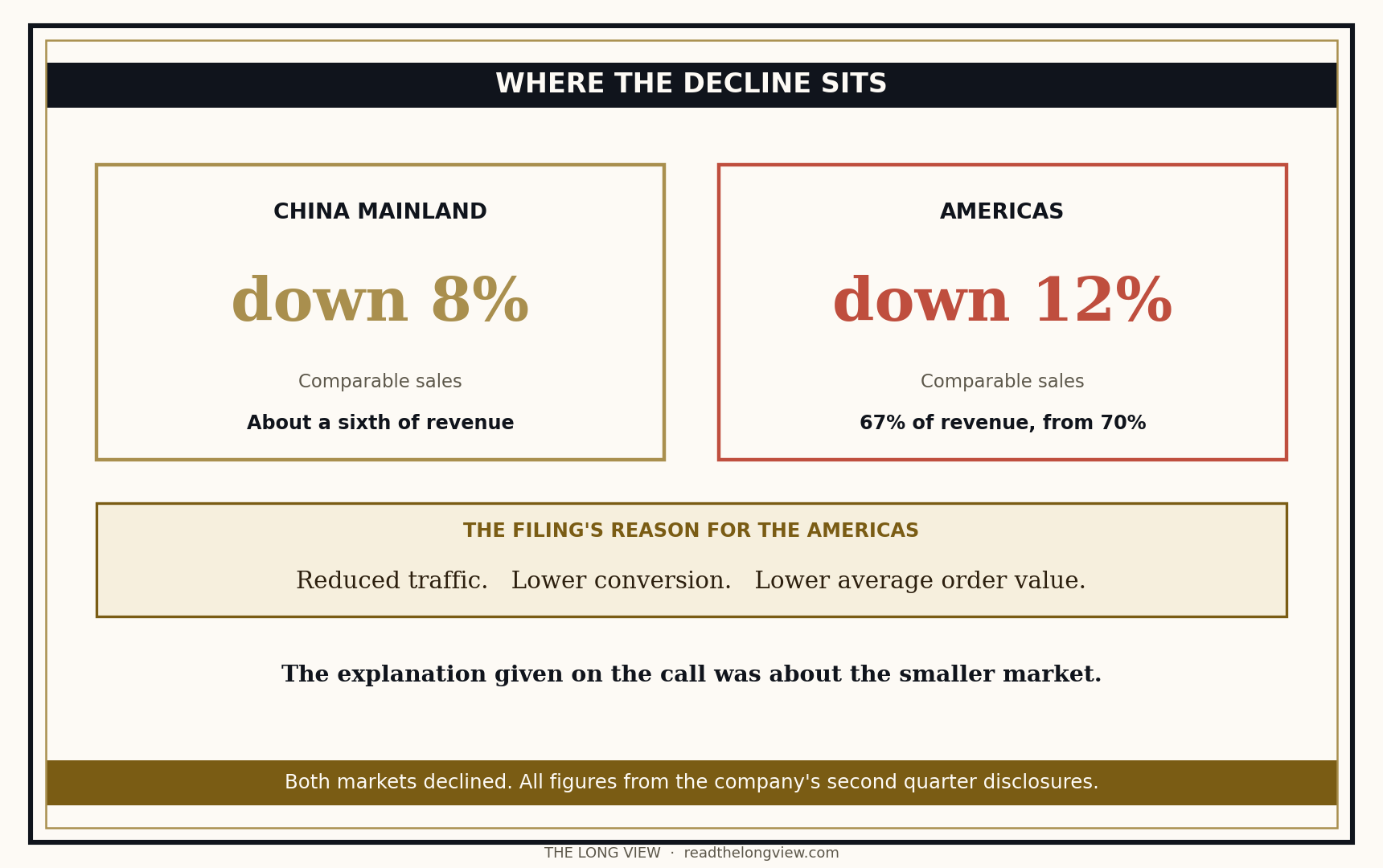
China did slow. Comparable sales there fell 8%, and revenue fell 2% in constant dollars. It rose 4% only in reported dollars, which is a currency effect rather than a sales one. So her answer was addressing something real.
The question is how much of the problem it addresses.
China Mainland is roughly a sixth of this company’s revenue. The Americas is 67% of it, down from 70% a year ago, and Americas comparable sales fell 12%, four points worse than China.
And the filing gives that larger decline a different reason. It attributes the Americas fall to traffic, conversion and average order value, all moving the wrong way at once. Nothing in that sentence is about brand sentiment.
Brand noise in China is an answer about a sixth of the business. Two thirds of it fell harder, and the filing explains that part differently.
I should be fair about one thing. She was asked about China, and an executive answering the question put to her is not dodging. Analysts choose what to ask. But an explanation that covers the smaller part of a decline is still only an explanation of the smaller part, and a reader who heard the call and not the filing would come away with the wrong impression of where this company’s problem sits.
Athleta is a North American business. It fell 12% in the same quarter. Whatever is happening to Lululemon in the Americas is happening to the one comparable public company in the same market, and no event in Beijing accounts for either.
About that word
I have used her word twice now without examining it.
Noise describes weather. Something that happens around you, that you did not cause and cannot control, that passes. It also has the useful property of containing no claim, which means there is nothing in it to check.
There is a specific thing it may refer to. According to Forbes, on 30 May the company staged a yoga event on the Great Wall of China with the actor Zhu Yilong and roughly two thousand attendees, promoted as honouring Chinese culture. The performance featured a drum that critics identified as a Japanese taiko rather than a Chinese dagu. The criticism drew more than fifty million views on Weibo. Forbes reported that the company took over two weeks to acknowledge it and apologise, and that its statement said limitations in its professional knowledge had left it unable to identify potential controversies.
That event sits inside the quarter that ended on 2 August. I cannot tell you it caused anything, and one article I read quoted people expecting little short-term sales impact.
What I can say is that it was not noise. An event the company planned, staffed, promoted and then took two weeks to address is not something that happened to it. It is something it did.
The two-week gap is the part I will come back to on Thursday, because how long a company takes to say a thing went wrong is a decision, and decisions are what this week is about.
What this establishes
Less than a clean answer, and more than I expected.
It is not the consumer. Denim grew 10% in the same malls, in the same quarter, to the same shoppers.
It is not all of activewear either, which Circana had up 2% while the rest of the wardrobe fell.
It is not only this company. The one comparable public business selling women’s activewear in North America reported exactly the same 12% decline in the same quarter.
Something is wrong in the performance end of North American women’s activewear, and both of the public companies in that description have it.
That is as far as filings can take me, and the reason is the four private companies. If Vuori and Alo and Rhone and Gymshark are taking this customer, their filings would show it. There are no filings. The evidence that would separate a category problem from a share problem does not exist in public.
Which makes the rest of the week matter more, not less
If the sector had collapsed, there would be no management question worth asking.
If the sector had been fine, the decline would point straight at the people and the rest of the week would be a formality.
Neither happened. Part of this looks like something happening to a category. Part of it is happening in a market nobody at the company was asked about, with an explanation in the filing that has nothing to do with the answer given on the call.
So the only evidence that can separate those is what this company did with its own money, what it said about its own results, and what it took while saying it. That evidence is filed, it goes back a decade, and nobody has to guess at it.
Tomorrow
Eight years of Calvin McDonald’s capital record.
Ten years of cash flow statements opened at once. What they bought, what they wrote off, and which way the share count moved. There is one acquisition in there that the whole day turns on.
I will also run the first test I described last Monday, which is whether earnings grew faster than the capital base, because a business that adds to its equity every year produces rising earnings almost on its own, and that flatters a record that may not deserve it.
Not investment advice. The subscriber decides.