

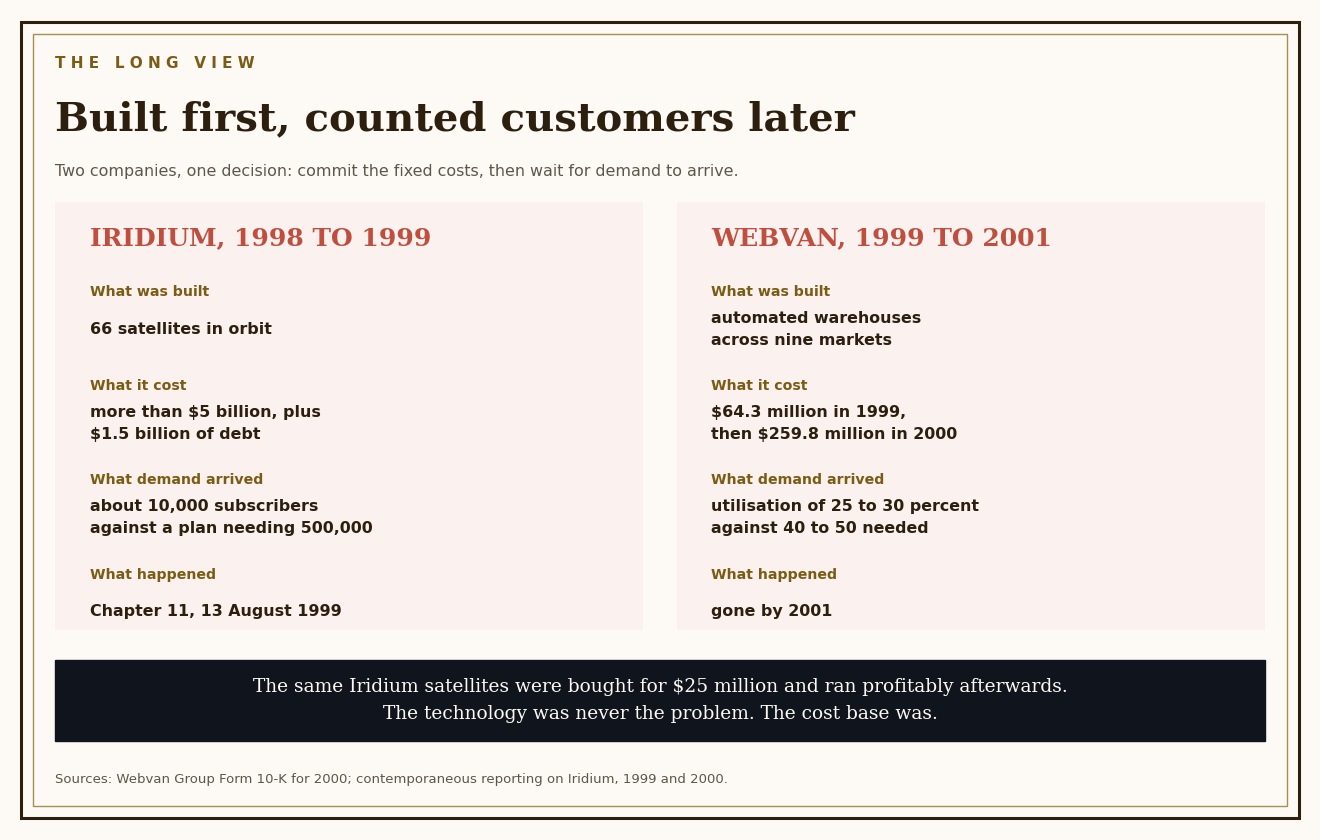
Iridium spent more than $5 billion building a constellation of 66 satellites, began commercial service on 1 November 1998, and by the spring of 1999 had roughly 10,000 subscribers against a business plan that needed something like 500,000. It filed for Chapter 11 on 13 August 1999. The satellites were not the problem. They worked then and they are still working now. Rigetti (RGTI) and IonQ (IONQ) are both building capacity ahead of demand, which is the same road, and the hidden assumption underneath both stories is that the customers arrive once the machine exists. Today is about who is buying, who could buy, and what happens to the arithmetic when the answer is fewer than expected.
Disclosure: the author holds a small position in Rigetti and no position in IonQ. This is analysis, not a recommendation.
What killed Iridium, and what did not
Not the engineering. The system did what it promised: a call from anywhere on earth, switched through space.
The cost structure killed it. More than $5 billion of capital spent before a single subscriber existed, then roughly $1.5 billion of debt to service, with interest running at tens of millions a month. Ten thousand customers cannot carry that. Five hundred thousand might have. The gap between those two numbers is not a rounding error in a forecast, it is the difference between a business and a monument.
Then comes the part that makes this the most useful failure in the archive. The assets were bought out of bankruptcy for $25 million, and the same satellites, in the same orbits, doing the same job, operated as a viable business afterwards. The new owner’s break-even was reported at around 60,000 subscribers instead of the million the old structure needed.
Same technology. Same customers available. Different fixed costs, opposite outcome.
Hold that against what was said at the time. The commentary in 1999 blamed handset size, call prices and a network outdated on arrival. All true, and all beside the point, because a company with a far smaller cost base sold the same service to the same kind of customer and made it work.
Webvan ran the same play on the ground
Webvan’s capital spending went from $64.3 million in 1999 to $259.8 million in 2000 against roughly $178.5 million of revenue, building automated warehouses across nine markets.
Its own break-even assumption required distribution centers running at 40 to 50 percent utilization. They ran at 25 to 30 percent while more were being built. The plan was not fantasy, it worked on paper at scale, and the company ran out of time before reaching scale.
Both companies made the same decision: commit the fixed costs first and let demand catch up. It is the single worst-performing road in the filing record, and it is worth being precise about why.
Fixed costs do not respond to a story. Depreciation, interest, rent and maintenance arrive on a schedule that has no interest in whether the customers did. A company with high fixed costs and uncertain demand has bought a deadline, and the deadline is set by the balance sheet rather than by the market.
So who is buying what Rigetti sells
This is the question I should have asked first, months ago, and did not.
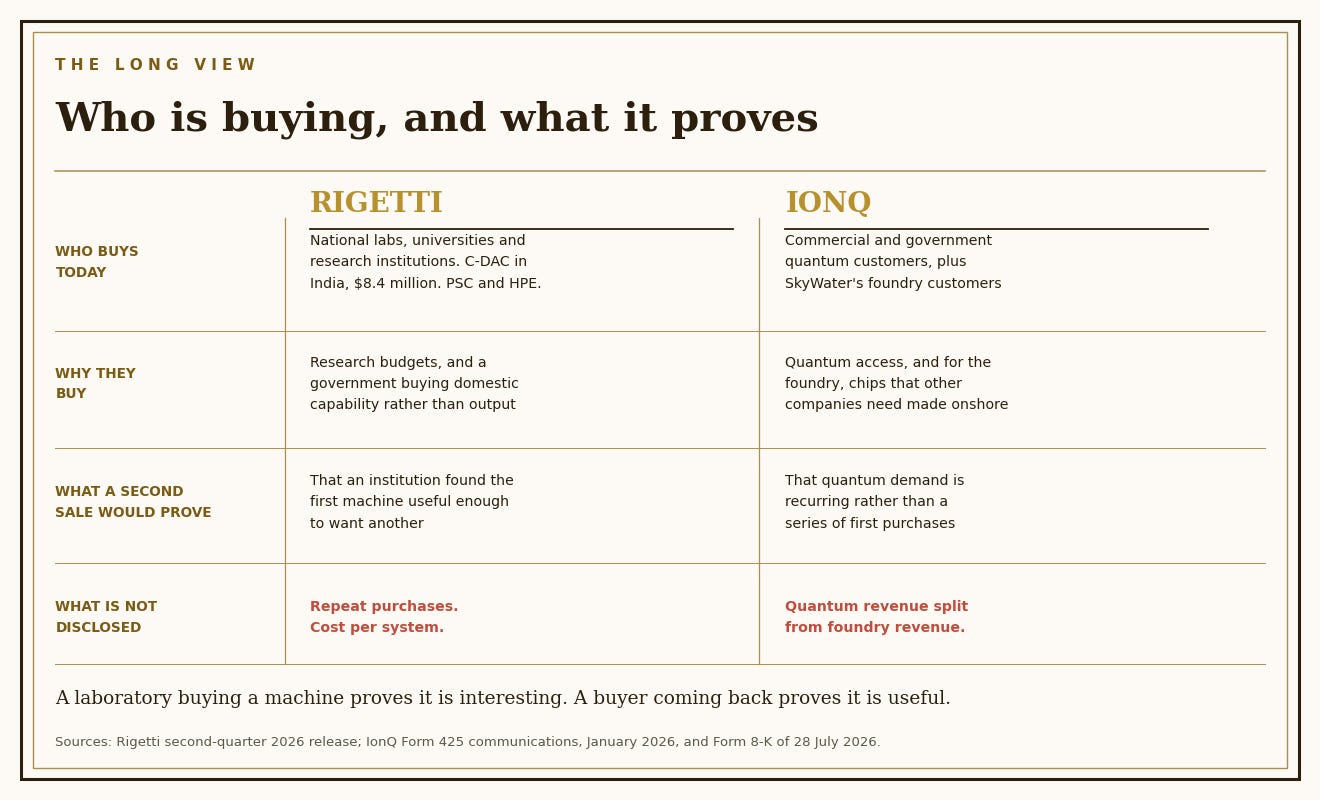
Rigetti’s second-quarter revenue was $5.1 million, up from $1.8 million, and the company attributes it to on-premises sales of its Novera and Cepheus systems. The buyers, as far as the disclosures go, are national laboratories, universities, research organisations and government-linked institutions, including an $8.4 million order from C-DAC in India and work with the Pittsburgh Supercomputing Center and HPE.
That is a real customer list and it has a specific shape: institutions with research budgets, buying one machine. It is not enterprises buying computing capacity because it solves a business problem more cheaply than the alternative.
The distinction is not snobbery about who the customer is. A research budget is a real budget and a national laboratory pays its invoices. It is about what the purchase proves. A laboratory buying a machine to study it proves the machine is interesting. A company buying a second one to run production proves it is useful.
What would change the picture is a second sale to the same institution, or a commercial buyer with a profit motive. Neither appears in the disclosures yet, and Rigetti does not publish repeat purchases.
Why the Commerce Department would pay $100 million
Worth answering directly, because the reason changes what the award tells you.
The Department is not buying quantum computers. It is buying domestic capability. Rigetti owns Fab-1, a superconducting fabrication facility on American soil, and the May program spread awards across nine companies and five different technologies with the explicit purpose of keeping that capability onshore.
So the award is evidence about national policy, not about commercial demand. A customer who buys because the product earns them money is a different signal entirely from a funder who buys because the capability must exist somewhere. The first proves the product. The second proves the politics.
That distinction matters for anyone holding the stock, because the government money is real and the revenue it produces is not the kind that compounds.
What IonQ bought, and whether it was a problem
You asked the right question about SkyWater, and the pre-deal filings answer it.
SkyWater was the largest exclusively United States based pure-play semiconductor foundry, accredited by the Defense Microelectronics Activity as a Category 1A Trusted Foundry, with facilities in Minnesota, Florida and Texas. It reported revenue of $342.3 million in 2024 and $150.7 million in the third quarter of 2025. That is an operating business with real customers, not a science project.
It was also thin. SkyWater had about $31 million of cash at the end of September 2025 against IonQ’s $1.5 billion, and IonQ’s chief executive described the transaction as something of a rescue on the call. IonQ paid $35.00 a share, a 38 percent premium to the thirty-day average price as of 23 January 2026, for an equity value of about $1.8 billion.
So the honest answer is both. A proven, accredited foundry with delivered revenue, bought at a premium, with a weak balance sheet and the capital intensity and thin margins that come with owning fabrication.
One risk sits on top of that. SkyWater’s customers included other quantum companies, D-Wave and PsiQuantum among them. Those customers now buy their chips from a competitor. Whether they stay is the integration question, and it will show up in revenue rather than in a press release.
What these two have in common with the survivors
Not an equivalence, and worth stating plainly. But two similarities are real and both are visible in documents.
The first is that their funder and their customer are often the same party. Intel, TSMC and Samsung bought shares in ASML because they needed the machine. The United States government funds Rigetti and also buys quantum research. That alignment is the thing that carried ASML through years of delay, and it is present here in a weaker form.
The second is that both are selling to a small number of sophisticated institutional buyers, which is where Intuitive Surgical started before instruments and service turned installed machines into recurring revenue. Rigetti and IonQ have the installed base problem in front of them rather than behind them.
The difference from Iridium and Webvan matters most today. Rigetti holds $541.3 million and no debt. IonQ holds about $2.0 billion after SkyWater. Neither is carrying $1.5 billion of debt into a market that has not arrived.
What would move either of them onto the Iridium road
Three conditions, and all of them are checkable. Capital spending rising faster than revenue, which is the Webvan signature. Debt taken on to fund capacity, which is what removed Iridium’s ability to wait. And utilisation running below break-even while commitments continue, which is the same arithmetic in any industry.
So here is where both companies stand on the first one, from the cash flow statements rather than from the balance sheet.
Rigetti spent $16.4 million on property and equipment in the first half of 2026, against $8.2 million in the same period of 2025. Revenue for that half was $9.5 million. Capital spending is running at roughly one and a half times revenue and it doubled year on year. A further $10.1 million of equipment purchases sat in accounts payable at 30 June, and total purchase commitments were $35.0 million, of which about $21.0 million relates to property and equipment.
The company is also explicit about where this goes. Its own filing says it may seek to significantly increase capital expenditures, including upgrading its chip fabrication facility, possibly investing in a new one, and buying additional refrigerators, and that this would require a significant amount of cash.
IonQ’s version did not come through capital spending. It came as an acquisition. The company’s filing put the cash requirement for SkyWater at approximately $1.0 billion, including roughly $0.8 billion of purchase consideration and $0.2 billion of debt repayment and transaction costs. Depreciation and amortisation for the first half rose to $89.2 million from $17.2 million a year earlier.
Neither of those is Webvan. Rigetti is spending sixteen million dollars, not two hundred and sixty. IonQ bought a business with customers rather than building empty capacity. But both are now carrying fixed costs that arrive whether the customers do or not, and the direction on both is up.
What this does not tell you
Iridium and Webvan are two cases, chosen because they are famous, and famous failures are not a sample.
The comparison also flatters the two live companies in one respect. Neither has yet had to build at Iridium’s scale, because nobody is asking them to deliver a global service. The test they face is different and arguably harder: proving one unit works before anyone will fund many.
And a company can do everything on this list correctly and still fail because the technology does not arrive. The road matters. It is not the only thing that does.
Tomorrow
The whole week gets published as a screen, both companies get marked against it, and I write down what I am watching from here, with dates attached where dates exist.
Some of that list I would not have been watching a week ago. The obvious numbers, the ones quoted at everyone all day, can all improve while a position gets worse. Revenue can triple while the share count rises. Guidance can be raised while what it measures changes. A fidelity record can be set while the machine that matters falls further from its target.
Tomorrow is about the handful of lines that cannot do that.
Not investment advice. The subscriber decides.