

On Thursday 5 November 2026, the S&P 500 had its worst day since April 2025, and the stocks tied to the AI build fell hardest. Nvidia (Nasdaq: NVDA) fell 9.3 percent and Advanced Micro Devices (Nasdaq: AMD) 17.3 percent, the Associated Press reported. When a stock you have been watching falls that far, the obvious thought is that it must be cheaper now. It is. Cheaper is not the same as cheap. Starting Monday 9 November, The Long View puts five companies that had a rough few days through one test: does the new price ask less of the business than its own record says it can deliver? By Friday 13 November you will know the five, the test, and how to run it yourself on any profitable stock that has just dropped.
Disclosure: the author holds no individual shares in any company named here. He owns broad index funds that include some of them.
What happened on Thursday 5 November
The numbers first, because they set the scene.
The S&P 500 fell 4.4 percent, its worst day since the “Liberation Day” tariffs of April 2025, AP’s Stan Choe reported. The Nasdaq Composite fell 5.5 percent, leaving it 11.9 percent below its all-time high. The Dow lost 3.4 percent.
Chip stocks fell furthest. The Philadelphia Semiconductor Index dropped 12.2 percent, its biggest one-day fall since April 2025, Reuters’ Chibuike Oguh reported. Nvidia fell 9.3 percent and AMD 17.3 percent, AP reported. Qualcomm fell 9.5 percent, Reuters said.
On Friday 6 November the selling paused. Nvidia rose 2.8 percent and Micron Technology (Nasdaq: MU) 5.1 percent, AP reported. The S&P 500 rose 0.3 percent, leaving it down 2.7 percent for the week.
The reasons given, and who gave them
Reporters and strategists gave several reasons, and they did not all give the same ones.
AP listed worries that construction of more AI data centers may slow, the higher cost of borrowing, critics who said AI stock prices had shot too high, and the midterm election results. Democrats’ wins, AP wrote, raised the possibility that “governments could force pauses in construction of more data centers.”
Reuters pointed to Qualcomm’s weak results and to concerns that a Democrat-controlled Congress could slow AI investment. Mark Hackett, chief market strategist at Nationwide, told Reuters: “Disappointing earnings and the Dem sweep potentially slowing the AI buildout are pressing sentiment.” Reuters also pointed to hedge funds that had been selling chip stocks.
If you read the pieces from 2 to 6 November, the pressure is familiar: permits paused in Oregon, and power bills tied to data centers.
One honest limit. These are the reasons people gave. A reason in a headline is not a record of why each seller sold, and a one-day fall is not a forecast.
The five companies
I picked five big names that earn real profits, because the test needs earnings to work with. Nvidia and AMD fell furthest on 5 November, AP reported. Corning had fallen furthest from where I last tested it.
Corning (NYSE: GLW) makes the glass fiber that carries data between servers. In a piece on 15 October I called it potentially overvalued at its 6 October close of $168.97. Working through its numbers that month, I estimated it would start to offer a buyer some protection somewhere around $95 to $120 a share. That rested on my own assumptions: Corning hits its plan, investors pay 20 to 30 times its earnings at the end of 2030, and you want 8 to 10 percent a year. On Friday 6 November it closed at $106.13, 37 percent below the October price.
One correction while I am on Corning. In an October note I wrote that its fiber sales fell 70 percent in 2002. Its 2002 annual report shows a 63 percent fall for the whole telecommunications segment, which held fiber, cable and photonics together. It does not give fiber alone.
Nvidia makes the chips at the center of many AI data centers. AMD makes rival chips and processors. Micron makes memory, which AI servers use in large amounts. Broadcom (Nasdaq: AVGO) makes networking chips and custom AI chips, which it expected to bring in $21.7 billion of AI chip revenue in its quarter ending 1 November 2026.
All five sell into the same build that sold off on 5 November. Their records, as you will see, could hardly be more different.
The prices fell. The forecasts made before the fall still stand
Here is the tension that makes this worth a week.
Each of the five gave its latest outlook before 5 November. Here is what each expected. Corning guided its December quarter to $0.96 to $1.00 of core earnings a share, against $0.91 in the September quarter. Nvidia guided its quarter ending in October to about $108.0 billion of revenue, against $96.2 billion in the quarter before. AMD, reporting on 3 November, guided its December quarter to about $17 billion, against $13.38 billion in the September quarter. Micron guided its fiscal first quarter, which runs into early December, to about $61.5 billion, against $54.23 billion. Broadcom guided its quarter ending 1 November to about $34.8 billion, against $29.6 billion.
Each outlook is above the company’s previous quarter. Those are the companies’ own forecasts, not results, and they can miss. Nothing in these five companies’ filings changed on 5 November. The prices did.
That is the moment I wait for as a value investor, and the moment a drop can fool you. The test below is how to tell the two apart.
Cheaper is not the same as cheap
Here is the idea the whole week rests on.
Price is what you pay for a share. Value is what the business behind it will earn for you over the years you own it. A falling price changes the first. It does not change the second.
Take a simple case. A stock costs $100, and the company earns $1 a share a year. You are paying 100 times its earnings. If the stock falls 30 percent to $70, it is cheaper. You are still paying 70 times earnings. Whether that is cheap depends on how fast the earnings will grow, not on how far the price fell.
A fall tells you the price moved. It does not tell you the price is right.
The test: five thousand dollars and five years
So the week asks one question of each company, in dollars.
Say you put five thousand dollars into the stock at the close on Friday 6 November. What would the company’s earnings need to do over five years just to give your money back?
To answer, I assume the stock trades at 20 times its earnings in five years. That 20 is the reference Peter Lynch’s rule of thumb treats as fair for a company growing about 20 percent a year. It is my assumption, not a forecast.
Here is the arithmetic on a made-up company. The stock is $100. It earns $2 a share, so it trades at 50 times earnings. At 20 times, a $100 price needs $5 of earnings. Going from $2 to $5 in five years takes growth of about 20 percent a year, every year, just to break even.
That number is the bar.
The bar and the record
Think of a pole vaulter. Before you bet on anyone clearing a 12-foot bar, you look at what they have cleared before.
A company’s record works the same way. For each of the five, I will go back through its own results to 2015 and measure every five-year stretch of earnings growth. Then the question is plain: has this company ever cleared a bar this high?
The wider record is sobering. In a study of US companies from 1951 to 1998, published in the Journal of Finance in 2003, Chan, Karceski and Lakonishok found that only about 10 percent grew income faster than 18 percent a year over ten years.
What a fall changes, and what it does not
A lower price lowers the bar. That is what a drop does for a buyer.
Corning shows how much. Core earnings are Corning’s own adjusted measure, which strips out items such as restructuring and some currency effects. On 6 October, at $168.97 and $2.87 of core earnings a share over the previous four quarters, the break-even bar was about 24 percent a year for five years, by my arithmetic. At $106.13, with core earnings now $3.12 a share over the last four quarters, the bar is about 11 percent. Both the lower price and the higher earnings pulled it down.
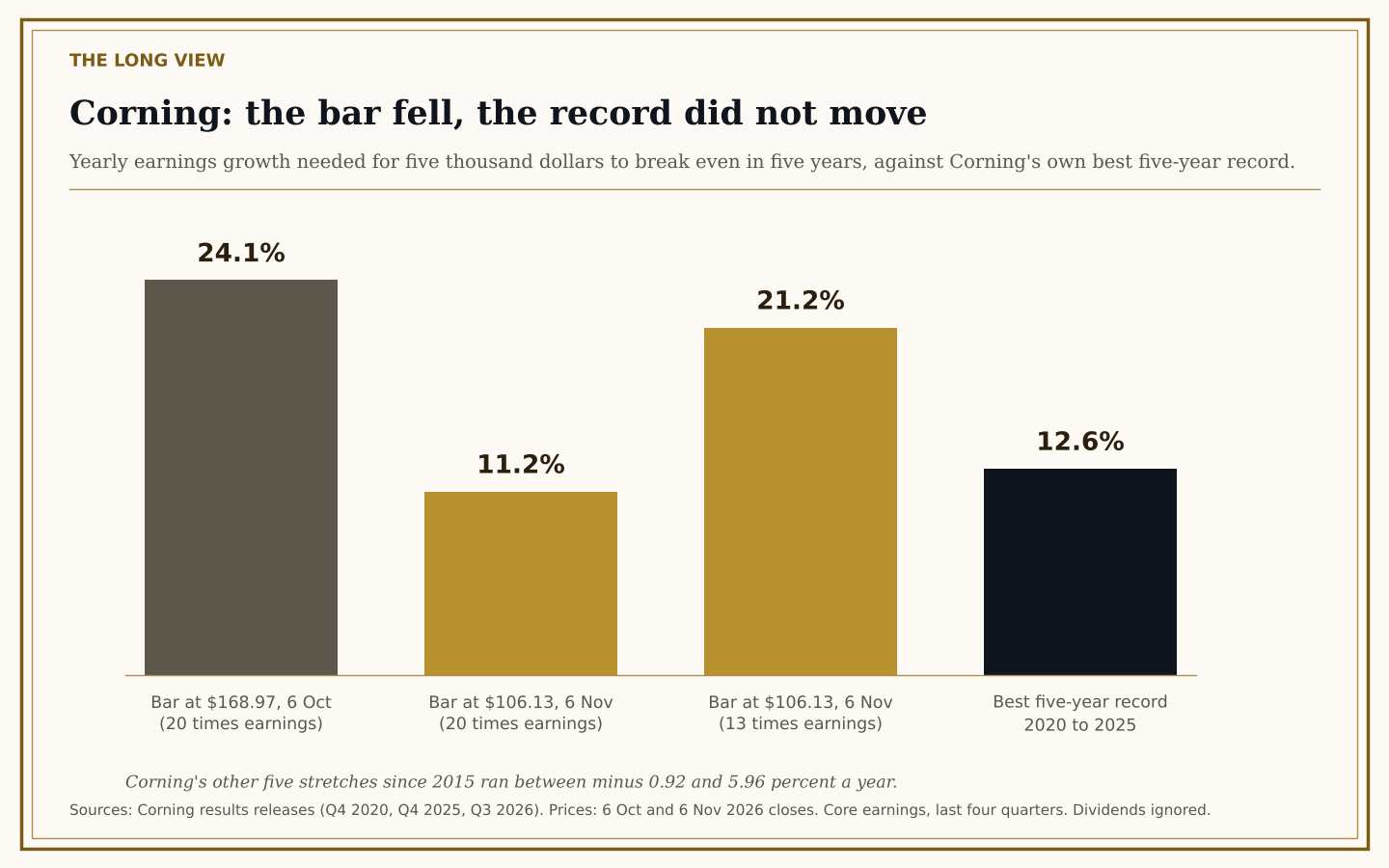
Corning’s best five-year stretch of core earnings growth since 2015 was 12.64 percent a year, from 2020 to 2025, and it started from a dip in 2020. The other five stretches ran between minus 0.92 and 5.96 percent. In October the bar sat about twice as high as the best stretch. Now it sits just below it.
Now the caution that keeps this honest. The 20 times in my test is generous for a company growing 12 percent a year. By Lynch’s own rule, a company growing about 13 percent a year deserves about 13 times earnings. At 13 times, Corning’s bar is about 21 percent, not 11. On reported earnings, which do not strip anything out, the bar at 20 times is about 17 percent. These bars also ignore dividends.
A drop does not change the record. A company that has not grown 20 percent a year for five years in the past did not become a faster grower because its stock fell.
So the drop brought Corning close, on one set of assumptions. Close is not the same as clear. On Wednesday 11 November, the rest of Corning’s record goes beside the bar.
The records we will be reading
The five records differ in ways that matter for the test.
Measured on reported earnings, Nvidia’s earnings per share grew more than 30 percent a year in six of the seven five-year stretches since its fiscal 2015. AMD lost money in 2015, 2016 and 2017, so three of its stretches start from a loss. Micron lost money in fiscal 2016 and fiscal 2023, then earned $74.33 a share in fiscal 2026, a 53-week year. Broadcom lost money in fiscal 2016.
Those swings raise the week’s sharpest question. When earnings have just hit a record, a stock can look cheap on its latest earnings and still be the riskiest of the five. Friday 13 November takes that on.
The hidden assumption
The hidden assumption behind buying a stock because it fell is that the price before the fall was about right. If it was, a lower price is a bargain.
If the old price was too high, a fall can still leave it too high. The only way to know is to set the new price against what the business earns and how fast it has grown before.
That is the habit the five companies are here to teach. A headline tells you a stock fell. Two numbers, the bar and the record, tell you whether the fall changed anything that matters to an owner.
A drop lowers the bar. It does not make the vaulter any better.
What comes next
The notes on Tuesday 10 November look at the first two records. Wednesday 11 November puts Corning and Nvidia through the test. The notes on Thursday 12 November set up the last three. Friday 13 November covers AMD, Micron and Broadcom, then puts all five on one scoreboard, each with a plain classification against the Buffett and Lynch playbook.
Reply with the one company of the five you would research first after this drop, and the number that decides it for you. I read every reply.
Not investment advice. The subscriber decides.