

The number that settles the bet was not in the release, and the CFO said so out loud.
Before Intel reported, we ran it through the Stock Story Firewall, our tool for finding the one belief a stock’s price depends on and published the result. This is the grade, against the bar the tool set, not a friendlier one written afterward.
One housekeeping note first, in the interest of the record. Our Watch Card set a tighter threshold on the foundry loss than the published preview did: the card asked for better than negative $2.0 billion, the article asked only that the loss narrow. Subscribers see both. We grade the bar we published, and flag below where the card would have read the number differently.
We did not have to remember this print was coming
The Watch Card flagged it, surfacing Intel with its tests still pending and the earnings date due on July 23. That is the point of the system. The calendar does not live in your head, it lives in the tool, and the tool told us it was time to grade.
What the tool told us
We fed Intel into the Firewall on June 28. Here is what it returned, and it is worth seeing the machine work, because this is the method.
The hidden assumption it surfaced, the belief the price quietly requires: Intel’s 18A process node and foundry platform will attract sufficient external customer volume to make the foundry business profitable and restore Intel’s competitive position in advanced semiconductor manufacturing.
The framework it prescribed: Turnaround Analysis. Not a growth screen, not a moat study. The tool recognized that Intel is a long-dominant incumbent that has lost share, missed cycles, and strained its balance sheet, and that the only question worth asking is whether the reset is real and durable.
The classification it assigned: Needs Proof. Not a knock on the story, a statement that the financial evidence had not yet confirmed it. The tool was specific about what proving it looked like: outside customers arriving in volume, the loss narrowing, and a named customer committed to production.
When the print landed, the Evidence Intelligence tool did the retrieval, pointing at the exact segment table the Firewall said to check. That is how we knew within minutes that the most important line was not in the document. The tool told us where to look. Intel did not put the number there.
What we said would confirm it
Our published confirm line was specific: external revenue clearly above the $307 million base and accelerating, the foundry loss narrowing, and ideally a named volume customer. Our break line: external revenue still tiny, the loss not improving, no customer beyond pilots.
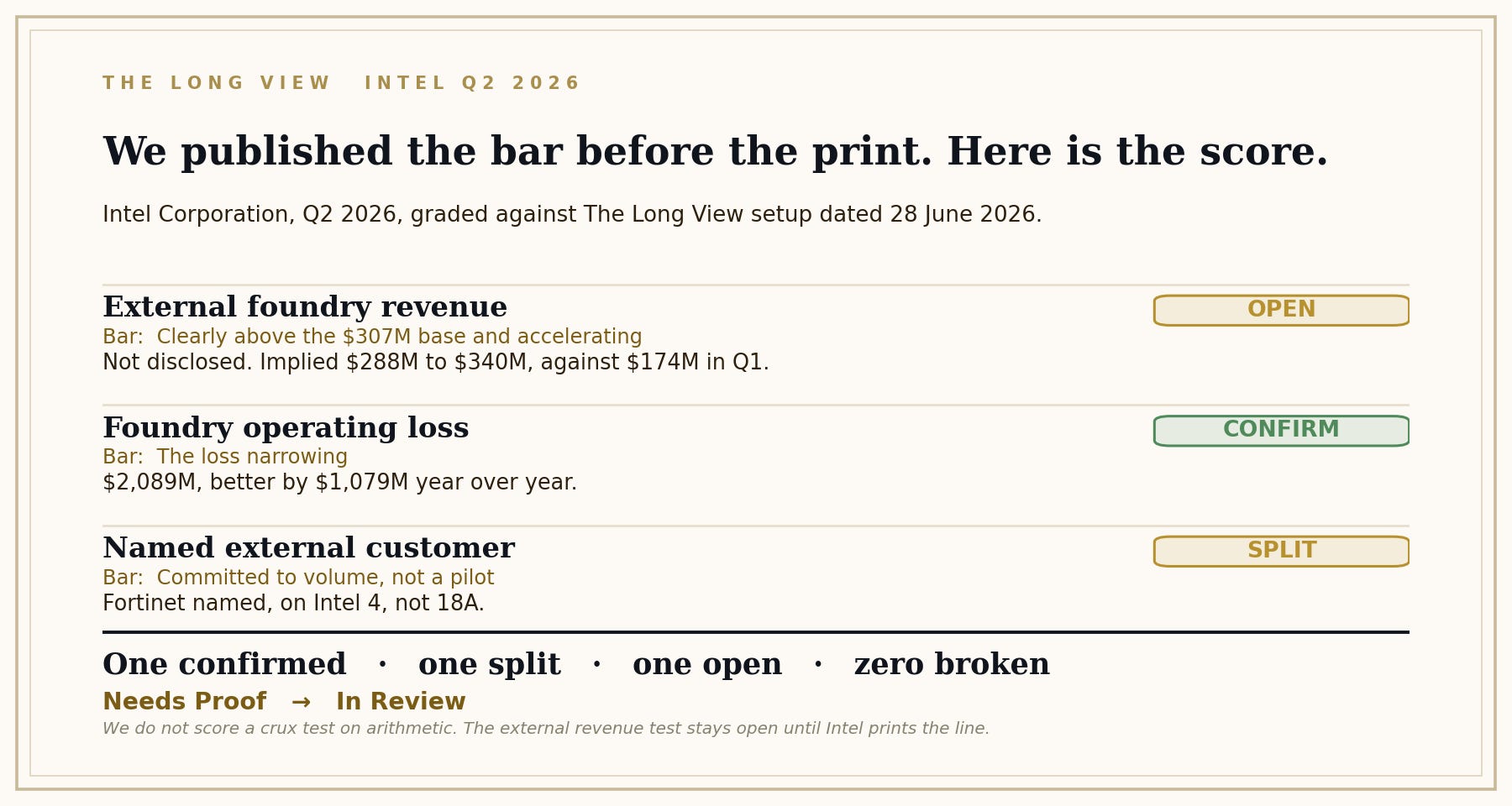
One confirmed. One split. One cannot be resolved from what Intel disclosed.
Test 1: External foundry revenue, the number the whole preview turned on
Published bar: clearly above the $307 million full-year 2025 base and accelerating. We set it that high on purpose: the moment a single quarter rivals a full prior year, the external base has stepped up for real.
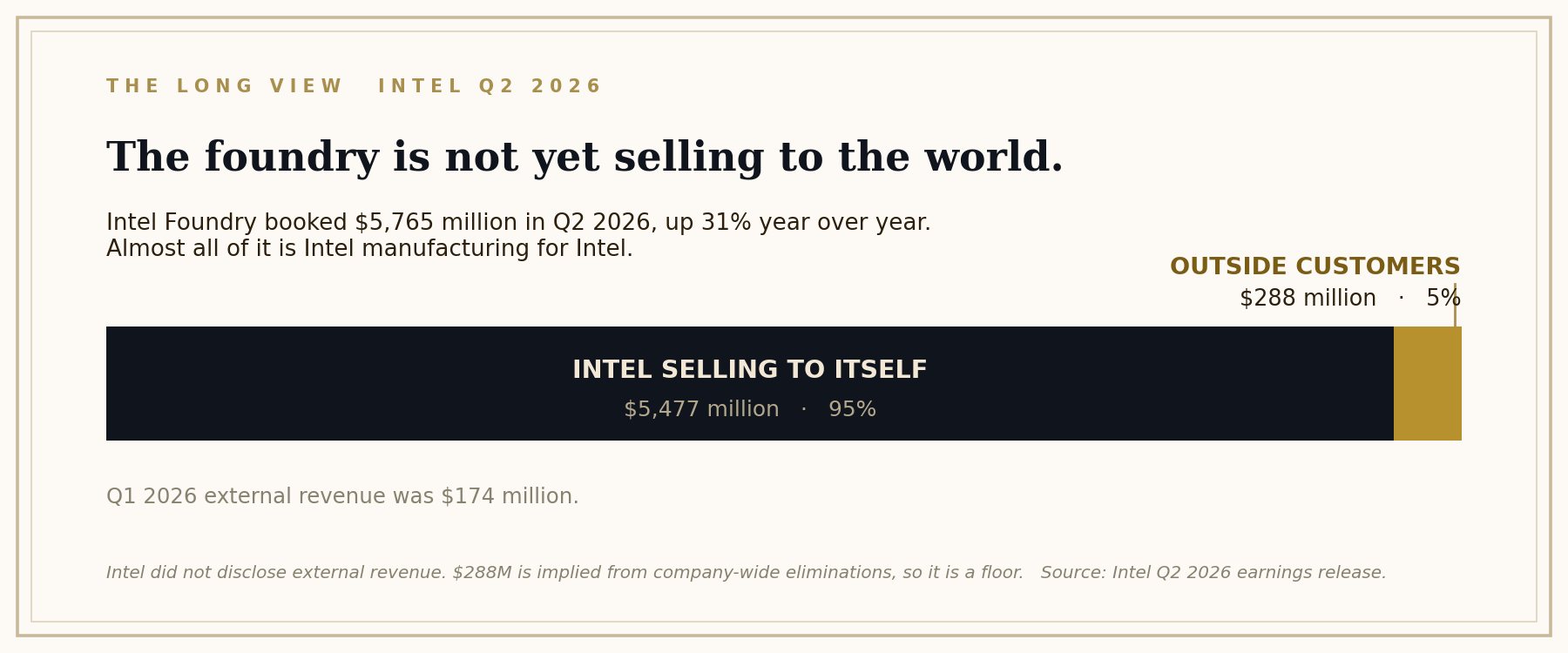
The number: Intel did not publish it. Open.
Intel disclosed segment revenue of $5,765 million and intersegment eliminations of $5,477 million. Subtract one from the other and you get $288 million, against a disclosed $174 million in Q1.
That $288 million is a floor, not an estimate, and the distinction matters. Eliminations are reported company-wide, not by segment, so the figure includes intersegment activity from businesses other than the foundry. Foundry’s own eliminations must be smaller than the total, which means its external revenue must be larger than $288 million. Our own Q1 report gives the calibration: foundry eliminations that quarter were $5,247 million against a company total of roughly $5.3 billion. Carry that same gap into Q2 and external foundry revenue lands nearer $338 million.
So the honest read is a range. At least $288 million, plausibly $330 to $340 million. The floor misses the bar we published. The likely figure clears it.
We are not scoring our own crux test on a range. That is arithmetic, not disclosure. The Q2 10-Q closes this test, and Intel files it within a day of the release.
Test 2: The foundry loss narrowing
Published bar: the loss narrowing confirms, the loss not improving breaks. Losses that widen as volume rises mean the unit economics are broken. Losses that narrow as volume rises mean the ramp is working.
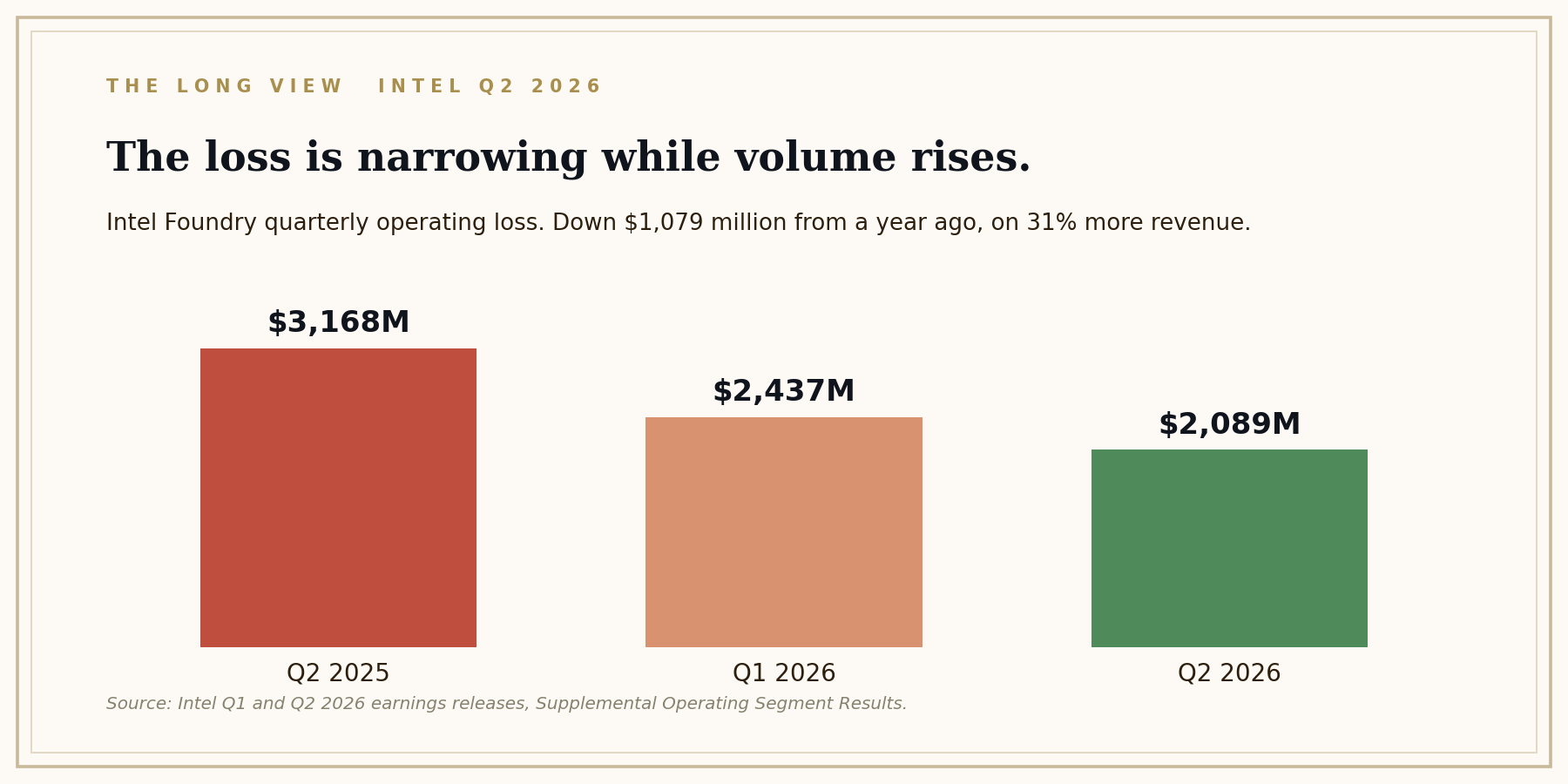
The number: an operating loss of $2,089 million, against $2,437 million in Q1 and $3,168 million a year ago. Confirms.
That is $348 million better sequentially and $1,079 million better year over year, on segment revenue up 31%. The cleanest result in the report. Note the record-keeping point from the top: at $2.089 billion the Watch Card would have read this as a near miss on its tighter threshold. The published bar asked the loss to narrow. It narrowed decisively.
Test 3: A named external customer committed to volume
Published bar: a named volume customer confirms, no customer beyond pilot’s breaks. Pilots and collaborations cost a customer nothing. Production commitments cost them a roadmap.
The result: Intel named Fortinet on July 21, its first named outside foundry customer since Lip-Bu Tan took over in March 2025, for its SP6 security processor. Split.
A production commitment, not a pilot, so it clears the letter of the test. It does not clear the spirit. Fortinet’s chip runs on Intel 4, two generations behind the 18A platform our assumption named. Our published question asked whether 18A has a named customer committed to volume. With 18A in volume production and Panther Lake shipping since January, the answer is still no.
The score, in full
Of the three-part bar we published, one confirmed, one split, and one stays open. Zero broke.
The number Intel did not print
The omission is the most interesting thing in the release, and management addressed it.
On any reading of the arithmetic, even the floor, Intel just had the strongest external foundry quarter in its history and chose not to state the line that turns a manufacturing arm into a competitor to TSMC. It may also have cleared the bar we set, and we cannot tell. On the call, CFO David Zinsner told investors he wanted to give them “a line of sight to expect that the number will be up.” The figure is rising. He would not say to what.
Two readings, pointing opposite directions. The number is not yet large enough to name, a problem for a stock priced as though the foundry already works. Or it is being saved for a quarter when it can be announced beside a named 18A customer, which is a decision about sequencing a story rather than disclosure.
We do not know which. Neither does anyone who heard the call.
What the rest of the quarter said
The parts of Intel that were not on trial delivered. Revenue was $16,128 million, up 25%, the fastest growth since 2011. Data Center and AI revenue was $6,262 million, up 59%, with segment operating income rising from $633 million to $2,474 million. Non-GAAP gross margin hit 41.8% against a 39% guide.
The headline GAAP loss of $11,033 million is an accounting artifact, not an operating one. We explain it separately in this week’s notes.
The state change
In the preview we said a pass moves Intel “from Needs Proof toward Clear for Deeper Research, and into In Review.” That is what happens now.
Intel advances out of Needs Proof and into In Review. It does not reach Clear for Deeper Research, because the gate we named as decisive is still open. A quarter that improves everything adjacent to the thesis while leaving the thesis itself undisclosed earns more of our attention, not our conclusion.
So Intel moves forward and stalls at the same time: forward on a narrowing loss and a real named customer, held at the gate the print could not answer. Not a buy, and not a finish.
Where it sits now: undecided, and priced as decided
At Thursday’s close Intel traded near $102 on a market capitalization around $516 billion, up roughly 170% in 2026 even after falling about 32% from its June peak. Non-GAAP EPS of $0.42 this quarter and $0.38 guided for Q3 puts the run rate near $1.60, a multiple in the low 60s. Adjusted free cash flow was negative $8,419 million.
At sixty times run-rate earnings the price already assumes the foundry works. A company can be a real turnaround and a poor entry at the same time. Intel is both at once, and the filing that separates them has not been read.
One thing we did not grade, and why
Our preview also pointed to the proxy, the question of how much stock officers and directors collectively hold. An earnings release does not answer that. It lives in the DEF 14A. So, it stays a research item, not a graded test, alongside the insider selling we flagged in June, which this print did not resolve either. We note it so the record shows what we did and did not settle today.
What we watch next, and when
The Q2 10-Q, for the external foundry revenue line in the Intel Foundry section of the MD&A. Intel files within a day of the release, so by the time you read this the number may already be public. We publish the update the moment it is, and the open test closes.
Then Q3, guided to $15.8 billion to $16.8 billion, for whether the loss keeps narrowing toward the break-even management targets by end 2027, and whether an 18A customer is named with volume attached. Both are logged in the Tracker.
The call we made in public came due. The loss narrowed, the customer arrived on the wrong node, and the number that decides it stayed in the company’s pocket. That is the scoreboard working as designed, including the discipline of leaving open what remains open.
This is what the Stock Story Firewall does. It finds the one assumption a price depends on, sets the test before the print, and lets the number decide. You can run it on any stock at firewall.readthelongview.com and follow every grade in the Research Tracker.
Intel spent this quarter proving it can build. Whether anyone else is buying is a number its own CFO says is rising and still would not name.
Not investment advice. The subscriber decides.