

On 14 July 2026, IBM told investors its mainframe business had missed, and the stock lost a quarter of its value in a single day. I have owned IBM since the bottom of the COVID crash in March 2020. Two months later, on 16 September 2026, an IBM company finalised a one billion dollar federal award to run a quantum chip foundry, and in the eight days around it the two small quantum companies I have been reading about, one of which I own, signed their own versions of the same kind of deal. This week I find out whether a fallen price and a manufacturing race belong in the same decision, and whether the answer is a reason to buy more of a stock I already own.
Disclosure: the author has held IBM since March 2020, is up about 100 percent on the position, and reinvests the dividend, and holds a small position in Rigetti. No position in IonQ. This is analysis, not a recommendation.
What happened on 14 July, and what IBM said
IBM did not wait for its results date. On 14 July 2026 it filed preliminary second-quarter figures and a letter from chief executive Arvind Krishna, and the numbers were worse than the company’s own April guidance. Revenue for the quarter ended 30 June 2026 came in at $17.16 billion, up 1 percent. In April, management had told investors to expect constant-currency growth of more than 5 percent for the year, and a second quarter in line with it. Constant currency means growth measured with exchange rates held still, so that a weaker or stronger dollar does not flatter or punish the comparison.
The damage sat in one place. Infrastructure revenue fell 7 percent, and inside it IBM Z, the mainframe line, fell 42 percent. In his letter Krishna wrote that in the last weeks of June clients moved their quarterly capital spending toward servers, storage and memory to secure supply ahead of expected price increases, and that the company “faltered.” Full-year constant-currency growth guidance was cut to 4 to 5 percent. The free cash flow outlook, roughly one billion dollars higher than last year, was held.
The market took a quarter off the price that day. CNBC reported it as the sharpest single-day decline on record for the stock, and the price I would be adding at this week is the price that fall produced.
Where the stock is, and where my position is
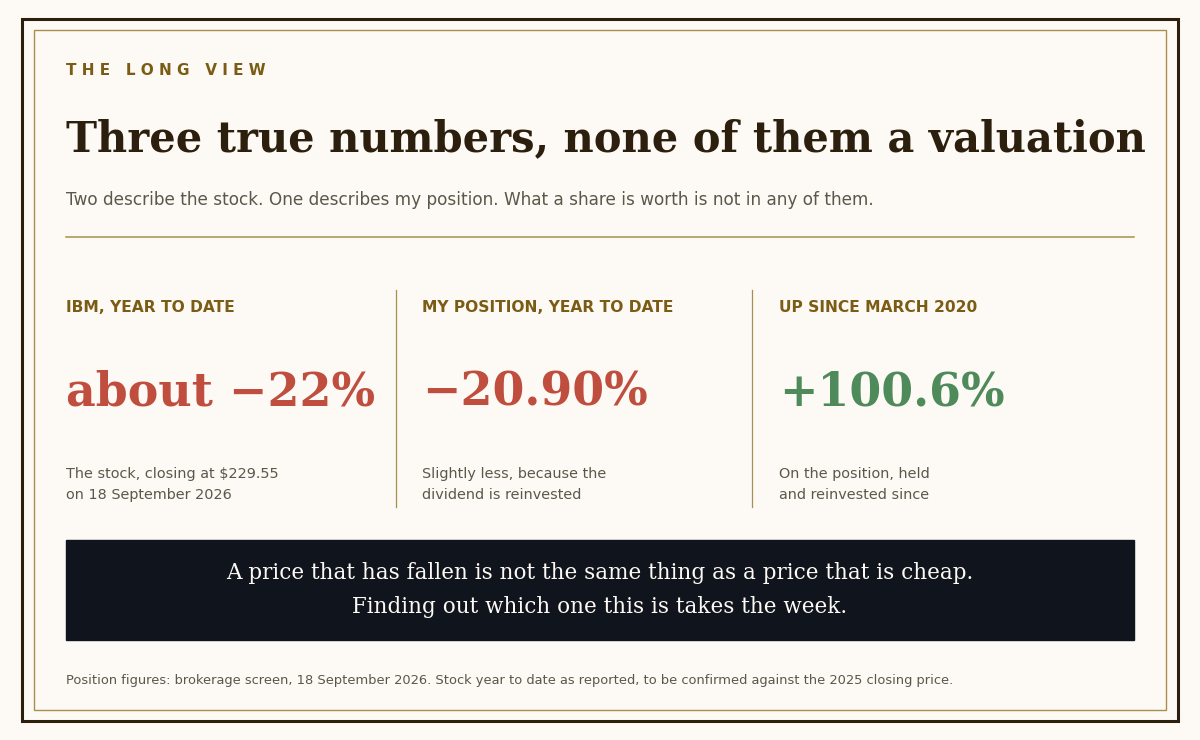
IBM closed at $229.55 on 18 September 2026. I am up about 100 percent on the position. The majority of it went on in March 2020, starting at $93.49 on the worst day of the crash, and I have reinvested the dividend ever since rather than putting new money in.
So the position is up a great deal in dollars and down this year, and both of those sentences are true at once. Year to date I am down 20.90 percent on it. IBM itself is down about 22 percent, and the small difference between those two numbers is the dividend. Anyone reading the pair as a contradiction is thinking about the wrong number. What I paid six years ago has nothing to do with what a share is worth today.
That is the setup worth a week. A large, profitable business marked down 22 percent in a year when most of what I look at is priced for everything going right is the situation value investing exists for. It is also the situation that most often turns out to be a trap, and the two look identical from the outside.
The part most people get backwards about adding
Buying more of something you already own at a profit is not the same trade as buying it cheap, and the arithmetic says so before any judgment does. Every share I buy at $229.55 raises what I have paid on average across the position, lowers the gain printed on my screen, and increases the money riding on one company.
None of that makes adding wrong. It makes the word “depressed” worth pinning down. IBM is depressed against its own June 2026 level. It is not depressed against what I paid, and it is not 2020. In March 2020 I was buying a business the market had given up on at roughly ten times earnings. In September 2026 I would be buying a business the market re-rated hard and then marked down on one quarter. Those are different situations, and this week has to treat them as different.
Why I am looking now, and it is not the chart
The reason I opened the file again is that IBM keeps turning up beside two companies I have been reading about all year, and I own one of those two as well. Rigetti is a small position of mine, and the piece I wrote about it in May is on this site. IonQ I do not own, which makes it the clean case this week, the one where nothing of mine is at stake and the test has nothing to flatter.
Put the three in the same quarter and the sentence stops making sense. For the quarter ended 30 June 2026, IBM reported revenue of $17.16 billion. IonQ reported $80.1 million, up 287 percent. Rigetti reported $5.1 million, up 185 percent. IBM’s quarter works out to roughly $188 million of revenue a day, dividing $17.16 billion by the ninety-one days in it. Rigetti booked $9.5 million in the whole of the first half of 2026.
Being named together is not evidence of anything. What made me take it seriously was what all three of them did in the same eight days.
Eight days in September
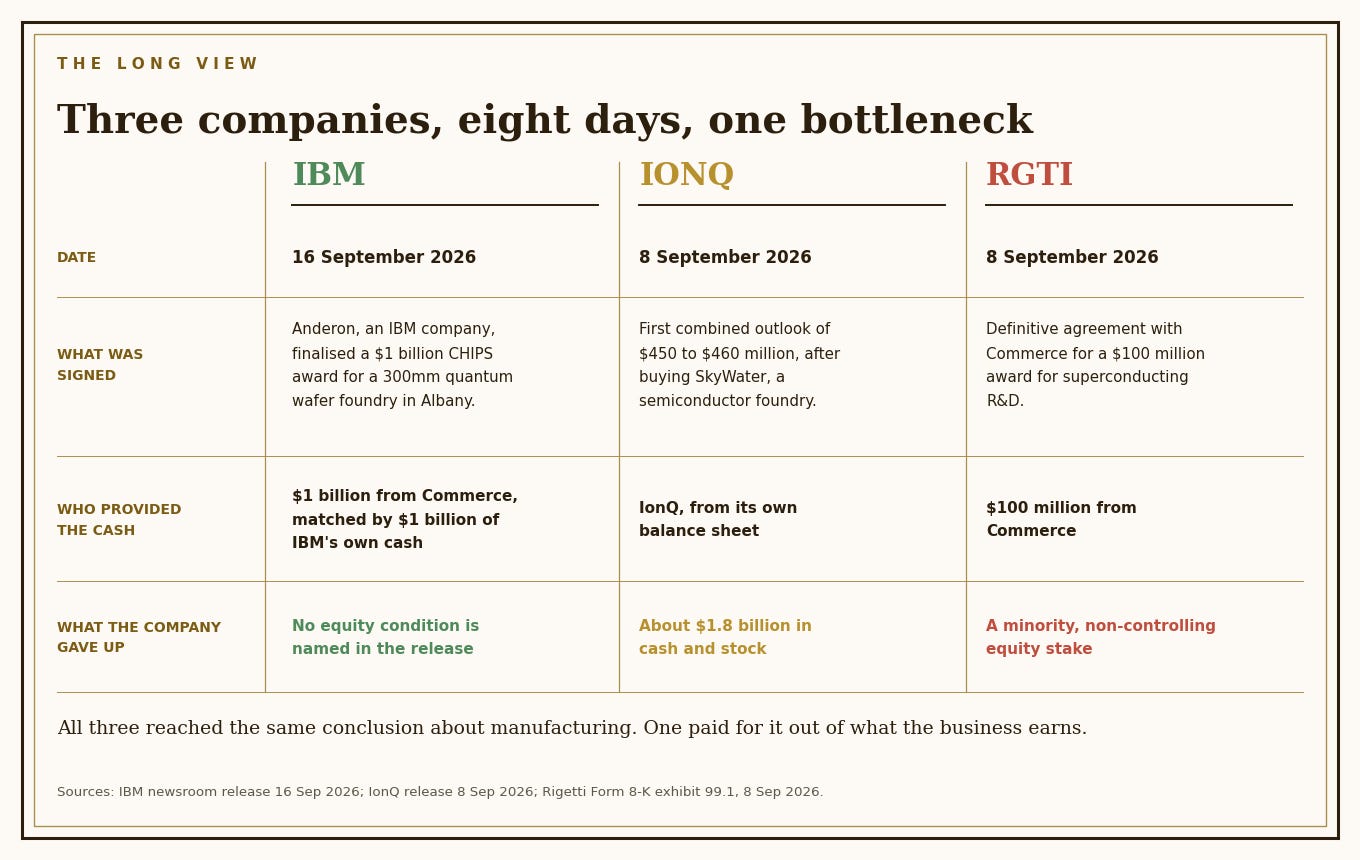
On 8 September 2026, Rigetti announced it had signed a definitive agreement with the U.S. Department of Commerce for a $100 million award to accelerate superconducting quantum research and development. As a condition, the Department receives a minority, non-controlling equity stake in Rigetti.
The same day, IonQ raised its full-year 2026 revenue outlook to between $450 million and $460 million. That was its first outlook to include SkyWater Technology, the semiconductor foundry IonQ bought for roughly $1.8 billion and closed on 31 July 2026.
On 16 September 2026, Anderon, an IBM company, announced it had finalised a $1 billion award under the CHIPS and Science Act with the same Department of Commerce, matched by a further $1 billion of IBM’s own money, to run a 300-millimetre pure-play quantum wafer foundry in Albany, New York. The release says first wafers are already running through the facility.
Three companies. Eight days. One conclusion each: that the thing standing between quantum computing and a business is manufacturing.
What each of them paid with
This is a value question rather than a physics one.
IBM put in one billion dollars of cash generated by a business that booked $17.16 billion of revenue in its worst recent quarter. The release naming that money names no equity condition attached to it, which is not the same as saying the agreement contains none, and Wednesday is where I go looking. IonQ bought its foundry for about $1.8 billion in cash and stock. Rigetti paid the U.S. government in its own shares. The September announcement says only that the stake is minority and non-controlling. The pricing formula in print is the one from May’s letter of intent, which set the issue price at the lowest of three specified closing prices, discounted by 15 percent. Those are shares in a company I own a little of, which makes Wednesday’s reading less abstract than I would like it to be.
Three companies reached the same conclusion about fabrication. One paid out of what the business earns. The other two paid with claims on the future ownership of the business, which is the part a milestone headline never carries.
What this week tests, and in what order
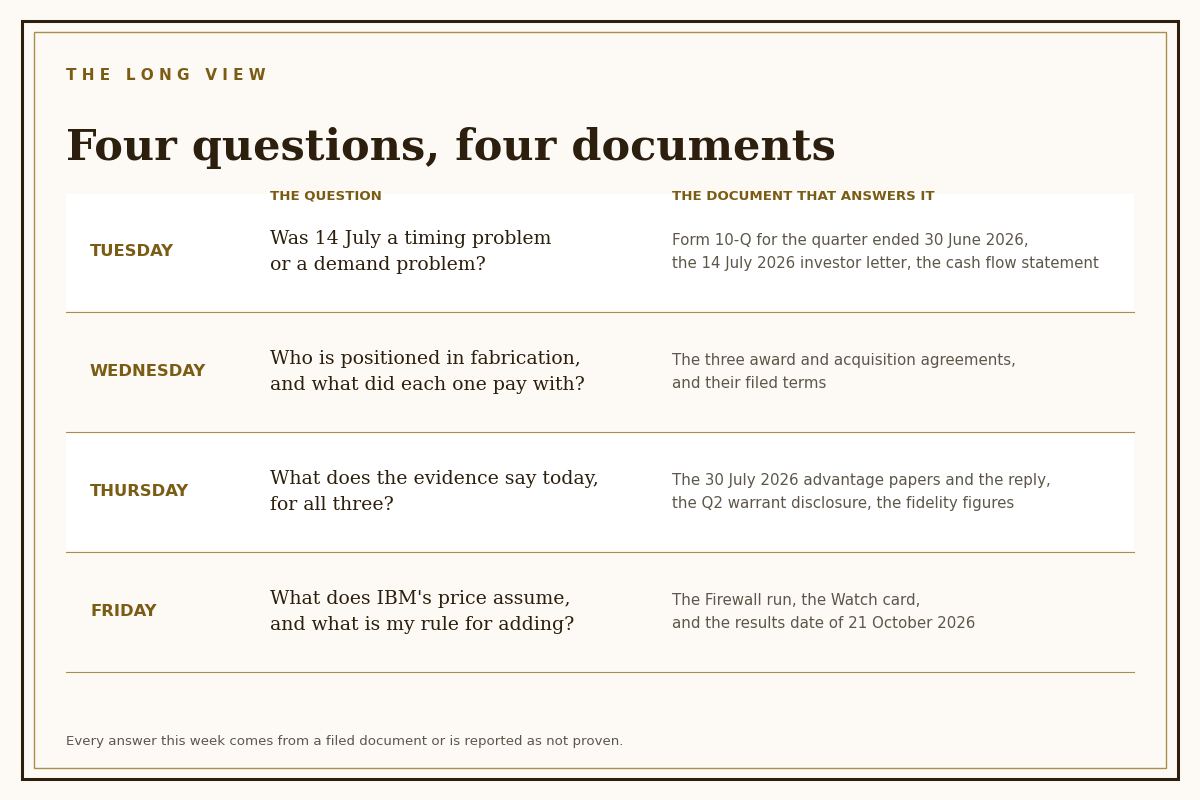
Four questions, each answered from a document rather than from a view.
Tomorrow: does the engine still work. The second-quarter filing, the investor letter and the cash flow statement, read for whether 14 July was a timing problem or a demand problem. Nothing about quantum matters if the business that funds it is breaking.
Wednesday: who is positioned in fabrication, and what each one gave up to get there. The three agreements side by side, with the dilution terms read out of the filings rather than the press releases.
Thursday: narrative against evidence, applied to IBM first. IBM made three quantum advantage claims on 30 July 2026 and researchers published a classical reply within weeks. A framework that only doubts small companies is not a framework.
Friday: the Stock Story Firewall on IBM, the hidden assumption its price depends on, the bar the company has to clear when it reports on 21 October 2026, and the rule I will use to decide on adding, written down before the numbers rather than after them. Two of these three companies are already mine, so Friday answers two questions rather than one. Whether to put more money into IBM is not the same question as what to do with a small position in Rigetti, and they do not get the same answer.
What this week cannot deliver
Three limits, stated now rather than discovered on Friday.
IBM does not report quantum as a segment. The company has said its quantum signings since 2017 are approaching one billion dollars, and a signings figure quoted in an investor presentation is not a revenue line in a filing. No amount of reading gets you IBM’s quantum revenue, because the disclosure does not exist.
The numbers that would settle the 14 July question arrive on 21 October 2026, after this week is over. This week sets a bar. It cannot grade one.
And IonQ and Rigetti cannot be valued the way I value anything else, because they do not have earnings to value. What I can do with them is narrower, and Thursday is where I say what it is.
The handoff
I am not going to decide whether to add to IBM on a quantum story. A business booking seventeen billion dollars of revenue a quarter does not get bought for a lottery ticket attached to its side, and the lottery ticket does not get evaluated at all until the engine underneath it is checked.
So tomorrow is the engine. Software grew 5 percent. Consulting was flat. Mainframe fell off a cliff. One of those is a business changing and one is a quarter changing, and the filing is the only thing that can tell them apart.
Run any company through the Stock Story Firewall, free, at firewall.readthelongview.com.
Not investment advice. The subscriber decides.