

On 30 July 2026, IBM (NYSE: IBM) announced three quantum advantage results in a single day, with three partners and three ways of proving it. On 13 August a team in Singapore took the published outputs of the strongest one and computed every one of them exactly, in 37.3 minutes, on 256 graphics processors. That is not a refutation, and the two teams are not measuring the same thing. It is also closer than “beyond the practical reach of classical computers” makes it sound. Today the framework that graded the two small companies gets pointed at the large one first, because a test only ever pointed downward is not a test at all. The hidden assumption under all three stories is identical: that a demonstration in a laboratory converts into revenue a shareholder can see.
Disclosure: the author has held IBM since March 2020, is up about 100 percent on the position, and reinvests the dividend. He also holds a small position in Rigetti. No position in IonQ. This is analysis, not a recommendation.
What IBM announced, and what sits underneath it
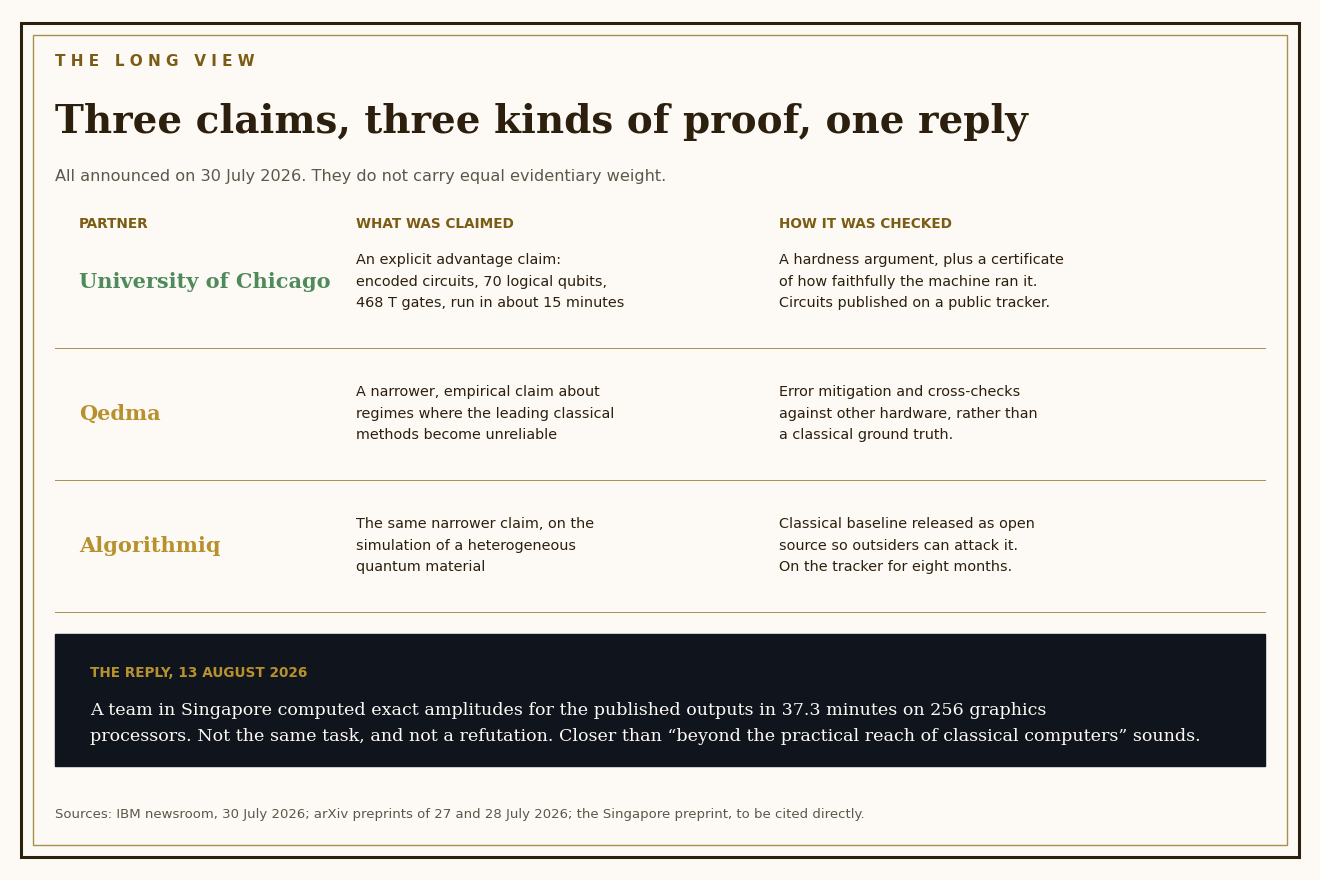
Three preprints went up on arXiv on 27 and 28 July, and the announcements followed on 30 July, presented together as evidence that quantum computing had entered what IBM called the quantum advantage era. The three do not carry equal weight. The University of Chicago paper makes the explicit advantage claim, with a certificate of how faithfully the machine executed the circuits. The Qedma and Algorithmiq papers claim something narrower: that in the regimes tested, the leading classical methods become unreliable.
Some vocabulary first. A qubit is the quantum version of a bit. A gate is one operation on one or two qubits, the way a processor performs one instruction. A physical qubit is real hardware and it is unreliable. A logical qubit is several physical qubits used together with error detection, so the whole behaves better than its parts. Quantum advantage means doing a task faster, cheaper or more accurately than the best classical method available.
The Chicago team ran encoded circuits representing up to 70 logical qubits and roughly 2,400 logical two-qubit operations on a Heron processor, with error detection built into the encoding. That delivered effective error rates about ten times lower than the hardware underneath, in about fifteen minutes.
The answer from Singapore
On 13 August 2026, a group at Singapore University of Technology and Design posted a preprint reporting that it had computed exact amplitudes for all of the published outputs from the Chicago circuit, in 37.3 minutes, on a cluster of 256 graphics processors.
That is not the same task IBM performed, and it does not overturn the paper. Computing the probabilities of outputs you have already been handed is easier than producing them. But it shows how much room sits between the headline phrase and the state of the art.
What IBM did before it made the claim
Here the framework cuts the other way.
The Algorithmiq result was not new on 30 July. IBM’s own release says the problem and its results went out eight months earlier at the launch of the Quantum Advantage Tracker, and that no classical method has reliably produced results across the full regime since. The claim has been standing in the open for anyone who wanted to knock it down.
On the same day, Algorithmiq released monoprop, an open-source engine carrying its best classical method. The release says what it is for: letting any research group stress-test advantage claims rather than take them on faith, including Algorithmiq’s own.
Both facts come from the releases rather than anyone’s characterisation of them. What I make of them is a judgement, and I will label it as one: a company that publishes the problem, the results and the best tool for attacking both is behaving like one that expects to be checked. The usual pattern here is an announcement with no artifact and no way for an outsider to test anything.
The wall I ran into
Then I went looking for what any of this is worth to a shareholder, and IBM will not say.
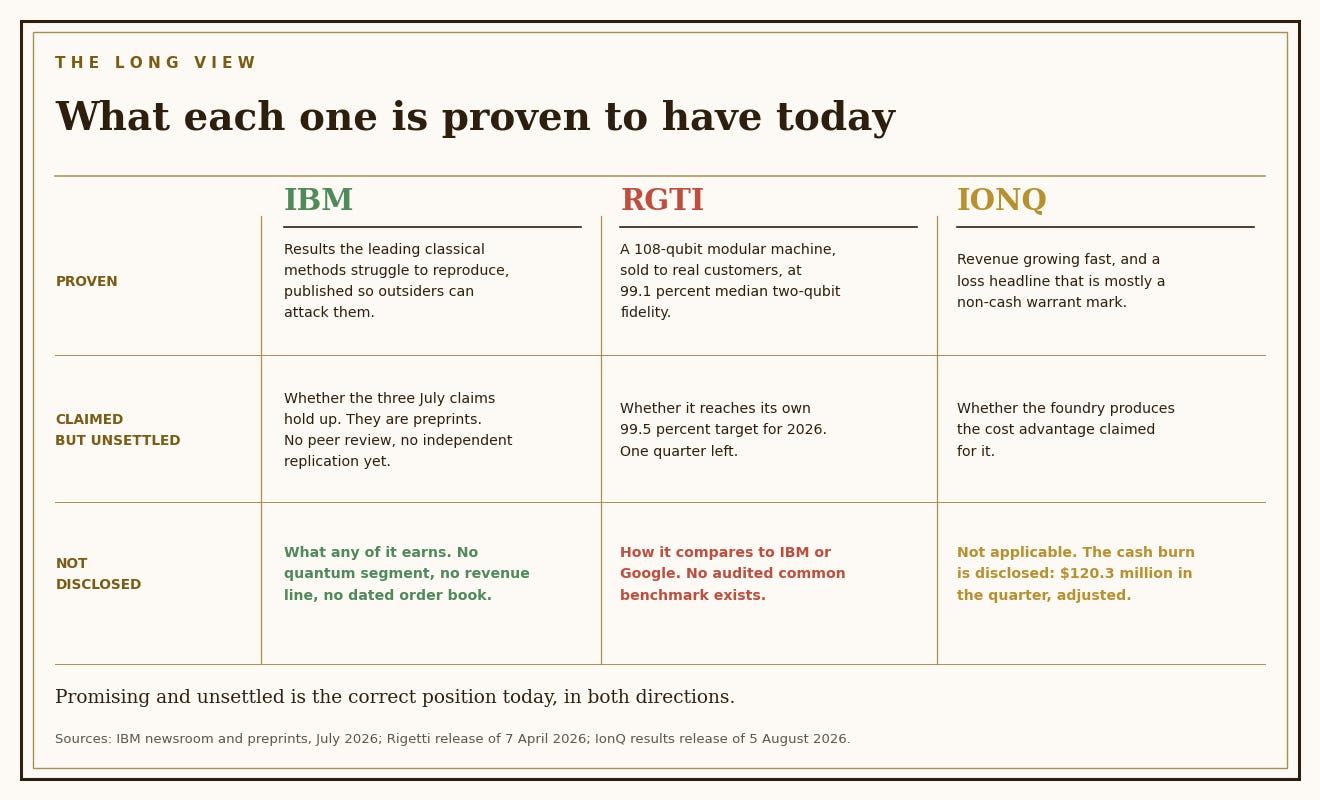
There is no quantum segment in its accounts, no quantum revenue line, and no order book disclosed in any filing. The only figure the company has put a number on is quantum signings approaching one billion dollars since 2017, given in an investor presentation. Tuesday produced a smaller version of the same problem, when the mainframe figure everyone quoted turned out to have no line of its own in the 10-Q.
What would close the gap is not complicated, and other segments already do it: a revenue line, an order book with a date, or a dated milestone tied to a figure. Until one appears, a shareholder funds a ten-year program and takes its commercial progress on trust.
So the tally reads like this. On quantum, the two small companies disclose more than the large one, because for them quantum revenue is all the revenue there is. IBM gives the science in detail and the economics not at all.
What fidelity is, and why tenths of a point decide everything
Now the company I hold, on the same terms. Rigetti’s May watch list promised to compare its hardware specifications against its competitors each quarter. That comparison needs the vocabulary before the verdict.
Fidelity is the number that governs everything else. A two-qubit gate fidelity of 99.1 percent means the machine gets one operation right 99.1 times in a hundred. That sounds close enough to perfect to ignore, and it is not, because errors compound. Chain a hundred of those operations and the chance the circuit ran clean is 0.991 multiplied by itself a hundred times, about 40 percent. At 99.5 percent, about 61 percent. At 99.9 percent, about 90 percent.
Stretch it to a thousand operations, a modest program, and they separate completely: about one clean run in ten thousand at 99.1 percent, seven in a thousand at 99.5, and 37 in a hundred at 99.9. That is the difference between a machine that can run a demonstration and one that can run a program.
Rigetti, on the number that matters
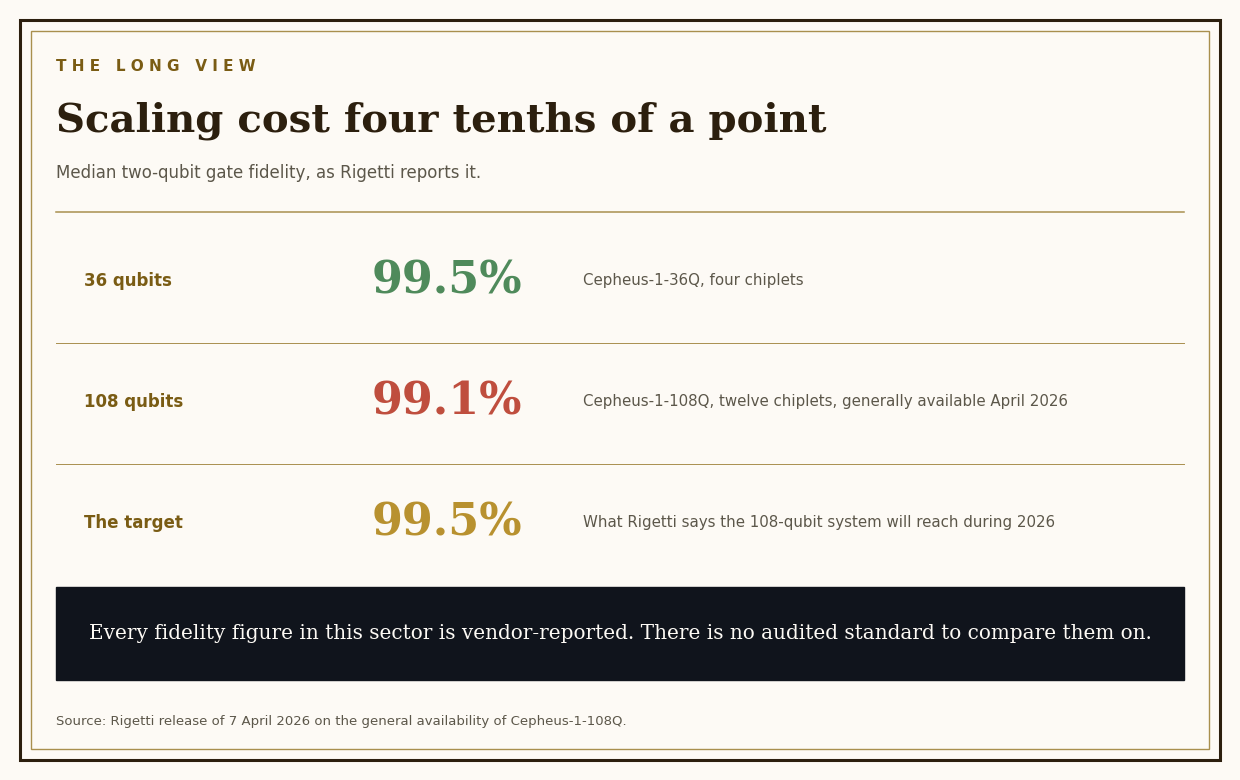
Rigetti builds modular processors: several small chips, called chiplets, wired together rather than one large chip, because yields on large chips are poor. The 36-qubit Cepheus system uses four chiplets of nine qubits and reached 99.5 percent median two-qubit fidelity. The 108-qubit system uses twelve of the same chiplets and runs at 99.1 percent. Tripling the size cost four tenths of a point, which on the arithmetic above is most of the machine’s useful depth.
Rigetti expects to bring the 108-qubit system back to 99.5 percent during 2026, and targets roughly 99.9 percent at about a thousand qubits within three years. The second figure matters more, because error correction only pays for itself once the hardware underneath is reliable enough. One quarter of 2026 remains for the first promise.
The wider comparison cannot be made properly, and that is the finding rather than an excuse. There is no audited standard benchmark across vendors. Every figure here is vendor-reported, measured the way the vendor chose, on the system it selected. The May piece asked for the gap against IBM and Google to be tracked. A quarter of looking produces this: it cannot be measured on a common instrument, and anyone quoting a league table is quoting marketing.
IonQ, which is not building the same machine
The two companies so far build superconducting processors: circuits printed on a chip, cooled to near absolute zero, with gates measured in nanoseconds. IonQ builds something else. It suspends individual ions in a vacuum using electromagnetic fields and manipulates them with lasers.
The trade-offs run in opposite directions. Trapped ions hold their state far longer, and every qubit can interact directly with every other one, where superconducting qubits mostly talk only to their neighbours and a circuit wastes operations shuffling information across the chip. IonQ’s published two-qubit gate fidelity is 99.99 percent, a figure repeated in its own filings since 2025, against Rigetti’s 99.1 percent. On the arithmetic two sections ago, that gap is enormous.
What runs the other way is speed. Ion gates are far slower, and IonQ’s answer is that all-to-all connectivity means fewer gates are needed for the same job. Scale runs against it too. IonQ’s results release says it sold its first sixth-generation, chip-based, 256-qubit system in the first quarter of 2026. Its roadmap calls for two million physical qubits by 2030.
And here is the tell for the whole week. IBM reports logical qubits and posts problems on a public tracker. Rigetti reports median two-qubit fidelity by system size. IonQ reports algorithmic qubits, a metric it invented, and its Tempo system scores 64. Three companies, three scoreboards, no common instrument.
IonQ, and the answer to our own question
Our IonQ card asked, as its first question, how much of that $1.87 billion second-quarter loss was non-cash. The filing answers it.
About $1.58 billion of it is a change in the fair value of warrant liabilities, which is an accounting mark rather than money leaving the building. The figure that tracks cash going out was $120.3 million for the quarter. IonQ held about $3.0 billion of cash and investments at 30 June, about $2.0 billion after SkyWater closed.
The mechanism will recur. A warrant is the right to buy stock at a fixed price. When the share price rises, that right becomes more valuable, the liability grows, and the company books a loss for the increase. A good quarter for the share price can manufacture a spectacular headline loss, and a falling one can flatter the same line.
None of that makes IonQ profitable. It burned $120.3 million in a quarter. It means the number that frightened everyone was the wrong one.
What is proven, and what nobody can settle yet
IBM: hardware producing results the best classical methods struggle to reproduce, published so outsiders can attack it, attached to a business that will not say what it earns.
Rigetti: a 108-qubit modular machine with paying customers, running below the fidelity its own smaller system reached and below its own target for this year.
IonQ: the highest published gate fidelity of the three, on a different kind of machine, one 256-qubit system sold, and a loss headline that is mostly an accounting mark.
All three July papers are preprints, and so is the Singapore reply. Peer review and independent replication are the steps that settle claims like these, and they have not happened. Advantage claims also have a history of being narrowed afterwards as classical algorithms improve. None of that makes IBM’s work wrong. It makes the correct position promising and unsettled, and anyone telling you otherwise in either direction is selling something.
Tomorrow
Tomorrow is the decision. IBM goes through the Stock Story Firewall, the assumption buried in its price gets named out loud, and the bar for 21 October gets written down in public before the numbers land. Then the harder half: what would have to become true for either of the small companies to be ownable on these terms, and what I do about the one I already hold.
Not investment advice. The subscriber decides.