

Two of IBM’s three segments came in short on the same July morning, and the market read it as one company breaking in two places at once. I have spent this morning in the company’s own filing, and the software shortfall and the mainframe shortfall are not two problems. They are one problem appearing on two lines, and the difference decides everything. A business with one cyclical problem is a different thing to own than a business losing customers in two places at the same time. Today I am not asking whether quantum computing is a good idea. I am asking whether the engine that would pay for it still runs, because if it does not, nothing else this week matters.
Disclosure: the author has held IBM since March 2020, is up about 100 percent on the position, and reinvests the dividend. He also holds a small position in Rigetti. No position in IonQ. This is analysis, not a recommendation.
What the company said happened
Start with IBM’s own account, because it is specific enough to be checked later, which is the only kind of explanation worth anything.
In April, management told investors the second quarter would be the wrap of the z17 launch and that Infrastructure would decline in the low single digits for the year. A mainframe generation sells hard at launch and then tails off. That much was planned.
What was not planned is in the letter Arvind Krishna filed on 14 July. At the end of June, buyers reallocated what was left of the quarter’s budget into hardware that was running short, servers and storage and memory, ahead of price rises they could see coming. Large deals that were meant to be signed were not signed. Krishna’s own summary is that IBM “faltered,” and that the company did not adapt quickly enough.
The result was revenue of $17.16 billion, up 1 percent, when the year had been guided to more than 5 percent growth at constant currency. Full-year guidance came down to 4 to 5 percent. The market took 25 percent off the price.
The two misses are one miss
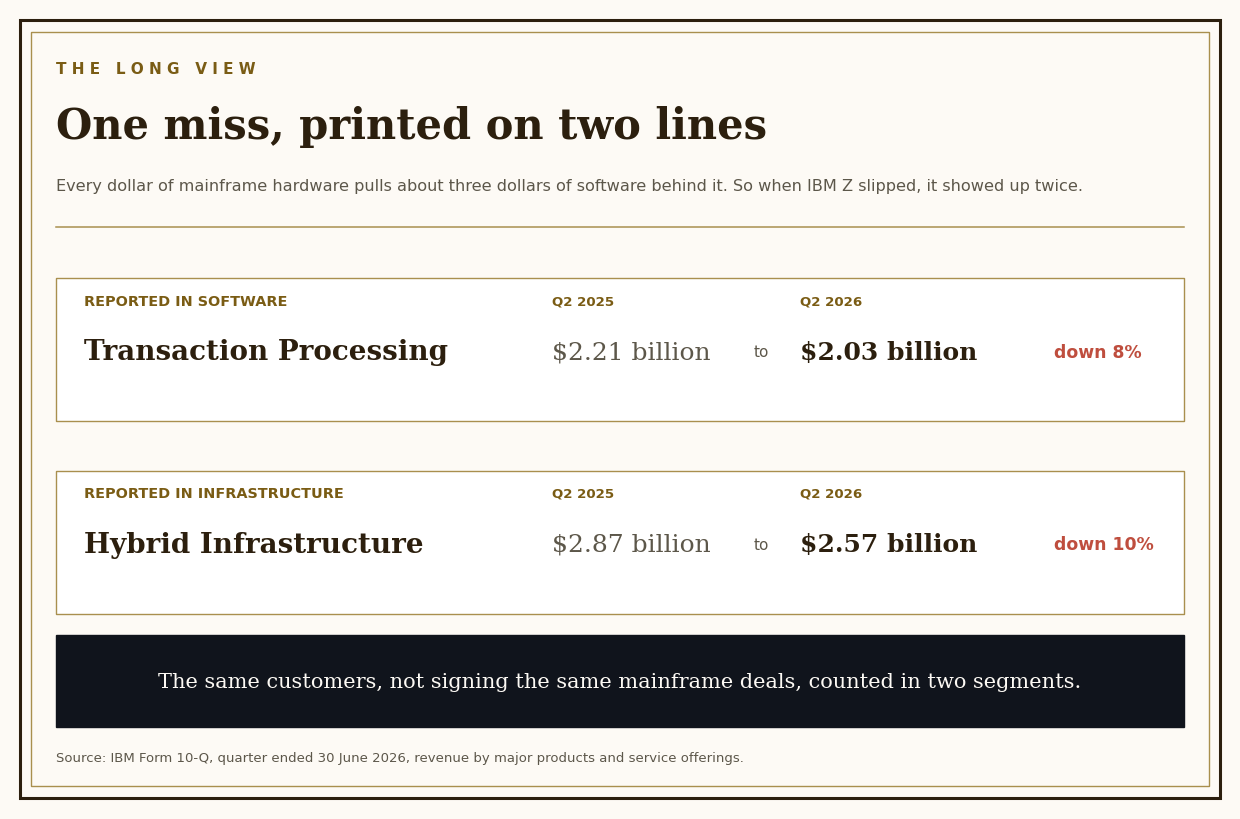
The Infrastructure shortfall was IBM Z. The Software shortfall was, in the company’s words, primarily in Transaction Processing, which is the software that runs on IBM Z. In the filing, Transaction Processing revenue went from $2.21 billion to $2.03 billion, a fall of 8 percent. Everything else in Software held: Data rose from $1.50 billion to $1.78 billion, Hybrid Cloud from $1.80 billion to $2.00 billion, Red Hat accelerated to 11 percent, and software annual recurring revenue reached $24.6 billion, up 8 percent.
So Software grew 5 percent instead of the 10 percent it was guided to, and Infrastructure fell 7 percent, and both sentences describe the same customers not signing the same mainframe deals.
IBM’s finance chief explains the mechanism the same way every year: every dollar of mainframe hardware pulls roughly three dollars of software behind it on long-term commitments. That multiplier is the moat when the cycle runs, and it is why a bad Z quarter prints twice.
The most quoted number of the quarter is not in the filing
Everybody repeated the same figure about this quarter, which is that IBM Z revenue fell 42 percent. I went to check it in the 10-Q and it is not there.
IBM does not report IBM Z as a revenue line. The closest thing the filing discloses is Hybrid Infrastructure, which holds the mainframe together with Power and Storage, and that line went from $2.87 billion to $2.57 billion, a fall of about 10 percent. The 42 percent is management’s own description of a product line the company defines and does not separately report.
I am not saying the number is wrong. I am saying it is a company-supplied figure that has been repeated everywhere as though it came out of a document, and it did not. Keep that in mind on Friday, when the question becomes what IBM discloses about quantum.
What timing looks like in a document
A slipped quarter and a shrinking business look identical in a headline. They do not look identical in a filing.
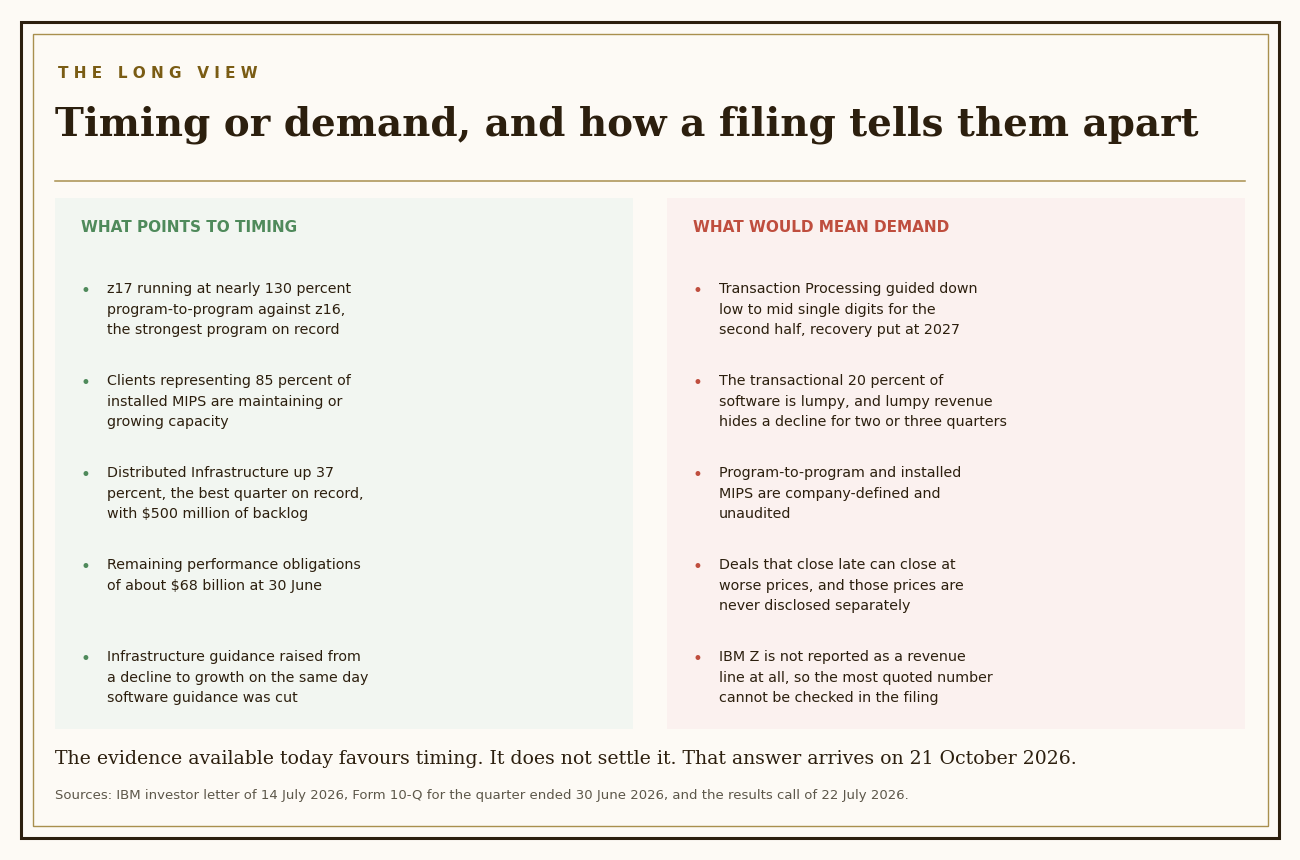
First, the z17 program is running at nearly 130 percent of the z16 program, measured at the same point, and z16 was the strongest mainframe program IBM had ever had. Second, clients representing 85 percent of installed MIPS, the measure of mainframe computing capacity in use, are maintaining or growing that capacity. Customers who are leaving do not grow capacity. Third, and most telling, Distributed Infrastructure revenue rose 37 percent, the best quarter on record for that line, with roughly $500 million of backlog leaving the quarter.
Read that last one again. The capital that did not buy mainframes went to servers and storage. A good share of it went to IBM’s own servers and storage.
And one item further back in the filing. Remaining performance obligations, the contracted work IBM has not yet delivered, stood at about $68 billion at 30 June, roughly 69 percent of it due within two years. That is not the profile of a company whose customers are leaving.
And then the guidance itself. On 22 July, IBM cut software growth for the year from more than 10 percent to 6 to 8 percent, and on the same day raised the Infrastructure outlook from a low-single-digit decline to low-single-digit growth. A company that has lost its customers lowers everything and blames the economy. Cutting one line while raising another is what a mix shift looks like.
The number the falling price ignored
The quarter was poor on revenue. It was not poor on profitability, and this is the part I would have missed if I had read the coverage instead of the document.
Operating pre-tax margin came in at 19.2 percent, up 30 basis points on the year. Operating earnings per share were $2.93, up 5 percent. Software segment profit rose 9 percent and its margin improved 110 basis points to 32.2 percent. Consulting’s margin reached 12.1 percent against 10.6 percent a year earlier. GAAP earnings per share of $2.27 were down 2 percent, and the gap between the two numbers is mostly amortisation of acquired intangibles, a non-cash charge.
Companies losing demand cut price to hold volume, and it shows up in margin first. On the July call, management said it had held price through July. The margins say the same thing the words do.
What would make it demand after all
Now the other side, because a case that only collects supporting evidence is not a case.
The strongest argument against me is management’s own guidance. Transaction Processing is not expected to recover in the second half. IBM has guided it down low to mid single digits for the rest of the year and described it as a growth opportunity for 2027. That means the mainframe software multiplier sits idle for something like eighteen months, and a problem that lasts eighteen months is not what most people mean by timing.
Then the shape of the business. About 80 percent of software revenue is recurring and grew through the quarter, which also means the other 20 percent is lumpy, and lumpy revenue can hide a real decline for two or three quarters. Program-to-program and installed MIPS are measures IBM defines and reports, they are not audited, and no competitor publishes anything comparable. Krishna said on 30 July that about 40 percent of the slipped deals had closed within three to four weeks, which he called a deferral rather than “destruction.” Deals that close late can close at worse prices, and those prices are never shown separately.
The honest position is that the evidence available today favours timing, and that it does not settle it.
The cash that pays for all of it
Whatever the answer, this is the part that decides whether the company gets to keep making ten-year bets.
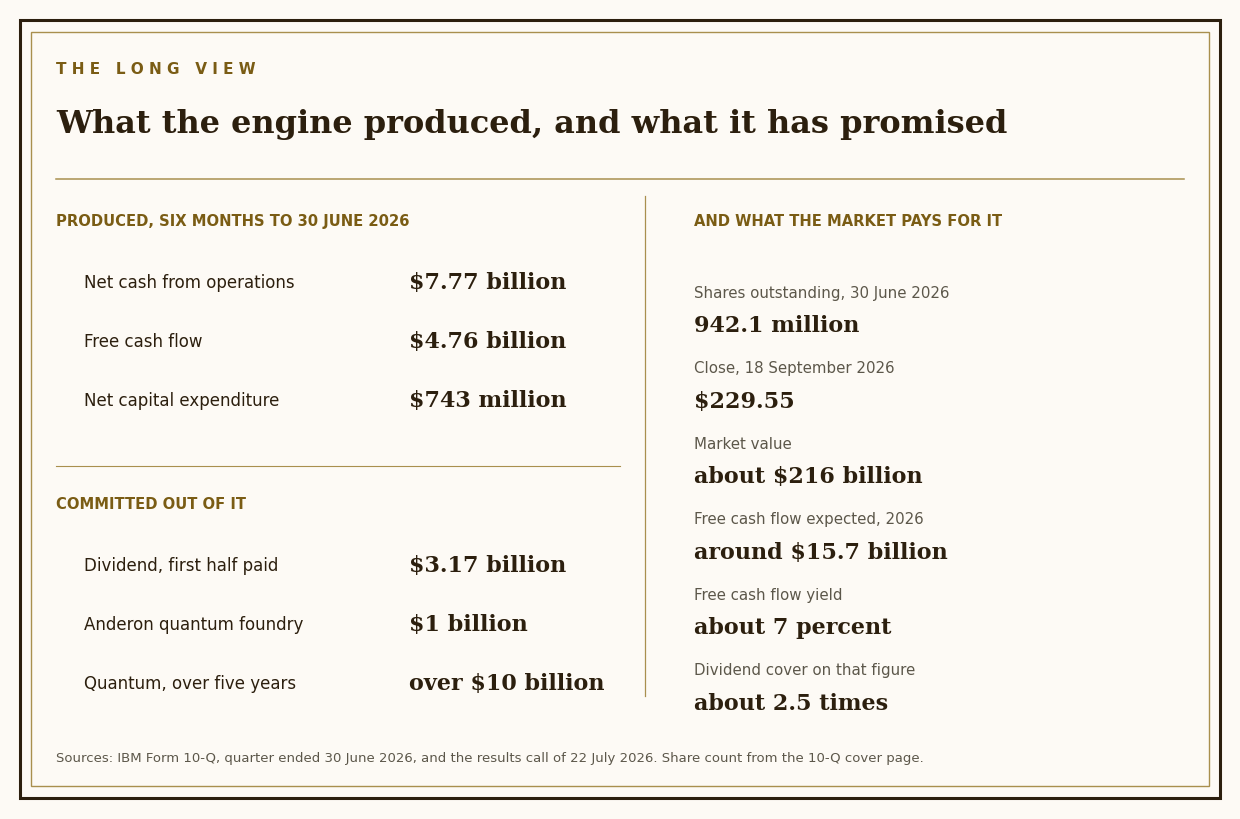
In the first half IBM generated $7.8 billion of net cash from operations and $4.8 billion of free cash flow, flat year over year, on net capital expenditure of $743 million. Management still expects full-year free cash flow about $1 billion higher than last year, which puts the second half under real pressure.
Out of that same cash comes the dividend. IBM paid $3.17 billion of it in the first half, which annualises to roughly $6.4 billion, and it has now been raised for thirty-one consecutive years, on a payment record that has run without interruption since 1916. Out of it also comes the billion dollars committed to the Anderon quantum foundry and the more than ten billion dollars IBM says it will put into quantum across five years.
One piece of arithmetic worth doing yourself. The 10-Q cover page reports 942.1 million shares outstanding. At Friday’s close of $229.55 that is a market value near $216 billion, against free cash flow the company expects to land around $15.7 billion this year. Roughly a seven percent free cash flow yield, with the dividend covered about two and a half times.
What that makes IBM, in the only terms I use
This is where the week’s three companies stop being comparable, and it is worth stating once before tomorrow.
IBM is a value question. It has earnings to be cheap or dear against, cash flow that covers a dividend two and a half times over, a franchise with switching costs measured in decades, and now a quantum foundry it is paying for out of its own pocket. Any of those can be wrong. All of them can be valued.
IonQ and Rigetti are not value questions and pretending otherwise would be dishonest. They have no earnings, so there is nothing for a price to be low against. What you can do with them is test evidence against story, which is Thursday. What you cannot do is call them cheap.
The bar for 21 October
Four things, written down now so I cannot move them later.
Transaction Processing declining no worse than the low to mid single digits management has already guided it to, because asking for growth there would be asking for something the company has said will not arrive until 2027. Hybrid Infrastructure revenue, the line the filing does disclose, improving on the $2.57 billion it printed this quarter. Software growth inside the 6 to 8 percent band it was cut to. And third-quarter free cash flow large enough to make the full-year promise of about a billion dollars of growth reachable rather than rhetorical.
If those four land, July was a quarter. If two or more miss, it was a business, and the price was right to fall.
Tomorrow
The engine looks intact, and that buys IBM the right to spend on a ten-year bet. It says nothing about whether the bet is any good, or about the two companies making the same bet with money they do not generate.
Tomorrow I read the three agreements themselves rather than the three press releases, and the question is not who announced what. It is who paid, and with what.
Run any company through the Stock Story Firewall, free, at firewall.readthelongview.com.
Not investment advice. The subscriber decides.