

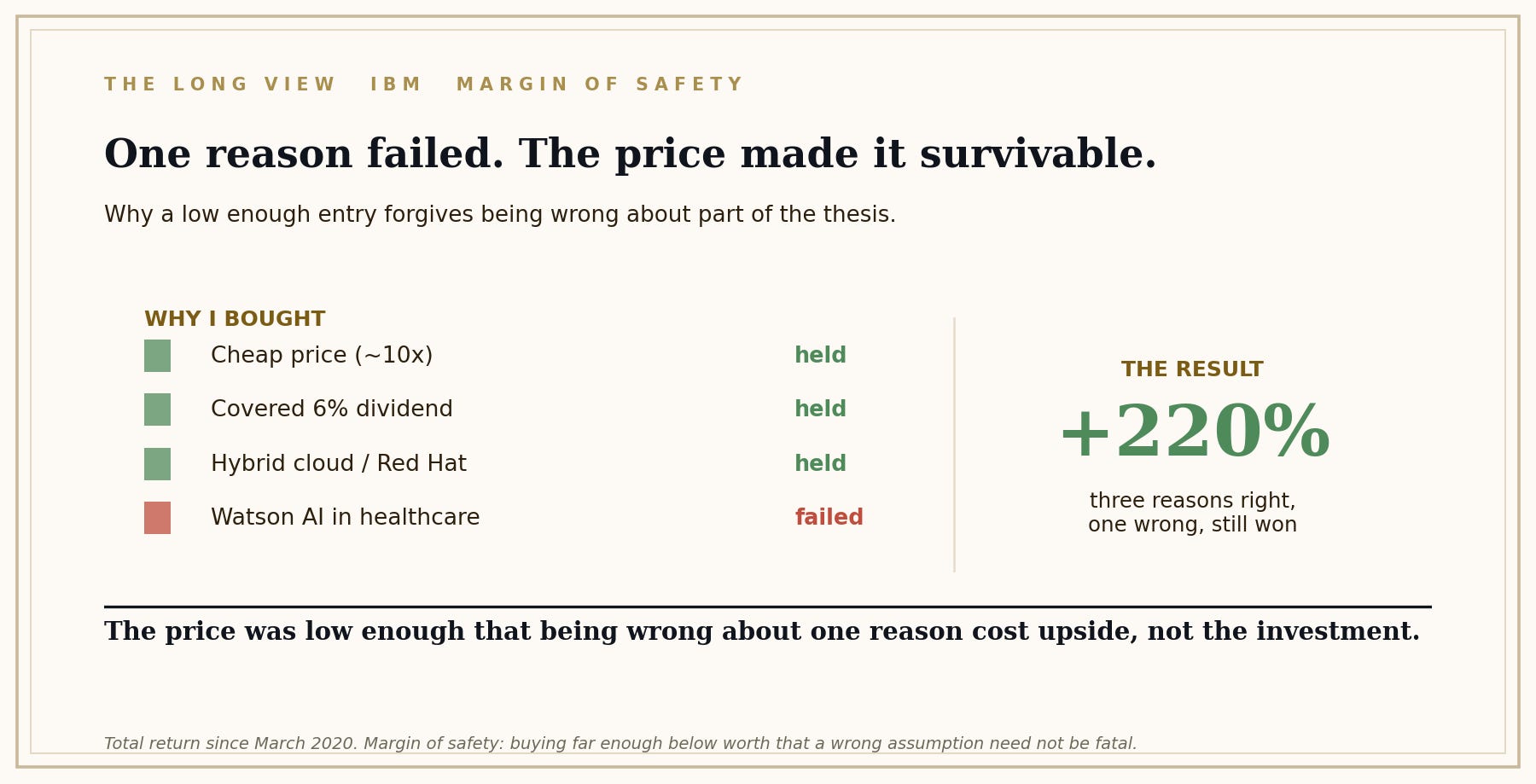
In March 2020 I bought a 109-year-old company at about ten times earnings, an eleven-year low, paying a dividend yield above 6 percent that was well covered, with a fresh cloud strategy and a working AI. One of my reasons for buying, the AI, later collapsed. The investment still returned more than 200 percent, and the reason is the most important idea in value investing: a price low enough is a margin of safety wide enough to forgive being wrong.
Disclosure: the author has held IBM since March 2020 at an average cost of $113.57 and reinvests the dividend. Independent dividend analysis contributed by Dave Ahern of Dividend School, printed unedited. This is analysis, not a recommendation.
This is the first of two pieces on a company I have owned for five years. This one is the story, and the lesson inside it. The second, tomorrow, is the discipline: the bar IBM has to clear to keep its place in the portfolio. You cannot understand the second without the first, so let me start where I started, at the bottom of a crash, with a stock almost nobody wanted.
What IBM looked like in March 2020
Cast your mind back. The COVID crash was tearing through the market, and IBM, already an unloved stock, fell to its lowest point since 2009, an eleven-year low. On March 23, the worst day of that crash, I started buying at $93.49.
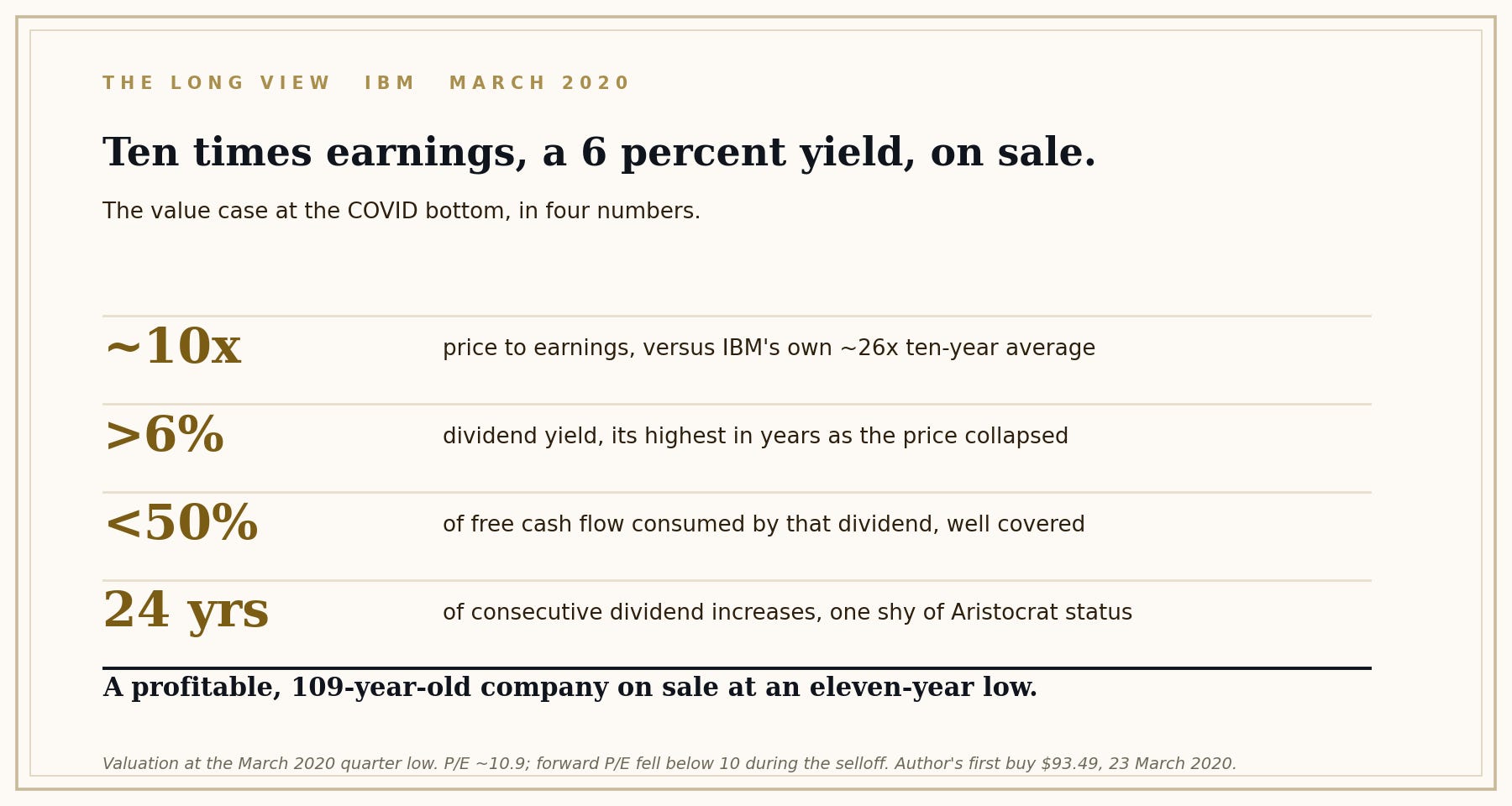
Here is what I was buying, in the language of value. IBM’s price had fallen to roughly ten times its earnings. To put that in perspective, over the previous decade IBM had traded at an average of about twenty-six times earnings, so I was buying it at well under half its own normal valuation. The dividend yield, the annual dividend divided by the share price, had climbed above 6 percent, because when a price falls far enough, the fixed dividend becomes a larger and larger share of it. And that dividend was not a fragile promise. IBM had raised it for twenty-four straight years, and it was consuming less than half of the company’s free cash flow, the cash left after running and investing in the business, and about 61 percent of earnings. A well-covered 6 percent yield on a 109-year-old company at ten times earnings. That is not a lottery ticket. That is a value.
The reasons I bought, and I want to be honest that there were several
I did not buy IBM for one reason, and being straight about that is the whole point of this piece.
The business case had real parts. IBM had just closed its $34 billion acquisition of Red Hat in July 2019, and it was building a hybrid-cloud strategy, the business of helping big companies run their computing across their own data centers and multiple public clouds at once, with Red Hat’s OpenShift platform as the engine. Not public cloud, IBM had already lost that race to Amazon and Microsoft, but hybrid cloud, a specific corner where IBM was positioned to lead. Alongside that was Watson, IBM’s artificial intelligence, and it was not a slide in a pitch deck, it was a working system being used in real applications, including cancer research, and its potential looked enormous.
So the case was: a deeply cheap price, a fortress dividend, a credible new cloud strategy, and a working AI with a huge runway. Several independent reasons to own it, bought at a price that demanded almost nothing go right.
The part I got wrong
Now the honest part. The Watson story, specifically Watson in healthcare, the piece I found most exciting, became one of the most expensive disappointments in IBM’s modern history. The company had poured roughly five billion dollars and thousands of people into Watson Health, the marquee hospital partnerships faltered, and in 2022 IBM sold those assets to a private equity firm for around one billion dollars, a fraction of what went in.
One of the reasons I bought IBM did not just underperform. It failed outright.
Why it worked anyway
And the investment still returned more than 200 percent. Sit with how those two facts coexist, because the space between them is where value investing really lives.
It worked for two reasons, and they are the same reason wearing two hats. First, the parts I got right, the cheapness, the dividend, the hybrid-cloud repositioning, were the durable ones, and they carried the whole. Second, and underneath everything, the price. I paid about ten times earnings for a profitable, cash-generating business. At that price, I was not depending on Watson to save me. I was being paid a well-covered 6 percent every year just to wait, on a business with several other ways to win. So when one of those ways collapsed, it cost me a piece of the upside, not the investment. The margin of safety absorbed the mistake.
That phrase, margin of safety, is the oldest idea in value investing, and it means buying so far below what a business is worth that you can be wrong about part of your thesis and still come out fine. It is insurance you buy with a low price. If I had paid a premium in 2020 and leaned the entire case on Watson, its failure would have been a wound. Because I paid a crash price for a business with multiple engines and a fat, covered dividend, the failure was a footnote.
An independent look at the dividend that anchored it
Because the dividend was so central to why this worked, and because I have reinvested it every quarter for five years and am therefore too attached to judge it cleanly, I asked someone who is not. Dave Ahern, who writes Dividend School, gave me his honest read, printed as he sees it.
His verdict was that IBM’s payout looks fairly safe. The scary-looking number is the earnings payout ratio, which has run above 100 percent in four of the last ten years, meaning IBM paid out more in dividends than it booked in reported profit in those years. Dave calls that not awesome, but not a killer, and here is why: he weights free cash flow over earnings, because a company like IBM carries heavy non-cash charges that make reported profit understate the actual cash coming in. On that truer measure, IBM’s free-cash-flow payout has stayed well below 70 percent, his threshold for concern. The cash covers the dividend even when earnings optically did not. He flagged one thing to watch, dividend growth is running slightly ahead of free-cash-flow growth, which slowly narrows the cushion over time. That is the honest kind of caution I wanted and could not have given myself. My thanks to him for the outside eyes.
The point for this piece is that the dividend was not decoration on the value case. It was a load-bearing part of it, then and now. A 6 percent yield you can trust is a huge share of the margin of safety, because it pays you to be patient while the rest of the thesis plays out, or does not.
The lesson, stated plainly
Here is what I want you to take from this, because it is the truest thing I know about investing, and it runs against how most people think about being right.
You do not have to get the story completely right to do well. You have to get the price right enough that being partly wrong cannot ruin you. I was wrong about the single most exciting reason I bought IBM. In most framings of investing, being wrong about your thesis means you lose. But value investing is not built on being right about the future. It is built on paying so little for the present that the future has many ways to reward you and few ways to hurt you. The margin of safety is not a nice-to-have. It is the whole mechanism by which ordinary investors survive their own mistakes, and everyone makes them.
Buy a good business at a punishing price and you need everything to go right. Buy a good business at a genuine discount, with a covered dividend paying you to wait, and you can be wrong about a great deal and still win. That is not a trick. It is the entire discipline, in one holding.
Tomorrow, the harder half
None of this tells me whether IBM still deserves its place in my portfolio today. That is a different question, a forward-looking one, and it does not get the gentle treatment just because the position has been good to me. The stock recently fell 25 percent in a day on a real disclosure, and it reports again in October. Tomorrow, I set the bar it has to clear, in public, before the numbers, and I grade it no more gently for owning it. The value that forgave my mistake in 2020 does not entitle IBM to anything now. Today it earns its place or it does not, and that is part two.
Run any company through the Stock Story Firewall, free, at firewall.readthelongview.com. Subscribers get the Watch cards, the Evidence tool, and the full Research Tracker, on the companies we own and the ones we do not.
I was half wrong about why I bought IBM, and at ten times earnings, with a 6 percent dividend paying me to wait, it barely mattered. Remember that the next time someone tells you investing is about being right. It is about being wrong safely, and the price is what makes the safety.
Not investment advice. The subscriber decides.