

At the start of the week, I asked Google’s AI who supplies the fiber for the AI buildout, and it crowned Corning Incorporated (NYSE: GLW) “The Monopoly King.” ChatGPT put Corning first as well. A week inside Corning’s filings, and its rivals’, gives a more useful answer: the contracts are real, the crown is unproven, the margins are shared, and the price at the 6 October close, $168.97, counts on years of growth before it pays. By the end of this piece you will have the scorecard, the verdict by Buffett’s and Lynch’s yardsticks, and five roads worth a week of their own.
Disclosure: the author holds no position in GLW.
This was never a week about whether AI is right or wrong. It was about what happens when you take an AI’s answer and ask the questions a filing can settle. Some of the answer held up. Some of it fell apart. The most useful findings came from places neither AI looked.
The scorecard: the contracts proved out, the crown did not
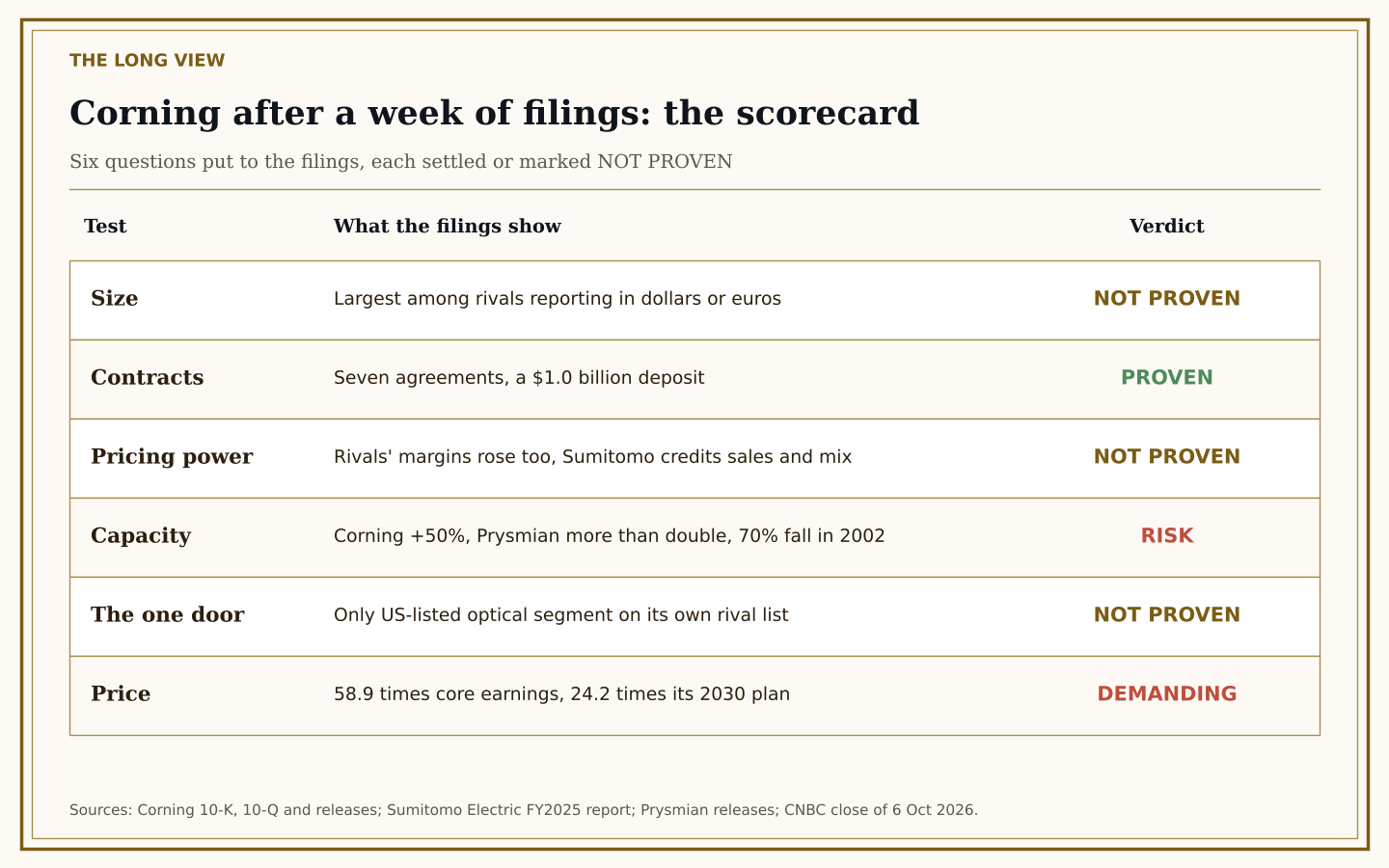
The week put six questions to the filings. Here is where each one landed.
Size. NOT PROVEN. No rival on Corning’s 10-K list that reports in dollars or euros has a larger optical business. Sumitomo reports in yen on a different profit measure, and I did not read Fujikura’s results, so “largest” against all four stays unproven. Corning’s 10-K claims cost advantages relative to several competitors, not the top spot.
Contracts. PROVEN. Corning has announced seven agreements since 23 September 2025. One buyer has already put $1.0 billion down, per the 10-Q. Meta’s figure caps out at $6 billion, and AT&T’s starts above $3 billion.
Pricing power. NOT PROVEN. Corning’s optical margin rose, and so did Sumitomo’s and Prysmian’s. Sumitomo’s report credits its info communications profit to higher sales, product mix and productivity. Price is not on its list.
Capacity. A RISK. Corning has committed to more than 50 percent more US fiber capacity, and Prysmian intends to more than double its own. After the last buildout, Corning’s 2002 annual report shows fiber and cable sales falling 70 percent that year.
The one door. NOT PROVEN. Set beside the four rivals its 10-K names, Corning alone is both listed in the US and reporting optical as its own segment. Whether its price carries a premium for that cannot be measured until the other doors are priced the same way.
Price. DEMANDING. At $168.97, Corning trades at 58.9 times its past four quarters of core earnings, and 24.2 times what its own plan says it will earn in 2030.
Google and ChatGPT: the numbers held, the words did not
Monday checked the first claims one at a time. With the week finished, the full tally shows a pattern worth more than any single claim.
Most of the numbers held. Nvidia’s $500 million, AT&T’s agreement of more than $3 billion, Verizon’s 80 million fiber miles and Amazon’s agreement each match a Corning release or filing. ChatGPT’s figures held on every claim I checked, from Corning’s second-quarter growth to the $2 billion Nvidia investment in Lumentum, which Lumentum’s own 8-K exhibit of 2 March 2026 confirms.
The errors sat in the words around the numbers. Google dropped “up to” from Meta’s agreement. It said Contour packs double the fiber, where Corning’s release says significantly more. It said Nvidia’s partnership prompted Corning to expand its US optical manufacturing capacity tenfold. Corning and Nvidia’s release of 6 May 2026 commits to tenfold for connectivity and more than 50 percent for fiber. And it set the word monopoly beside a 19.5 percent market share that none of the Corning filings I read contains.
The numbers in Google’s answer mostly held. The words around them did not.
Two gaps no wording could fix. Neither answer named Fujikura or Sumitomo, two of the four rivals Corning’s 10-K lists. And neither put a price on Corning. Google’s answers I saved never raised price. ChatGPT closed by saying the question of which was the better business at today’s valuation still needed investigating. That was the question this week most needed answered, and both left it open.
The money behind the buildout, then and now
I worked inside the last buildout. Around 2000 I was installing ATM switches on fiber, and watching businesses move from token ring to Ethernet, with fiber running to switches in building closets. So the comparison I most wanted was between that spending and today’s.
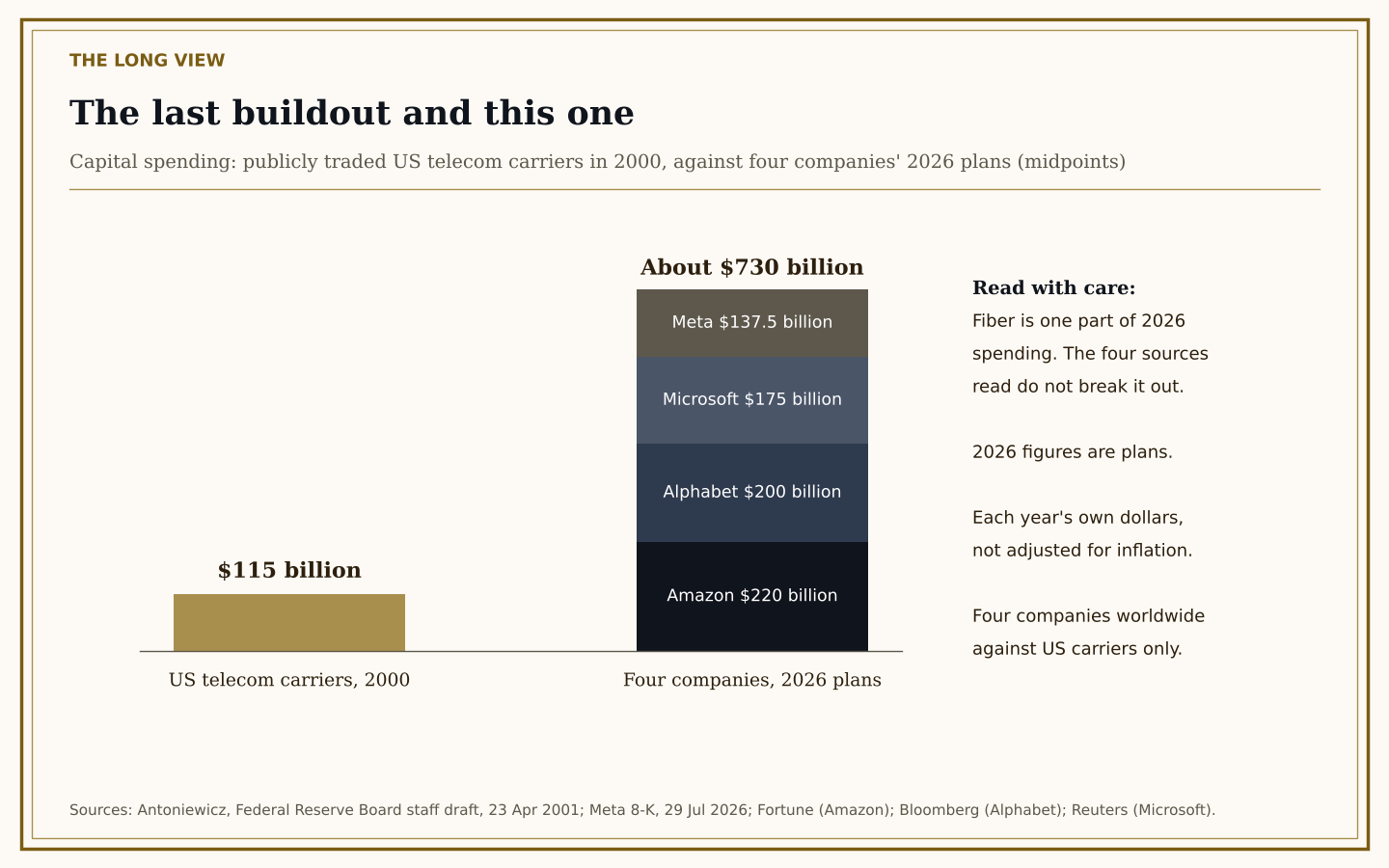
A Federal Reserve Board staff paper by Rochelle Antoniewicz, a draft dated 23 April 2001, puts 2000 capital spending by publicly traded US telecom service providers at $82 billion for investment-grade firms and around $33 billion for speculative-grade firms. That is about $115 billion together.
Now today’s plans. Meta’s results release of 29 July 2026 anticipates 2026 capital spending of $130 billion to $145 billion. Amanda Gerut of Fortune reported on 30 July 2026 that Amazon expects $220 billion. Davey Alba and Julia Love of Bloomberg reported on 23 July 2026 that Alphabet raised its range to $195 billion to $205 billion. Reuters reported on 31 July 2026 that Microsoft expects $175 billion for calendar 2026, below its earlier $190 billion, partly because of a change in lease accounting.
At the midpoints, those four plans add up to about $730 billion, more than six times what those carriers spent in 2000.
Three caveats travel with that comparison. Fiber is one part of today’s spending: Meta’s release names servers, data centers and network infrastructure, and none of the four sources I read breaks out the fiber slice. The 2026 figures are plans. And four companies spending worldwide stand against one industry of US carriers, in each year’s own dollars.
With those caveats, the direction holds. This buildout is being funded at several times the scale of the last one. That supports the demand side of Corning’s story. It says nothing about the price of its shares.
Where the documents stopped me
A week that only shows the tests that worked is an advertisement. So here is every place an answer could not be found, and whose wall it was.
Corning’s wall: its filings count fiber sold in dollars. I found no count in miles, so Corning’s fiber output is NOT PROVEN. The 19.5 percent share was in none of them either.
Sumitomo’s wall: its segment profit is in yen and counted before tax. Corning’s is in dollars and after tax. Lining them up needs a dated exchange rate and one profit measure.
Amphenol’s wall: none of the three segments in its quarterly filing is fiber, so Amphenol’s fiber sales stay NOT PROVEN.
The spenders’ wall: Meta’s release and the three news reports I read do not separate fiber from servers and buildings.
My own wall: I did not read Fujikura’s results, so it is the one named rival that never testified. And Amazon’s, Alphabet’s and Microsoft’s figures came from reporters, not from the companies’ own documents. Next week opens those documents first.
On my tally, Corning gave a shareholder the most to work with: a separate optical segment, a dated growth plan, quarterly guidance, and the deposit in its 10-Q. A company that discloses more is easier to test. It is not cheaper because of it.
What Buffett’s yardstick says about the price
Buffett has long described buying a stock as buying a share of a business and what it earns. The first question that sets up, before any forecast, is what today’s earnings are worth on their own.
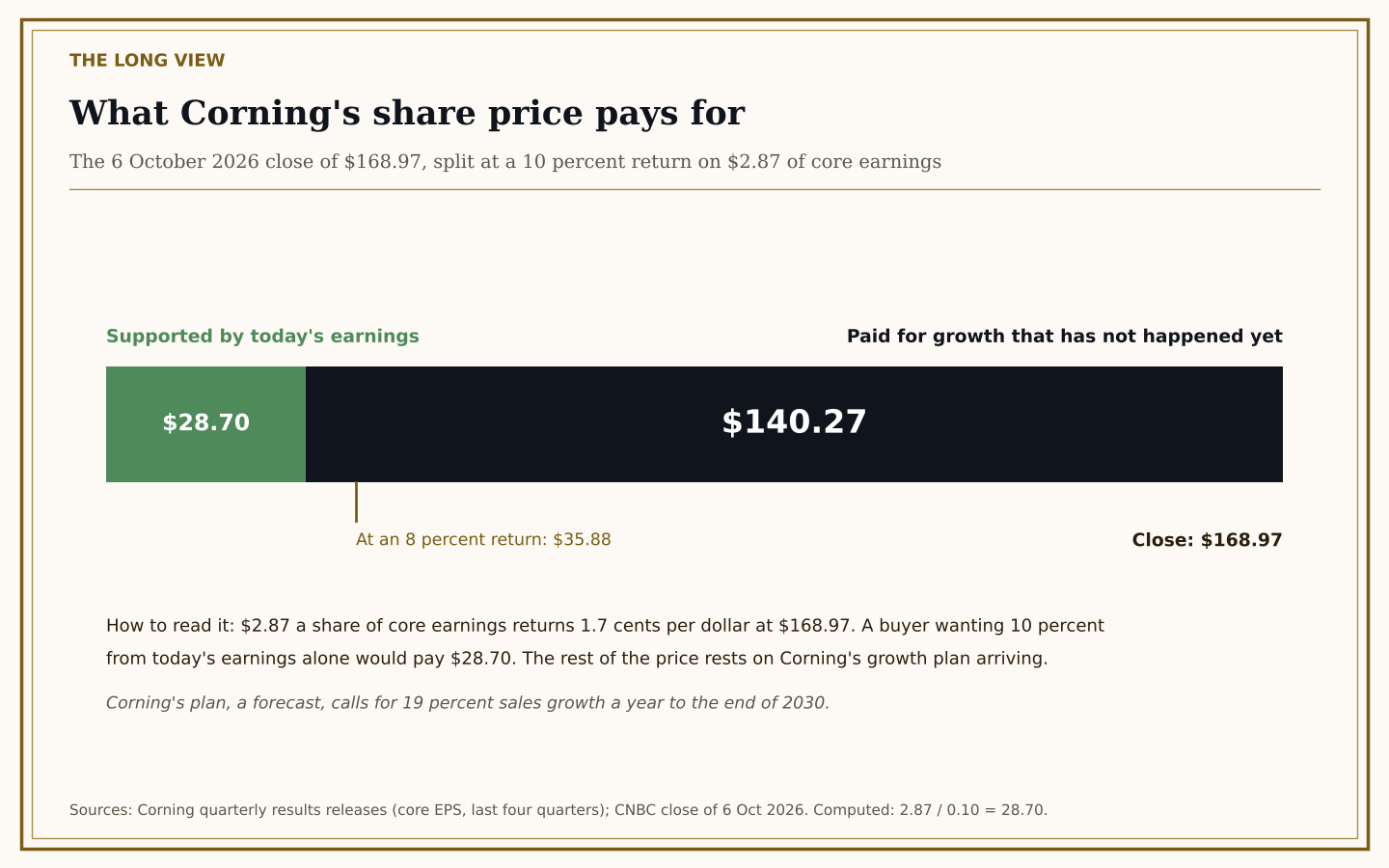
Over its last four quarters, Corning’s core earnings came to $2.87 a share. At $168.97, that returns 1.7 cents per dollar before any growth. A buyer who wanted 10 percent from those earnings alone would pay about $28.70. A buyer who wanted 8 percent would pay about $35.88. On free cash flow the figures are lower still.
At a 10 percent return, about $140 of Corning’s $168.97 share price pays for growth that has not happened yet.
That is not a verdict that the growth will fail. Corning’s plan has sales rising 19 percent a year to the end of 2030, and its second-quarter core earnings grew 30 percent. It is a measure of how much of the price rests on the plan. Thursday’s piece asked how much room for error you would want at this price. My own answer is more room than this price leaves.
What Lynch’s yardstick says, and what kind of company Corning is
Peter Lynch, in One Up on Wall Street, sorted companies into six kinds before judging any of them. Two matter here. A fast grower expands its earnings quickly for years. A cyclical is a company whose sales rise and fall with its industry’s cycle.
Read against his categories, Corning’s documents describe both. Its 2026 plan describes a fast grower. Its 2002 annual report, with fiber and cable sales that fell by 70 percent, describes a cyclical. The price pays for the fast grower. That is my reading, and it is the one tension in this company that no single filing resolves.
For fast growers, Lynch compared a stock’s price-to-earnings ratio with its growth rate. He treated a ratio equal to the growth rate as fair, and one twice the growth rate as a warning. At 58.9 times core earnings, Corning’s ratio is about 3.1 times its 19 percent plan and about 2.0 times its recent 30 percent pace. The plan’s 19 percent is for sales, and Corning expects earnings to grow faster, which would lower the first figure. Neither figure is near 1.
Five thousand dollars, and the verdict
The conviction test puts real money on the question. Five thousand dollars at $168.97 buys 29.59 shares. With the dividend held at $0.28 a quarter, what does Corning have to reach by 6 October 2031?
For a 30 percent gain in total, about $214. If the plan’s 19 percent pace ran one year past the end of the plan, that would be about 26 times 2031 earnings. So even a modest gain needs the plan delivered and the market still paying a high multiple five years from now.
For 30 percent a year, about $622, or about 75 times those same earnings. That needs Corning to command a higher multiple in 2031 than the 58.9 it carries today, after five years of plan growth.
Corning looks like a strong business that is a long way from the Buffett and Lynch playbook at today’s price. It belongs on the watch list.
That is a classification, not a recommendation. A lower price, or earnings that outrun the plan, would move it.
The roads beyond Corning, and how they will be judged
Following the fiber from where it is made to where it earns money gives next week its five stops.
Amphenol (NYSE: APH) makes the connectivity around the fiber, and its 29 July 2026 release puts expected CommScope sales this year near $4.6 billion. Lumentum (Nasdaq: LITE) makes laser components that create the light, with $2 billion of Nvidia’s money behind it. Coherent (NYSE: COHR) was the third company ChatGPT said it would put in a comparison, and its own filings come first when its day arrives. Dycom (NYSE: DY) installs and repairs fiber, and Google’s AI called it the largest restoration provider in North America, a claim Dycom’s own filings will have to carry. Lumen (NYSE: LUMN) owns networks already in the ground. Reuters reported that AT&T agreed to buy Lumen’s consumer fiber business for $5.75 billion, so the first question for Lumen is what it still owns.
Each gets the same five thousand dollars and one of three classifications. Deserves serious review: the price leaves a margin of safety, or growth is cheap against the multiple. Keep on watch: the business may be strong, but the price is a long way from the playbook, which is where Corning sits. NOT PROVEN: the filings do not give enough to run the tests fairly. None of the three is a buy or a sell.
The part of the buildout I could not count
In 2000 I watched ordinary businesses rewire their own buildings with fiber, switch by switch. Today the headlines count the hyperscalers’ billions. That leaves a question this week could not answer: is there a part of the AI buildout that is not being counted, in companies getting their own networks ready for AI?
The 2000 record shows why the question is worth asking. A Federal Reserve Bank of Richmond study of that boom found investment in communications equipment grew from about $62 billion a year in the first quarter of 1996 to over $135 billion a year in the fourth quarter of 2000, in 1996 dollars. The study sources that series to the Bureau of Economic Analysis and measures it against all private investment, so it reaches beyond the carriers.
Next week goes looking. Amphenol’s building connectivity, Dycom’s customers, and five companies drawn at random from the S&P 500 will show whether ordinary businesses are spending on their networks, and whether their filings say so. If none of them does, that is part of the answer.
The hidden assumption, clause by clause
The hidden assumption this week was that Corning’s size, contracts and technology turn into AI fiber revenue at margins its competitors cannot match, at a price that has not already paid for all of it.
An assumption with four clauses is only as strong as its weakest one. The contracts clause held. The size clause held against every rival I could measure. The margin clause, the one that would make Corning special rather than busy, is the one no filing I read could settle. And the price clause runs the wrong way: at 24.2 times the earnings Corning plans for 2030, much of that plan is already in the price.
Google’s AI was right that Corning matters to AI fiber. It could not tell me what Corning is worth, or what I would be paying for it. Those answers came from asking the filings a better question.
That is the idea behind my book, AI Won’t Make You a Better Investor: But the right question will. It is on Amazon at https://a.co/d/0fQzCk4V.
The question to carry into next week: of Lumen, Amphenol, Lumentum, Coherent and Dycom, which do you expect to come closest to the Buffett and Lynch playbook at today’s price?
Not investment advice. The subscriber decides.