

I asked Google’s AI a deliberately leading question: who is providing all the fiber for the AI buildout. It named Corning Incorporated (NYSE: GLW) and called it “The Monopoly King,” the ultimate gatekeeper of the AI fiber wave. ChatGPT also put Corning first. Over five days I am going to test those answers against the documents Corning and its competitors file, starting with a question neither one answered from a filing: who does Corning compete with?
Disclosure: the author holds no position in GLW.
I asked it that way on purpose. I wanted to see whether an AI asked for a leader would hand me one. It did. I then asked who trains, installs and repairs the most fiber, and got a leader for each job: Corning for training, AFL for installation, Dycom for repairs, each described as the largest or the absolute largest.
Three questions shaped like rankings produced three rankings. That is where the filings come in.
Why fiber, from someone who has installed it
I have worked in technology for 35 years. For part of that I was a network engineer, and around 2000 I worked on large Y2K projects, installing ATM switches that ran on a great deal of fiber.
When I started researching AI hardware, the racks and the equipment inside them, I kept coming back to fiber. I have not seen a technology that replaces what it does, though something may come along, and I will say so if it does. AI agents pass more and more data between machines, and in my experience that data travels over glass.
The 2000 buildout taught me one thing that matters more than the technology.
In 2000 the fiber was the right technology. The question was who got paid for it, and at what price.
That question is still open, and this week tries to answer it for Corning.
The internet hierarchy
I call it the internet hierarchy. Ask the internet who the best company in a field is and you get a ranking with one name on top. In my experience, that name is usually the one that gets talked about most.
The company on top is often a good business. A good business can still be the wrong purchase, because the internet and a value investor are asking different questions.
The internet hierarchy tells you which company is best. A value investor asks which company is worth owning at the price.
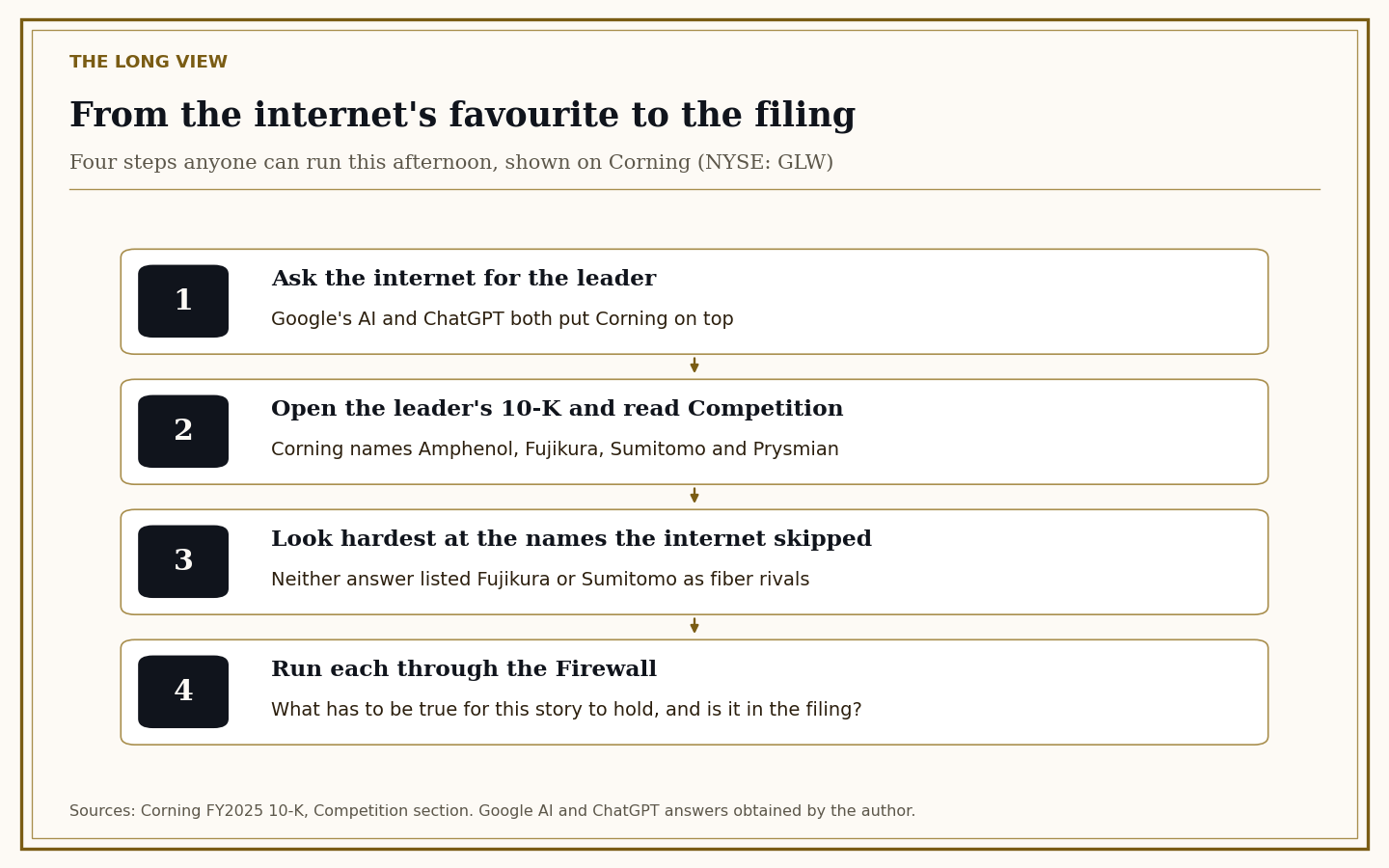
I use the hierarchy as a starting point. I take the leader it names, open that company’s annual report, find the companies it says it competes with, and look hardest at the ones the internet skipped. That is how I found Dynatrace, by going past the name the internet put on top in that field, Datadog.
What Google and ChatGPT said
Google’s answer opened with the crown and a number: Corning, it said, holds “roughly 19.5%” of the global market.
Those two claims do not fit together. A company with about a fifth of a market is not a monopoly, by the answer’s own figure. I did not find the 19.5 percent in any Corning filing I read, so it is NOT PROVEN.
ChatGPT restated my question as which publicly traded fiber or optics company is best positioned to benefit structurally from the AI buildout. Its answer was hedged. Corning was its current pick, and it ranked Corning beside Lumentum, Coherent and Broadcom, companies that make lasers, transceivers and switching chips.
The two answers describe two different industries. Google’s question was about who supplies the glass. ChatGPT’s was about who benefits from moving light through it. Each answered the question it was given.
What they got right, and what they stretched
Start with what they got right. Amazon did sign a multiyear, multibillion-dollar agreement for Corning’s fiber, cable and connectivity, according to Corning’s results release for the second quarter of 2026. ChatGPT’s growth figures for that quarter match the release: optical sales up 32 percent, the enterprise networks business up 65 percent. And Google was right that Nvidia put $500 million into Corning. The money appears as proceeds from warrants in Corning’s second-quarter cash flow statement, and Corning’s Form 8-K dated 6 May 2026 names Nvidia as the buyer of those warrants.
Other claims went further than the documents. Google called Meta’s agreement a $6 billion deal. Corning’s release calls it up to $6 billion, which is a ceiling, not a sum. Google said Corning’s Contour cable packs double the fiber strands into the same diameter. Corning’s release of 8 September 2026 with Verizon says the cable lets Verizon deploy significantly more fiber within its conduit. It does not say double.
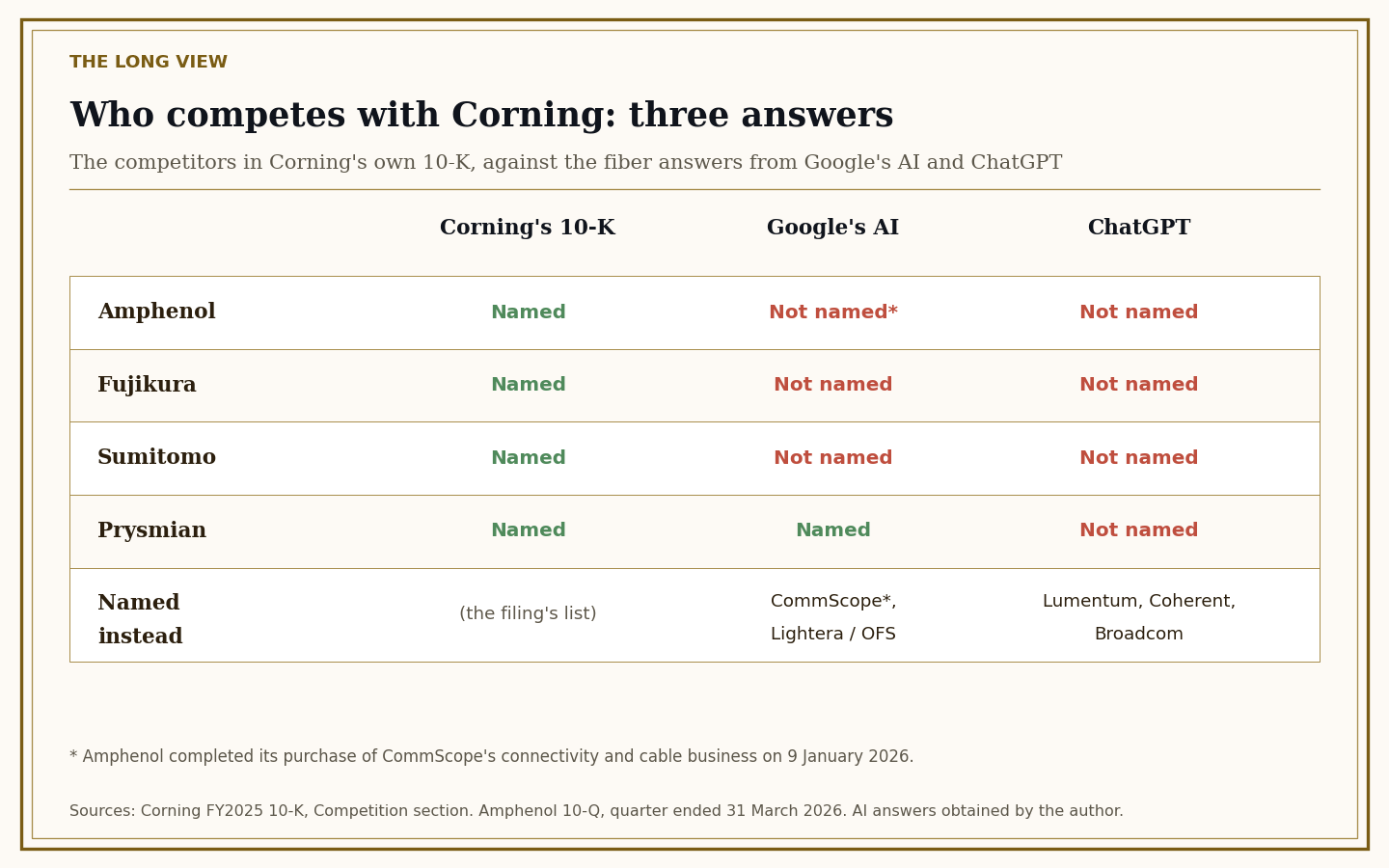
Google also listed CommScope as a fiber supplier. Amphenol’s Form 10-Q for the quarter ended 31 March 2026 says Amphenol completed its purchase of CommScope’s connectivity and cable business on 9 January 2026.
The list neither one used
Corning’s annual report on Form 10-K for the fiscal year ended 31 December 2025 has a section on competition. It names Corning’s principal competitors in optical communications: Amphenol, Fujikura and its subsidiary America Fujikura Ltd., Sumitomo, and Prysmian.
Google’s answer named one of those four as a fiber supplier, Prysmian. ChatGPT’s named none of them. Neither answer listed Fujikura or Sumitomo as a fiber competitor. Google mentioned Fujikura only in a later answer, as the owner of the installer AFL.
In the passage I read, Corning does not claim the top spot. It says its manufacturing scale, fiber process, technology and intellectual property give it cost advantages relative to several of its competitors. Several is a smaller word than monopoly.
The AI tells you who gets talked about. The 10-K tells you who the company says it competes with.
One door
Next I looked up where each of those four trades.
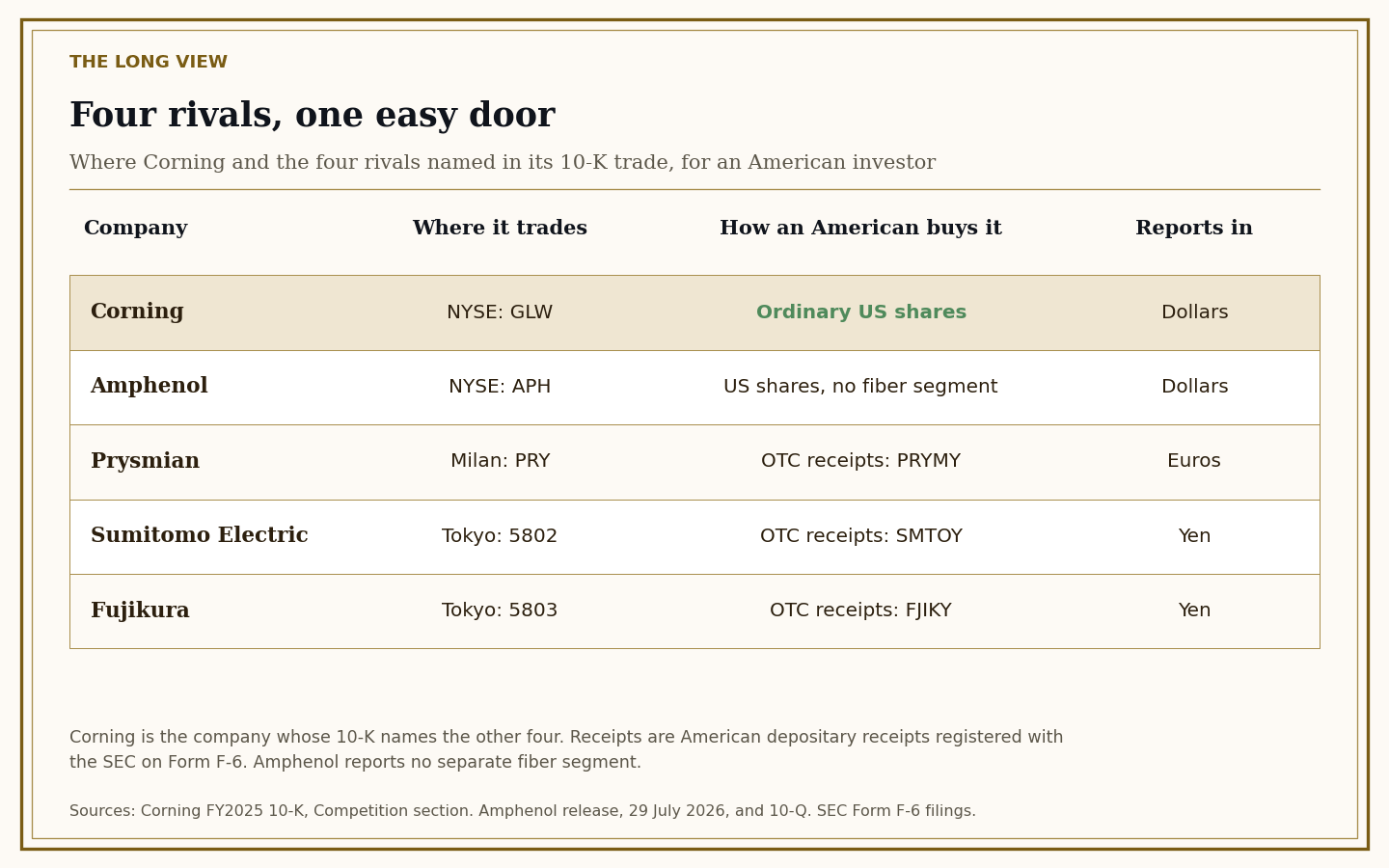
Amphenol (NYSE: APH) is listed in New York. Prysmian trades in Milan under PRY, Sumitomo Electric in Tokyo under 5802 and Fujikura in Tokyo under 5803. In the SEC filings and market listings I searched, none of those three is listed on a US stock exchange. Each has American depositary receipts, issued by US banks and registered with the SEC on Form F-6. They trade over the counter: Sumitomo’s as SMTOY, Prysmian’s as PRYMY and Fujikura’s as FJIKY.
Amphenol is easy to buy, but it does not report fiber as a segment. Its Form 10-Q splits the company into Communications Solutions, Harsh Environment Solutions, and Interconnect and Sensor Systems, with $16.38 billion of sales across them in the first half of 2026. Its results release of 29 July 2026 says it expects the CommScope connectivity and cable unit to sell about $4.6 billion this year. I did not find a separate fiber sales figure in the release or the 10-Q, so how much of Amphenol is fiber is NOT PROVEN.
Among Corning and the four rivals its 10-K names, Corning is the only one that trades on a US exchange and reports optical communications as a segment of its own, and its largest. Smaller US-listed fiber companies exist outside that list. This week stays with the list Corning wrote.
When there is only one door, everyone walks through it, and the door gets expensive.
That line is my reasoning, not a finding. Thursday tests it against the price.
Corning, on its own terms
Corning’s results release for the quarter ended 30 June 2026 reports Optical Communications sales of $2.07 billion, against $1.57 billion a year earlier, an increase of 32 percent. The segment’s net income was $438 million, against $247 million.
Optical is the largest part of the company. Corning’s five segments together reported $4.74 billion of sales in the quarter, and optical was 43.7 percent of that.
Corning reports its segments using its currency hedge rates, so the five segments add up to its $4.74 billion of core sales rather than the $4.51 billion reported under standard accounting. Every segment figure in this piece is on that basis.
The rivals are witnesses, not picks
You do not have to own a company to learn from its filings. Corning’s rivals report on the same market it sells into.
Sumitomo Electric’s annual report for the fiscal year ended 31 March 2026 says operating profit in its infocommunications segment rose by ¥57.5 billion to ¥77.4 billion, on data center demand. That is close to four times the prior year’s ¥19.9 billion. Corning is not the only company reporting that demand.
Prysmian’s results release for the six months to 30 June 2026 reports second-quarter Digital Solutions sales of €540 million, against €387 million a year earlier, in a segment Prysmian defines more broadly than fiber. That is growth of about 40 percent, faster than Corning’s 32. I have not yet read Fujikura’s own annual results summary, so its figures stay out.
Among the rivals that report in dollars or euros, Corning’s optical segment is the largest. Sumitomo reports in yen and before tax, where Corning reports segment profit after tax, so the two cannot be lined up without a dated exchange rate and the same measure. Against all four, “largest” is NOT PROVEN. On Wednesday these filings testify on a more useful question: who holds the pricing power.
The hidden assumption, and the rest of the week
An investment story rests on something that has to be true. I built the Stock Story Firewall to name that thing before anything else gets tested. For Corning, the hidden assumption is this: Corning’s size, contracts and technology turn into AI fiber revenue at margins its competitors cannot match, at a price that has not already paid for all of it.
The week tests that in order. Tuesday reads the contracts, and what “up to” means. Wednesday calls the rivals as witnesses on pricing power and capacity, and looks for what happened to fiber suppliers after the last buildout. Thursday sets the price against what the business has delivered, and asks whether Corning carries a premium for being the only door. Friday scores all of it and follows the road to companies an American investor can own that deserve a week of their own.
The week will not tell you to buy or sell anything, and it will not value Corning’s rivals. Where a document does not answer a question, the answer is NOT PROVEN, which is a verdict, not a gap.
Tomorrow
Today was about who competes. Size is not commitment, and an answer that drops two words from a contract turns a ceiling into a fact. Tomorrow reads the agreements Corning has announced and asks what each one obliges anyone to buy.
Run Corning, or any company you are weighing, through the free Stock Story Firewall at firewall.readthelongview.com before then.
Not investment advice. The subscriber decides.