


Power margins expanded again. The number that would prove the durability is the one GE Vernova will not put a figure on.
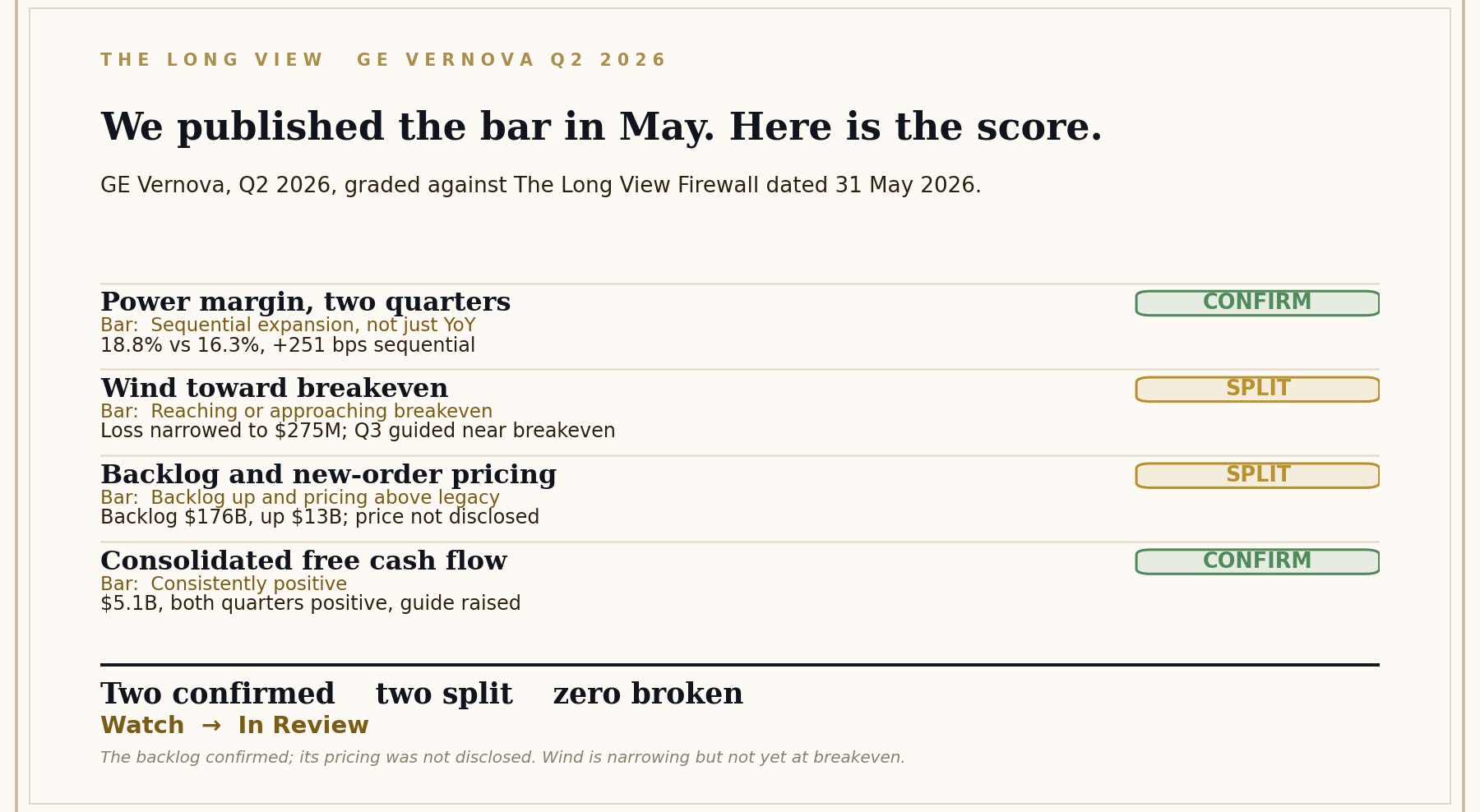
Before GE Vernova reported, we ran it through the Stock Story Firewall on May 31 and published the result. This is the grade, against the bar the tool set, not a softer one written after the numbers arrived.
We did not have to remember this print was coming
The Watch Card carried the date, surfacing GE Vernova with its tests pending and earnings due July 22. The calendar lives in the tool, not in your head.
What the tool told us in May
We fed GE Vernova into the Firewall, and it returned this. Worth seeing the machine work, because the assumption it named is the whole grade.
The hidden assumption it surfaced: that GE Vernova’s gas turbine backlog is already converting into durable, expanding margins, and that last quarter’s improvement was a structural shift rather than a temporary mix or pricing tailwind.
The framework it prescribed: Unit Economics Durability. Not a growth screen. The tool recognized that the entire valuation premium rests on whether the improving margins are repeatable at scale, rather than a function of favorable backlog timing or one strong quarter of deliveries.
The classification it assigned: Watch. Margin movement was visible, so the assumption was testable now rather than a future promise, but it had not yet proven durable. The tool was specific about what proving it looked like, and we published all four conditions.
The bet, in one number
GE Vernova trades near 135 times earnings. That figure is not a verdict that the stock is expensive. It is a prediction, that earnings multiply from here as a $44 billion gas turbine backlog converts into profit. So the question was never whether GE Vernova has demand. It plainly does. The question is whether backlog size and backlog profitability are the same thing. Everything below tests that one seam.
Test 1: Power margins expanding sequentially, across two quarters
Published bar: gas turbine margins expanding sequentially across at least two consecutive quarters, not just year over year on easy comparisons. We set it that way on purpose, because a year-over-year jump can be a soft prior quarter, while two quarters of sequential gains is a trend.
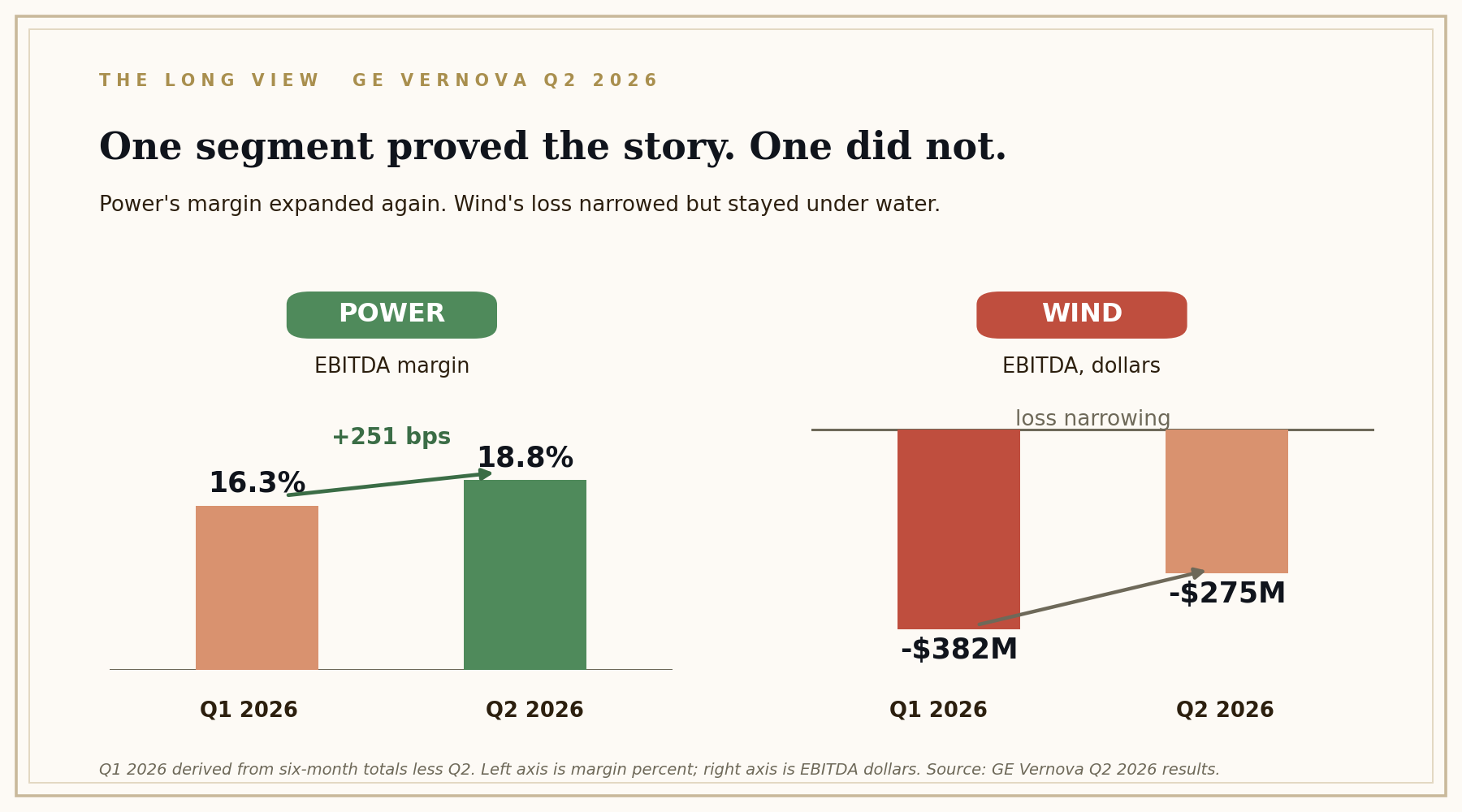
The number: Power segment EBITDA margin was 18.8% in Q2, against 16.3% the prior quarter, a gain of roughly 251 basis points sequentially, and up about 320 basis points organically year over year. The filing attributes it to higher volume and favorable price at Gas Power. **Confirms.
The cleanest result in the report, and the heart of the bull case: margin moving the right way, at scale, two quarters running.
Test 2: Wind reaching or approaching breakeven
Published bar: the Wind segment reaching or approaching breakeven, proof the legacy loss-maker is being restructured rather than subsidized. It breaks if Wind keeps losing money with no breakeven timeline disclosed.
The number: Wind lost $275 million in segment EBITDA this quarter. Sequentially that is an improvement, the loss narrowed from $382 million in Q1. Management guided Q3 Wind to approximately breakeven. But year over year the loss widened, from $165 million in the same quarter last year. **Split.
Here is what keeps it from a clean confirm, and it is arithmetic, not opinion. The first half lost $657 million against full-year guidance of roughly $400 million. For both to hold, the second half must produce positive EBITDA of about $257 million, a swing of more than $900 million. Management expects that turn. The print has not shown it. Approaching breakeven is the direction, not the arrival.
Test 3: Backlog growing in dollars and duration, priced above the legacy book
Published bar: orders backlog growing in dollar value and extending in duration, with pricing on new orders visibly above the legacy book. It breaks if units grow but average selling price is flat or falling, which would mean customers are locking in old prices ahead of increases.
The result: the backlog half confirms, decisively. Total backlog reached $176 billion, up $13 billion in a single quarter. Gas equipment under contract went from 100 to 116 gigawatts, with at least 125 anticipated by year end. The pricing half cannot be graded. **Split.
GE Vernova discloses no average selling price. What it offers is language, favorable price at Gas Power, disciplined underwriting, corroborated indirectly by the margin expansion in Test 1. But the specific thing our bar asked for, new-order pricing above the legacy book as a number, is not in the filing. We do not score a test the company would not let us see. The backlog is proven. The pricing is asserted.
Test 4: Consolidated free cash flow, consistently positive
Published bar: free cash flow turning consistently positive at the consolidated level, confirming earnings are not being consumed by working capital or warranty reserves.
The number: free cash flow was $5,107 million in Q2, positive in both quarters of 2026, against $194 million in the year-ago quarter. Full-year guidance was raised to $11.5 to $12.5 billion, from $6.5 to $7.5 billion. Confirms.
One note on quality. That $5.1 billion is roughly four times the quarter’s adjusted EBITDA, and the gap is customer down payments, cash collected now for equipment that ships later. A healthy feature of an order boom, but cash for work not yet performed, so it flatters the conversion rate. The cash confirms. The multiple does not repeat.
The tally: two confirmed, two split, zero broken
The two things that would prove the machine is working, margin and cash, both confirmed. The two things that would prove the machine is durable, Wind economics and new-order pricing, both came back half-answered. That is a fair description of where GE Vernova is: converting, provably, on the parts it discloses, and asking you to trust it on the parts it does not.
The number that would settle it
The whole bet turns on whether a full backlog is a profitable backlog, and GE Vernova handed us the cleanest illustration of the gap. Wind demand is at an all-time high. Wind is guided to lose $400 million this year. Those two facts sit in the same release, and together they are the thesis in miniature: strong demand does not fix contracts signed at prices that do not cover current cost. A backlog tells you what you will build, not what you will earn building it.
That is why new-order pricing was on our published list. The margin expansion in Power says pricing is probably improving. The refusal to quantify it says you are not yet allowed to check.
The state change
The rest of the quarter was strong and the market sold it anyway, which tells you the expectations bar: revenue up 22%, orders up 88% organically, and a cash balance of $13.1 billion, but adjusted EBITDA margin of 11.3% came in light, so a revenue beat met a lower stock. This is a company executing, priced for perfection, and docked for anything short of it.
In the May report we classified GE Vernova Watch, meaning the margin story was testable but unproven. The print moves it forward.
GE Vernova advances to In Review. Two tests confirmed, the two that matter most for near-term cash. It does not reach Clear for Deeper Research, because the two split tests are the ones that speak to durability, and durability is the entire premium. A company can execute beautifully and still be priced beyond what the disclosed evidence supports. Only the first of those was answered this quarter.
Where it sits now: earning the story, not yet the multiple
At roughly 135 times earnings, GE Vernova is priced as though the backlog is already durable margin. This quarter proved the backlog converts to margin and cash today. It did not prove that margin is durable, because the two facts that would show it, real Wind breakeven and new-order pricing above the legacy book, are one unproven and one undisclosed. The execution is real. The valuation is a claim about years not yet reported.
One thing we did not grade, and why
Our published break conditions included rising warranty or field-service costs on legacy wind turbines, the kind of hidden liability that eats future cash. The Q2 release does not break that out, and we will not infer it from a segment loss with other moving parts. It stays a research item for the 10-Q, not a graded test. We note it so the record shows what we settled and what we did not.
What we watch next, and when
Q3, for the Wind turn. Management guided to approximately breakeven. Given a first half at negative $657 million against a full-year guide of negative $400 million, Q3 is where the roughly $900 million second-half swing either starts to appear or does not.
Then the 10-Q, for two lines this release withheld: any disclosed price realization on new Power orders, and warranty or field-service accruals on the legacy wind fleet. The first would let us grade the pricing limb of Test 3. The second would close the break condition we left open.
We named the assumption in May, before the margin was proven durable. The Watch Card flagged the date so we did not have to. The Evidence tool pointed at the segment tables where the answer lives, which is how we know precisely which two lines the company chose not to print. GE Vernova now sits in the Tracker at In Review.
Run any company through the Stock Story Firewall, free, at firewall.readthelongview.com. Subscribers get the Evidence tool, the Watch Cards, and the full Research Tracker, including every test we have published and how each one scored.
GE Vernova proved this quarter that the backlog converts. Whether it converts at a profit is a number the company is not yet willing to show, and until it does, the price is trusting what the filing will not confirm.
Not investment advice. The subscriber decides.