

Two of five AI fiber stocks passed my price test this week: Amphenol (NYSE: APH) and Dycom (NYSE: DY). Lumen, Lumentum and Coherent did not. Today I close out everything this week promised, then answer the only question that matters to a buyer. If you put five thousand dollars into each of these companies at the 12 October close, what would that company have to do for you to make money?
Disclosure: the author holds no position in LUMN, DY, APH, LITE or COHR.
The five: Lumen (Nasdaq: LUMN) owns long-haul fiber. Dycom builds and repairs fiber networks. Amphenol makes the plugs and cable inside data center racks. Lumentum (Nasdaq: LITE) and Coherent (NYSE: COHR) turn electrical signals into light. Prices are the 12 October 2026 closes, per CNBC.
The verdict on all five
On Monday I set a bar before any company faced it. Earnings I can defend from the company’s own filings. A price that is not too high for its growth. And more cash coming in than going out last year.
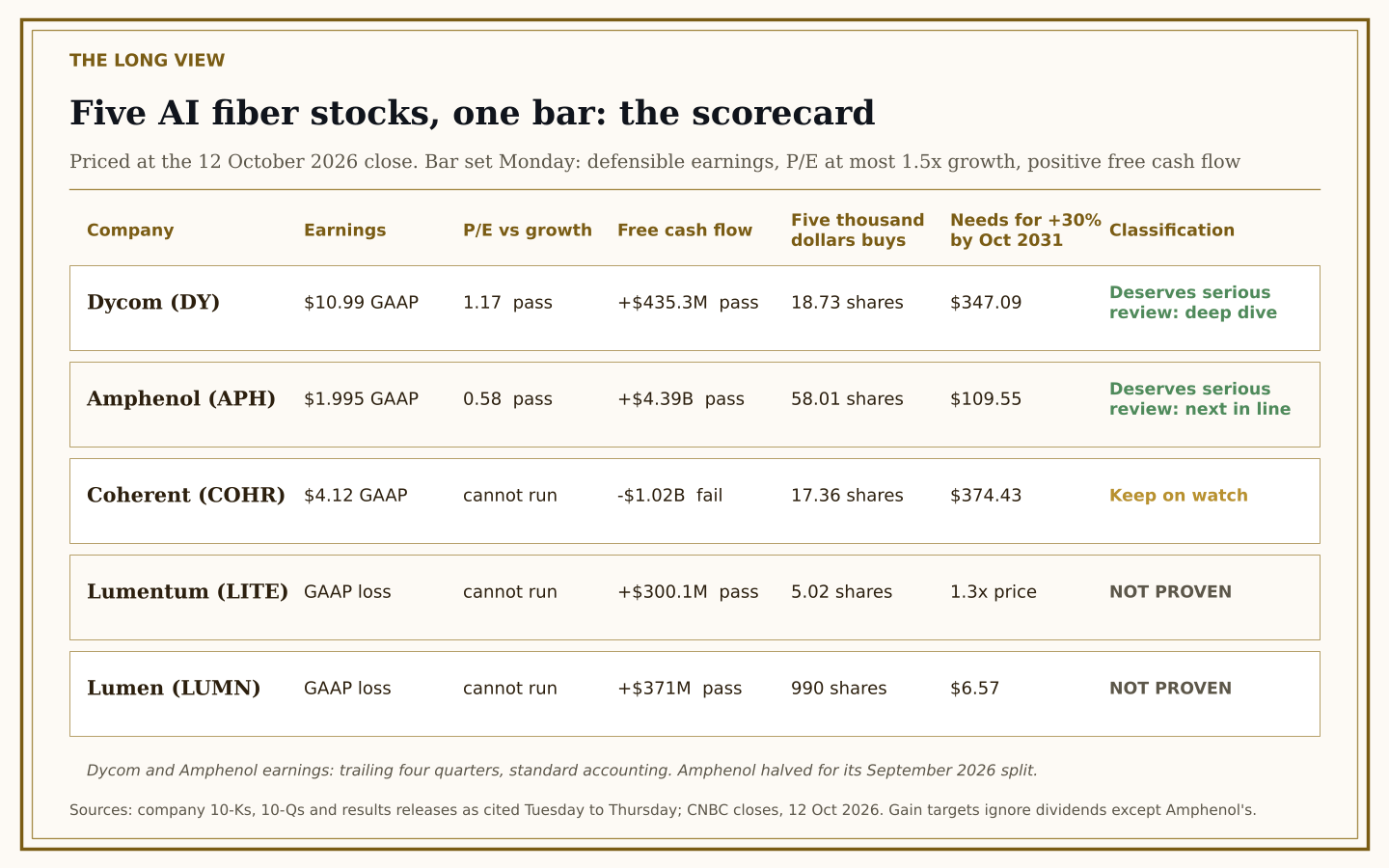
Dycom and Amphenol passed all three. Both are classed and deserves serious review.
Lumen and Lumentum reported losses, so there were no earnings to test. Both are NOT PROVEN, which means the test could not run, not that they failed. Coherent had earnings but spent $1.02 billion more cash than its operations brought in. It is keep on watch.
Thursday asked whether passing two companies meant the bar was too easy. At Peter Lynch’s stricter line, from One Up on Wall Street, Amphenol still passes and Dycom does not. And both passes need growth to stay about where it is today.
The other promises, kept
Tuesday showed what Lumen kept after selling its home fiber to AT&T: its long-haul network, its business customers and its copper. It also found that Dycom’s own 10-K calls it “a leading provider,” not the largest, whatever Google’s AI says. Thursday read Coherent’s own filings first. Monday checked the hyperscalers’ spending plans where the companies published them.
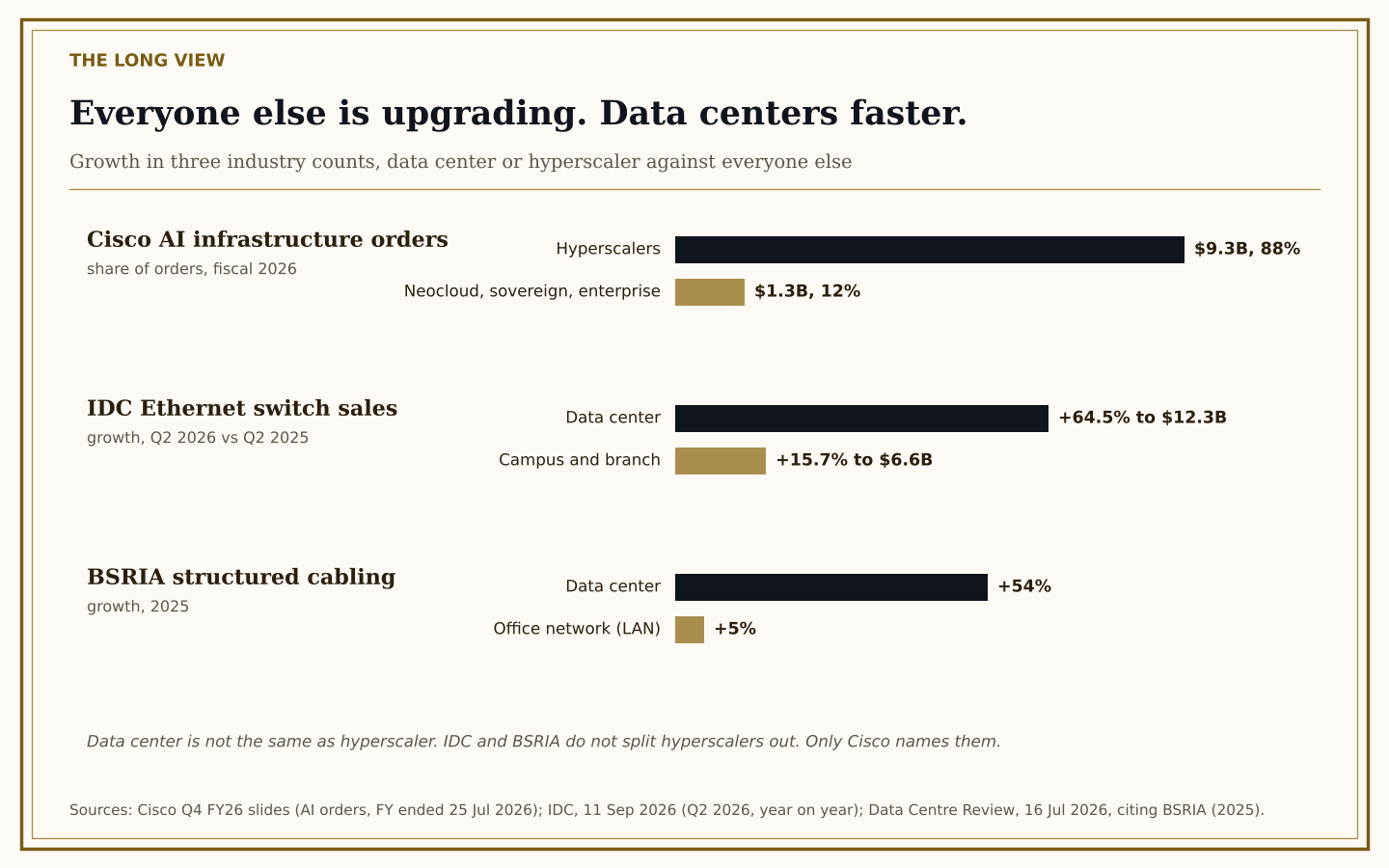
The last promise was who is paying for all this fiber. The hyperscalers, the few giant cloud companies, are the biggest and fastest-growing buyers. They are not the only ones. Most of Lumen’s revenue comes from ordinary businesses and government. Dycom’s biggest customers are phone companies. No single customer buys even 10 percent of Amphenol’s sales.
IDC counted data center switch sales up 64.5 percent in the second quarter of 2026, and office switch sales up 15.7 percent. Everyone else is upgrading. The data centers are upgrading about four times faster.
How to read what each company has to do
A stock price goes up in only two ways. The company earns more, or buyers pay more for each dollar it earns.
What buyers pay for each dollar of yearly earnings is the price-to-earnings ratio. Today it is high for all of these companies. If it comes down, earnings have to grow just to keep your money where it started.
So here is the test for each company. Five years from now, in October 2031, assume buyers pay 20 times earnings. Lynch would call that fair for a company growing 20 percent a year. That 20 is my assumption, not a forecast. Then ask: how much would earnings have to grow for your five thousand dollars to be worth five thousand dollars again? Anything above that is your profit.
Then check the company’s own record since 2015. Has it ever grown that fast for five years?
Dycom: earnings up about 21 percent
Five thousand dollars bought 18.73 shares at $266.99.
Dycom earned $10.99 a share over its last four quarters. For your money to be whole in October 2031, it needs to earn about $13.35. That is growth of about 4 percent a year. Everything above that is profit.
Its record says it can grow much faster than that. In each five-year stretch I could measure, ending in fiscal 2024, 2025 and 2026, Dycom grew earnings by 30 percent a year or more.
The catch is where those stretches started: from bad years. The last time Dycom started from a good year, in fiscal 2017, its earnings per share fell from $4.92 to $1.07 by fiscal 2021. Today it starts from its best year in the records I read. Its order book is strong: $12.24 billion of backlog at 1 August 2026, up 53.2 percent in a year. But its buyers are mostly phone companies, and AT&T alone is a quarter of its revenue.
Dycom needs the least. The risk is a downturn, not a missed growth target.
Amphenol: earnings more than double
Five thousand dollars bought 58.01 shares at $86.19.
Amphenol earned about $2.00 a share over its last four quarters, adjusted for its stock split. For your money to be whole in October 2031, it needs to earn about $4.31. That is more than double, or growth of 16.7 percent a year for five years.
Its record says that is possible but not easy. In six five-year stretches since 2015, it grew that fast twice. Over the full ten years it grew 18.7 percent a year, just above the bar.
Right now it is growing much faster. In 2025, its earnings per share jumped 74 percent. But growth without acquisitions has slowed for three quarters in a row, from 41 percent to 30 percent. No customer buys 10 percent of its sales, the widest spread of buyers of the five. Amphenol reports again on 28 October.
Amphenol has to keep growing at a pace it has hit only twice in ten years, just to give your money back.
Coherent: earnings up three and a half times
Five thousand dollars bought 17.36 shares at $288.02.
Coherent earned $4.12 a share in its last fiscal year. For your money to be whole in October 2031, it needs to earn about $14.40. That is 3.5 times as much, or growth of 28.4 percent a year for five years.
Its record has never done that. In seven five-year stretches since 2015, its best was 17.9 percent a year. It reported a loss in four of its last seven fiscal years.
Coherent also has to stop burning cash. Last year it spent heavily on factories and inventory. If those orders turn into sales, the cash comes back. Coherent guides to sales between $2.2 billion and $2.4 billion for the quarter to September 2026, up from $1.58 billion a year before. Its two biggest customers make up 32 percent of its revenue, and neither is named in the filings I read.
Lumentum: earnings up nearly six times
Five thousand dollars bought 5.02 shares at $995.41.
Lumentum reported a loss last year, almost all of it one charge on its debt. On its own adjusted figures it earned $8.67 a share. For your money to be whole in October 2031, it needs to earn about $49.77. That is 5.7 times as much, or growth of 41.8 percent a year for five years.
Its record has never done that either. It reported a loss in six of its last eleven fiscal years. Its earnings rise and fall with the industry’s cycle.
It is growing fast now. It expects $4.05 to $4.35 a share of adjusted earnings in the quarter to September 2026. If it delivers, that one quarter would equal about half of what it earned all last year. Two customers make up 41.6 percent of its revenue.
Lumen: first, a profit
Five thousand dollars bought 990 shares at $5.05.
Lumen lost money over its last four quarters. For your money to be whole at 20 times earnings in October 2031, it needs to earn about $0.25 a share each year. So the first job is simple to say and hard to do: turn a loss into a steady profit.
Its new business is growing, but its old one is shrinking faster. It owes $13.21 billion, about 2.5 times what all its shares are worth. Its chief executive bought stock this year at about $6 a share, above the $5.05 close.
Which one gets the deep dive, and your routine
Monday said only one company would earn a deep dive, the weeks of reading I do before any money moves. It goes to Dycom. It needs the least growth to give your money back, and more of its price is backed by what it earns today. At a 10 percent return, Dycom’s last year of earnings is worth about 41 percent of its share price. For Amphenol, it is 23 percent. Corning’s piece asked which of these comes closest to the Buffett and Lynch playbook. Dycom comes closest to Buffett. Amphenol comes closest to Lynch.
This is my reading, not a finding. The AI buildout is real money for these companies. What no filing can show is earnings that keep growing for a decade after it ends.
The risk is not that the AI buildout stops. The risk is that it is already in the price.
Your routine for any stock:
1. Write down the hidden assumption: what has to be true for the story to hold.
2. Find what the company earned last year, under standard accounting.
3. Work out what it must earn in five years for your money to be whole.
4. Check whether it has ever grown that fast, and from where.
5. Find out who the customers are before you believe any growth rate.
Reply with a ticker you own or are watching, and I will run it through these five steps. I read every reply.
Not investment advice. The subscriber decides.