

Fabrinet (NYSE: FN) reported no outstanding debt at 26 June 2026. Between the 9 and 16 October closes its stock fell 25.2 percent, the same as CoreWeave, which carries $35.07 billion. Bloom Energy, CrowdStrike and Corning fell too, by between 15.8 and 21.1 percent, and none of them carries debt on CoreWeave’s scale. This piece follows the fear down three routes to companies whose own books look fine, and shows the line in a 10-K that tells you which route a company sits on.
Disclosure: the author holds none of the companies named here.
The question from Tuesday
On Tuesday I asked which of four companies was hit hardest by debt that sits on someone else’s balance sheet. Fabrinet, Bloom Energy (NYSE: BE), CrowdStrike (Nasdaq: CRWD) and Corning (NYSE: GLW) all fell in the week of 12 October. Here is each one, set against its own debt and cash, from its latest filing.
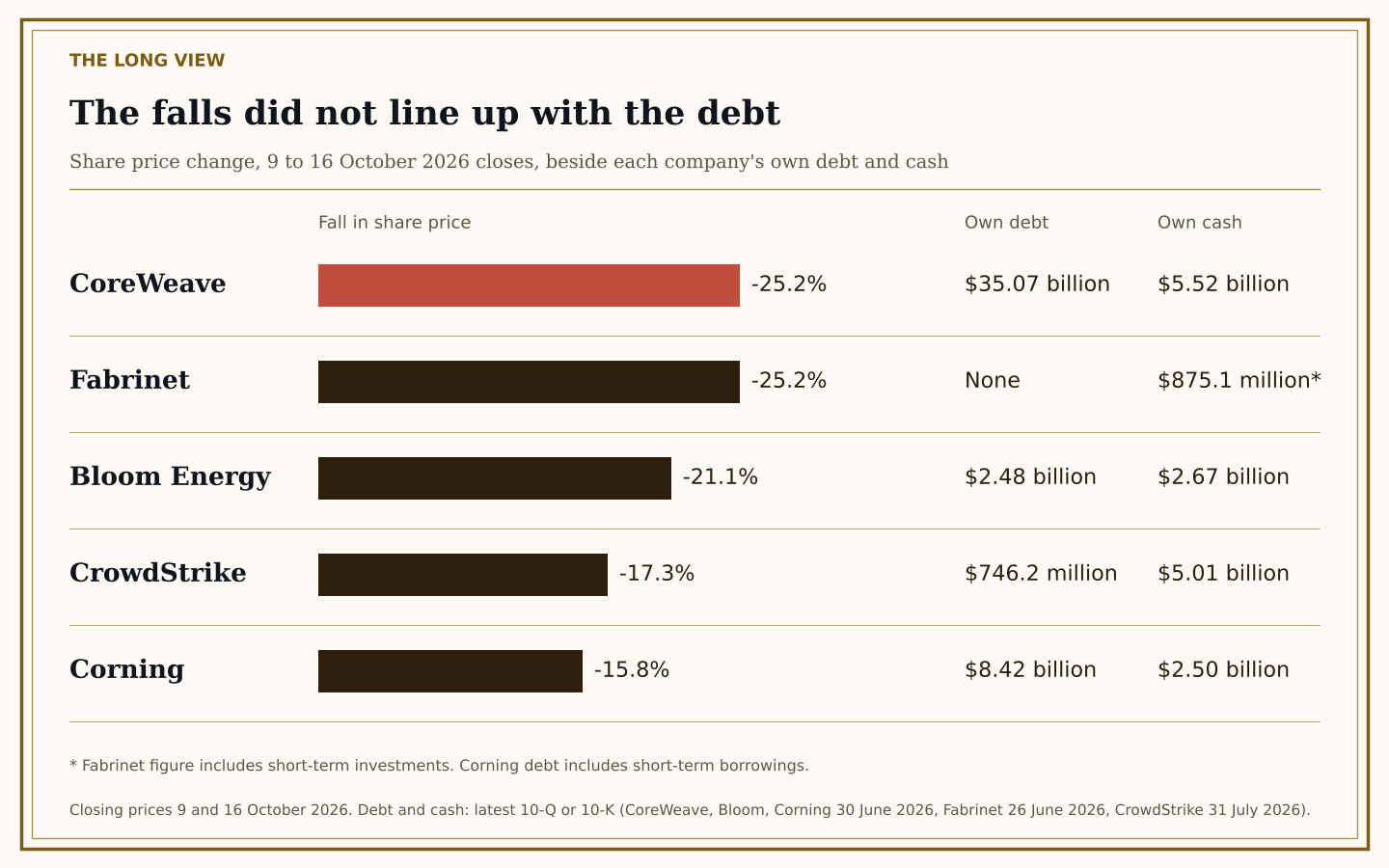
Read the graphic from top to bottom and one thing stands out. The size of each fall does not line up with the size of each company’s debt. The company with the most debt and the company with none fell the same amount. The filings show three different routes the fear took.
Route one: your revenue depends on borrowed spending
Fabrinet makes optical and precision parts for other companies. Its 10-K for the year ended 26 June 2026 lists four customers that each bought more than 10 percent of its output: Cisco at 19.9 percent, Nvidia at 16.3, Nokia at 10.7 and Amazon at 10.5. Together they made up 57.4 percent of revenue, and data center customers made up 47.9 percent.
Nvidia sells CoreWeave its chips and is a large CoreWeave shareholder, according to CNBC. Amazon runs the AWS cloud. When lenders start pricing doubt about how the AI build gets paid for, Fabrinet’s revenue sits downstream of that build.
Owing nothing protects your balance sheet. It does not protect your customers’ order books.
The filing cannot tell you why anyone sold Fabrinet. It can tell you whose spending Fabrinet’s revenue depends on. That is the answer to Tuesday’s question.
Bloom Energy: profitable, and concentrated
Bloom Energy makes fuel cells that generate electricity on site. Its 10-Q for the quarter ended 30 June 2026 shows revenue of $1.07 billion, against $401.2 million a year earlier. It earned $196.3 million, after losing $42.6 million in the same quarter of 2025. Its $2.67 billion of cash exceeds its $2.48 billion of debt.
Then the customer note. One customer made up about 44 percent of the quarter’s revenue and a second about 21 percent. The note gives percentages, not names. Two buyers produced roughly two thirds of the quarter.
Bloom sits on route one only if those two buyers are part of the AI build, and the filing does not say who they are. On that point the answer is NOT PROVEN. What the filing does show is two buyers carrying two thirds of a quarter. Its stock fell 21.1 percent between the 9 and 16 October closes.
Route two: your price assumed cheap money
CrowdStrike, the cybersecurity company, held $5.01 billion of cash against $746.2 million of long-term debt at 31 July 2026, per its 10-Q. Revenue for that quarter was $1.47 billion, up 25.8 percent. Net income was $5.3 million.
At the 16 October close of $227.39, its 1,023,934,842 shares were worth about $232.8 billion together. That price rests on profits that have mostly not arrived yet.
A high price is a bet on profits far away. When safe government bonds pay more, a profit ten years out is worth less today, whatever the company owes. My August piece called this the second route by which rising rates reach AI stocks. CrowdStrike fell 17.3 percent.
CrowdStrike also had news of its own that week, and its fall had more than one cause in the coverage I read. It carries the least weight of the four.
Route three: a borrower that earns
Corning fell from $156.68 at the 9 October close to $132.00 on 16 October, a drop of $24.68 a share, or 15.8 percent. Those were the same five days The Long View spent on Corning.
Corning does carry debt. Its 10-Q shows $7.76 billion of long-term debt and $668 million of current debt and short-term borrowings at 30 June 2026, about $8.42 billion together, against $2.50 billion of cash. That is more than Fabrinet, Bloom and CrowdStrike carry combined.
Corning carries the most debt of the four and fell the least.
It also earns. Net income for the quarter ended 30 June 2026 was $559 million. Optical communications products brought in $2.07 billion of its $4.51 billion of sales, about 46 percent. My reading is that a borrower paying its interest out of profit sits on a different route from a borrower paying it out of new loans. That is a reading, and Friday’s gauges test it.
The hidden assumption
The hidden assumption this week tests is simple: a company with a clean balance sheet sits outside a debt scare.
Fabrinet’s 25.2 percent says it does not. A company can owe nothing to lenders and still depend on customers who are spending borrowed money. A company can owe very little and still be priced on cheap money continuing.
The line in a 10-K that shows your route is the customer note. Search the filing for “accounted for” and read the percentages. If a few customers produce most of the revenue, find out how those customers are paying for what they buy.
What one week cannot tell you
Three limits again. Nothing in a filing says why any particular investor sold. Five days of prices can reverse, and a fall is not a forecast. And Corning’s numbers suggest that debt size alone did not decide who fell most. That is one week of evidence, not a rule.
What the filings do show is the order of exposure: the borrower, the companies selling to borrowers, and the companies priced for patience.
Spreading or fading
Five companies, three routes. The open question is whether this spreads or fades, and you do not need a forecast to find out. Four published numbers will show it, each on its own schedule: the price of insuring AI borrowers’ debt, investment-grade credit spreads, Treasury yields, and the spending plans of the companies building AI data centers.
Tomorrow’s notes take those four one at a time, with where each is published. Friday’s piece scores them.
Not investment advice. The subscriber decides.