

It grew ARR 17 percent, raised guidance, expanded margins, and bought back stock. And retention, the one number that mattered, ticked down to 110 percent. So the puzzle holds: excellent, cheap, and still waiting for the market to care. I have owned it since 2022, and I am going to grade it straight anyway.
Disclosure: the author has held shares of Dynatrace since 23 September 2022, at a cost of $33.21. This is a grade against a published bar, not a recommendation, and the discipline demands it be graded no more gently for being owned.
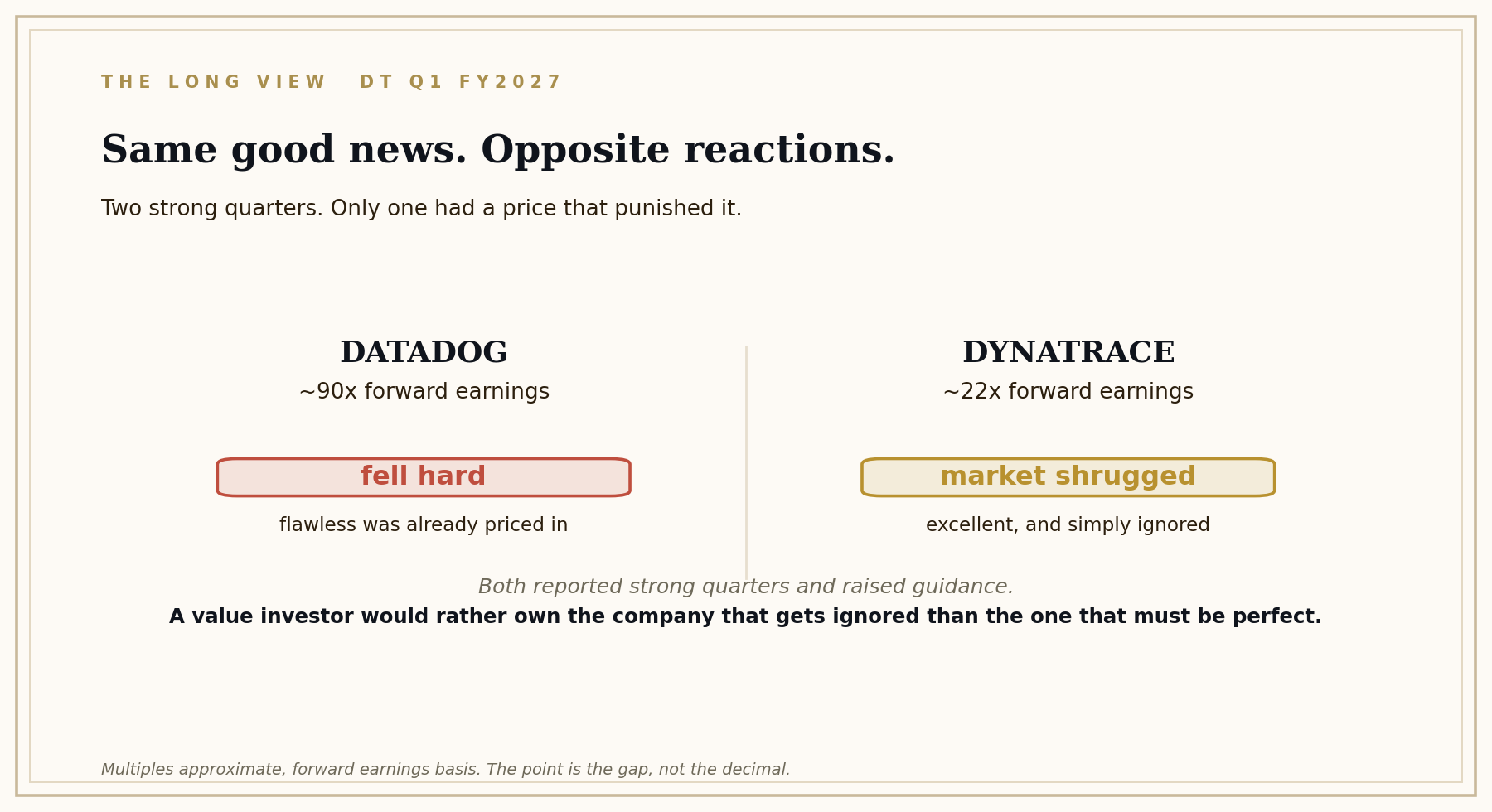
Yesterday we graded Datadog, the company that has to be perfect forever, which reported a flawless quarter and fell 17 percent. Today we grade its quieter competitor, the one I own, and the contrast is the reason this whole week exists. Before Dynatrace reported, we published a piece calling it “The Profitable Company Nobody Wants,” and we named the single thing it had to prove. This is the grade against that bar. And because I hold the stock, it gets the harder read, not the softer one.
The bar we set, before the number
Dynatrace is the mirror image of Datadog. Where Datadog is priced for perfection, Dynatrace is priced like the market has already decided the story is boring: profitable, growing in the mid-teens, and trading at a fraction of its flashier rival’s multiple. So the bar was different. Datadog had to stay flawless. Dynatrace only had to prove the business was not quietly deteriorating underneath a cheap price.
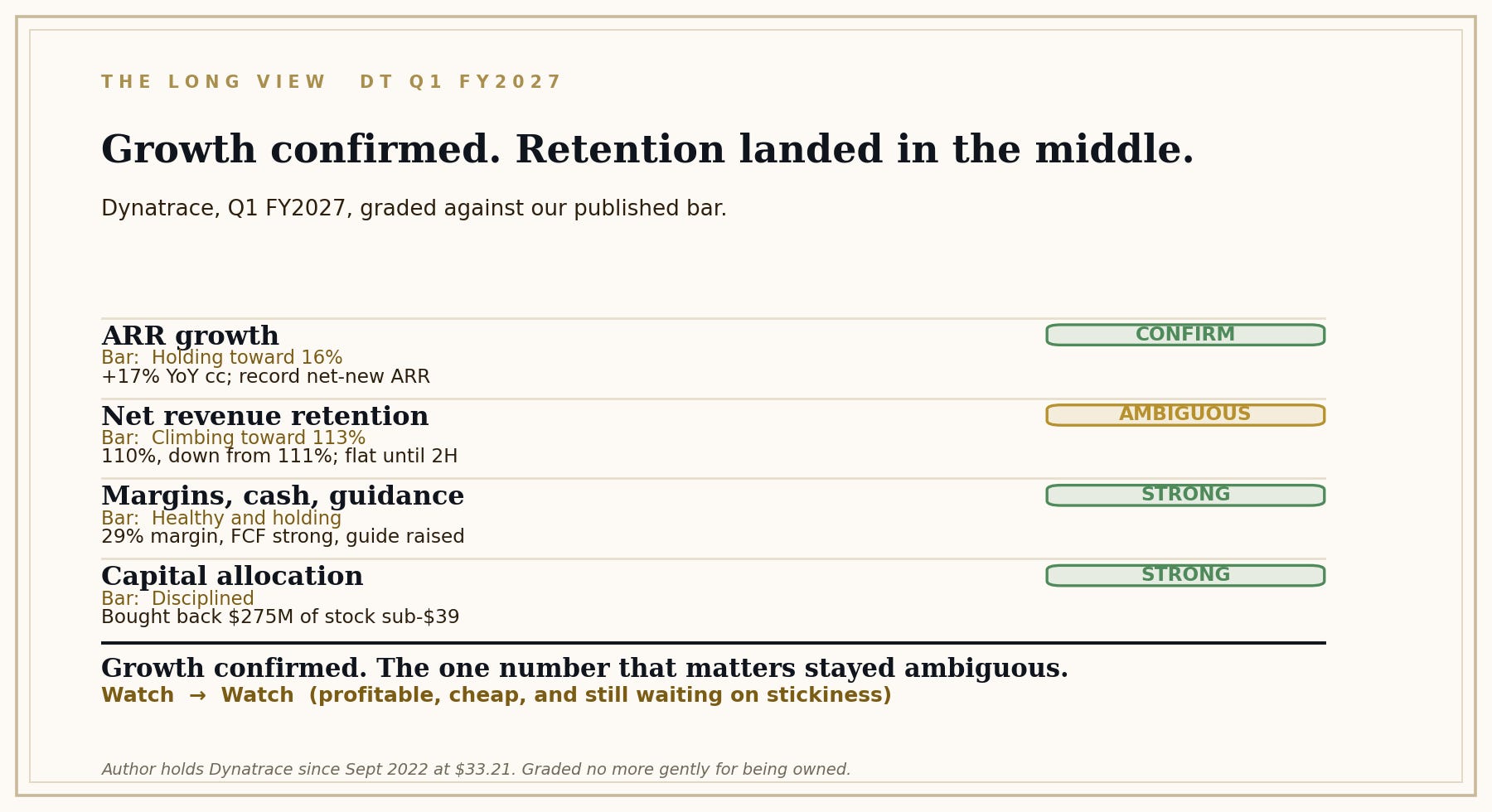
We set it precisely, and one term is worth defining first, because the whole grade turns on it. Annual recurring revenue, or ARR, is the annualized value of a software company’s subscription contracts, the run-rate of revenue it can expect to keep collecting year after year as long as customers stay. For a subscription business it is the truest measure of size and momentum, because it strips out one-time noise and shows the durable, repeating base. Confirmation required ARR growth holding toward 16 percent and net revenue retention climbing toward 113 percent. Net revenue retention measures how much more, or less, existing customers spend this year versus last, before any new customers are counted. Above 100 percent means the customers a company already has are spending more over time, the clearest sign a product is becoming more essential rather than more optional. It is the single best gauge of whether a platform is getting stickier. A break was ARR growth falling below 14 percent or retention slipping below 108. And we named the ambiguous middle in advance: retention stuck around 111, growth steady in the mid-teens, a quarter that neither confirms the re-rating nor breaks the thesis. We wrote all three down before the print.
Test 1: ARR growth
Published bar: growth holding toward 16 percent confirms; below 14 percent breaks.
The number: annual recurring revenue reached $2.14 billion, up 17 percent year over year in constant currency, meaning after stripping out the distortion of exchange-rate swings so the underlying growth is what you see. Net new ARR grew 66 percent, with record new-logo wins. Confirms. Growth did not just hold, it came in above the line, driven by the largest new-customer quarter the company has posted. On the growth half of the bar, Dynatrace cleared it cleanly.
Test 2: Net revenue retention
Published bar: retention climbing toward 113 percent confirms the platform is getting stickier; below 108 breaks it.
The number: net revenue retention was 110 percent, down from 111 a quarter earlier, and management said it does not expect improvement until the back half of the year, citing light renewal periods. Ambiguous, and slightly soft. This is the exact case we flagged in advance. Retention did not break, it sits comfortably above the 108 line. But it did not climb toward 113 either. It drifted down a point, and the one number that would prove the platform is deepening its hold on customers stayed stuck, with management telling us to wait two more quarters. This is the crux of the whole Dynatrace story, and it is still unresolved.
Everything else the market claims to want, it got
Non-GAAP operating margin was 29 percent, a point above guidance, which added to 16 percent revenue growth gives what software investors call a Rule of 50 score of 45. That rule adds a company’s revenue growth rate to its profit margin, and a combined score in the 40s or above signals a business that is both growing and profitable rather than buying growth by burning cash. At 45, Dynatrace is closing in on the demanding end of that mark. Adjusted free cash flow was $309 million at a 56 percent margin. The company raised full-year guidance on revenue, ARR, and earnings. And it bought back 7.1 million shares for $275 million during the quarter, at an average under $39, management putting the company’s cash behind the same conviction it asks investors to have.
By almost every measure a value investor cares about, profitability, cash generation, capital discipline, reasonable growth, this was an excellent quarter from a business trading around 22 times forward earnings. Which is the puzzle.
The tally: it confirmed the growth, and left the one question open
So here is the honest grade. On the growth bar, Dynatrace confirmed. On everything ancillary, margins, cash, guidance, buybacks, it was strong to excellent. And on the single number the whole thesis turns on, retention, it landed in the ambiguous zone we named in advance, ticking down to 110 with no improvement promised until later in the year. The business is healthy. The proof that it is getting stickier, the thing that would make the market finally re-rate it, is one more quarter away, at least.
That is not a break. It is not a full confirm. It is the profitable company nobody wants, doing profitable things nobody rewards, because the one number that would force a re-rating stays just out of reach.
The state change: it holds, and so does the puzzle
Dynatrace remains Watch. Nothing broke. But the case for a re-rating rests on retention turning up, and it did not. The valuation is reasonable, the profitability real, the growth fine, and the stock stays unloved because the market wants the platform proven stickier before it pays up, and this quarter did not deliver that proof. A cheap, profitable, growing business with one unproven variable is a Watch that becomes more the moment the variable resolves.
One thing worth flagging, and why
The company announced its CFO plans to resign. We do not grade a leadership transition as a test, and a planned, orderly CFO change at a healthy company is not a red flag on its own. But we note it, because a value investor watches management continuity, and a new CFO is a variable to track, not to panic over. It stays a research item, not a mark against the grade.
Why I own it, and why that does not soften the grade
Here is the personal part, because personalizing this is only honest if it stays truthful. I have owned Dynatrace since September 2022, at $33.21. I bought it then for a specific reason: the company had built its own AI engine, real, proprietary technology, at a time when much of the market was still just talking about AI as a concept. The depth was the draw. I understood what that technology was, the price was defensible for what the business was, and so I bought it and held it. Its larger competitor, Datadog, was a top name in the same space, and it simply was not my focus. I was drawn to the specific edge Dynatrace had built, not to surveying the field.
In the years since, Datadog has been the bigger stock. I will not pretend I made a brilliant call against it, because I was not weighing it. I bought the business I understood, at a price I could defend, and I held it. For what Dynatrace brought to the table, the technology, the profitability, the edge, it was a value at the price. That is the only question a value investor asks: for what this company truly is, is the price a value. For Dynatrace it was, and near 22 times forward earnings today, a version of that question is still open in its favor.
And the story is not over. Dynatrace is not the superstar Datadog has been. But it is still here, still competing, still profitable, and the figures still justify the conviction that bought it. Owning it is exactly why I have to grade it straight, which is why this quarter goes in the record as what it was: growth confirmed, retention still unproven, Watch holds. I do not get a gentler grade for being an owner. Neither does the company.
What we watch next, and when
Retention, above all. The back half of the year is where management says the number should improve. If net revenue retention climbs back toward and past 113, the re-rating case gets real. If it keeps drifting, the profitable company nobody wants may stay exactly that.
Then the CFO transition, for continuity, and the price, because at a reasonable multiple this is the rare case where a good quarter and a fair price already coexist, and the only missing piece is the market’s attention.
We named the one thing before the print: stickiness, proven through retention. Dynatrace confirmed its growth, raised its guidance, and left that one number sitting in the ambiguous middle we drew in advance. The business is doing its job. The proof that would make the market care is still pending. And I will keep holding, and keep grading it straight, until the number resolves one way or the other.
Run any company through the Stock Story Firewall, free, at firewall.readthelongview.com. Subscribers get the Watch Cards, the Evidence tool, and the full Research Tracker, including every test we have published and how each one scored, on the companies we own and the ones we do not.
Dynatrace did almost everything right, and the market shrugged, again. For a company priced for perfection, that shrug would be a catastrophe. For the profitable company nobody wants, it is just Tuesday, and the reason it is still, for what it is, a value.
Not investment advice. The subscriber decides.