

On 25 February 2026, Lumen Technologies (Nasdaq: LUMN) told investors its turnaround was complete. In the quarter to 30 June, its strategic revenue grew $159 million from a year earlier, and its legacy revenue fell $205 million. Dycom Industries (NYSE: DY) builds and maintains fiber networks, Lumen’s among them, and its largest customers are phone companies. At its 12 October 2026 close, Dycom became the first company this week to pass Monday’s bar. Today: what Lumen still owns, whether Dycom’s filings support the word largest, who pays each of them, and why Dycom’s pass comes with one honest caveat.
Disclosure: the author holds no position in LUMN or DY.
The Firewall’s hidden assumption for Lumen is that its new business grows faster than the old one shrinks. That is a sentence the filings can test, and they test it quarterly.
What Lumen still owns
Lumen sold its consumer fiber business, in 11 states, to AT&T for $5.75 billion. The sale closed on 2 February 2026, and about $4.76 billion of the proceeds went to retiring debt, according to Lumen’s filings.
What it kept is the network most people never see. Its 10-K for 2025 counts over 340,000 route miles of fiber, most of it long-haul links between cities, plus metro fiber connecting buildings. Its Investor Day release says Lumen had deployed 17 million intercity fiber miles by the end of 2025 and plans to reach approximately 58 million miles by 2031. Route miles count the paths. Fiber miles count every strand in them.
It also kept its business customers, its wholesale customers and its copper network. In the quarter to 30 June 2026, Lumen reported revenue of $2.81 billion, against $3.09 billion a year earlier. The consumer business that went to AT&T is most of the difference.
Who pays Lumen
Lumen’s second-quarter revenue, by customer: large enterprises $794 million, wholesale $653 million, the public sector $490 million, mid-sized businesses $435 million, international $72 million, and what remains of its consumer business $361 million.
Lumen sells to hyperscalers and AI companies through what it calls Private Connectivity Fabric. Its Investor Day release counts “nearly $13B in total PCF deals to date, including hyperscalers and AI leaders such as Anthropic.” Its second-quarter slides show $91 million of PCF revenue in the quarter, about 3.2 percent of the total.
Lumen’s revenue rests on ordinary businesses and government. The hyperscaler line is new, and still small.
Its 10-K adds a caution worth reading in full: “certain hyperscaler customers have developed infrastructure that has reduced their reliance on our network.”
The hidden assumption, tested
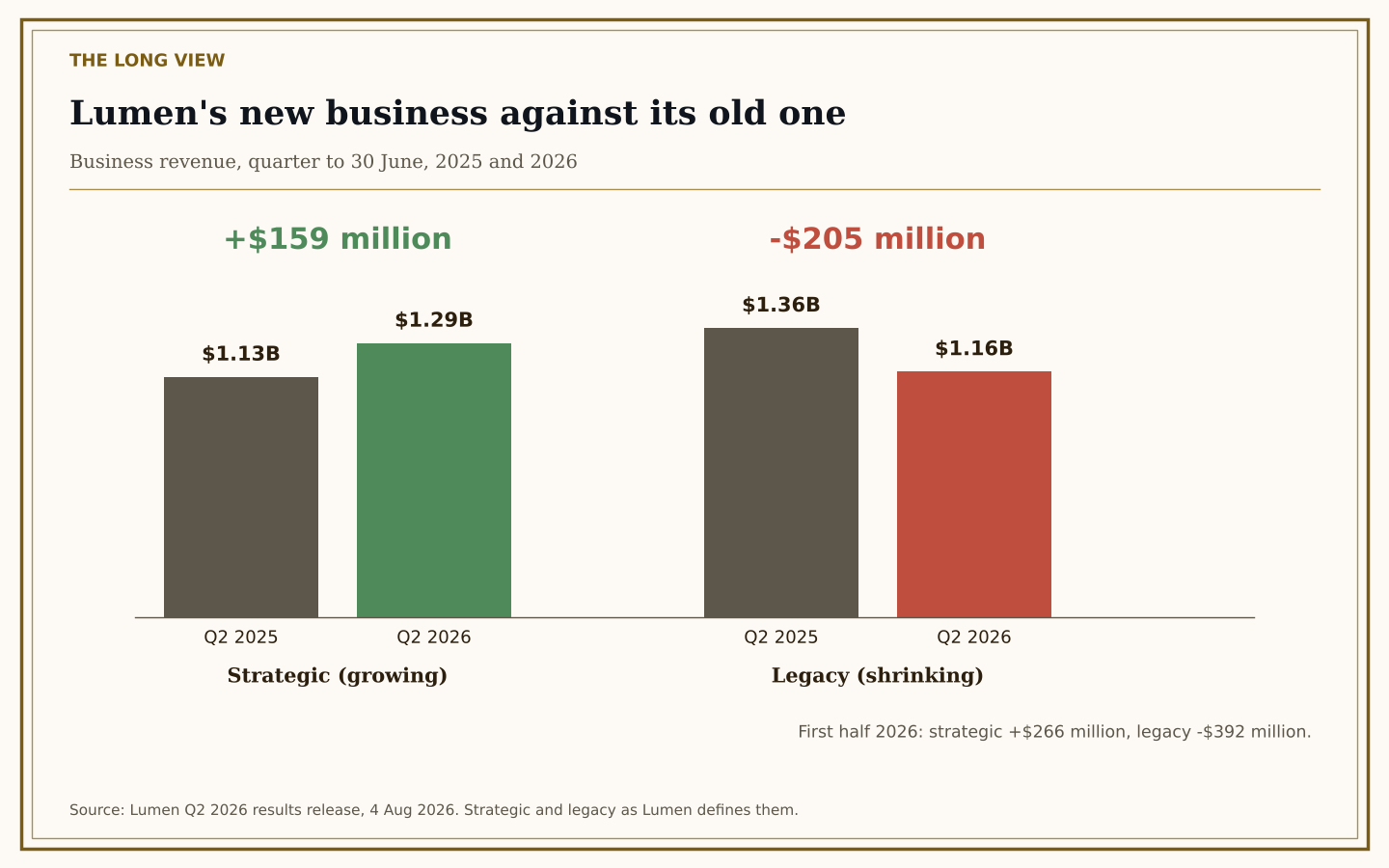
Lumen splits its business revenue into strategic, the products it is growing, and legacy, the older services it is managing down.
In the quarter to 30 June 2026, strategic revenue was $1.29 billion against $1.13 billion a year earlier, up $159 million. Legacy revenue was $1.16 billion against $1.36 billion, down $205 million. Over the first half, strategic rose $266 million and legacy fell $392 million.
The new business is growing at 14 percent. The old one is shrinking faster in dollars. Total business revenue fell from $2.49 billion to $2.44 billion.
The assumption has not been met yet. It may be. The crossover is a number to watch each quarter, and it has a date only in Lumen’s plans, not in its results.
Which earnings for Lumen
Lumen has no earnings to put a multiple on. Under standard accounting it lost $0.62, $0.00, $0.20 and $0.20 a share in its last four quarters. With no profit, there is nothing to divide the share price by.
Cash is the defensible figure, and it needs care. Lumen guides to free cash flow of $1.9 billion to $2.1 billion for 2026, excluding what it calls Special Items. Its own footnote says that guidance includes $729 million of proceeds from the AT&T sale, booked as operating cash. The same outlook reflects a $400 million tax refund, and nothing I read in the filings says whether the refund sits inside the cash figure.
So there are three honest readings: $0.36 a share of reported free cash flow in 2025, $1.01 excluding Special Items, and $1.23 for the 2026 guidance midpoint once the AT&T money comes out, each over today’s 1.03 billion shares. Against $5.05, a 10 percent return on those three figures implies $3.60, $10.10 and $12.30 a share.
Two more numbers sit beside the cash guidance in the same outlook: capital spending of $3.2 billion to $3.4 billion, and adjusted EBITDA of $3.1 billion to $3.3 billion. Capital spending about the size of operating earnings, with free cash flow still positive, means cash is arriving from somewhere besides profit. One place it can come from is customers paying ahead: Lumen carried $8.18 billion of noncurrent deferred revenue at 30 June 2026, money billed or received for service it has not yet delivered.
Pick the 2025 reported figure and Lumen looks expensive. Pick the 2026 guidance and it looks cheap. The choice is the analysis.
Can Lumen survive the fix
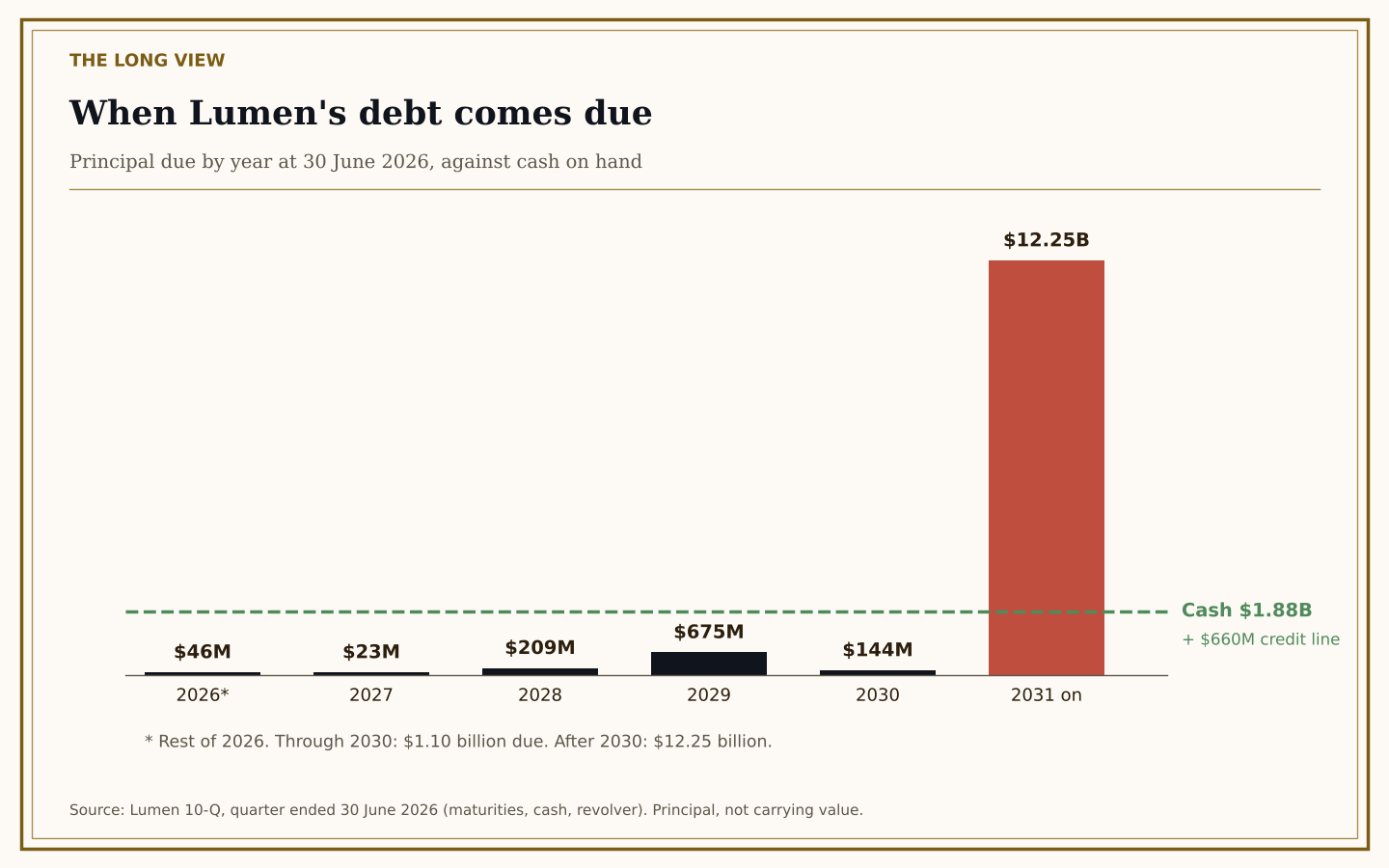
Lynch judged a turnaround on whether it could last long enough for the repair to work. For Lumen, the answer sits in its 10-Q maturity table.
At 30 June 2026, Lumen owed $46 million of principal for the rest of 2026, $23 million in 2027, $209 million in 2028, $675 million in 2029 and $144 million in 2030. Everything else, $12.25 billion, falls due in 2031 or later. It held $1.88 billion of cash and had $660 million available on its credit line.
Through 2030, the cash covers what comes due. The wall is real, and it is five years out. The chief executive’s purchases, flagged on Monday, came at weighted average prices of $6.35 a share in February and $6.13 in August, per her two Form 4 filings.
Lumen against the bar
Test one, defensible earnings: there is a loss, and the cash figure needs two adjustments to defend. Test two, price against growth: it cannot run, because there are no earnings to divide by. Test three, cash: Lumen’s reported free cash flow for 2025 was $371 million, positive.
At its 12 October 2026 close of $5.05, per CNBC, Lumen was valued at $5.21 billion, below the $6.35 and $6.13 its chief executive paid. Five thousand dollars buys 990 shares. A total gain of 30 percent by October 2031 needs $6.57 a share, and 30 percent a year needs $18.75.
Lumen is classed NOT PROVEN. That is not a judgment against the turnaround. It means this bar cannot measure it until there are earnings to measure.
Dycom, and the word largest
Google’s AI called Dycom “the absolute largest provider of specialized outside-plant (OSP) wireline construction and emergency restoration services in North America.” Friday’s piece promised Dycom’s own filings would have to carry that word.
They do not use it. Item 1 of Dycom’s 10-K for the year ended 31 January 2026 opens: Dycom “is a leading provider of specialty contracting services focused on the digital infrastructure, telecommunications and utilities industries throughout the United States.” In the parts of the 10-K and the latest 10-Q I read, including Item 1, the word largest does not appear, and neither does restoration.
Leading is a claim. Largest would be a ranking. The filing makes the first and not the second.
Who pays Dycom
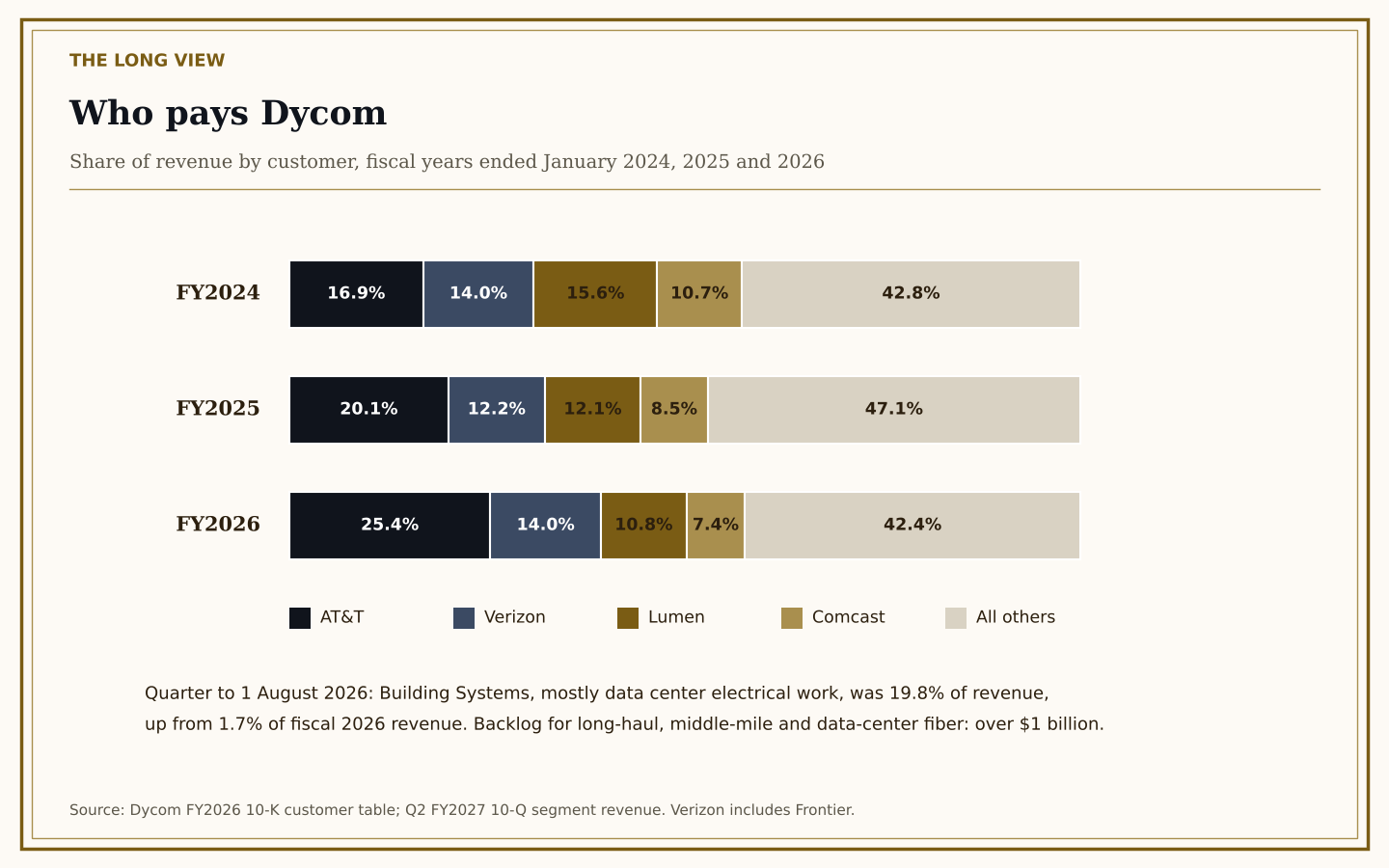
In its fiscal year ended 31 January 2026, Dycom’s revenue came 25.4 percent from AT&T, 14.0 percent from Verizon, 10.8 percent from Lumen and 7.4 percent from Comcast. Four phone and cable companies made up 57.6 percent of its revenue. Its 10-K says plainly: “Our customer base is highly concentrated.”
That mix is shifting. In December 2025 Dycom bought Power Solutions, an electrical contractor whose revenue its deal release put at over 90 percent data centers. That new Building Systems segment was 1.7 percent of fiscal 2026 revenue, after one partial quarter, and 19.8 percent in the quarter to 1 August 2026. Dycom also says its contracted backlog for long-haul, middle-mile and data-center fiber builds “exceeds $1 billion,” out of $12.24 billion in total.
Dycom’s buyers are mostly phone companies today. Its new Building Systems business, mostly data center electrical work, is already a fifth of revenue.
Dycom against the bar
Dycom has been here before. Its fiscal 2002 10-K reports revenue down 24.5 percent to $624.0 million and a net loss of $123.0 million, after “certain segments of the telecommunications industry suffered a severe downturn.” Several customers, including WorldCom, filed for bankruptcy. By Lynch’s categories that history is a cyclical’s. Its latest year reads like a fast grower’s.
Test one, defensible earnings: standard-accounting earnings over the last four quarters add up to $10.99 a share. The growth rate is 20.7 percent, the rise in earnings per share in fiscal 2026, a year that had 53 weeks instead of 52. Test three, cash: free cash flow was $435.3 million in fiscal 2026, positive, though the first half of this year ran $54.2 million negative, as the first half did a year earlier.
At its 12 October 2026 close of $266.99, per CNBC, Dycom was valued at $8.05 billion, or 24.3 times $10.99 of trailing earnings. Against 20.7 percent growth, that is 1.17 times the growth rate. The bar allows 1.5. Five thousand dollars buys 18.73 shares. A total gain of 30 percent by October 2031 needs $347.09 a share, and 30 percent a year needs $991.32.
Dycom passes all three tests of the bar. It is the first company this week classed deserves serious review, which earns it the deep dive: the long filings work, not a purchase. The pass rests on the growth rate. Fiscal 2026 had an extra week, and in the year before it, earnings per share grew 7.5 percent. At that rate, the same price would be 3.2 times growth, and Dycom would fail. Its backlog of $12.24 billion, up 53.2 percent in a year, is the evidence for the faster rate.
Tomorrow
Tomorrow is Amphenol, the connectors and cable around the fiber. No customer reaches 10 percent of its sales, and a stock split in August changed the basis of every per-share figure it printed before, so the earnings figure has to be chosen with care before the bar can be applied.
One question to sit with before then: when a turnaround’s new business grows 14 percent and its old business shrinks faster, how many quarters would you give it before the crossover has to show up?
Not investment advice. The subscriber decides.